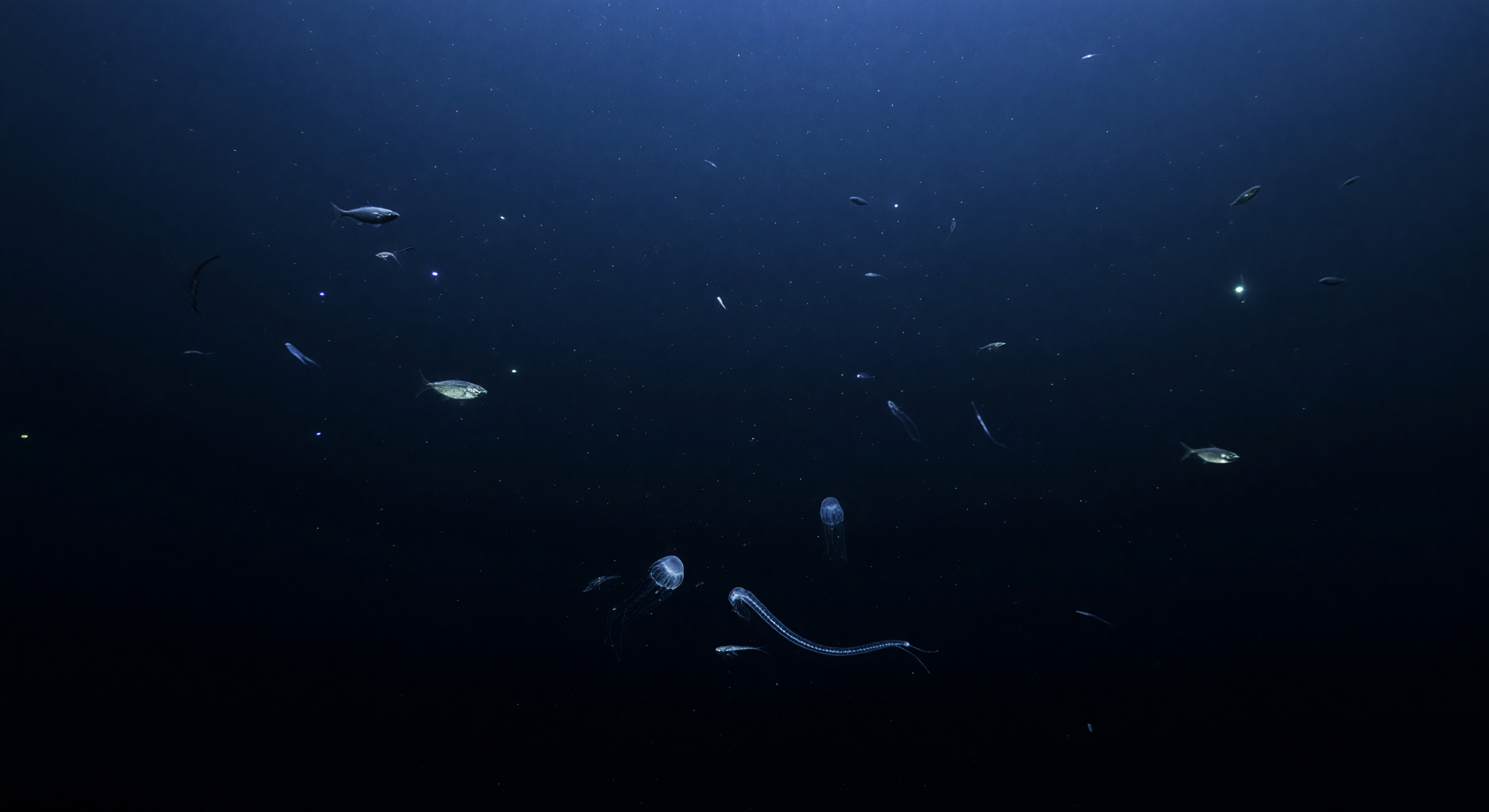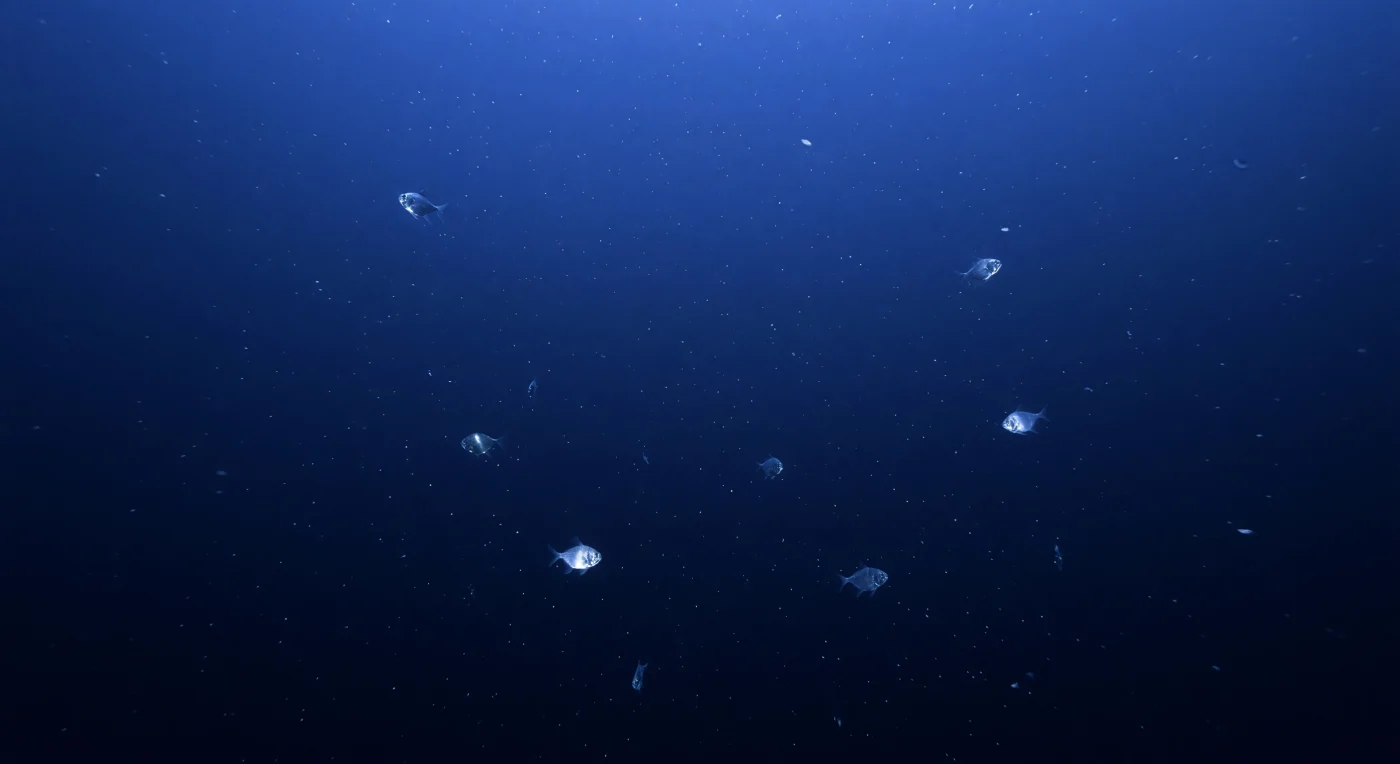
At roughly 250–320 meters below the surface, the ocean enters a realm where sunlight has surrendered nearly all its warmth and color, leaving only the last attenuated wavelengths of blue to penetrate the water column — a cold cobalt residue that fades imperceptibly into sapphire darkness below. Here, pressure approaches 30 atmospheres, compressing the world into a silence that has no equivalent on land, and the water itself is neither empty nor still: a continuous gentle fall of marine snow — fragments of dead phytoplankton, fecal pellets, mucus aggregates, and transparent organic flake — drifts downward through the entire water column, carrying fixed carbon from the sunlit surface toward the abyss in what oceanographers call the biological pump. Suspended within this perpetual drift, sternoptychid hatchetfish — Argyropelecus and allied genera — hang in loose, unhurried aggregations, their laterally compressed bodies silvered like living mirrors, each flank tuned to reflect the ambient downwelling blue and erase the shadow that would otherwise betray them to predators below. Their enormous upward-facing eyes are adapted to detect the silhouettes of prey against the faint luminous ceiling overhead, a hunting strategy made possible by the very last photons the ocean will carry this deep. Far below, scattered pinpricks of cold bioluminescent light pulse without rhythm in the deeper darkness — the self-generated signals of a community that has learned, over hundreds of millions of years, to make its own light in a world the sun has almost entirely forgotten.
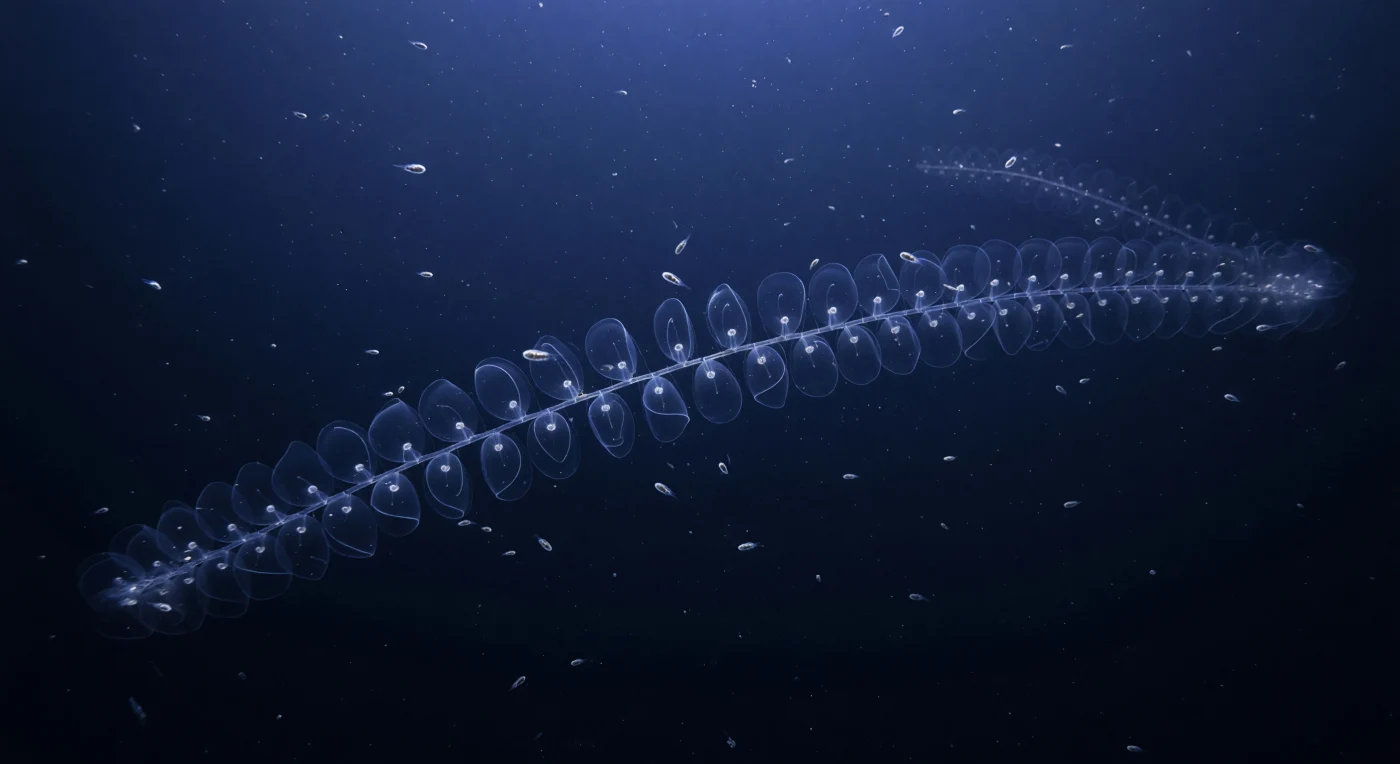
At roughly 400–500 meters, the last remnants of sunlight arrive as a faint, monochromatic cobalt wash — not true illumination, but enough to trace the edges of a world. Stretching diagonally through the indigo water column, an enormous siphonophore colony — potentially among the longest organisms on the planet — suspends itself in near-weightlessness, its repeating nectophores arranged like a procession of hand-blown glass bells along a stem that fades into blue-black void at both ends; each gelatinous bell catches the residual downwelling light only at its thinnest rim, revealing tissue so transparent it is essentially the ocean wearing itself as a body. Siphonophores are not single animals but superorganisms — colonial hydrozoans in which genetically identical zooids differentiate into specialized roles for propulsion, feeding, defense, and reproduction — and a colony of this scale may filter-feed continuously on the sparse rain of copepods and euphausiids that drift through the surrounding water column, those crustaceans themselves nearly invisible, rendered as slivers of cold silver or perfect glass by evolutionary pressure to disappear in a world where bioluminescent flashes betray the living. At this depth, hydrostatic pressure exceeds 45 atmospheres, the temperature hovers near 4–8 °C, and the marine snow — microscopic particles of organic debris, mucus, fecal pellets, and diatom fragments — drifts downward through the darkness without destination, carrying carbon from the sunlit surface toward the abyss in a slow, permanent, unwitnessed transfer that quietly governs the chemistry of the entire planet.
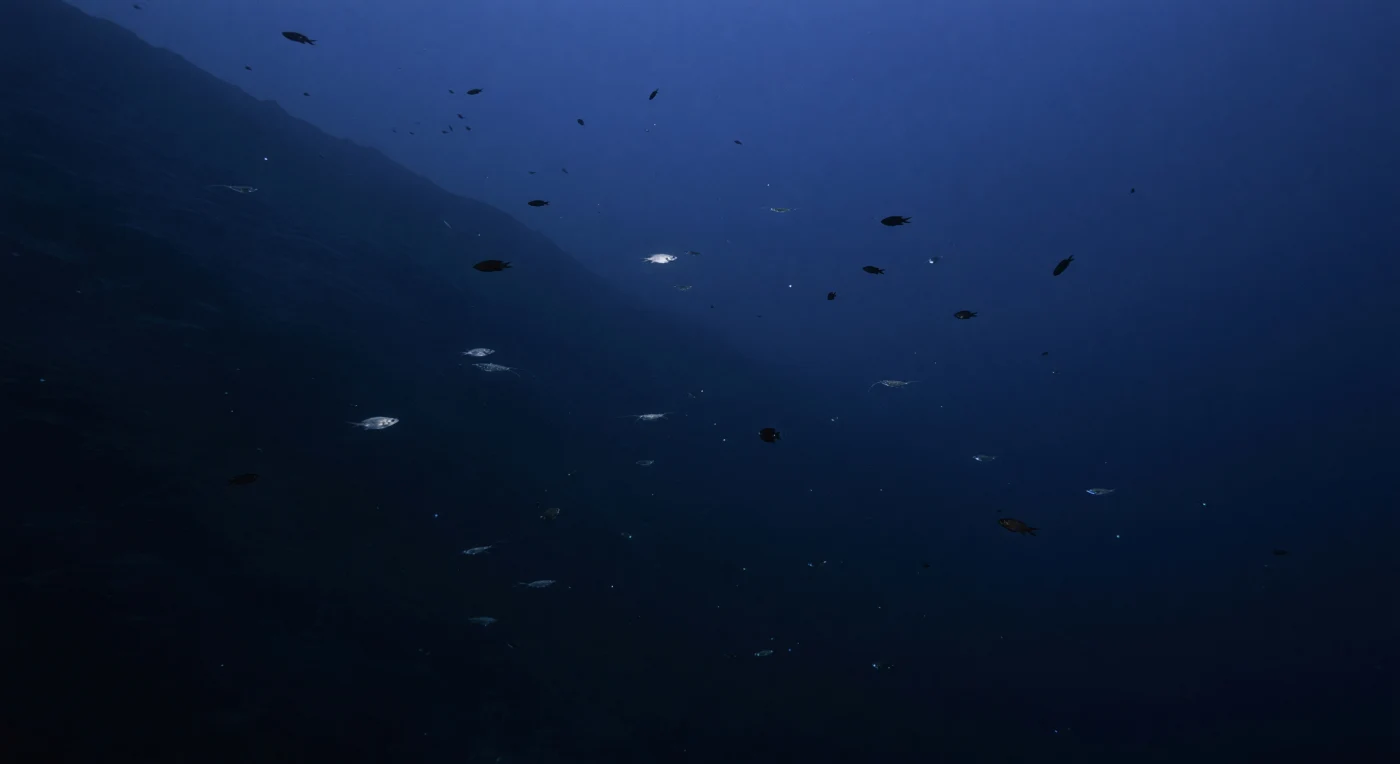
At roughly 400–500 meters along the flank of a continental slope, the last attenuated threads of sunlight filter down as a cold, monochromatic cobalt glow that dissolves into blue-black long before it reaches the sediment below. The slope itself rises as a vast charcoal plane, its surface softened by distance and the slow accumulation of marine snow — particles of organic detritus that drift continuously downward, carrying the chemistry of the sunlit world into these pressurized depths where water temperatures hover near 4–8 °C and pressures exceed 40 atmospheres. Against this dim backdrop, lanternfish — myctophids no longer than a finger — hang in the open water column, their silvered flanks catching just enough residual light to render them as fleeting mirror-flashes before they angle back into near-invisibility, their photophore rows dark and latent for now. Sergestid shrimps drift alongside them, their bodies so nearly transparent that only refractive edges, thread-fine antennae, and the dark punctuation of compound eyes betray their presence, with an occasional cool blue-green bioluminescent pulse flickering somewhere deeper in the haze. This is a world of exquisite biological economy, where every adaptation — mirror scales, transparent tissue, counterillumination — has been refined over evolutionary time to navigate the perpetual negotiation between being seen and remaining invisible in a realm that has never needed witnesses.
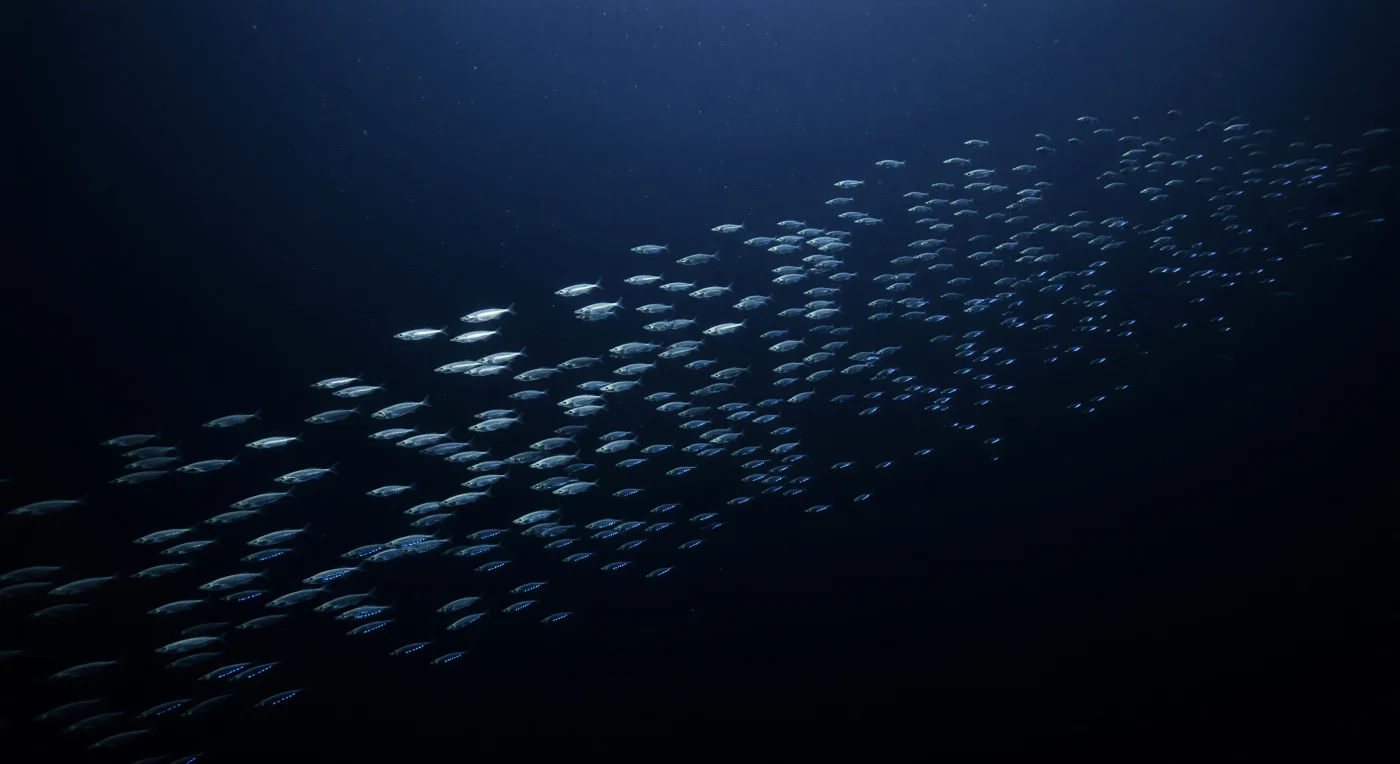
At 400–500 meters, the ocean exists as a vast pressurized column where sunlight arrives only as a faint blue residue, already stripped of every warmer wavelength by the weight of water above. Through this cobalt veil, thousands of myctophids — lanternfish of several species — ascend in a broad oblique front, their diel vertical migration carrying them upward from deeper darkness toward shallower feeding waters as the day fades. Each small body, rarely exceeding a few centimeters, is built for this twilight world: large dark eyes sensitive to the dimmest photons, flanks plated with guanine crystals that mirror the ambient blue and dissolve the fish into their surroundings, and along each belly a species-specific constellation of photophores emitting restrained blue-white points of bioluminescence, likely used for counterillumination against the faint glow from above. The sheer biomass these migrations represent is staggering — mesopelagic fish alone may constitute the largest vertebrate assemblage on Earth, yet the school moves in near-total silence, suspended in water cold enough to slow metabolism and dense enough to exert pressures exceeding forty atmospheres. Marine snow drifts through the ascending column undisturbed, and below the living sheet the ocean simply deepens into blackness, indifferent and complete.
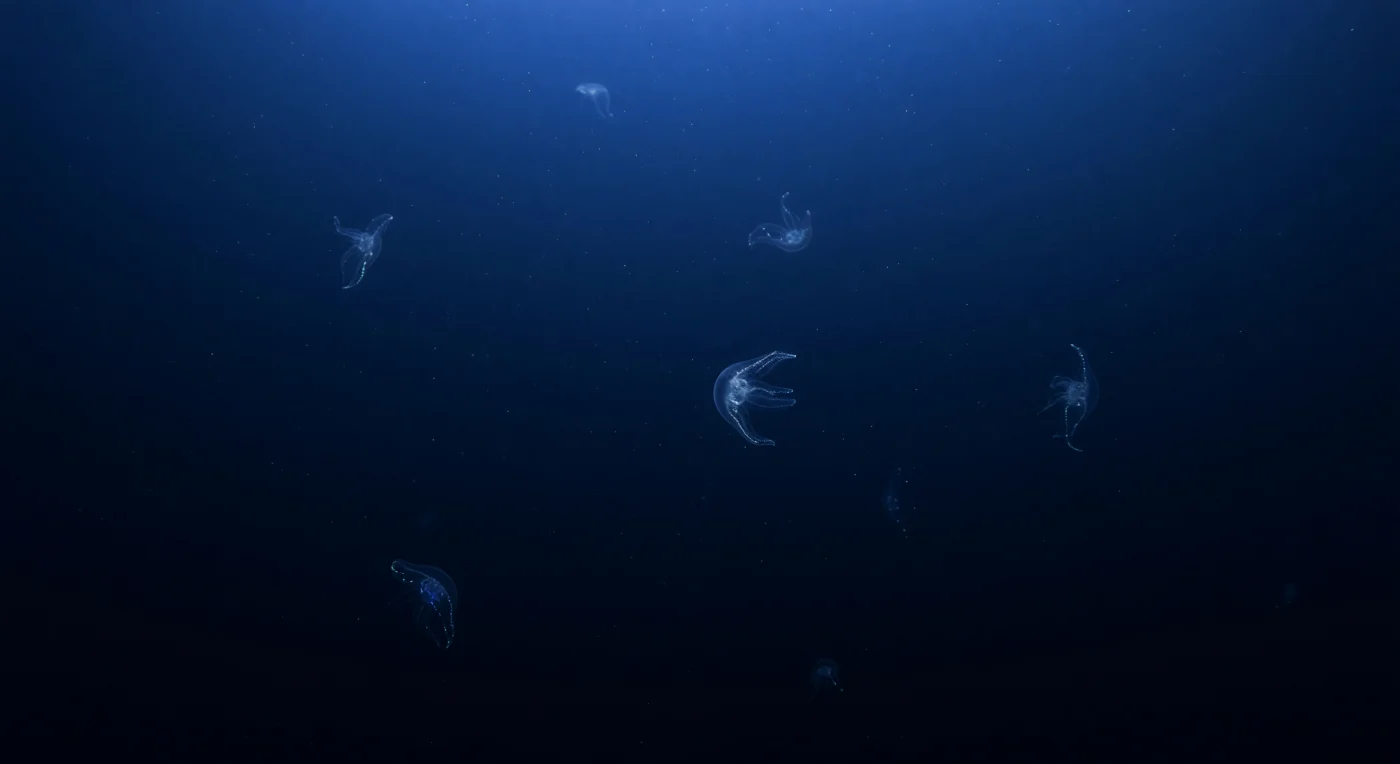
Somewhere between the last whisper of sunlight and the permanent dark below, several ctenophores hang in the open water column as though suspended in blue glass — their bodies so transparent that only the faintest refractive shimmer along curved lobes betrays their presence against the deep ultramarine. At these depths, roughly 200 to 1,000 metres down, hydrostatic pressure climbs to dozens of atmospheres, yet these gelatinous animals require no rigid skeleton to persist, their tissue barely denser than the water itself. Sparse marine snow — the slow, continuous rain of organic particles from surface waters far above — drifts past in the ambient blue, each fleck briefly legible before dissolving into darker registers below, giving scale to a volume of ocean that dwarfs anything on land. Along the comb rows that give ctenophores their name, tiny bioluminescent pulses trace dotted arcs of blue-green light, a form of cold chemical luminescence entirely independent of any external source, igniting and fading in the stillness as though the animals are quietly thinking. This is a realm that has existed for hundreds of millions of years in precisely this silence — pressured, dark, and full of life that never needed light from above to find its way.
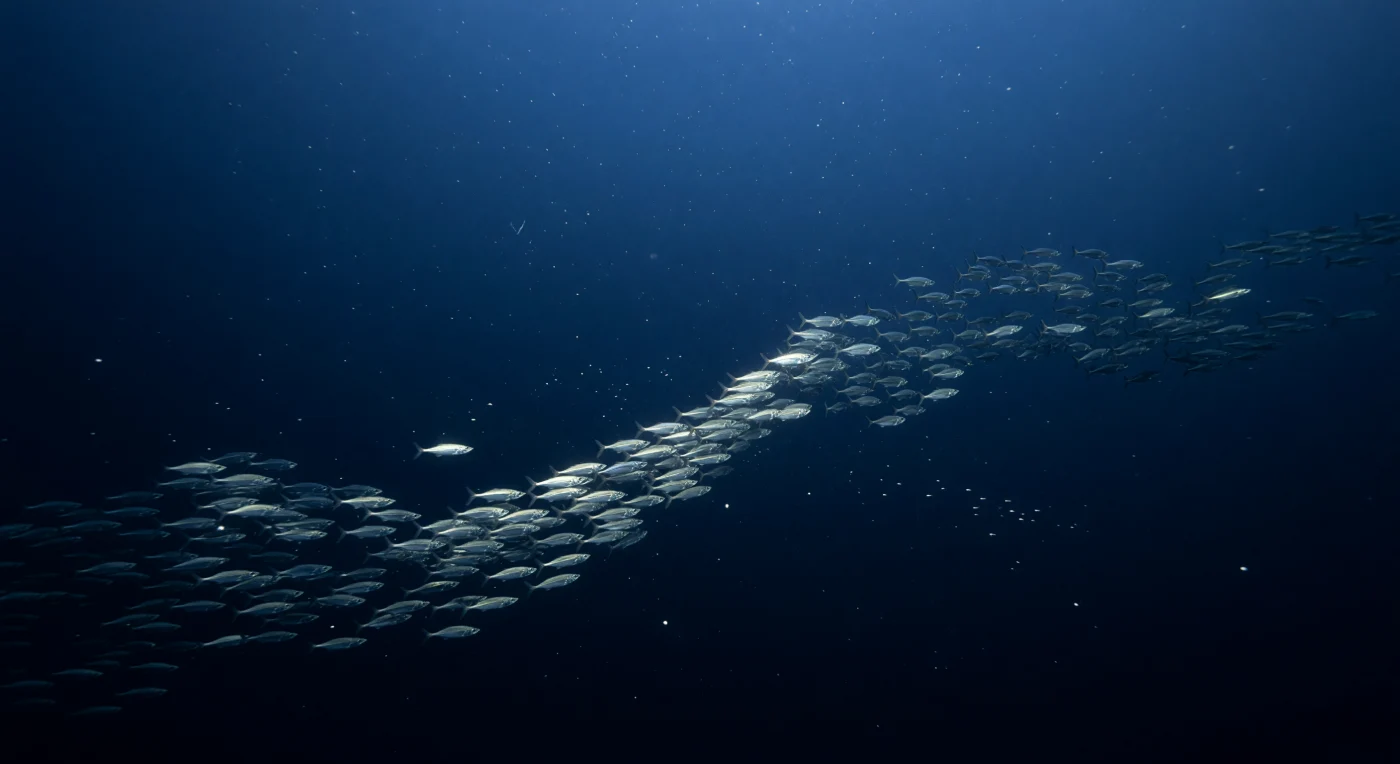
At roughly 300–350 meters below the surface, the last usable remnant of sunlight has been stripped of every wavelength except a faint, attenuating blue, descending from far above like the memory of day. In this residual luminescence, a vast school of pearlsides — *Maurolicus* and related sternoptychid and myctophid relatives — twists through the open water column in a living river of coordinated motion, their laterally flattened bodies and photophore-lined flanks acting as biological mirrors that catch and amplify the dim downwelling light, producing synchronized flashes of silver that roll through the shoal in rippling waves before fading back into cobalt shadow. Pressure here exceeds thirty atmospheres, yet these centimeter-scale fish navigate it with physiological precision, their large, upward-tilted eyes evolved specifically to detect the silhouettes of predators against the brighter water above — a survival strategy known as counterillumination, where ventral photophores mimic residual downwelling radiance to erase their own shadow. Sparse marine snow — the slow rain of organic detritus from the productive surface far overhead — drifts freely between the fish, each particle a fragment of the biological pump that transfers carbon from the sunlit world into this pressurized blue-black interior. Beyond the school's dissolving edges, isolated pinpricks of bioluminescence glimmer in the deeper dark, evidence of the dense, largely uncounted biomass that inhabits this zone entirely on its own terms, indifferent to any surface world.
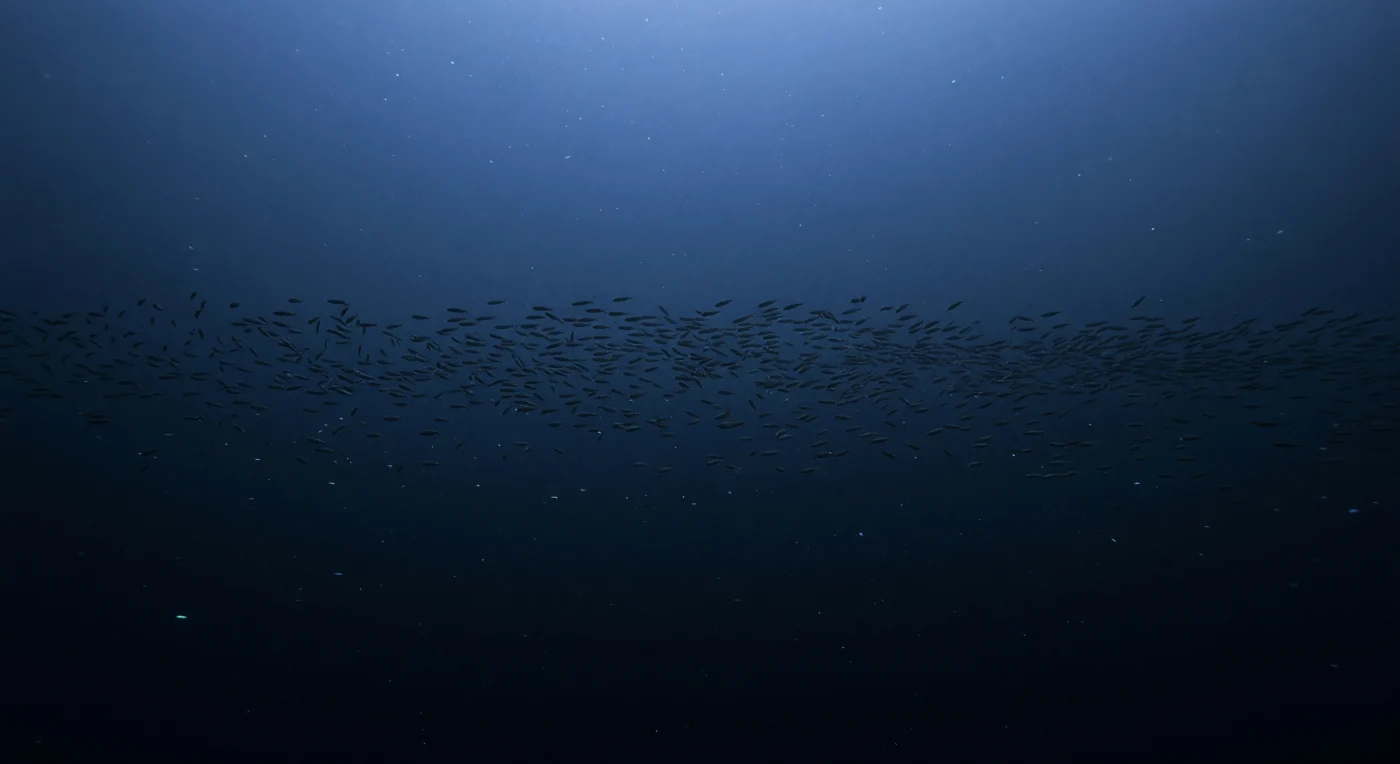
At roughly 450–550 meters below the surface, the last whisper of sunlight descends as a cold, diffuse blue that fades imperceptibly into cobalt and then into near-blackness — no boundary, only gradient, only weight. Here, pressure exceeds 50 atmospheres, compressing the water column into a silent immensity through which marine snow drifts in slow, unhurried descent, each particle a fragment of organic matter sinking from the sunlit world far above. Spanning the mid-water like a living stratum, tens of thousands of bristlemouths — among the most numerically abundant vertebrates on Earth — hang in a compressed diel scatter band, their needle-slender bodies and outsized eyes evolved for this precise threshold between faint light and none, their collective mass forming the backbone of the ocean's biological pump as they migrate nightly toward shallower feeding grounds and return by day to this dim refuge. From deeper in the darkness below, scattered pinpricks of blue-green bioluminescence pulse and drift — the chemical light of organisms that have never known the sun, communicating, luring, or simply existing in a language older than vision itself. This layer exists in perpetual, pressurized silence, a vast interior ocean that has always been here, indifferent and complete, whether witnessed or not.
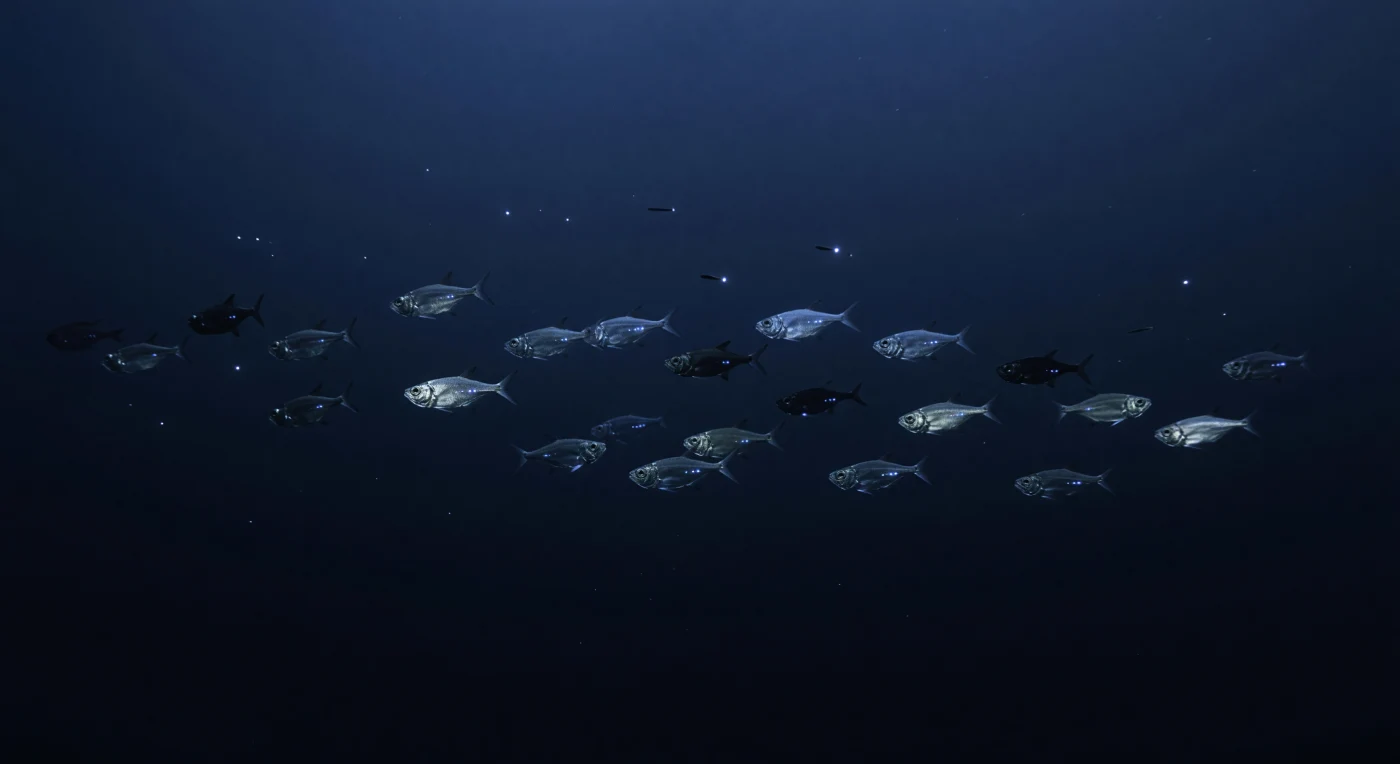
At 300 to 450 meters below the surface, the last usable fraction of sunlight arrives as a cold monochromatic blue — attenuated, directionless, barely enough to cast a pale luminance through the water column but sufficient to silhouette anything that rises above. Here, sternoptychid hatchetfish suspend themselves in a diffuse living mirror layer, their laterally compressed bodies — deep-chested, blade-thin, large-eyed — evolved into near-perfect optical instruments: the mirror-like guanine crystals tiling their flanks reflect ambient downwelling light at almost the same intensity as the surrounding water, rendering them functionally invisible until a slight tilt produces a brief cold metallic flash, a fleeting signature before they dissolve back into the blue. Pressures at this depth already exceed 30 to 45 atmospheres, yet the animals are physiologically tuned to this crushing stillness, and the orderly rows of photophores along their ventral surfaces emit a faint blue-white counterillumination — bioluminescence calibrated to cancel their own shadow against the dim glow above, an evolutionary answer to predators hunting by silhouette from below. Marine snow drifts through the open water in slow suspension, tiny organic particles descending from the sunlit world far overhead, carrying carbon and chemistry downward into the vastness beneath. This is a zone the ocean populates densely and tends silently, an immense open stratum of pressure and residual light where millions of animals hover between the bright world above and the absolute dark below, indifferent to any witness.
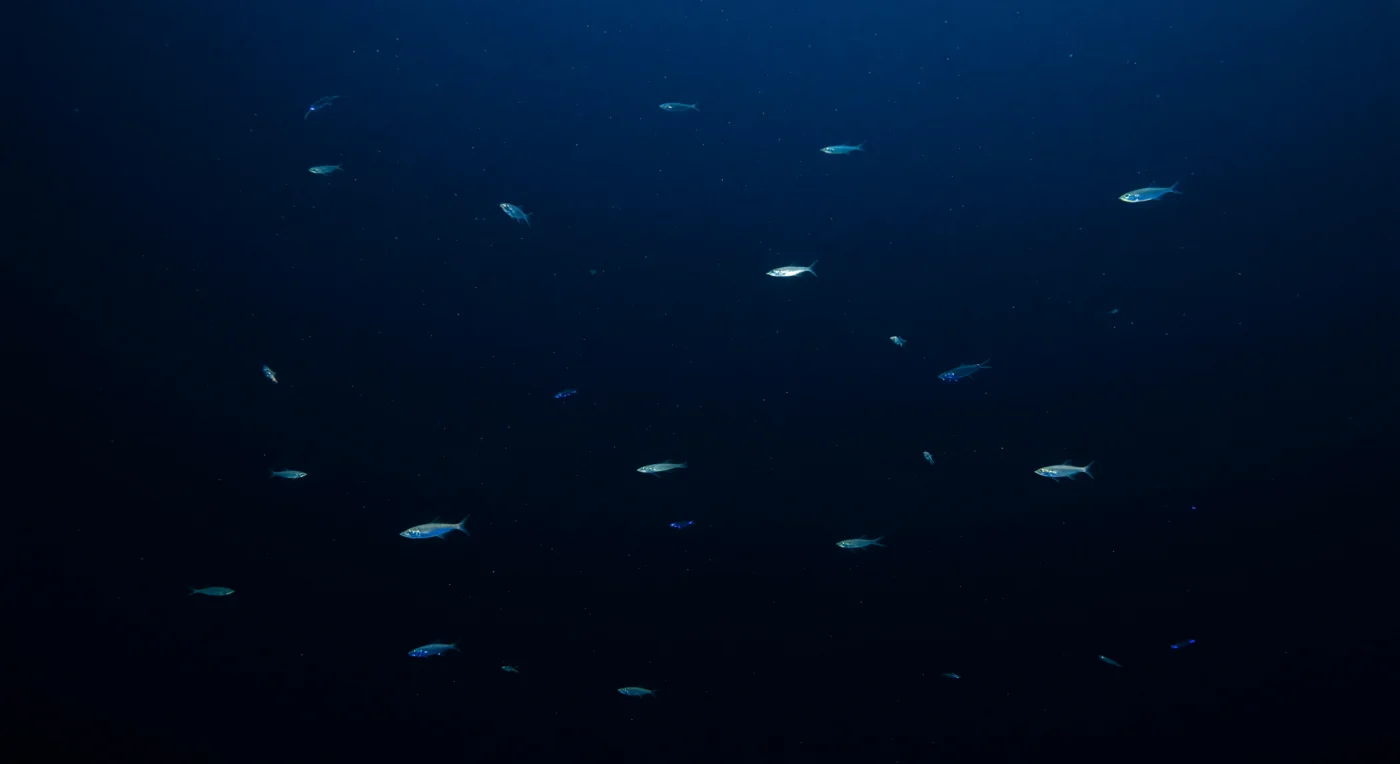
At roughly 600 to 1,000 metres below the surface, the last measurable traces of solar energy arrive as a barely perceptible cobalt wash, attenuated to near-nothing by the mass of water pressing down at pressures exceeding 60 to 100 atmospheres — enough to collapse any uncompensated air space and demand radical physiological adaptation from every organism present. Here, in this transitional lower realm, hatchetfish hold their characteristic near-vertical posture in the open water column, their laterally compressed, mirror-silvered bodies evolved to minimize reflective cross-section against the faint overhead glow, while their ventral photophores — tiny blue-emitting organs aligned along the belly — fire in subtle, asynchronous pulses, a strategy called counterillumination that erases their downward silhouette against whatever diffuse light remains from above. Alongside them drift mesopelagic squid whose tissues are nearly optically transparent, their internal organs faintly visible as shadows within glass-clear mantles, their own photophore arrays flickering with the same restrained luminescence — points of cold blue light appearing and dissolving back into the surrounding dark in no fixed rhythm. Fine marine snow, the slow rain of organic particles descending from productive surface waters, drifts freely through the enormous open space between these animals, connecting this lightless interior to the sunlit world far above in an unbroken vertical flux of carbon and life. This is an ocean that has never needed witnesses: its economies of light and camouflage, its chemical signaling and predator-prey geometries, have been operating in perfect, pressurized silence for hundreds of millions of years.
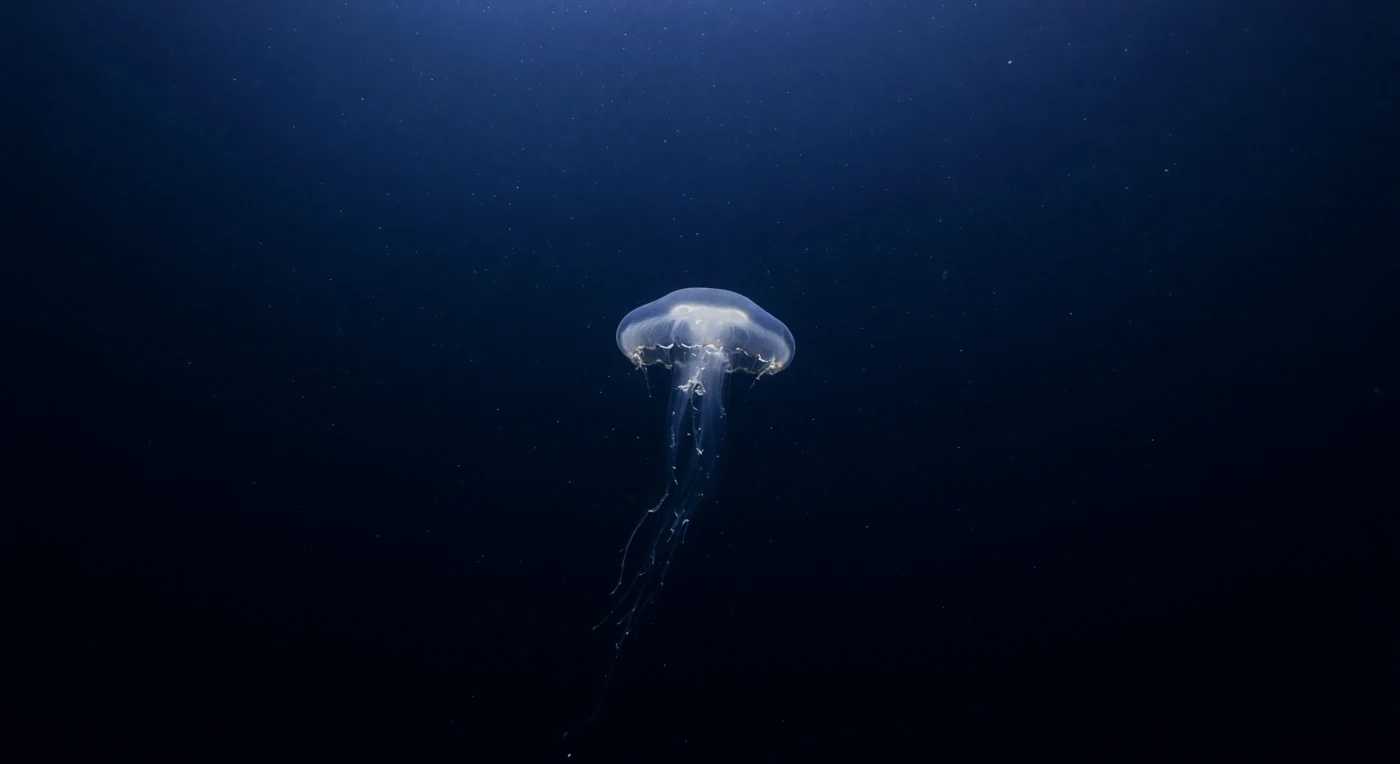
At roughly 400–500 meters, the mesopelagic water column presses down with forty to fifty atmospheres of hydrostatic force, a pressure that has shaped every tissue and strategy present here. A broad-bell medusa drifts through open water, its umbrella rendered nearly invisible by the evolutionary imperative of transparency — the faint milky musculature and delicate radial canals visible only because the last residual downwelling blue from the distant surface catches the curved upper dome at precisely the right angle, lending it a cold luminous silhouette against the darkness below. Long trailing filaments extend downward and dissolve entirely into the deepening cobalt, giving this single animal a vertical presence that spans meters of otherwise empty midwater — a hunting architecture perfectly suited to this open, structureless realm where prey must be intercepted rather than pursued. Marine snow drifts past in slow suspension, microscopic particles of organic matter sinking from the productive sunlit world far above, carrying carbon downward through what oceanographers recognize as one of the ocean's most critical biological pumps. Somewhere in the far distance, a handful of cold blue bioluminescent pinpricks mark other organisms going about their lives in the permanent pressurized dark, in a world that has never needed a witness.
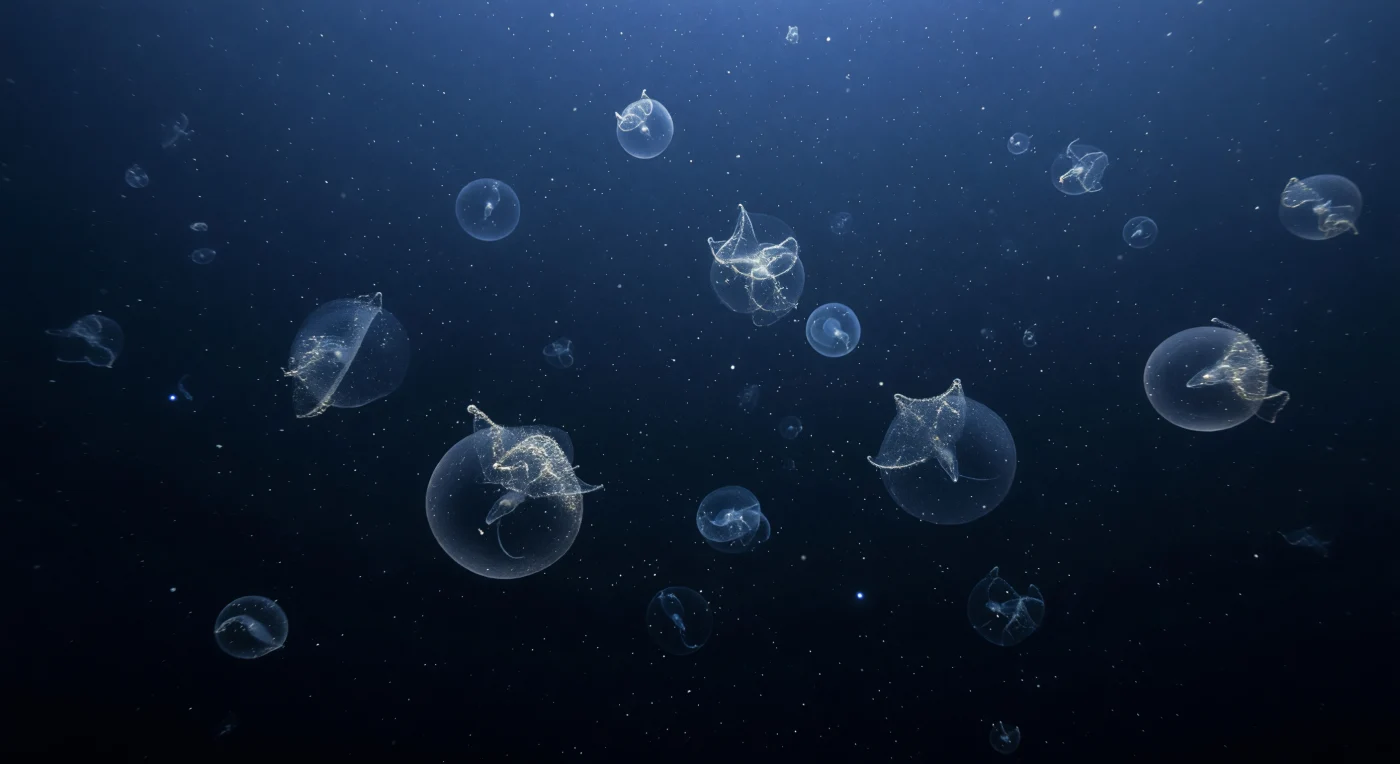
Somewhere between 350 and 500 meters below the surface, where the last traces of sunlight thin into a cold cobalt wash before dissolving into blue-black nothing, giant larvaceans have erected an architecture that belongs to no human vocabulary. Each animal — a centimeter-long tunicate relative, its glassy body barely distinguishable from the surrounding water — secretes a mucous house orders of magnitude larger than itself, an elaborate nested structure of filters, channels, and chambers that can span half a meter or more, designed to concentrate food particles from the surrounding sea. Suspended across the water column like a field of ghostly lanterns, these houses reveal themselves only where trapped marine snow and sinking detritus have traced their membranes in fine silvery relief, entire spheres and partial veils made legible by the very particles they were built to catch. At this depth, pressure exceeds 40 atmospheres, ambient downwelling light is so diminished that only the most sensitive biological photoreceptors can register it, and the dominant visual currency is transparency itself — to be seen is to be eaten, to disappear into the column is survival. When a larvacean house becomes clogged it is abandoned in seconds, collapsing slowly downward as a parcel of concentrated organic matter bound for the deep seafloor, while its builder begins secreting a new one, and the silent, pressured water holds both the living and the discarded with equal indifference.
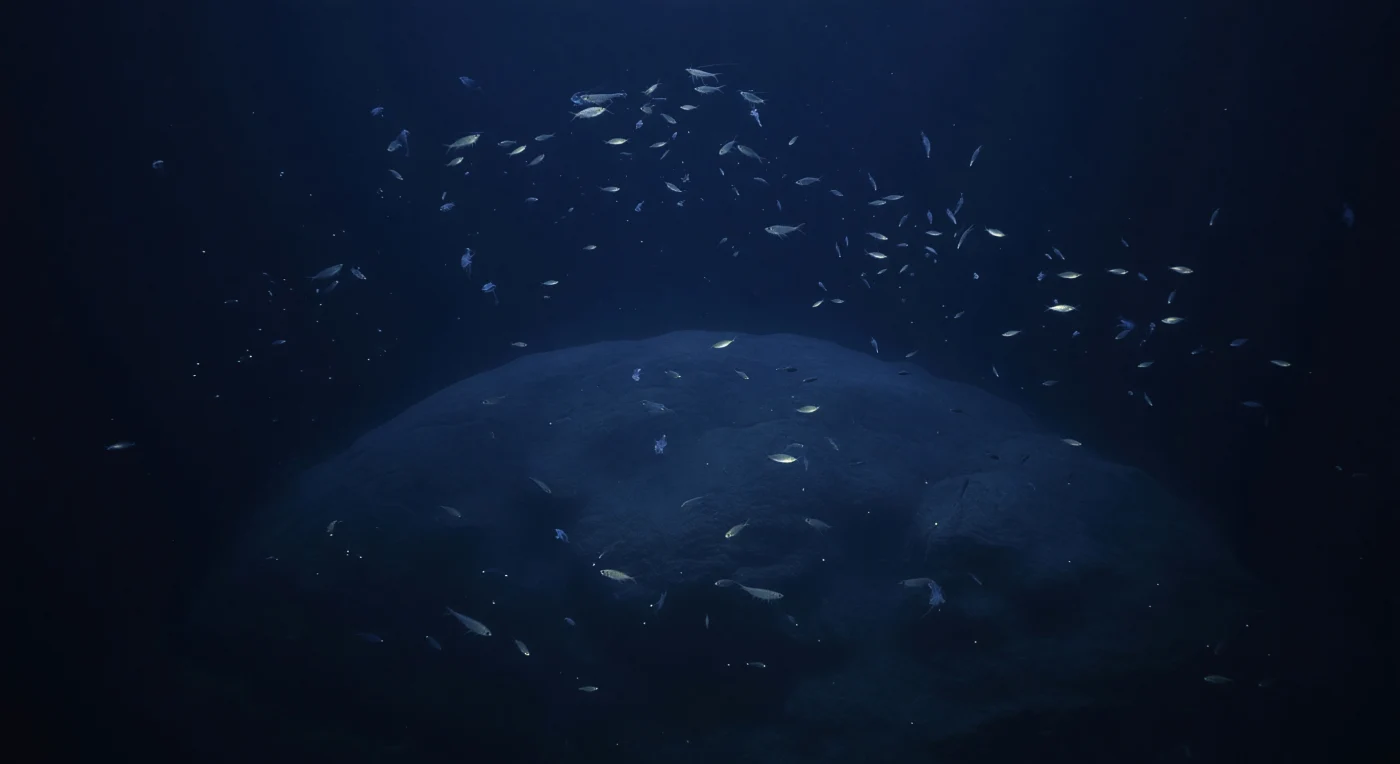
Between 200 and 1,000 metres below the surface, sunlight surrenders gradually to the ocean's weight, arriving as nothing more than a faint cobalt suffusion that grows dimmer with every metre of descent — and here, against the broad rounded shoulder of a seamount rising through the midwater column, that dying light reveals one of the most densely inhabited yet least-seen realms on Earth. The seamount itself acts as a topographic anchor, deflecting deep currents upward and concentrating nutrients, drawing the mesopelagic deep scattering layer into a thickening congregation above its indigo mass: transparent mysid shrimp with organs visible through glass-like carapaces, small silvery lanternfishes and hatchetfishes whose mirror-bright flanks reflect the last blue photons downwelling from far above, and gauzy gelatinous forms drifting on near-neutral buoyancy through water pressing at 20 to 100 atmospheres. As the daily vertical migration shifts into its nightward phase, this living layer tightens, animals ascending toward shallower water while others hold station, their bodies — evolved over hundreds of millions of years to be invisible in exactly this light — flickering with cold blue-green bioluminescent pinpricks that serve as species recognition, predator deterrence, and lure rather than illumination. Marine snow, the slow rain of organic particles from the productive surface far above, drifts through the scene without witness, carrying the chemistry of sunlit waters down into a world that has never needed the sun to persist.
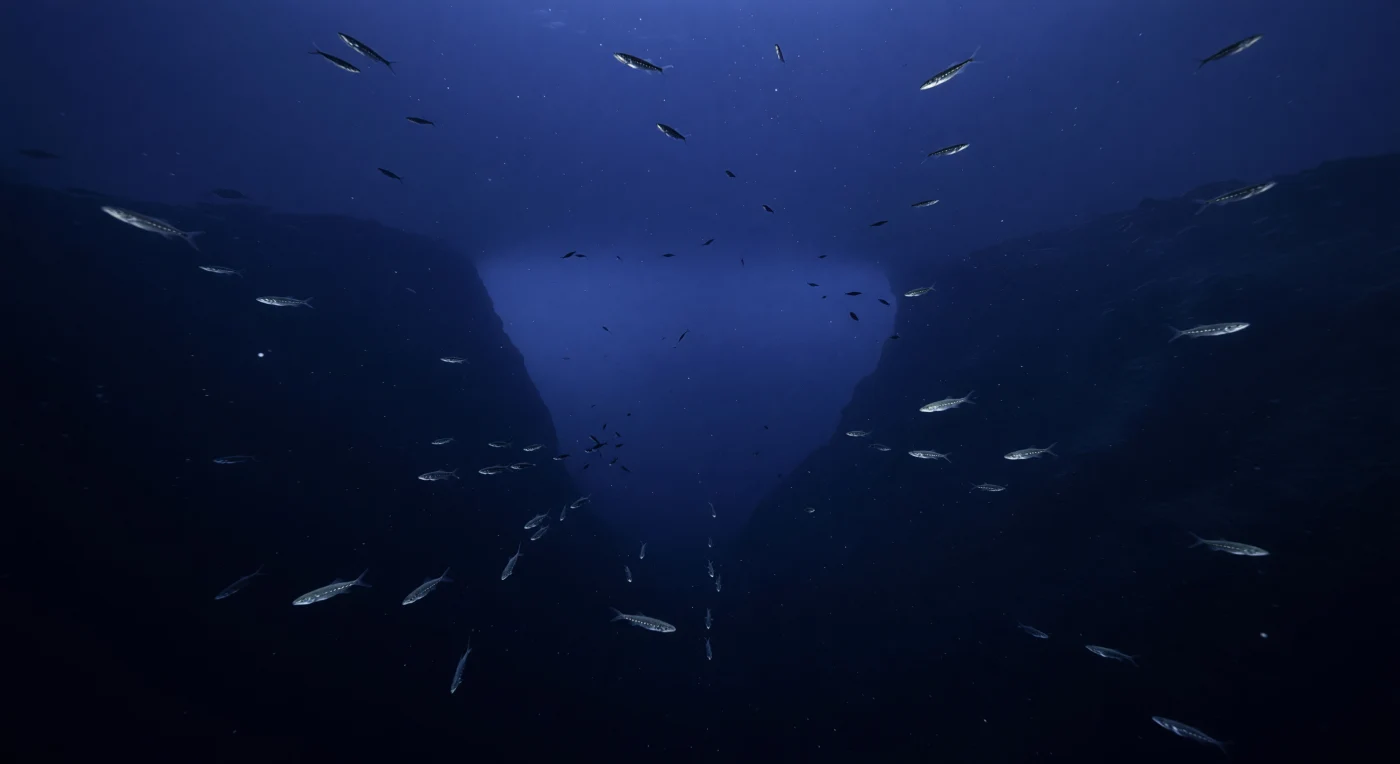
At roughly 350–500 metres depth, where the last cold residual daylight arrives as little more than a faint cobalt stain fading imperceptibly into black, the mouth of a submarine canyon opens like a wound in the water column — its steep flanks dissolving into monochromatic darkness, its geometry only barely readable as a deeper wedge against the surrounding blue-black void. Pressure here already exceeds 35–50 atmospheres, the water temperature hovers just above 4°C, and photosynthesis has long since become impossible, yet the mid-mesopelagic is anything but lifeless. Myctophids — lanternfish of the family Myctophidae, among the most numerically abundant vertebrates on Earth — stream outward from the canyon in thin wavering ribbons, their silvery flanks catching the last blue photons in brief metallic flashes, their ventral photophores arranged in species-specific rows that produce faint counterillumination, reducing their silhouettes against the dim ceiling glow above. Fine marine snow — aggregates of sinking organic particles, mucus, and the cast-off structures of surface life — drifts freely through the entire water column, a slow continuous rain of carbon connecting the sunlit ocean above to the abyss far below. The canyon itself channels deep, cold, nutrient-laden water upward into the pelagic realm, concentrating prey and predator alike at its rim, a geological structure shaping the invisible ecology of a world that has never required a witness.
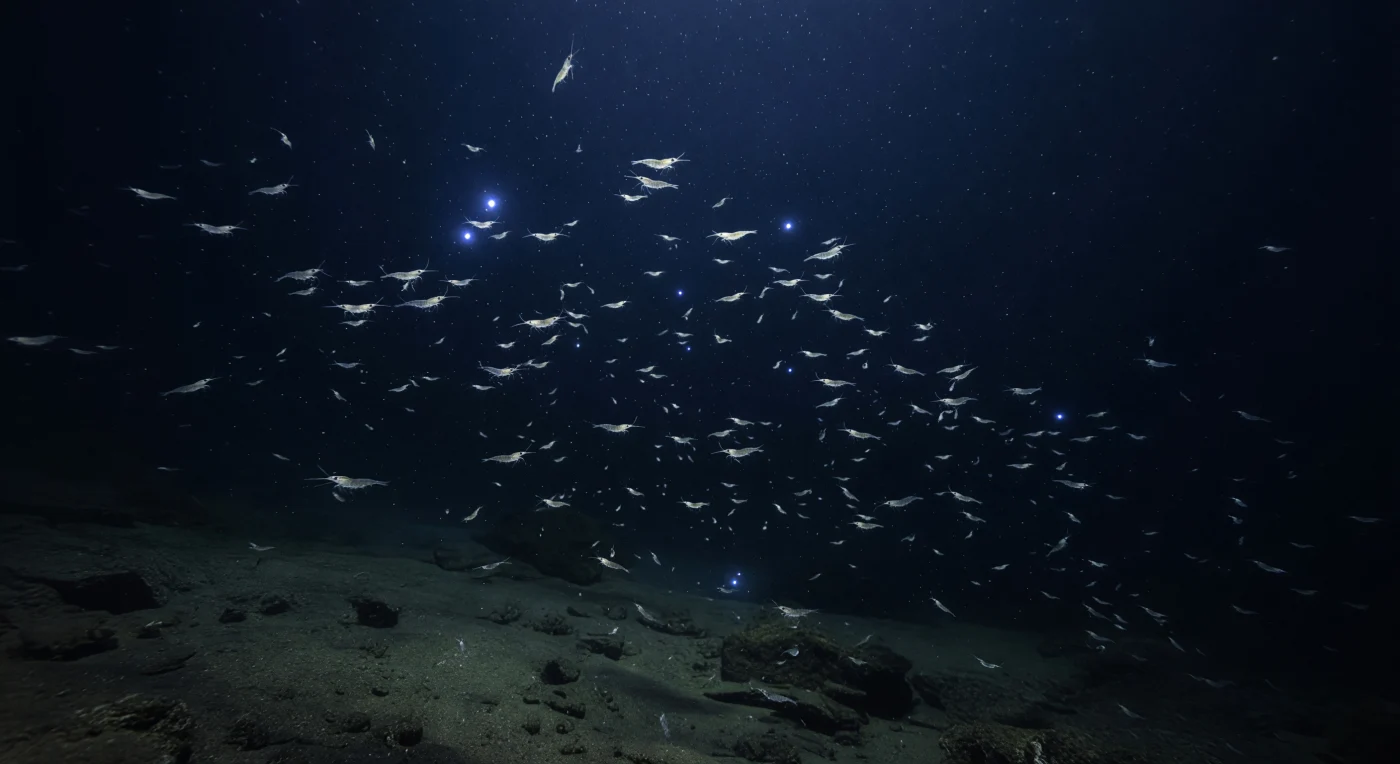
At roughly 500 to 700 meters below the surface, the ocean holds its breath. Here, in the mesopelagic water column where pressure exceeds 50 to 70 atmospheres, sunlight has surrendered nearly everything — only the faintest residual cobalt persists as a diffuse overhead glow, attenuated to a fraction of surface intensity and stripped of all wavelengths except the deepest blue. Against this dim background, hundreds of sergestid and oplophorid shrimps — *Sergia*, *Acanthephyra*, and their kin — hang suspended in a loose, pulsing aggregation, their carapaces so thoroughly transparent that each individual is more absence than presence, betrayed only by fine refractive outlines, dark compound eyes, and occasional mirror-like flashes where internal silvered surfaces catch the last ambient photons. Within this hovering veil, isolated points of cool bioluminescent blue flare and extinguish without pattern, produced by photophores or by secreted luminescent fluid, each momentary pulse briefly silhouetting the glassy bodies of neighboring shrimps before the darkness reclaims them entirely. Below, a sediment slope descends into blue-black opacity, dusted with foraminiferan tests and organic detritus settling through a water column that supports — across the global ocean — an estimated biomass of hundreds of millions of tonnes of mesopelagic fauna, an immense living community cycling carbon and energy in a world that has never required a witness.
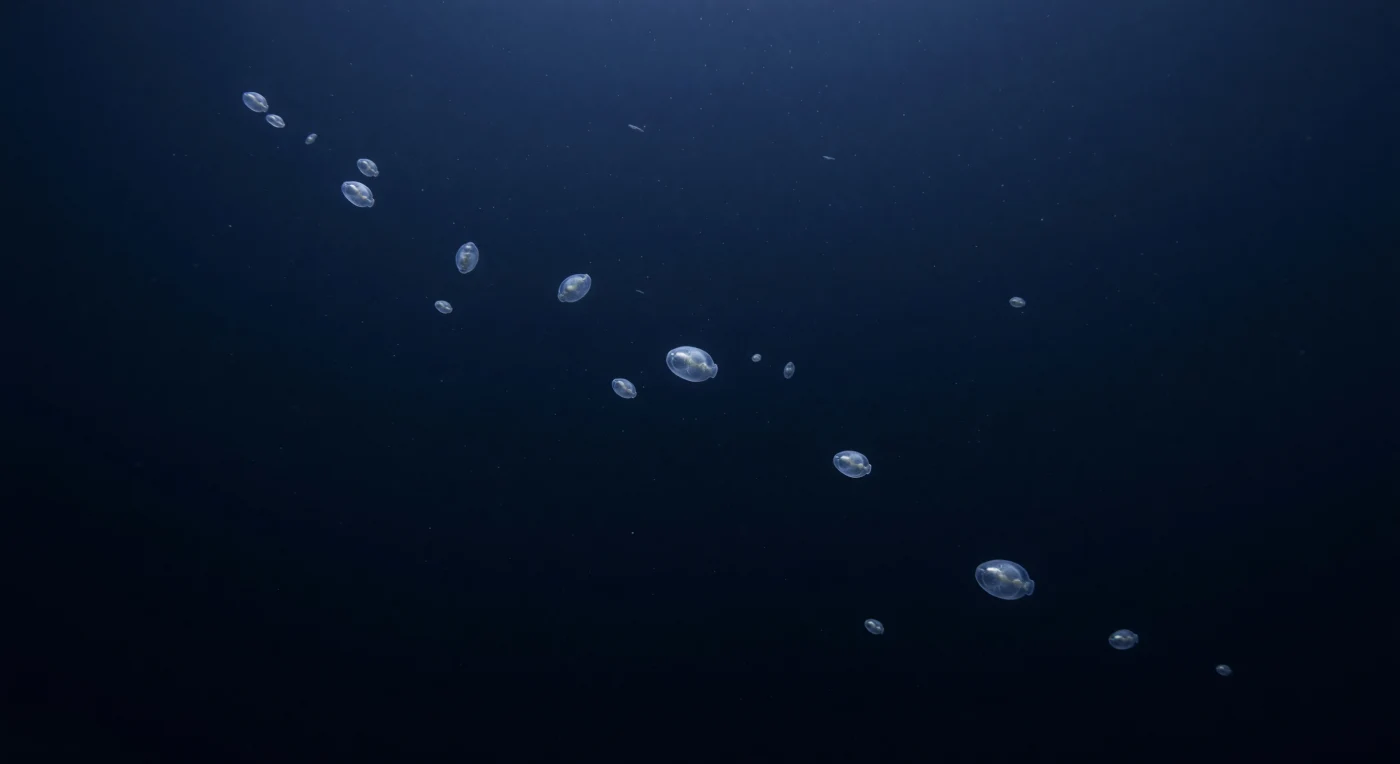
At roughly 350–450 metres below the surface, the last attenuated remnants of sunlight descend as a faint monochromatic blue wash, too weak to sustain photosynthesis yet still sufficient to silhouette the bodies of animals drifting within the water column. Here, a loose procession of salps — Thaliacea, barrel-shaped tunicates of entirely gelatinous construction — moves on a slow diagonal through the open pelagic midwater, each individual a near-invisible cylinder of seawater enclosed by delicate circular muscle bands and a translucent tunic that catches residual light along its curved rims in faint silver. Salps are filter feeders of remarkable efficiency, drawing water continuously through their bodies to extract phytoplankton and fine organic particles, and at this depth they represent one of the ocean's most important biological pumps, packaging carbon-rich fecal pellets that sink rapidly toward the seafloor far below. The pressure here exceeds 40 atmospheres, the temperature hovers just above 4 °C, and marine snow — microscopic flakes of dead organic matter, mucus, and shed cells — drifts uniformly through the water column in all directions, unguided by any current stronger than the mesopelagic's gentle internal waves. Scattered in the deep blue-black distance, cold bioluminescent pinpricks flicker from organisms unseen, marking a world of immense biological abundance that has proceeded, entirely undisturbed, across geological time.
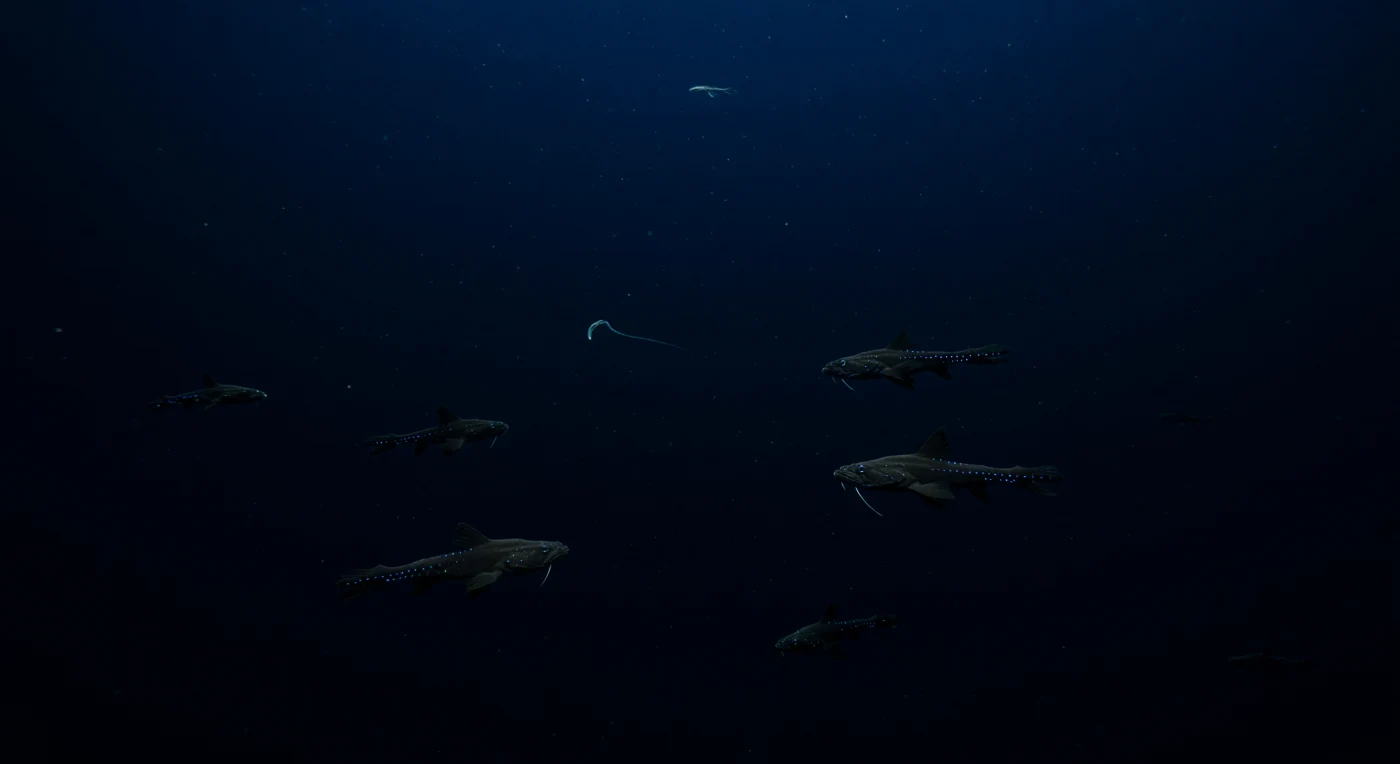
At 850–950 meters beneath the surface, the ocean has surrendered nearly all memory of sunlight, leaving only the faintest ancestral cobalt whisper far above — light reduced to a theoretical trace rather than a useful quantity, pressing down through hundreds of meters of cold, clear water until it dissolves entirely into black. Here, at pressures exceeding 90 atmospheres, the cold hovers near 4–6 °C, and the water column is so transparent that marine snow — fragile aggregates of organic detritus, mucus, and microscopic shells — drifts freely in all directions, each particle suspended in its own silence, undisturbed by any current stronger than the slow thermohaline drift. Through this void move the dragonfish, stomiid predators of extraordinary refinement: their bodies wrapped in chromatophore-dense black skin that absorbs virtually all incident photons, they become negative shapes, presences defined only by the rows of blue-green photophores stitching delicate ember-dotted constellations along their flanks and bellies — signals that may serve species recognition, counterillumination, or prey luring, depending on context and audience. The chin barbel hangs forward in the darkness, a patient lure trailing its own faint luminous tip into a world where every photon is both message and weapon, and where these animals have evolved over millions of years into creatures so perfectly adapted to absence that light itself, when they produce it, reads as something almost geological — brief, local, and utterly indifferent to any witness.
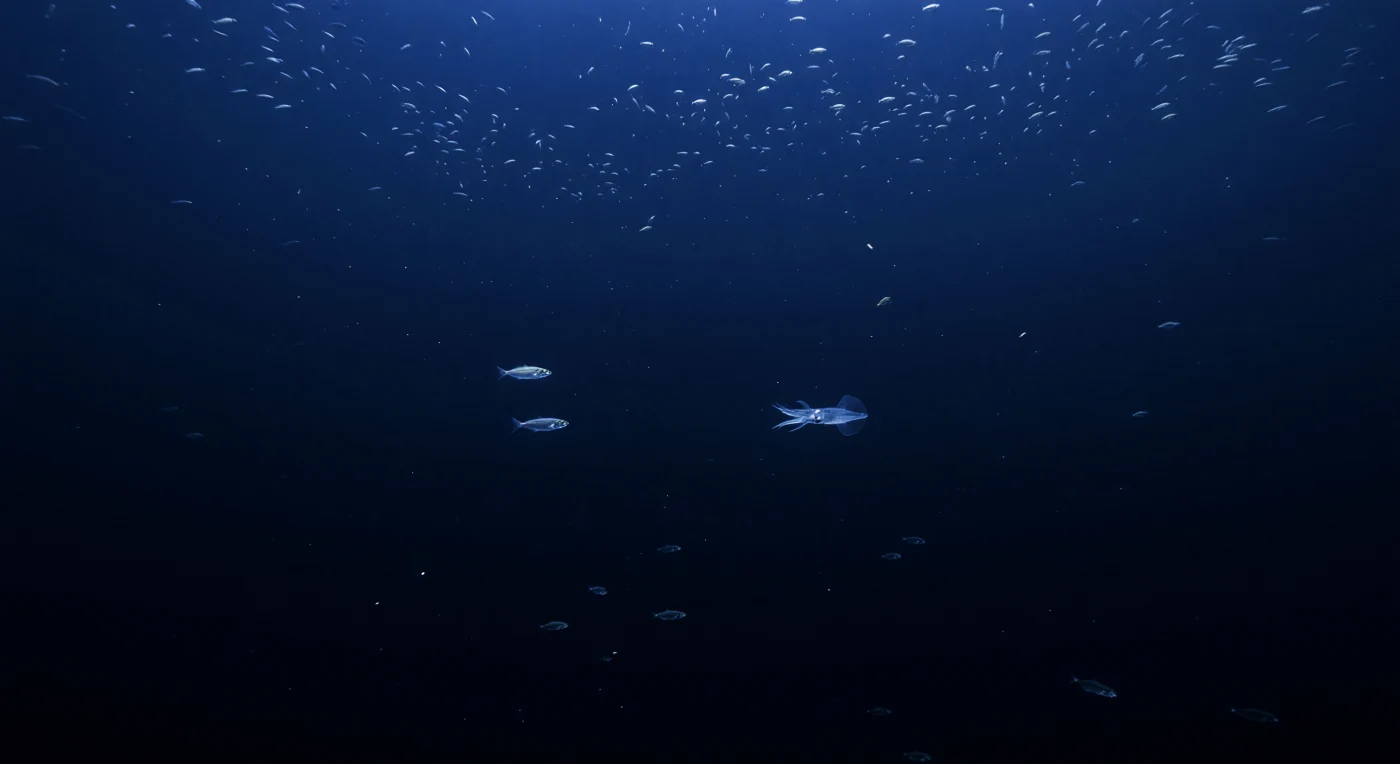
At around 200 to 1,000 metres below the surface, solar energy dwindles to its last coherent expression: a faint, monochromatic cobalt that illuminates nothing so much as it hints at the world above. Looking upward from the open pelagic void, the deep scattering layer resolves into a granular living ceiling — a diffuse, shifting band of myctophids, euphausiids, siphonophores, and gelatinous bodies compressed by perspective into something almost architectural, a biological stratum that marks the lower boundary of productive ocean life. Beneath it, the water column empties into darkness interrupted only by the occasional hatchetfish, its body reduced to a wafer of mirrored scales and a row of ventral photophores that counter-illuminate its silhouette against the dim downwelling blue — a camouflage strategy refined across hundreds of millions of years of pelagic evolution. A solitary squid drifts nearby, its mantle nearly transparent, chromatophores subdued, internal organs ghosting through glass-like tissue, the whole animal existing at the threshold of visibility as marine snow particles settle slowly past in trajectories shaped by the gentle internal currents of an ocean no surface force can reach. Here, at pressures exceeding twenty atmospheres and in a silence that is not metaphorical but physical, an entire ecosystem persists in perpetual dim blue, witnessed by nothing, dependent on nothing human, cycling carbon and energy through bodies that have never needed the light we carry.
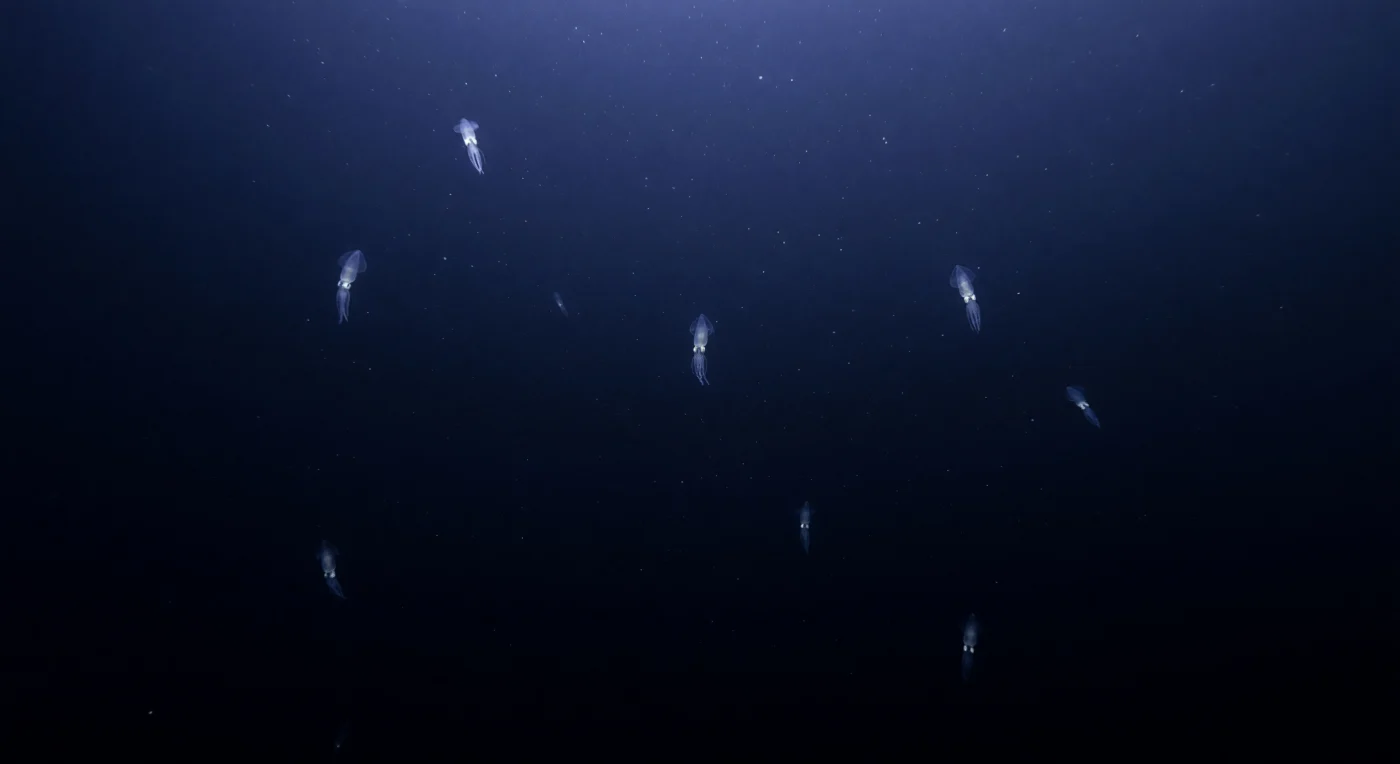
Between roughly 200 and 1,000 meters beneath the surface, the ocean becomes a realm of vanishing blue light and enormous hydrostatic pressure — at 500 meters, roughly 50 atmospheres compress every cubic centimeter of water and tissue alike. Here, a handful of cranchiid squid drift in the vast pelagic emptiness, their gelatinous mantles so transparent that only the bright mirrors of their silver eyes and the faint shadow of internal organs betray their presence against the deep cobalt column. These glass squid have evolved radical transparency as a survival strategy in this lit-but-dim intermediate world, where residual downwelling sunlight still silhouettes anything opaque against the brighter water above, making invisibility the most effective form of camouflage. Fine marine snow — the ceaseless slow rain of organic particles from the productive surface — drifts past them in quiet suspension, while cold bioluminescent pinpricks flicker distantly in the surrounding darkness, hints of the dense and largely invisible community of mesopelagic life that fills this twilight column. The water above glows faintly with the last geometry of solar blue, grading imperceptibly into blackness below, and the squid hang within it, perfectly still, perfectly hidden, in a world that has never needed a witness.