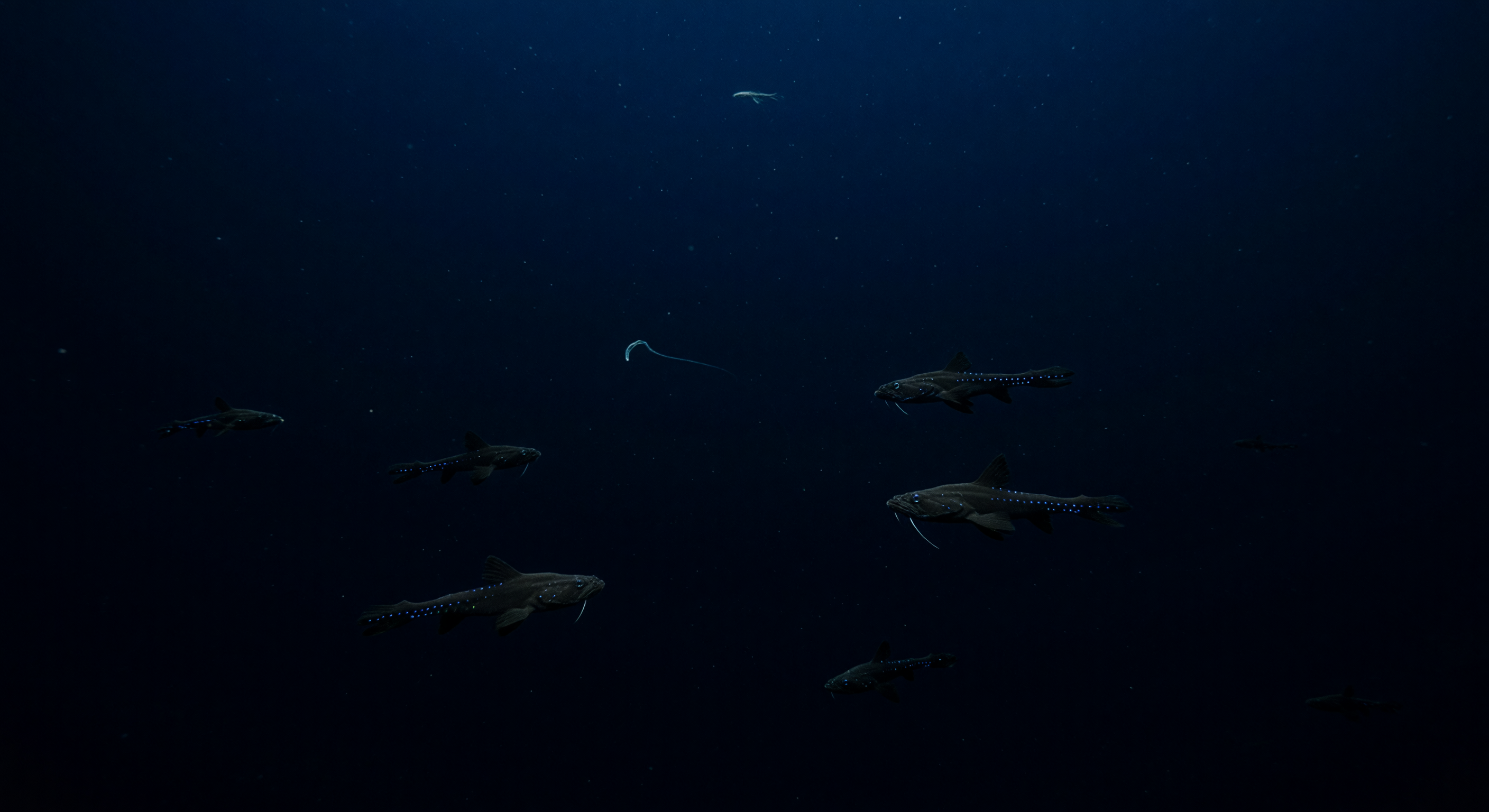
At 850–950 meters beneath the surface, the ocean has surrendered nearly all memory of sunlight, leaving only the faintest ancestral cobalt whisper far above — light reduced to a theoretical trace rather than a useful quantity, pressing down through hundreds of meters of cold, clear water until it dissolves entirely into black. Here, at pressures exceeding 90 atmospheres, the cold hovers near 4–6 °C, and the water column is so transparent that marine snow — fragile aggregates of organic detritus, mucus, and microscopic shells — drifts freely in all directions, each particle suspended in its own silence, undisturbed by any current stronger than the slow thermohaline drift. Through this void move the dragonfish, stomiid predators of extraordinary refinement: their bodies wrapped in chromatophore-dense black skin that absorbs virtually all incident photons, they become negative shapes, presences defined only by the rows of blue-green photophores stitching delicate ember-dotted constellations along their flanks and bellies — signals that may serve species recognition, counterillumination, or prey luring, depending on context and audience. The chin barbel hangs forward in the darkness, a patient lure trailing its own faint luminous tip into a world where every photon is both message and weapon, and where these animals have evolved over millions of years into creatures so perfectly adapted to absence that light itself, when they produce it, reads as something almost geological — brief, local, and utterly indifferent to any witness.
Twilight zone