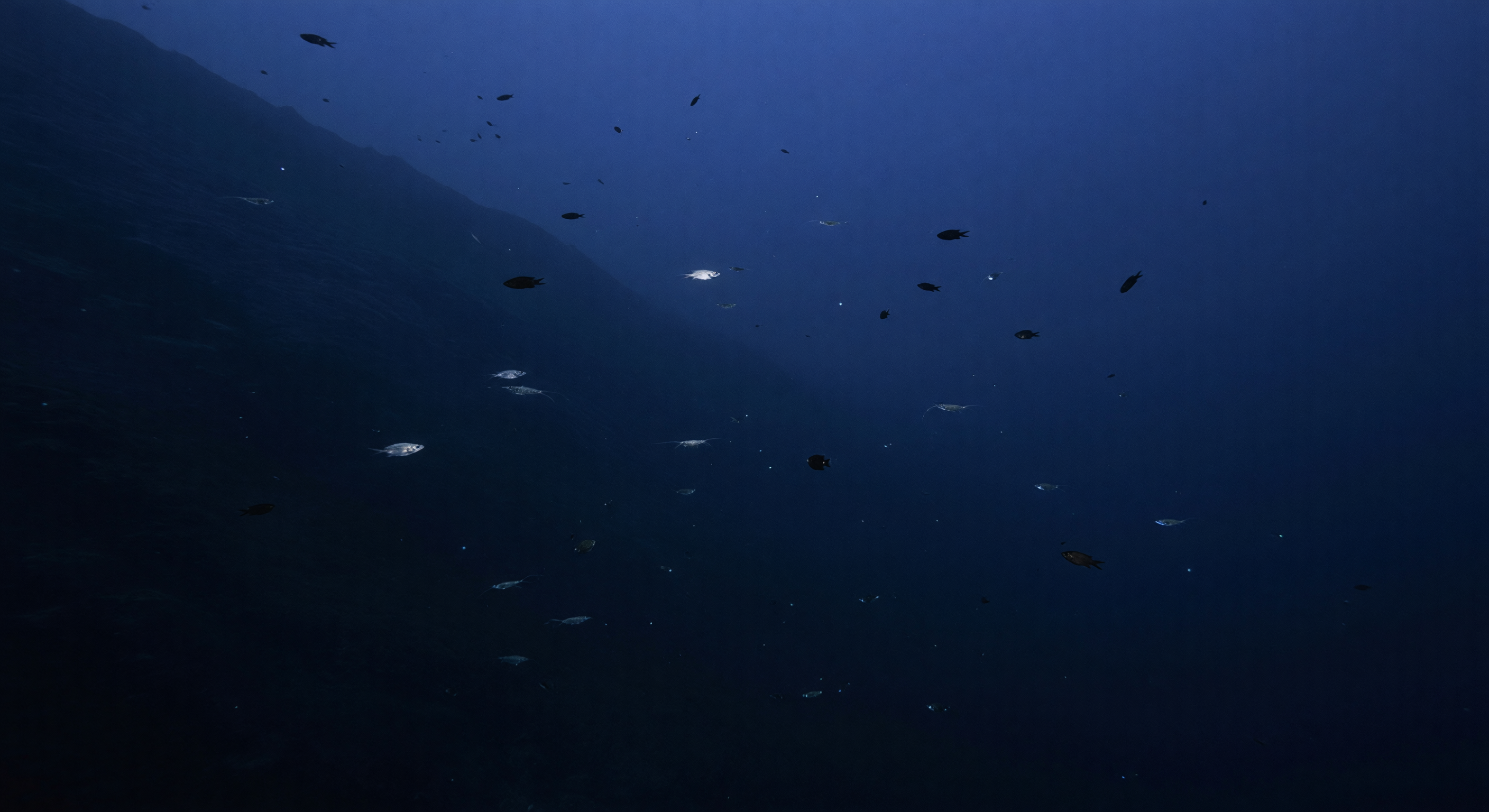
At roughly 400–500 meters along the flank of a continental slope, the last attenuated threads of sunlight filter down as a cold, monochromatic cobalt glow that dissolves into blue-black long before it reaches the sediment below. The slope itself rises as a vast charcoal plane, its surface softened by distance and the slow accumulation of marine snow — particles of organic detritus that drift continuously downward, carrying the chemistry of the sunlit world into these pressurized depths where water temperatures hover near 4–8 °C and pressures exceed 40 atmospheres. Against this dim backdrop, lanternfish — myctophids no longer than a finger — hang in the open water column, their silvered flanks catching just enough residual light to render them as fleeting mirror-flashes before they angle back into near-invisibility, their photophore rows dark and latent for now. Sergestid shrimps drift alongside them, their bodies so nearly transparent that only refractive edges, thread-fine antennae, and the dark punctuation of compound eyes betray their presence, with an occasional cool blue-green bioluminescent pulse flickering somewhere deeper in the haze. This is a world of exquisite biological economy, where every adaptation — mirror scales, transparent tissue, counterillumination — has been refined over evolutionary time to navigate the perpetual negotiation between being seen and remaining invisible in a realm that has never needed witnesses.
Twilight zone