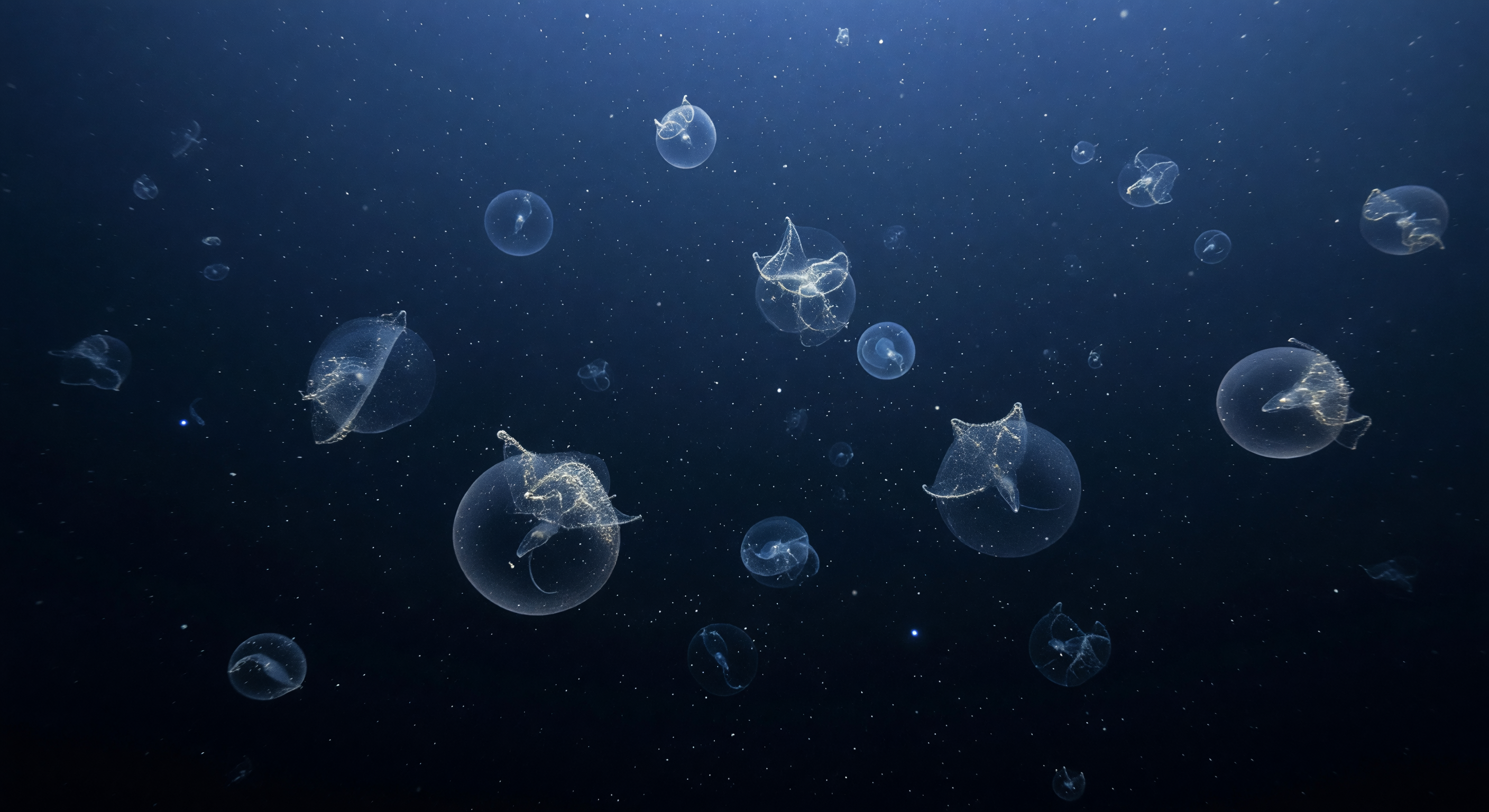
Somewhere between 350 and 500 meters below the surface, where the last traces of sunlight thin into a cold cobalt wash before dissolving into blue-black nothing, giant larvaceans have erected an architecture that belongs to no human vocabulary. Each animal — a centimeter-long tunicate relative, its glassy body barely distinguishable from the surrounding water — secretes a mucous house orders of magnitude larger than itself, an elaborate nested structure of filters, channels, and chambers that can span half a meter or more, designed to concentrate food particles from the surrounding sea. Suspended across the water column like a field of ghostly lanterns, these houses reveal themselves only where trapped marine snow and sinking detritus have traced their membranes in fine silvery relief, entire spheres and partial veils made legible by the very particles they were built to catch. At this depth, pressure exceeds 40 atmospheres, ambient downwelling light is so diminished that only the most sensitive biological photoreceptors can register it, and the dominant visual currency is transparency itself — to be seen is to be eaten, to disappear into the column is survival. When a larvacean house becomes clogged it is abandoned in seconds, collapsing slowly downward as a parcel of concentrated organic matter bound for the deep seafloor, while its builder begins secreting a new one, and the silent, pressured water holds both the living and the discarded with equal indifference.
Other languages
- Français: Constellation de Maisons Larvacées
- Español: Constelación de Casas Larváceas
- Português: Constelação de Casas Larváceas
- Deutsch: Larvazeen Haus Konstellation
- العربية: كوكبة بيوت اليرقات
- हिन्दी: लार्वेशियन गृह नक्षत्र
- 日本語: 幼生動物の家星座
- 한국어: 유충 집 성좌
- Italiano: Costellazione di Case Larvacee
- Nederlands: Larvacee Huis Constellatie