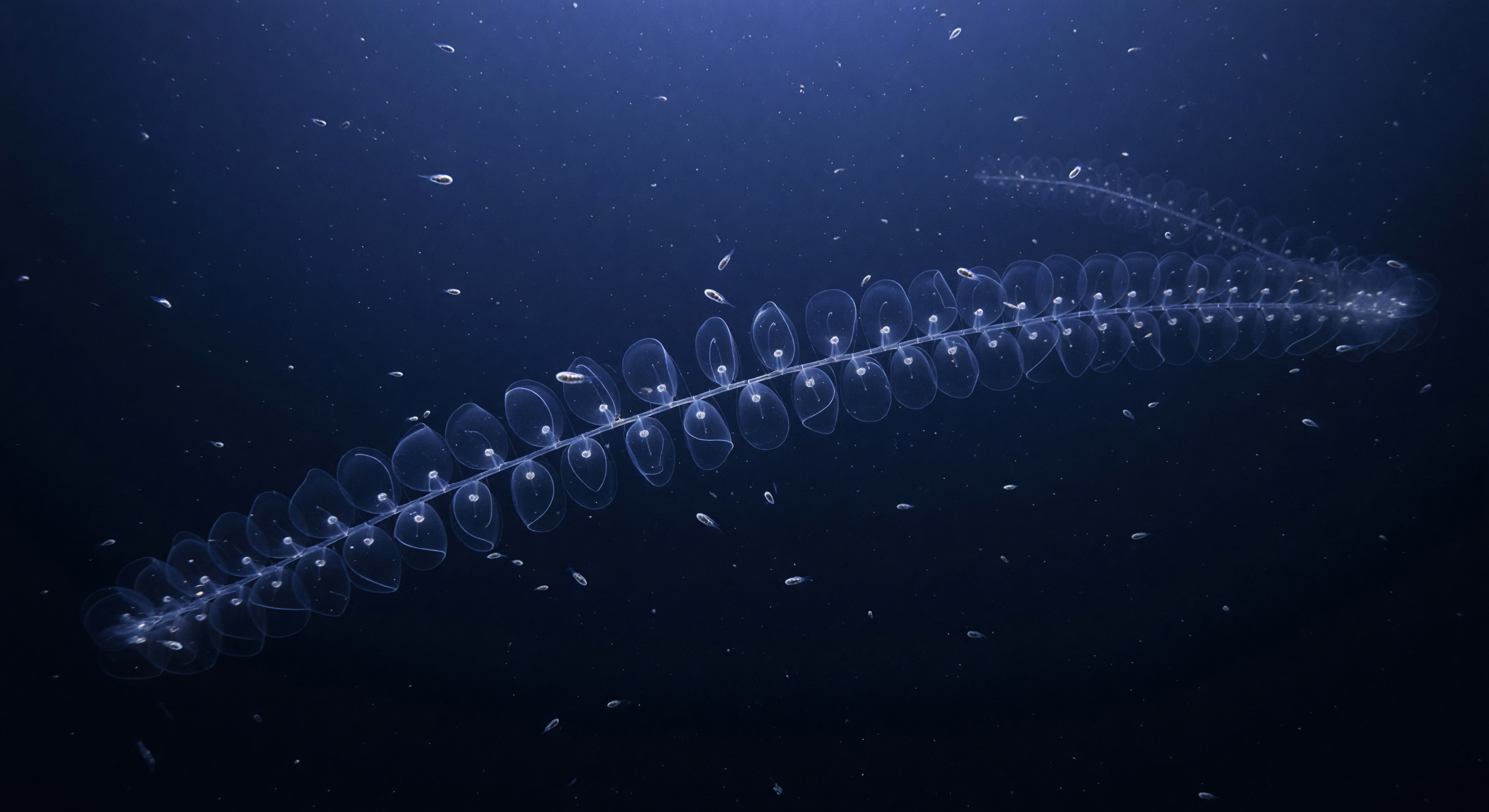
At roughly 400–500 meters, the last remnants of sunlight arrive as a faint, monochromatic cobalt wash — not true illumination, but enough to trace the edges of a world. Stretching diagonally through the indigo water column, an enormous siphonophore colony — potentially among the longest organisms on the planet — suspends itself in near-weightlessness, its repeating nectophores arranged like a procession of hand-blown glass bells along a stem that fades into blue-black void at both ends; each gelatinous bell catches the residual downwelling light only at its thinnest rim, revealing tissue so transparent it is essentially the ocean wearing itself as a body. Siphonophores are not single animals but superorganisms — colonial hydrozoans in which genetically identical zooids differentiate into specialized roles for propulsion, feeding, defense, and reproduction — and a colony of this scale may filter-feed continuously on the sparse rain of copepods and euphausiids that drift through the surrounding water column, those crustaceans themselves nearly invisible, rendered as slivers of cold silver or perfect glass by evolutionary pressure to disappear in a world where bioluminescent flashes betray the living. At this depth, hydrostatic pressure exceeds 45 atmospheres, the temperature hovers near 4–8 °C, and the marine snow — microscopic particles of organic debris, mucus, fecal pellets, and diatom fragments — drifts downward through the darkness without destination, carrying carbon from the sunlit surface toward the abyss in a slow, permanent, unwitnessed transfer that quietly governs the chemistry of the entire planet.
Other languages
- Français: Chaîne Cathédrale Siphonophore
- Español: Cadena Catedral Sifonóforo
- Português: Corrente Catedral Sifonóforo
- Deutsch: Siphonophoren Kathedralenkette
- العربية: سلسلة كاتدرائية الطافيات
- हिन्दी: साइफोनोफोर गिरजाघर श्रृंखला
- 日本語: クダクラゲ大聖堂の連鎖
- 한국어: 관해파리 대성당 사슬
- Italiano: Catena Cattedrale Sifonoforo
- Nederlands: Sifonofoor Kathedraal Keten