Scientific confidence: Very High
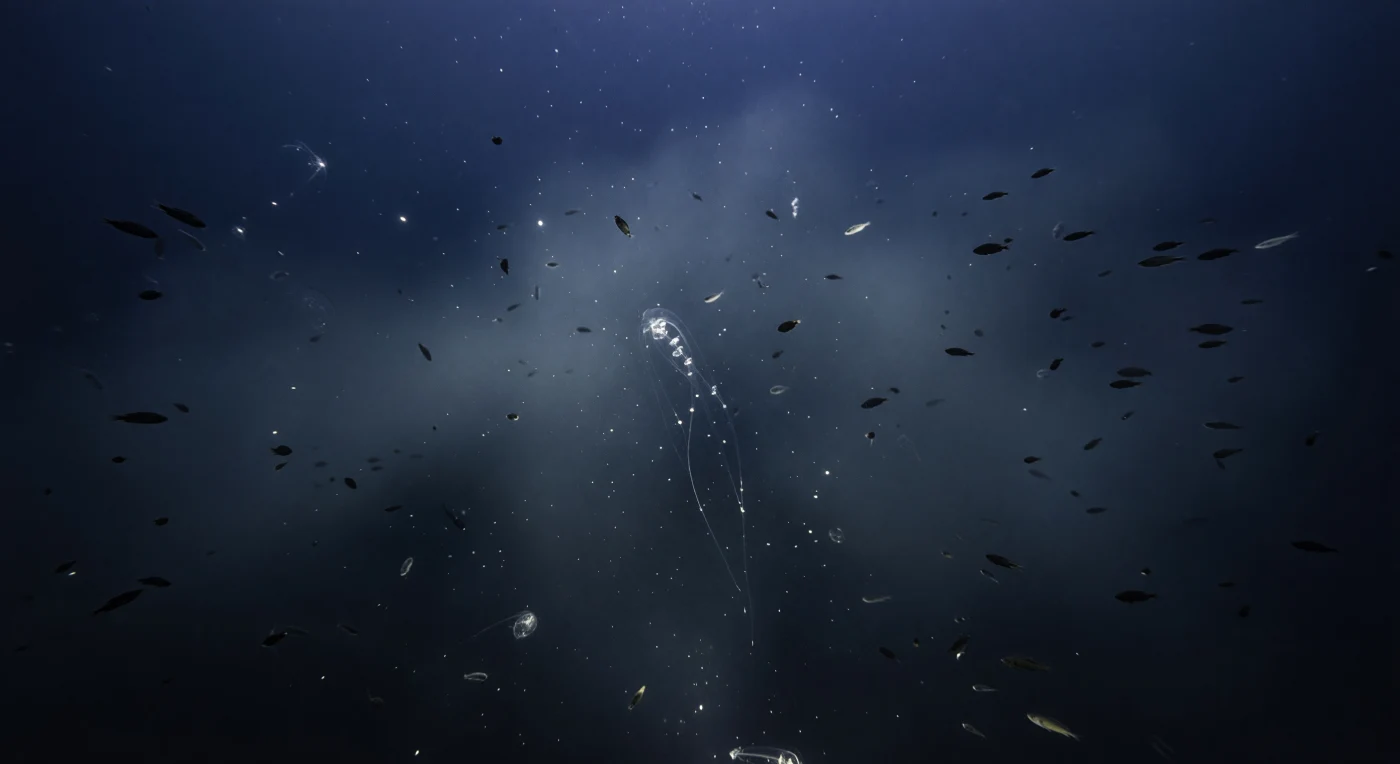
The ROV holds position at 430 meters, its thrusters barely whispering, as a siphonophore of extraordinary length drifts to within centimeters of the camera housing — a colonial organism so architecturally intricate it seems less like an animal and more like a sentence written in glass, each pneumatophore and nectophore barely catching the observation light before dissolving back into blue. At this depth, roughly 44 atmospheres press against every surface, sunlight has been reduced to a colorless whisper of downwelling photons that the human eye would register as near-total darkness, and yet the water column ahead is alive in a way that defies the silence: a volumetric haze of lanternfish, euphausiid krill, and gelatinous micronekton drifts slowly through the frame, their aggregate biomass so acoustically dense that early naval sonars mistook this living curtain for the seafloor itself. Individual myctophids flash silver for a fraction of a second where their mirror-like scales intersect the ROV's restrained cool-white beam, then vanish back into silhouette, while the siphonophore's trailing tentilla — each armed with nematocysts capable of paralyzing small prey — remain nearly invisible except as a trembling suggestion of filament against the fading blue. Marine snow particles, the continuous rain of organic detritus from the productive surface far above, drift through the near-field light like slow static, each fleck a reminder that this entire biological architecture is sustained by the thin thread of carbon falling from a sunlit world the animals here may visit only under cover of darkness.
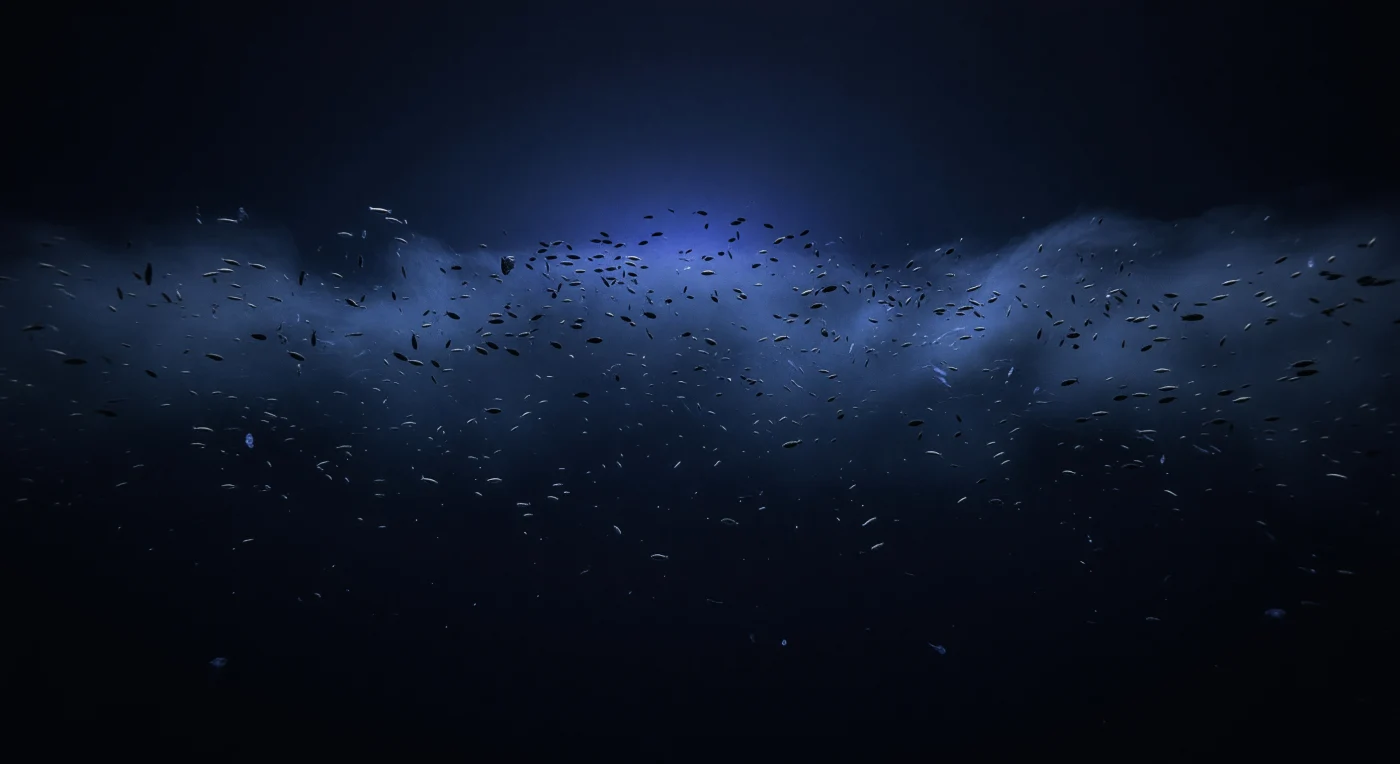
The submersible hangs motionless in the water column at 350 meters, and through the thick acrylic viewport an extraordinary vision fills the frame: a broad, uneven horizon of living matter stretches from edge to edge, charcoal-blue and dense as a storm front, composed of countless myctophid lanternfishes whose silvery flanks catch the submersible's barely-lit lamps in momentary mirror-flashes, interspersed with krill and small shrimps suspended like frozen sparks in the dim column. At this depth, pressure exceeds 35 atmospheres, and the last vestiges of downwelling blue light from the sunlit surface filter down just enough to silhouette the upper contour of the layer against a faintly luminous ceiling of water, while the layer's lower edge dissolves without boundary into open blackwater below. This is the deep scattering layer — a daily-migrating pelagic assemblage that once confounded wartime sonar operators into believing they had found a false seafloor, a biological phenomenon rather than any geological feature, dense enough to return strong acoustic echoes across its vertical extent of tens to hundreds of meters. Transparent ctenophores drift at the margins, their delicate bodies nearly invisible until a stray photon catches them, and deep within the biological haze, faint bioluminescent pinpricks pulse and vanish — the photophores of lanternfishes communicating in a language older than any predator that hunts them. The water beyond the viewport is immaculately still, threaded with marine snow and suspended particles, carrying the absolute silence of open-ocean mid-water where no seafloor anchors the world below.
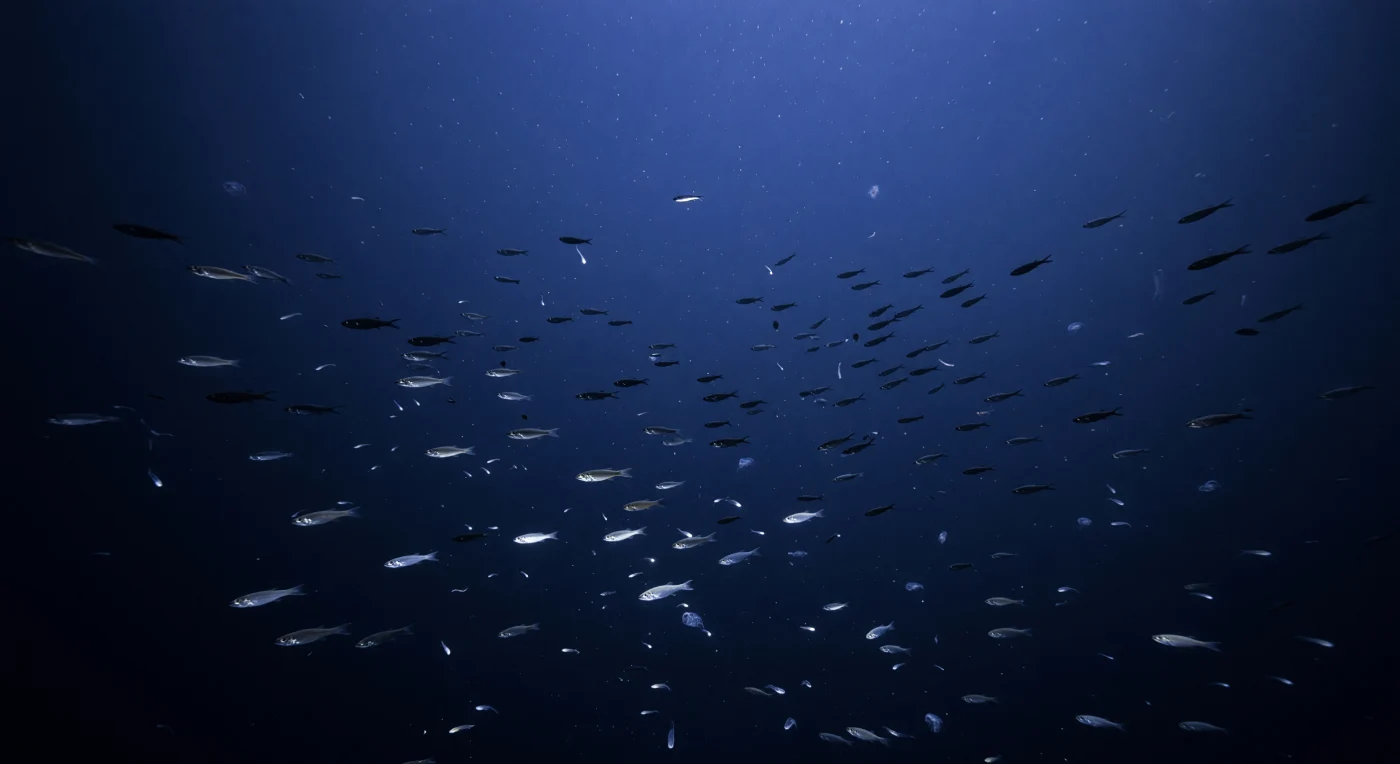
The AUV's nose camera tilts upward into a vast, living architecture: thousands of lanternfish—myctophids no longer than a finger—angle through the water column in staggered, dissolving bands, their flanks occasionally catching the last ghost of downwelling cobalt light in knife-thin silver flashes before fading back into silhouette. At 280 meters, the pressure bears down at roughly 28 atmospheres, and what little solar energy remains has been stripped to a faint, diffuse ceiling of blue-indigo that brightens only at the center of the frame before bleeding away to near-black at the edges—there is no sun here, only its memory. This is the dusk ascent of the deep scattering layer, one of the largest synchronised animal migrations on Earth, as billions of mesopelagic organisms ride the retreating light gradient upward each evening to feed in richer, shallower waters before descending again at dawn. Drifting among the lanternfish are glassy ctenophores trailing refractive comb rows, scattered krill, and translucent shrimps, all suspended in a gentle snowfall of marine particulates—organic detritus sinking from the productive surface far above—that catches the AUV's barely perceptible spill of cool light within arm's reach before vanishing into the dark below. The scene is cold, silent, and profoundly volumetric: a biological horizon that once fooled wartime sonar operators into believing they had found the seafloor, now revealed as a living, breathing, migrating frontier of the ocean's twilight interior.
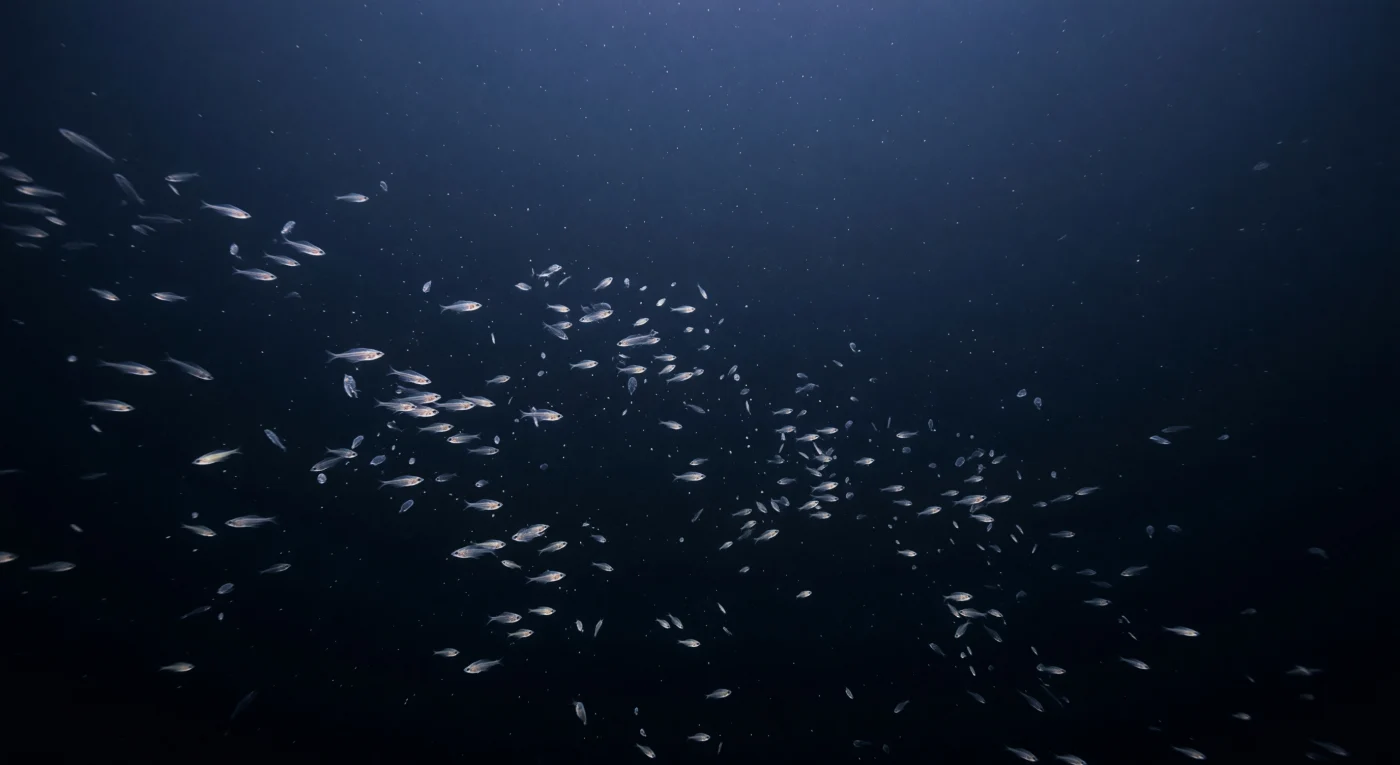
The submersible hangs motionless in a column of near-absolute darkness, its twin lamps carving a narrow white-blue cone into water pressing down at roughly 52 atmospheres — a pressure that would collapse an unprotected human body in seconds. Through the forward viewport, dense streams of krill surge sideways across the beam like a living blizzard, each animal semi-transparent and silvery, their tiny black eyes catching the light for a fraction of a second before they dissolve back into the surrounding void; this is the deep scattering layer in daylight position, the biological aggregation that once fooled wartime sonar operators into believing they had found a false seafloor. Between the krill, isolated ctenophores drift like glass commas, nearly invisible until the lamps ignite their transparent lobes and the faint ribbons of their internal structure, while farther out in the gloom, pinpricks of cold blue-green bioluminescence flicker and vanish — organisms communicating, startled, or simply completing biochemical processes evolved over hundreds of millions of years of darkness. Fine marine snow sparkles close to the lights and disappears within meters, underscoring how brutally short the light budget is here, where no downwelling sunlight of any biological consequence remains and the only photons that matter are the ones an animal generates itself. Beyond the reach of the submersible's lamps, the water column extends in every direction as a featureless biological haze, neither seafloor nor surface within sight, just an immense living suspension preparing, as it does every dusk, to migrate hundreds of meters upward in one of the largest animal movements on Earth.
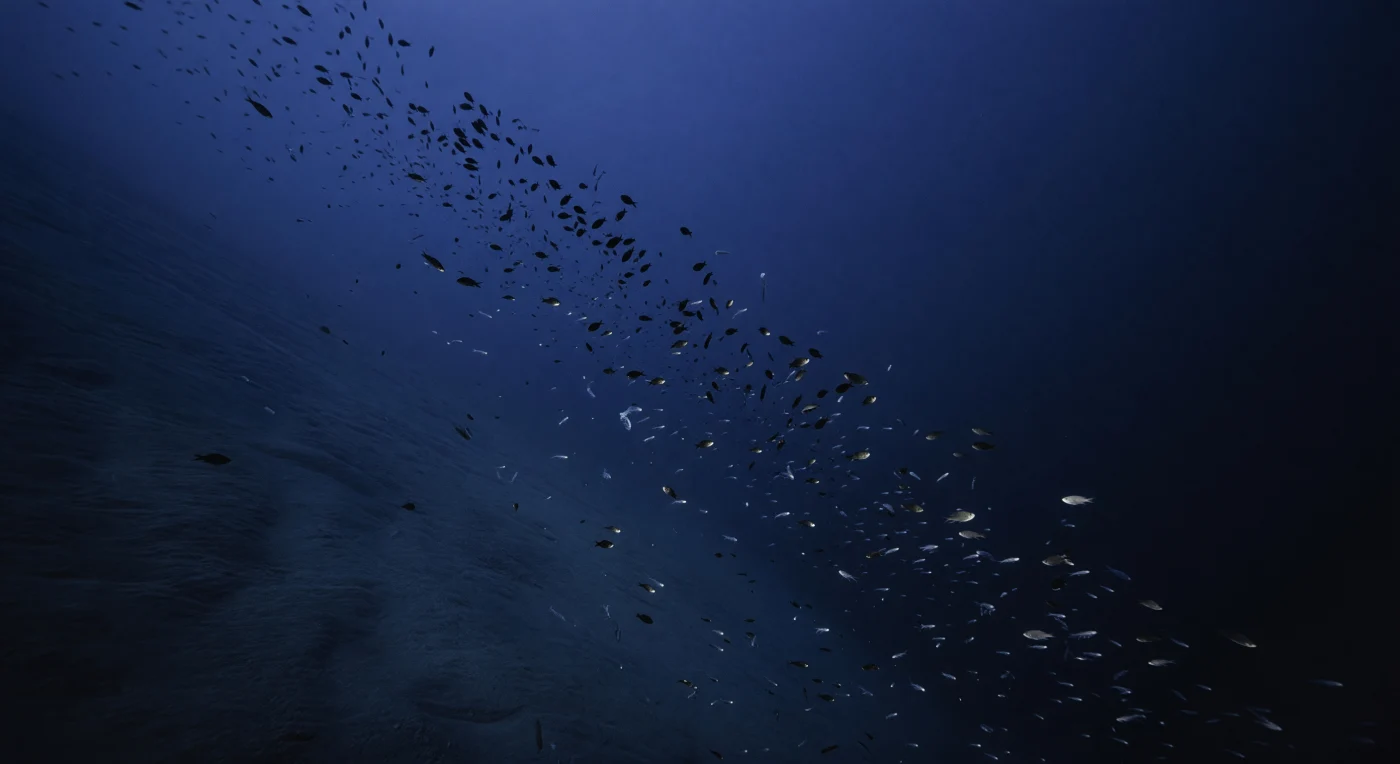
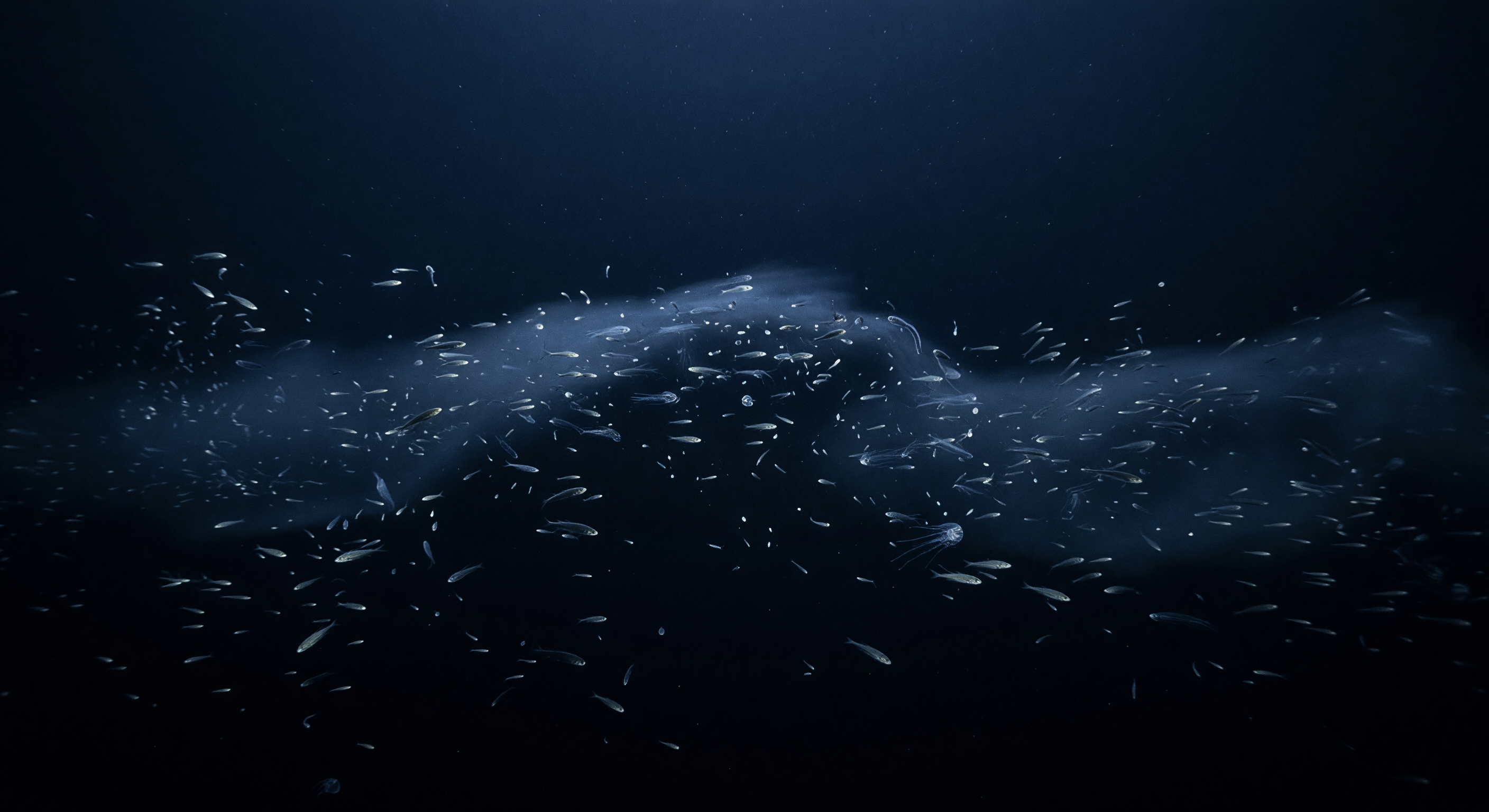
The lander sits motionless against the base of the continental slope, its faint observation light barely reaching a meter into water that presses down at roughly forty atmospheres, cold and almost perfectly still. To the left, the slope wall rises as a vast matte plane of dark cobalt that dissolves upward into monochromatic haze long before any edge becomes visible, its surface texture only hinting at the enormous geological structure it represents — an ancient sediment-draped margin where the deep ocean basin meets the shallower shelf. Against this wall, something extraordinary is happening: the deep scattering layer, normally a diffuse acoustic horizon spread across hundreds of meters of open water column, has been forced into a compressed ribbon by the slope's topography, concentrating lanternfishes into low-contrast silver silhouettes, transparent sergestid shrimps and euphausiid krill into glassy drifting clusters, and scattered ctenophores into fragile spinning geometries, all streaming slowly upslope in a living current thickest near the wall and fraying into the blue-black open water to the right. Marine snow catches the lander's light for an instant and vanishes, a few fish flanks flash silver where residual downwelling blue still reaches from far above, and deep within the band tiny bioluminescent points flicker and go dark — the metabolic sparks of organisms adapted to carry their own light because none arrives from the surface. This is one of the most biomass-dense environments on Earth, an acoustically opaque horizon that once fooled wartime sonar operators into believing they had found the seafloor, now revealed as a compressed wall of living tissue migrating along geology that has been building for millions of years.
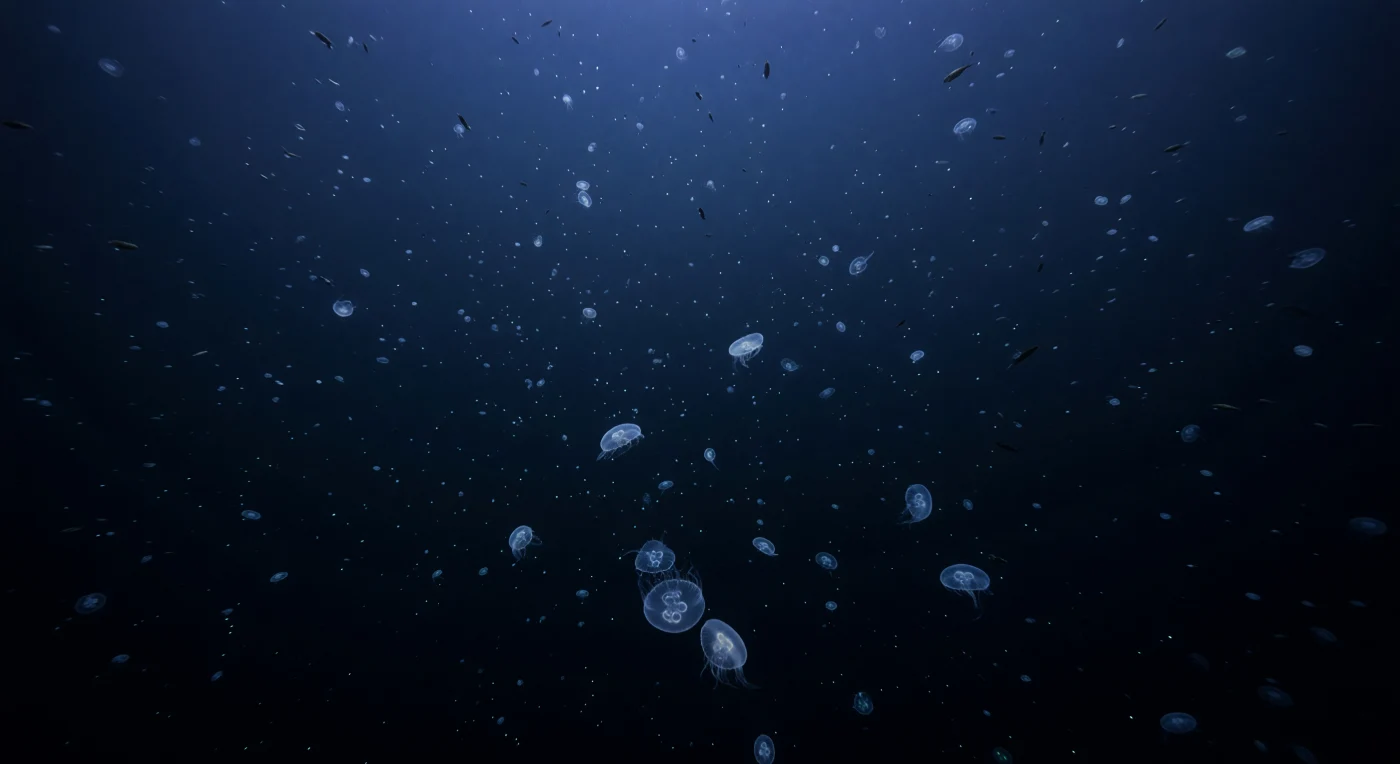
The ROV glides forward at 460 meters into what the camera renders as a silent snowfall in reverse—hundreds of ctenophores suspended in the cobalt-black water column, their glass-clear bodies catching the vehicle's cool-white lamps in brief, translucent flashes before the light fails and they recede into pale ovals and scattered blue-green bioluminescent pinpoints. At this depth, pressure exceeds 47 atmospheres and the last trace of downwelling sunlight has collapsed to a faint monochromatic blue gradient above, leaving the surrounding water to thicken into indigo darkness just meters beyond the ROV's reach. This is the daytime heart of the deep scattering layer—the biological "false bottom" that once deceived wartime sonar operators into misreading their own charts—a mobile, vertically migrating aggregation of gelatinous fauna, micronekton, and lanternfishes that constitutes one of the largest daily animal migrations on Earth. Threading through the ctenophore field, slender myctophid silhouettes cross the dim blue field with minimal photophore display, conserving their bioluminescent signatures in the presence of the ROV's artificial light, their gas-filled swim bladders compressed by pressure into acoustically dense targets that collectively form the layer's strong sonar return. Fine marine snow drifts continuously through the frame—particulate organic matter descending from the productive surface far above—giving the water column a volumetric, living texture that reminds the observer that this silent, pressurized darkness is not empty but is among the most biologically significant habitats in the ocean.
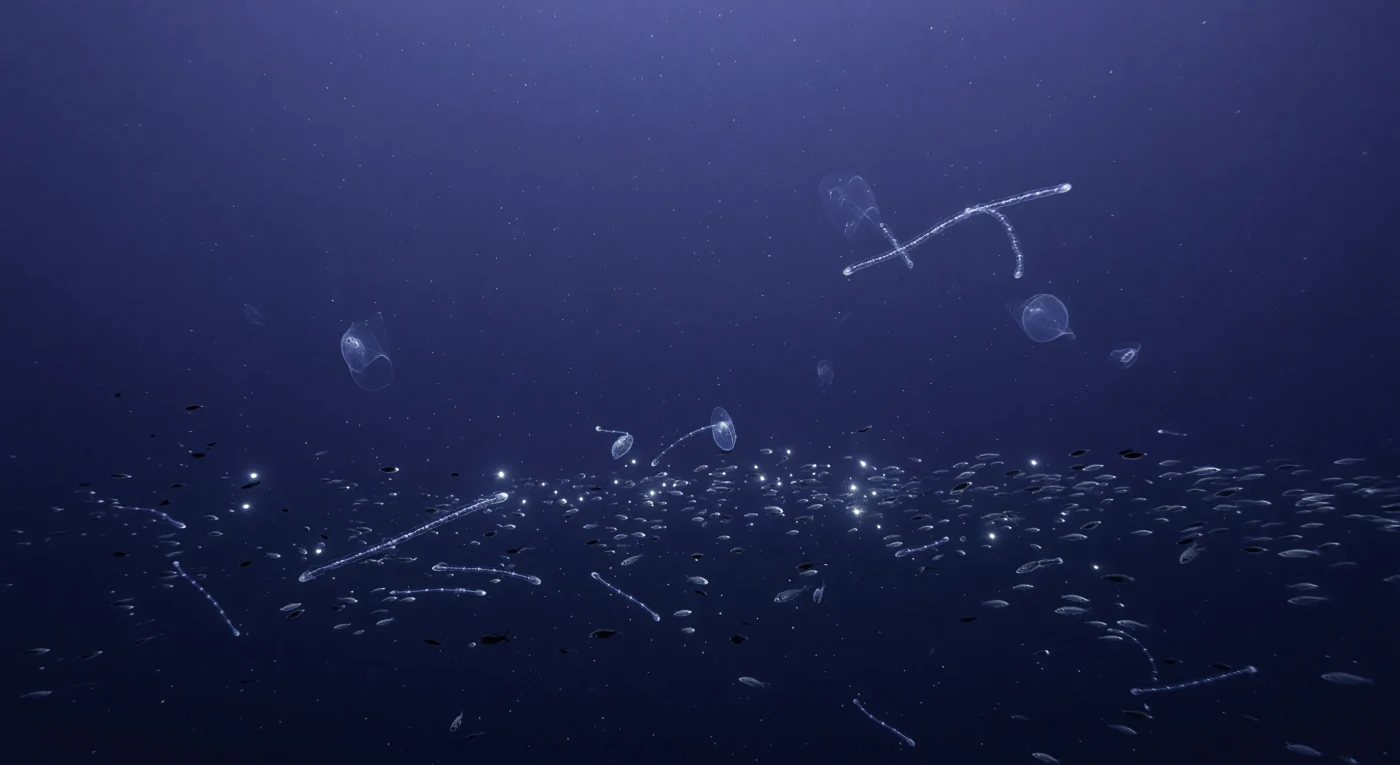
Pressed against the acrylic dome at 240 meters, the submersible's occupant watches long chains of salps drift past in slow procession, each gelatinous capsule catching the last feeble downwelling light as a faint indigo outline before dissolving back into the blue-black water column — at this depth, roughly 25 atmospheres of pressure compress the world into silence, and the warm wavelengths of sunlight have been stripped away hundreds of meters above, leaving only this cool monochrome twilight at the very edge of human visibility. Collapsed larvacean houses hang in the midwater like shed ghosts, their mucus-mesh architecture now shapeless and translucent, releasing captured marine snow back into slow descent — these abandoned filtration structures are among the ocean's most efficient carbon-export vehicles, ferrying surface productivity toward the seafloor in a biological pump that shapes the planet's carbon cycle. Below the submersible, the water thickens into something alive and volumetric: the deep scattering layer is rising with the fading sun, and what sonar operators once mistook for a false seafloor reveals itself here as a swarm of krill and lanternfish so dense it forms its own trembling horizon, individual animals flickering as silver glints and dark silhouettes amid scattered sparks of bioluminescence. This nightly upward migration — hundreds of meters traveled in a matter of hours — represents one of the largest coordinated movements of animal biomass on Earth, a biological tide that redistributes energy between the productive surface and the twilight depths in rhythms older than any human science.
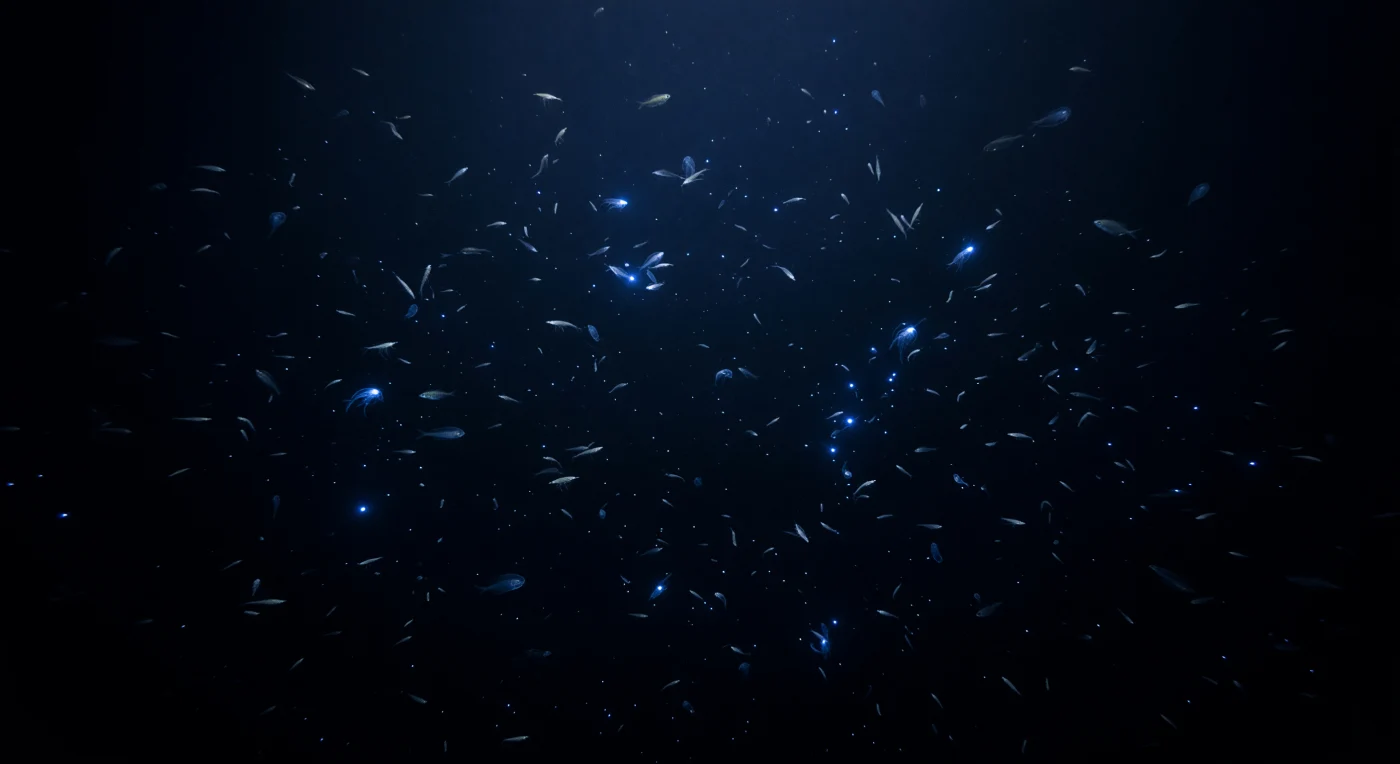
The ROV drifts weightless in open water, its forward camera revealing a living haze suspended between the last whispers of surface light and absolute darkness — directly ahead, transparent shrimps and ctenophores hang motionless in the weak cobalt downwelling glow, their glassy tissues barely distinguishable from the surrounding seawater until a sharp electric-blue spark ignites against a shrimp's flank, then another, then a third among the ghostly lobes of a ctenophore, bioluminescent chemistry firing in cold sequence across the frame. At this depth, roughly 30 atmospheres of pressure compress the water column into near-silence, and the sun's spectrum has been stripped to a single residual wavelength of blue that fades to nothing within a few meters in any lateral direction, leaving only the ROV's dim observation spill to graze the nearest marine snow and reveal the faint silver mirror-flanks of distant myctophid silhouettes layered deeper in the dark. This is the deep scattering layer in its daytime refuge — a volumetric biological cloud famously mistaken by wartime sonar for a false seafloor, built not from rock but from millions of migrating organisms whose gas-filled swim bladders bounce acoustic pulses as decisively as sediment. Here krill, euphausiid shrimps, siphonophores, and lanternfishes share this suspended middle world, each species occupying its preferred pressure stratum, waiting for dusk to trigger one of the planet's largest daily animal migrations — a vertical ascent of hundreds of meters that will carry this entire living horizon toward the surface in darkness. For now, the only light belongs to the animals themselves, each blue pinprick a chemical signal in a world where vision has been almost entirely surrendered to chemistry and sound.
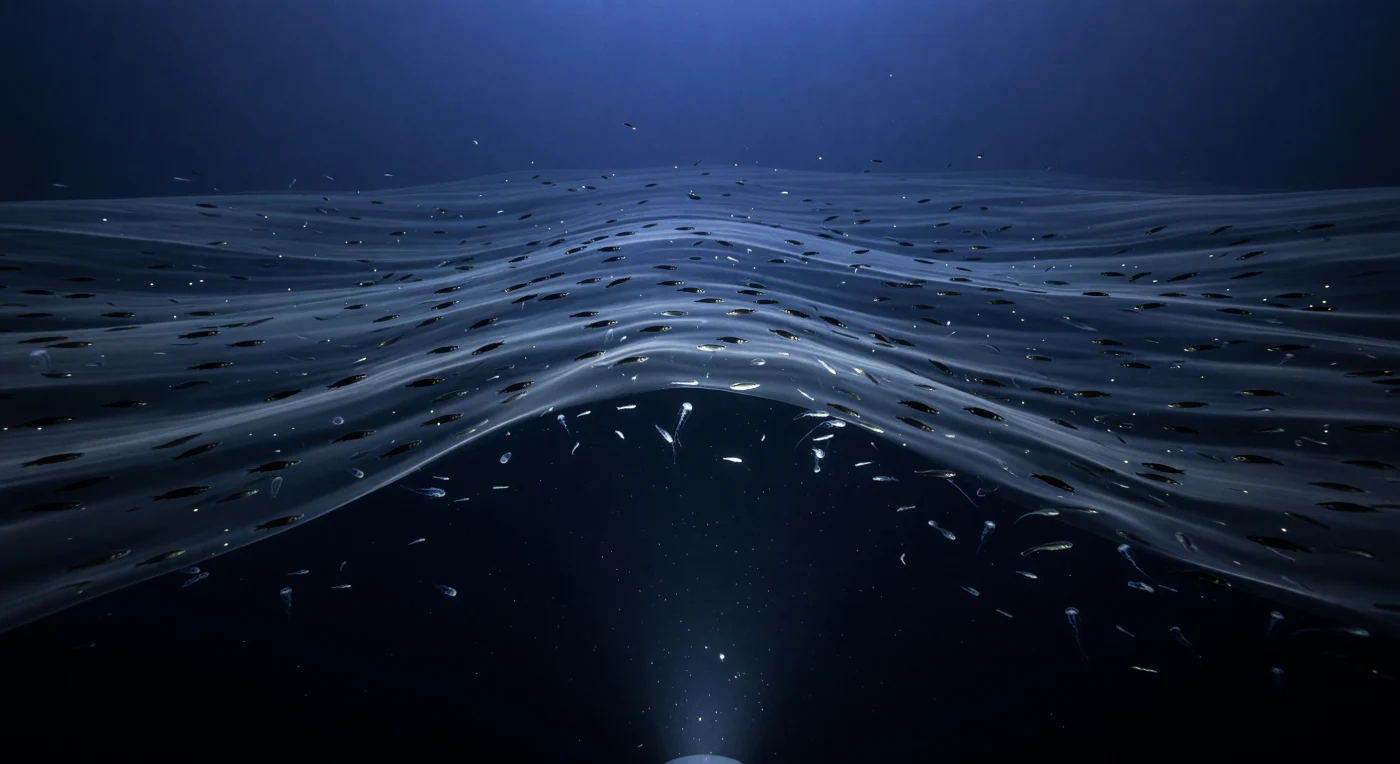
The AUV glides forward through open water at 410 meters, its faint forward beam dissolving within a few body-lengths into an expanse of deep monochromatic blue-black, while far above a last ghost of cobalt downwelling light silhouettes the scene in the barest gradient from dim to absolute dark. Ahead, the deep scattering layer has been sculpted by an internal wave into a broad, shallow arch — a living pleated horizon where dense ribbons of myctophids and krill alternate with clearer lanes, giving the water column the appearance of ribbed fabric slowly breathing in the current, a structure that acoustic echosounders would read as a false seafloor. At this depth, pressure exceeds 41 atmospheres, compressing swim bladders and shifting the buoyancy of the lanternfishes hovering as slim silvery-black silhouettes, their tiny photophores pricking the darker bands like scattered embers, while transparent ctenophores, drifting salps, and hair-fine siphonophore threads pass through the AUV's beam as barely-there glassy geometries suspended in a slow rain of marine snow. Internal waves — propagating undulations at density interfaces within the stratified water column — routinely deform biological layers into precisely these folded arches, concentrating prey and predator alike into thicker, denser strips where the wave compresses the layer from below. The scene carries no sense of a bottom anywhere beneath; there is only this immense, pressurized, silently migrating cloud of life deforming in the cold, and the profound stillness of a zone that daylight has almost entirely abandoned.
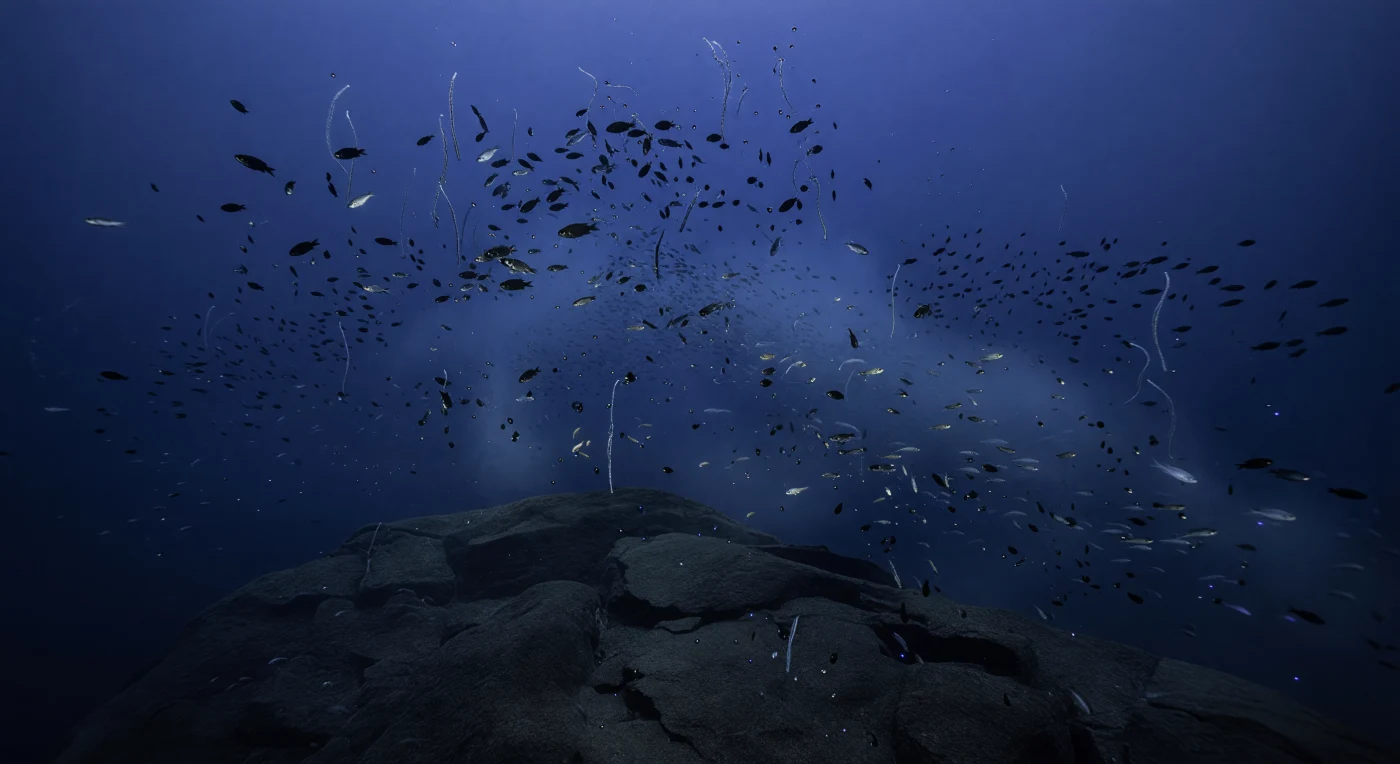
The ROV skims forward along the dark basaltic flank of the seamount, its hull lamps catching silvery flashes on myctophid flanks and the glassy margins of siphonophore chains no more than a meter away, while everything beyond dissolves into a monochromatic cobalt blue that deepens steadily toward black. At roughly 330 meters the pressure exceeds 34 atmospheres, compressing swim bladders and shifting the acoustic backscatter signature of the aggregation in ways that once fooled wartime sonar operators into believing they had found the seafloor — the same "false bottom" illusion that gave this biological phenomenon its name. Lanternfish, krill, and translucent shrimps lift off the seamount contour in loose volumetric sheets, using the topographic barrier to aggregate before beginning their nocturnal ascent of hundreds of meters toward surface feeding grounds, one of the largest daily animal migrations on Earth. Marine snow drifts through the lamp beams like cold suspended dust, each particle razor-sharp against the darkness, and deeper in the frame — beyond all artificial illumination — a few blue-green bioluminescent pinpricks flicker and vanish, the only light that has ever belonged to this place.
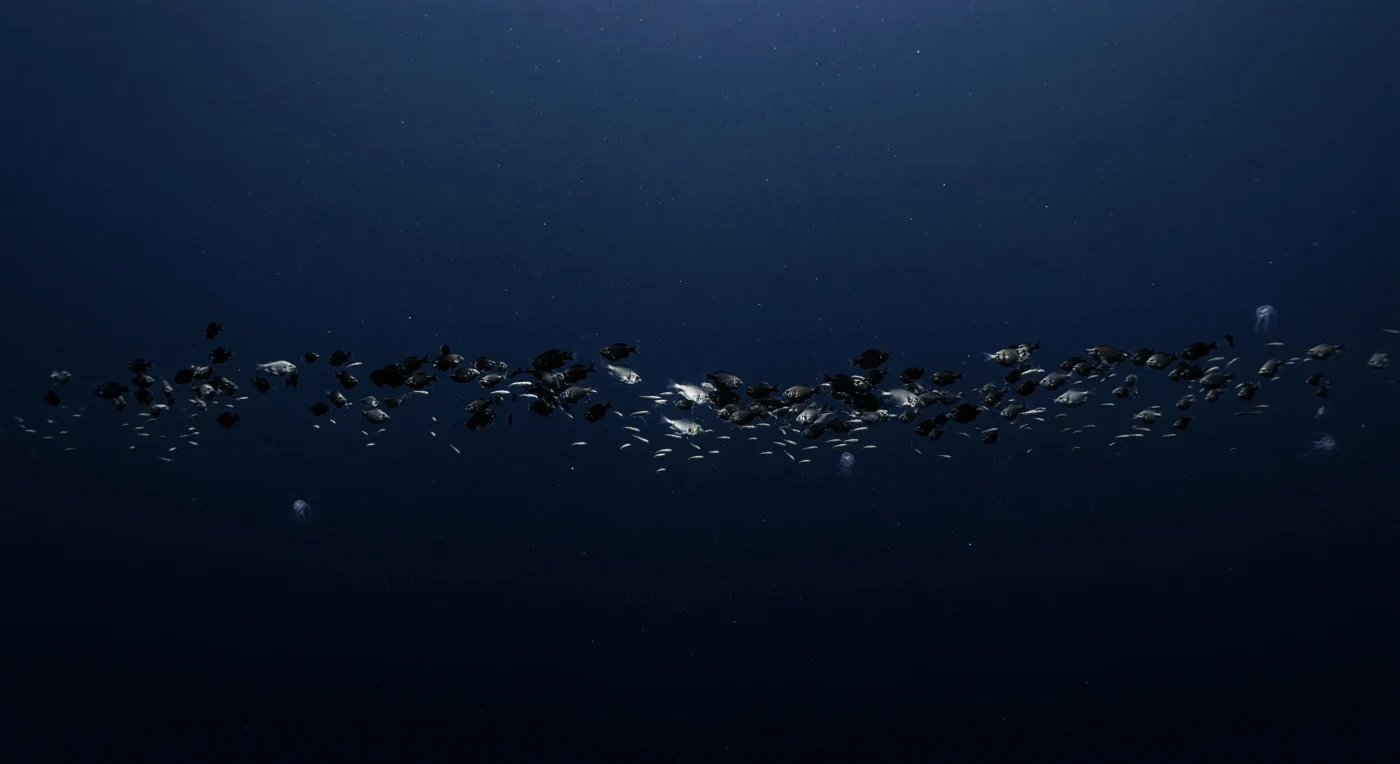
The submersible drifts in an almost perfectly still water column, and as the forward lamps sweep ahead, they reveal something extraordinary: a living horizon suspended in open ocean, a compressed ribbon of lanternfishes, krill, and small shrimps hovering at the precise boundary where dissolved oxygen drops sharply enough to create a biological bottleneck, concentrating thousands of animals into a band no more than a few meters thick yet stretching invisibly in every direction beyond the light cones. At sixty atmospheres of pressure, the water feels viscous and absolute, and the air inside the sphere seems to carry the weight of the sea itself; up here in the mesopelagic twilight zone, the last ghost of blue daylight fades into a dim gradient near the top of the viewport while everything below tumbles quickly into cobalt and then near-black, leaving the submersible's two cool-white lamps as the only meaningful illumination. The animals in the ribbon barely move — myctophid flanks flashing cold metallic silver as photophores glint in erratic pinpoints, transparent shrimp bodies rendered almost invisible until a carapace catches the beam at exactly the right angle, a pair of ctenophores pulsing with faint iridescence at the edge of visibility — because this oxygen-minimum interface acts as an ecological trap, rich enough in migrating biomass from above to feed predators, yet chemically hostile enough to thin the fauna above and below, producing the stark emptiness that makes the band so visually arresting. Fine marine snow drifts continuously through both light cones, each particle a slow confession of the surface world hundreds of meters overhead, and in the darkness beyond the beams, tiny bioluminescent sparks flicker and vanish, the deep scattering layer announcing itself with the same acoustic authority that once convinced wartime sonar operators they had found the seafloor.
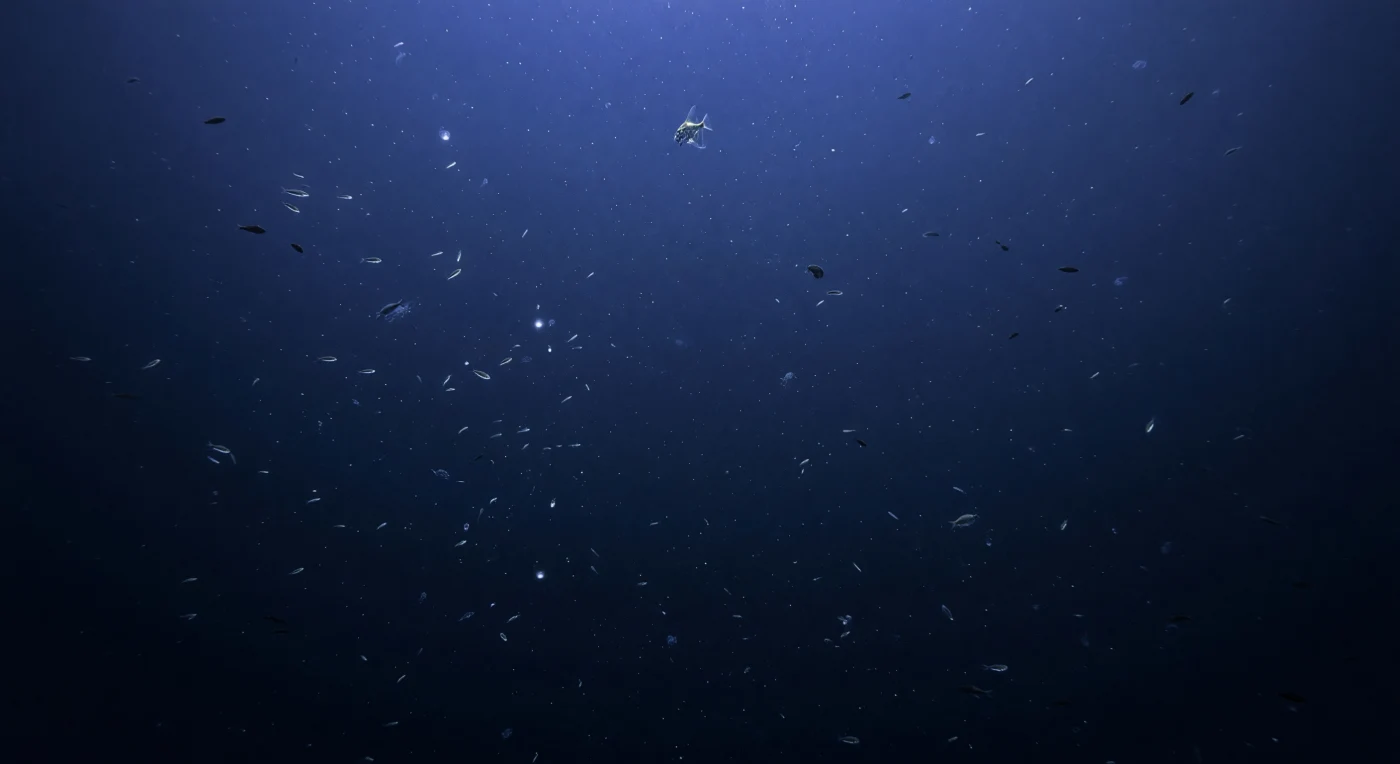
The lander's upward-facing camera peers into a vast column of open water at roughly 370 meters, where the last ghost of blue-violet downwelling light—attenuated to near-nothing by a third of a kilometer of ocean above—filters through a living haze of krill, decapod shrimps, and lanternfishes that constitute the daytime deep scattering layer, the same biological aggregation that fooled Second World War sonar operators into charting a phantom seafloor. At this depth, pressure bears down at approximately 38 atmospheres, compressing swim bladders and altering the acoustic backscatter signature that first made this layer famous, while the surrounding water settles into the cold, stable chemistry of the mesopelagic thermocline below. The assemblage drifts past in volumetric suspension—dark comma-shaped myctophids at mid-distance, translucent siphonophore chains barely resolving against the indigo gradient, pinprick sparks of bioluminescence igniting and extinguishing in the further dark—a self-lit ecosystem conducting the metabolic business of the twilight zone in what might as well be outer space. Then, for a single frozen instant, a hatchetfish materializes overhead: wafer-thin, its mirror-bright flanks evolved to counter-illuminate against downwelling light through photophores along its belly, a biological stealth technology refined over millions of years of predator pressure in exactly this half-lit niche. It catches the faintest cold gleam from the lander's instrument glow, flashes once like a struck coin, and is swallowed back into the haze, leaving only the immensity of the water column pressing silently in every direction.