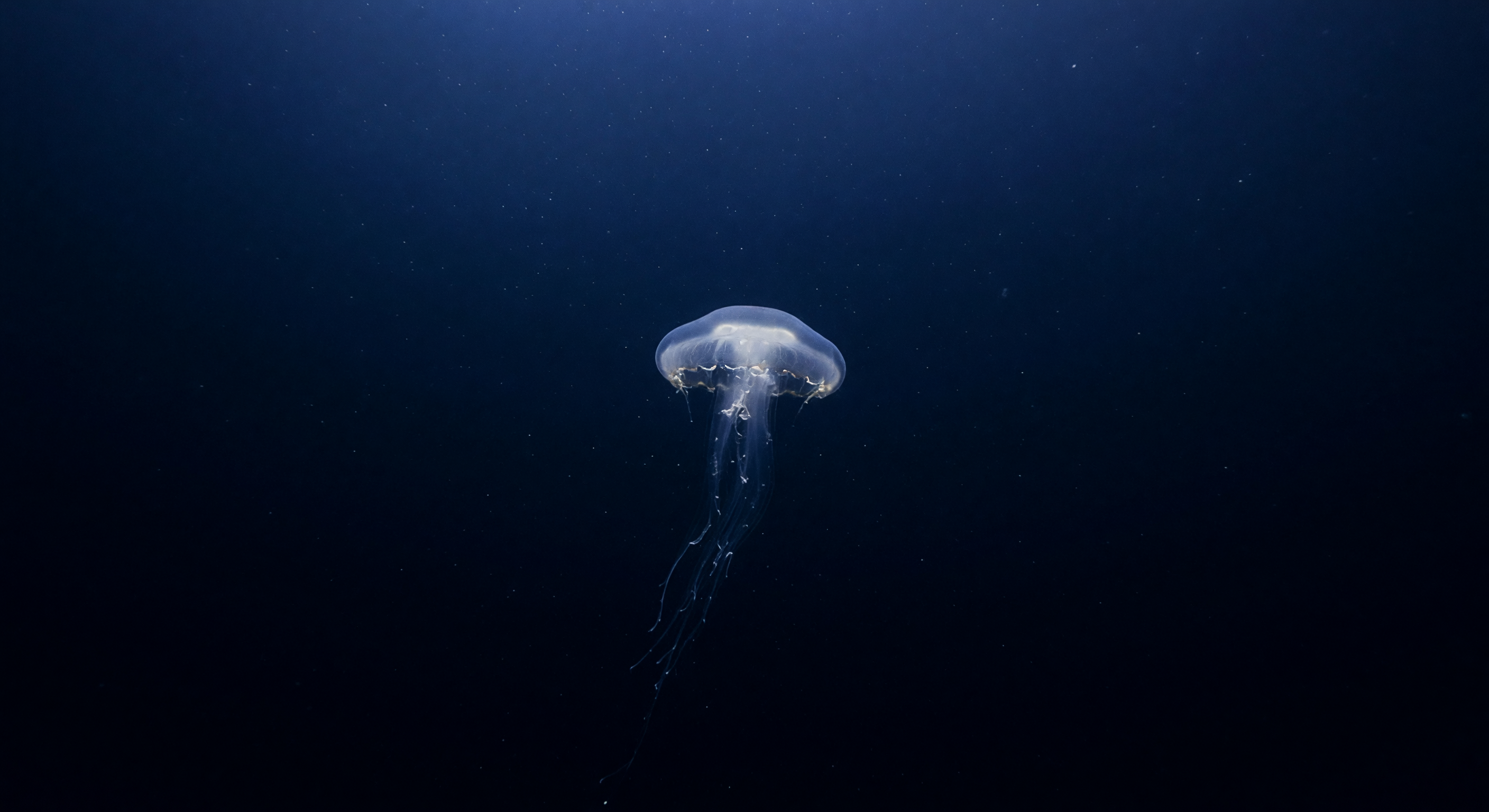
At roughly 400–500 meters, the mesopelagic water column presses down with forty to fifty atmospheres of hydrostatic force, a pressure that has shaped every tissue and strategy present here. A broad-bell medusa drifts through open water, its umbrella rendered nearly invisible by the evolutionary imperative of transparency — the faint milky musculature and delicate radial canals visible only because the last residual downwelling blue from the distant surface catches the curved upper dome at precisely the right angle, lending it a cold luminous silhouette against the darkness below. Long trailing filaments extend downward and dissolve entirely into the deepening cobalt, giving this single animal a vertical presence that spans meters of otherwise empty midwater — a hunting architecture perfectly suited to this open, structureless realm where prey must be intercepted rather than pursued. Marine snow drifts past in slow suspension, microscopic particles of organic matter sinking from the productive sunlit world far above, carrying carbon downward through what oceanographers recognize as one of the ocean's most critical biological pumps. Somewhere in the far distance, a handful of cold blue bioluminescent pinpricks mark other organisms going about their lives in the permanent pressurized dark, in a world that has never needed a witness.
Twilight zone