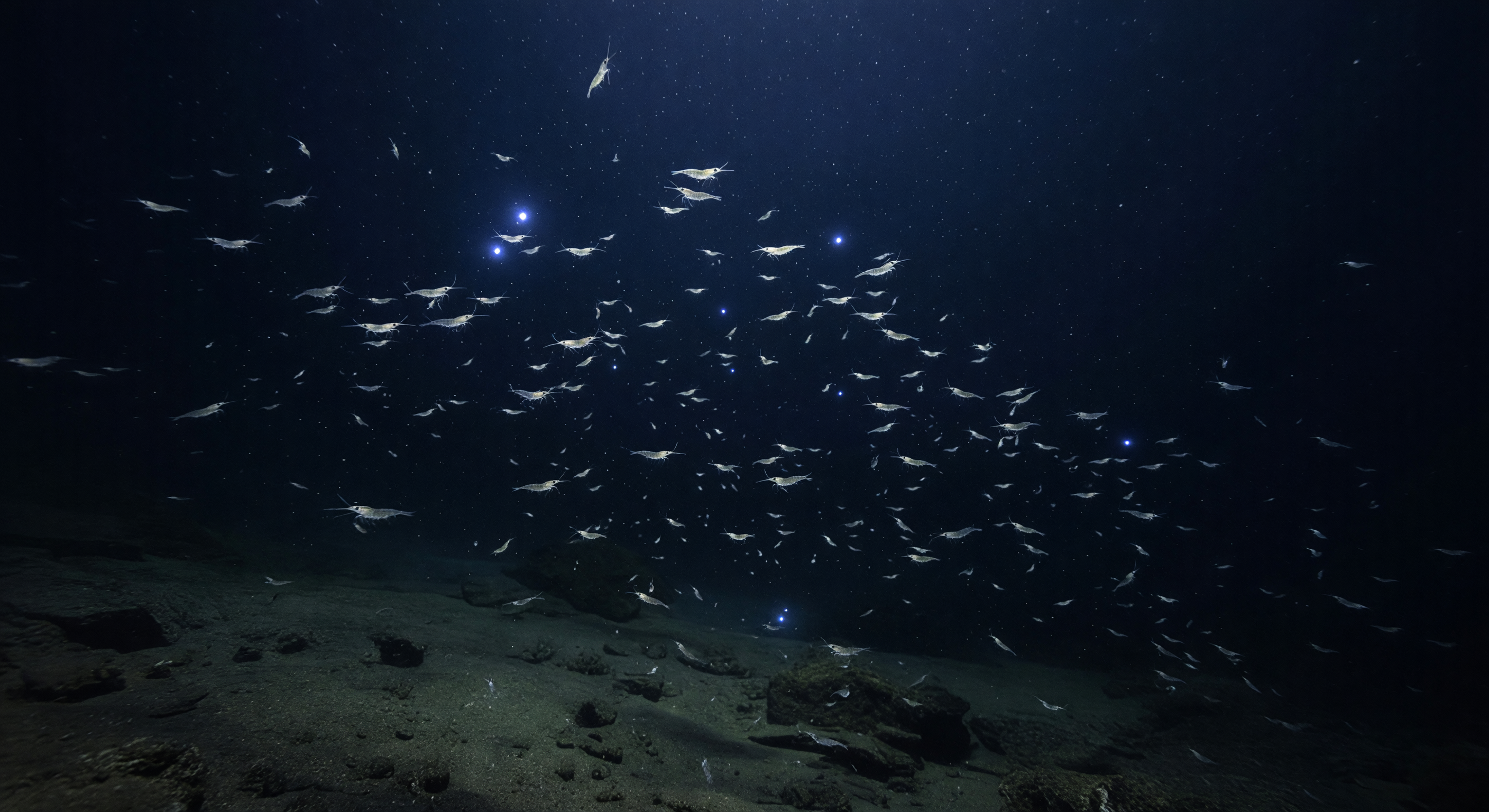
At roughly 500 to 700 meters below the surface, the ocean holds its breath. Here, in the mesopelagic water column where pressure exceeds 50 to 70 atmospheres, sunlight has surrendered nearly everything — only the faintest residual cobalt persists as a diffuse overhead glow, attenuated to a fraction of surface intensity and stripped of all wavelengths except the deepest blue. Against this dim background, hundreds of sergestid and oplophorid shrimps — *Sergia*, *Acanthephyra*, and their kin — hang suspended in a loose, pulsing aggregation, their carapaces so thoroughly transparent that each individual is more absence than presence, betrayed only by fine refractive outlines, dark compound eyes, and occasional mirror-like flashes where internal silvered surfaces catch the last ambient photons. Within this hovering veil, isolated points of cool bioluminescent blue flare and extinguish without pattern, produced by photophores or by secreted luminescent fluid, each momentary pulse briefly silhouetting the glassy bodies of neighboring shrimps before the darkness reclaims them entirely. Below, a sediment slope descends into blue-black opacity, dusted with foraminiferan tests and organic detritus settling through a water column that supports — across the global ocean — an estimated biomass of hundreds of millions of tonnes of mesopelagic fauna, an immense living community cycling carbon and energy in a world that has never required a witness.
Other languages
- Français: Nuage de crevettes lumineux
- Español: Nube de camarones pulsante
- Português: Nuvem de camarões pulsante
- Deutsch: Leuchtende Garnelenwolke
- العربية: سحابة الروبيان المتوهجة
- हिन्दी: चिंराट प्रकाश मेघ
- 日本語: エビの発光雲
- 한국어: 새우 빛 구름
- Italiano: Nuvola di gamberi pulsante
- Nederlands: Glanzende garnalenneevel