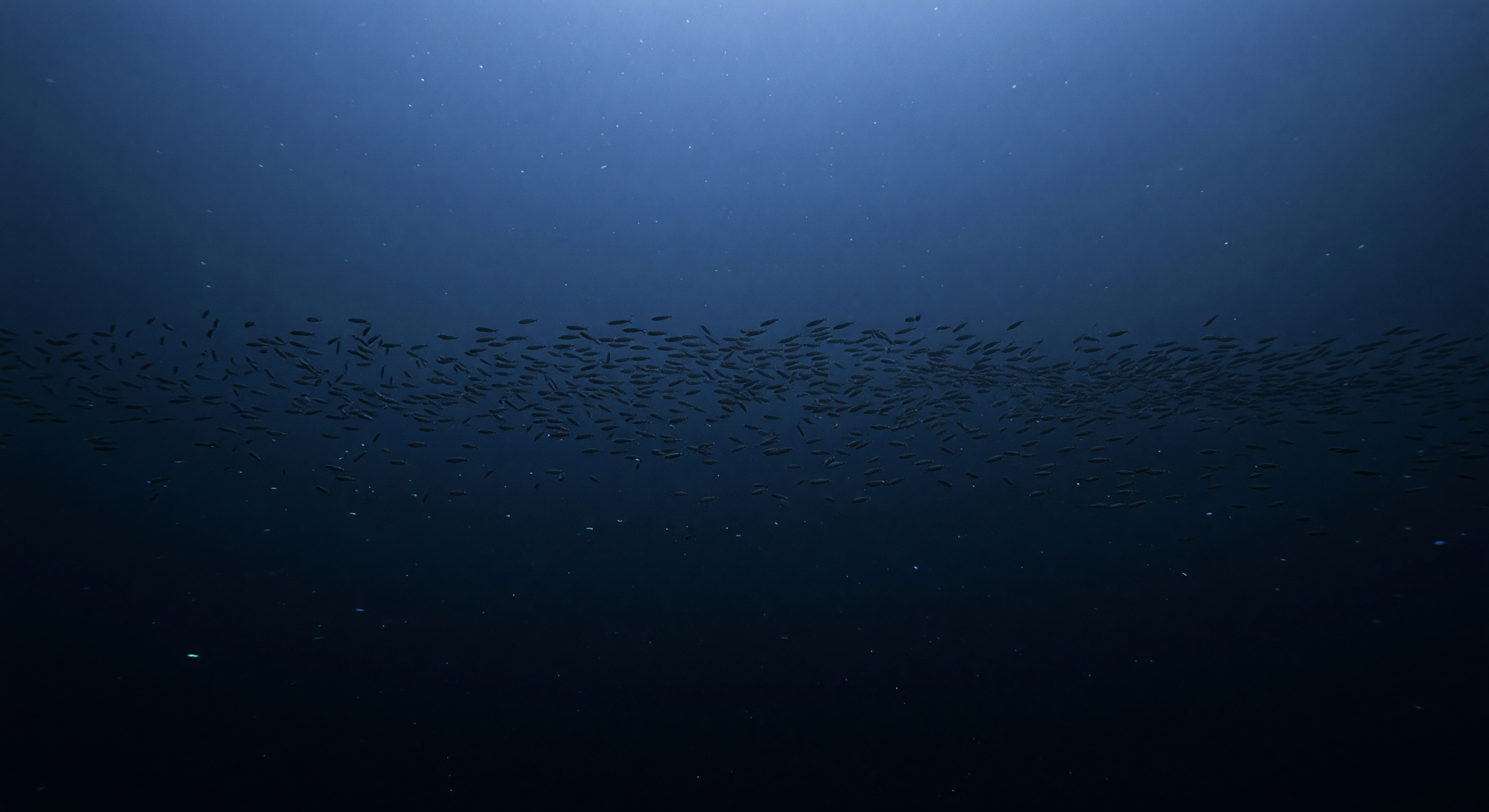
At roughly 450–550 meters below the surface, the last whisper of sunlight descends as a cold, diffuse blue that fades imperceptibly into cobalt and then into near-blackness — no boundary, only gradient, only weight. Here, pressure exceeds 50 atmospheres, compressing the water column into a silent immensity through which marine snow drifts in slow, unhurried descent, each particle a fragment of organic matter sinking from the sunlit world far above. Spanning the mid-water like a living stratum, tens of thousands of bristlemouths — among the most numerically abundant vertebrates on Earth — hang in a compressed diel scatter band, their needle-slender bodies and outsized eyes evolved for this precise threshold between faint light and none, their collective mass forming the backbone of the ocean's biological pump as they migrate nightly toward shallower feeding grounds and return by day to this dim refuge. From deeper in the darkness below, scattered pinpricks of blue-green bioluminescence pulse and drift — the chemical light of organisms that have never known the sun, communicating, luring, or simply existing in a language older than vision itself. This layer exists in perpetual, pressurized silence, a vast interior ocean that has always been here, indifferent and complete, whether witnessed or not.
Twilight zone