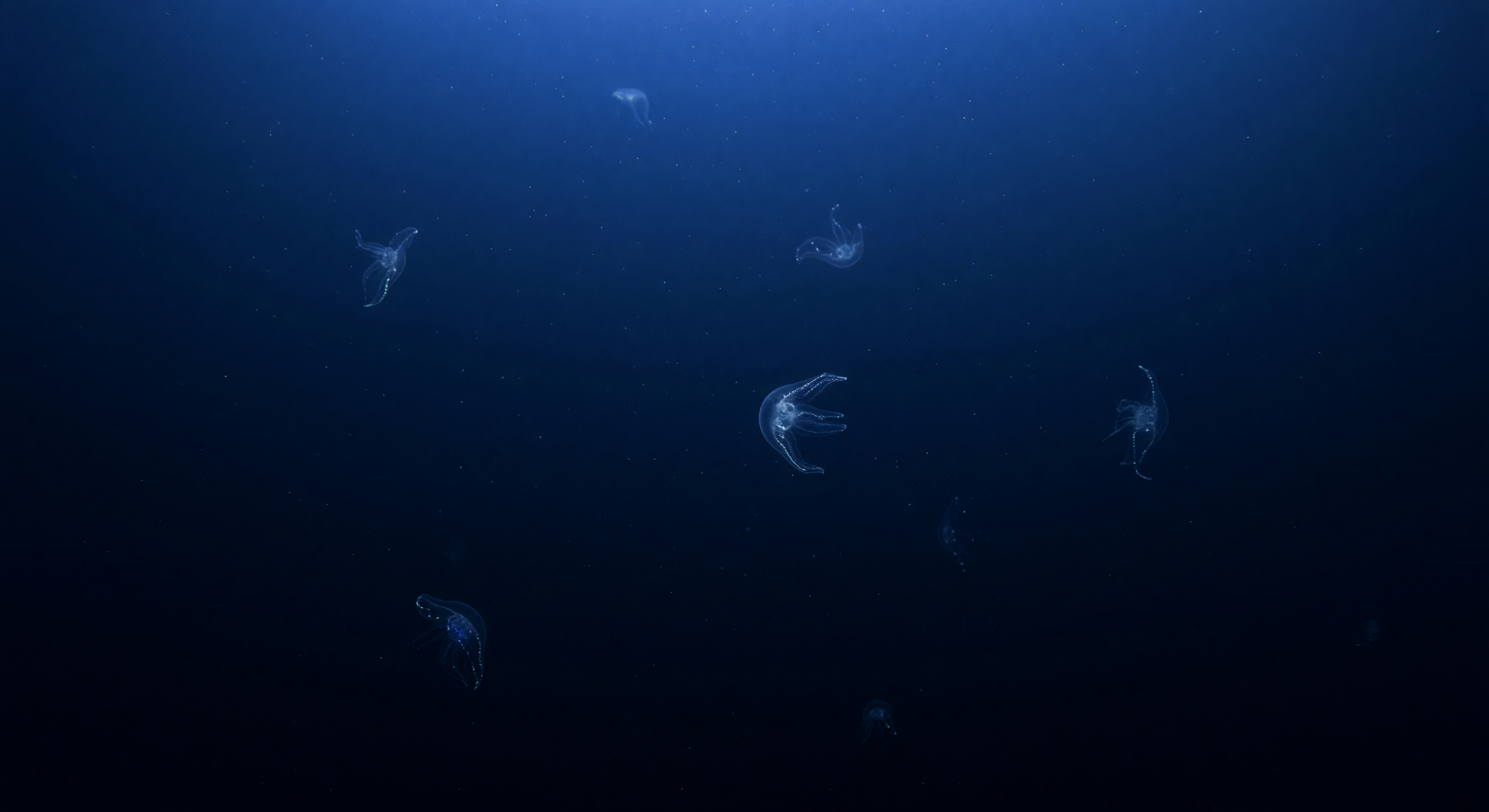
Somewhere between the last whisper of sunlight and the permanent dark below, several ctenophores hang in the open water column as though suspended in blue glass — their bodies so transparent that only the faintest refractive shimmer along curved lobes betrays their presence against the deep ultramarine. At these depths, roughly 200 to 1,000 metres down, hydrostatic pressure climbs to dozens of atmospheres, yet these gelatinous animals require no rigid skeleton to persist, their tissue barely denser than the water itself. Sparse marine snow — the slow, continuous rain of organic particles from surface waters far above — drifts past in the ambient blue, each fleck briefly legible before dissolving into darker registers below, giving scale to a volume of ocean that dwarfs anything on land. Along the comb rows that give ctenophores their name, tiny bioluminescent pulses trace dotted arcs of blue-green light, a form of cold chemical luminescence entirely independent of any external source, igniting and fading in the stillness as though the animals are quietly thinking. This is a realm that has existed for hundreds of millions of years in precisely this silence — pressured, dark, and full of life that never needed light from above to find its way.
Twilight zone