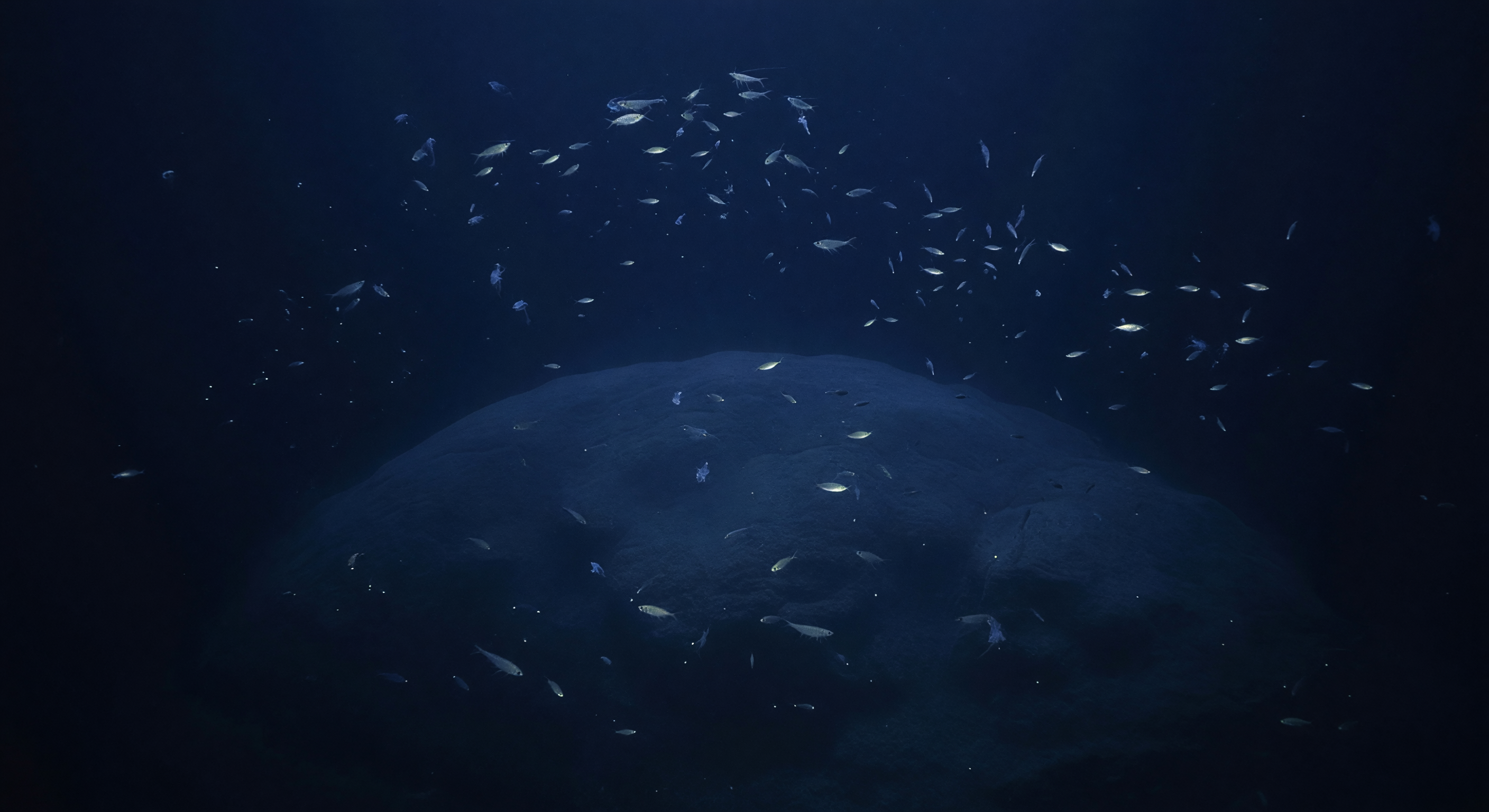
Between 200 and 1,000 metres below the surface, sunlight surrenders gradually to the ocean's weight, arriving as nothing more than a faint cobalt suffusion that grows dimmer with every metre of descent — and here, against the broad rounded shoulder of a seamount rising through the midwater column, that dying light reveals one of the most densely inhabited yet least-seen realms on Earth. The seamount itself acts as a topographic anchor, deflecting deep currents upward and concentrating nutrients, drawing the mesopelagic deep scattering layer into a thickening congregation above its indigo mass: transparent mysid shrimp with organs visible through glass-like carapaces, small silvery lanternfishes and hatchetfishes whose mirror-bright flanks reflect the last blue photons downwelling from far above, and gauzy gelatinous forms drifting on near-neutral buoyancy through water pressing at 20 to 100 atmospheres. As the daily vertical migration shifts into its nightward phase, this living layer tightens, animals ascending toward shallower water while others hold station, their bodies — evolved over hundreds of millions of years to be invisible in exactly this light — flickering with cold blue-green bioluminescent pinpricks that serve as species recognition, predator deterrence, and lure rather than illumination. Marine snow, the slow rain of organic particles from the productive surface far above, drifts through the scene without witness, carrying the chemistry of sunlit waters down into a world that has never needed the sun to persist.
Other languages
- Français: Brume sur le Mont Sous-marin
- Español: Niebla del Monte Submarino
- Português: Névoa do Monte Submarino
- Deutsch: Dunst am Seamount-Hang
- العربية: ضباب كتف الجبل البحري
- हिन्दी: समुद्री पर्वत धुंध
- 日本語: 海山の肩に漂う霞
- 한국어: 해저 산 어깨의 안개
- Italiano: Foschia sul Monte Sottomarino
- Nederlands: Nevel over Zeeberg Schouder