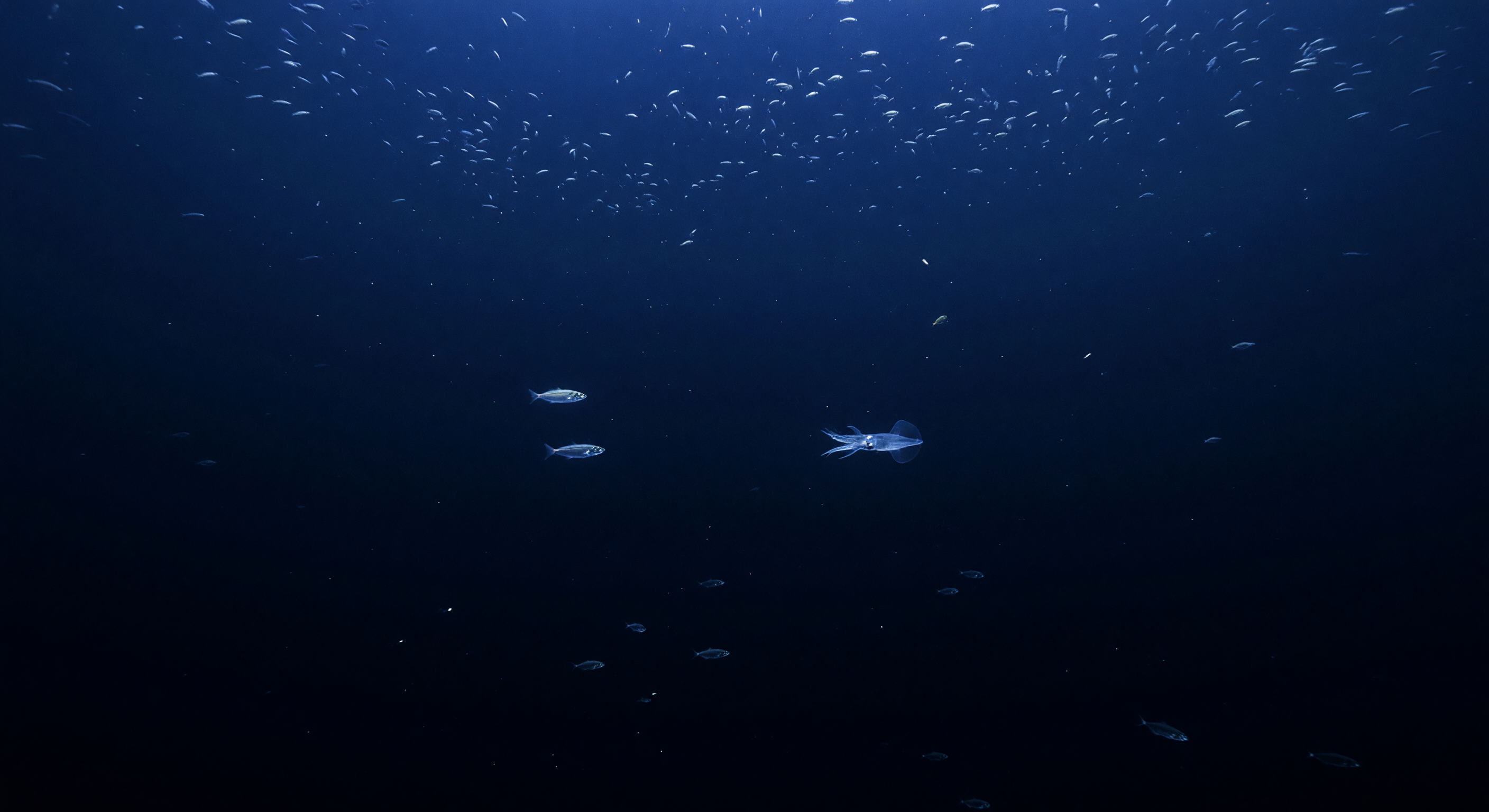
At around 200 to 1,000 metres below the surface, solar energy dwindles to its last coherent expression: a faint, monochromatic cobalt that illuminates nothing so much as it hints at the world above. Looking upward from the open pelagic void, the deep scattering layer resolves into a granular living ceiling — a diffuse, shifting band of myctophids, euphausiids, siphonophores, and gelatinous bodies compressed by perspective into something almost architectural, a biological stratum that marks the lower boundary of productive ocean life. Beneath it, the water column empties into darkness interrupted only by the occasional hatchetfish, its body reduced to a wafer of mirrored scales and a row of ventral photophores that counter-illuminate its silhouette against the dim downwelling blue — a camouflage strategy refined across hundreds of millions of years of pelagic evolution. A solitary squid drifts nearby, its mantle nearly transparent, chromatophores subdued, internal organs ghosting through glass-like tissue, the whole animal existing at the threshold of visibility as marine snow particles settle slowly past in trajectories shaped by the gentle internal currents of an ocean no surface force can reach. Here, at pressures exceeding twenty atmospheres and in a silence that is not metaphorical but physical, an entire ecosystem persists in perpetual dim blue, witnessed by nothing, dependent on nothing human, cycling carbon and energy through bodies that have never needed the light we carry.
Twilight zone