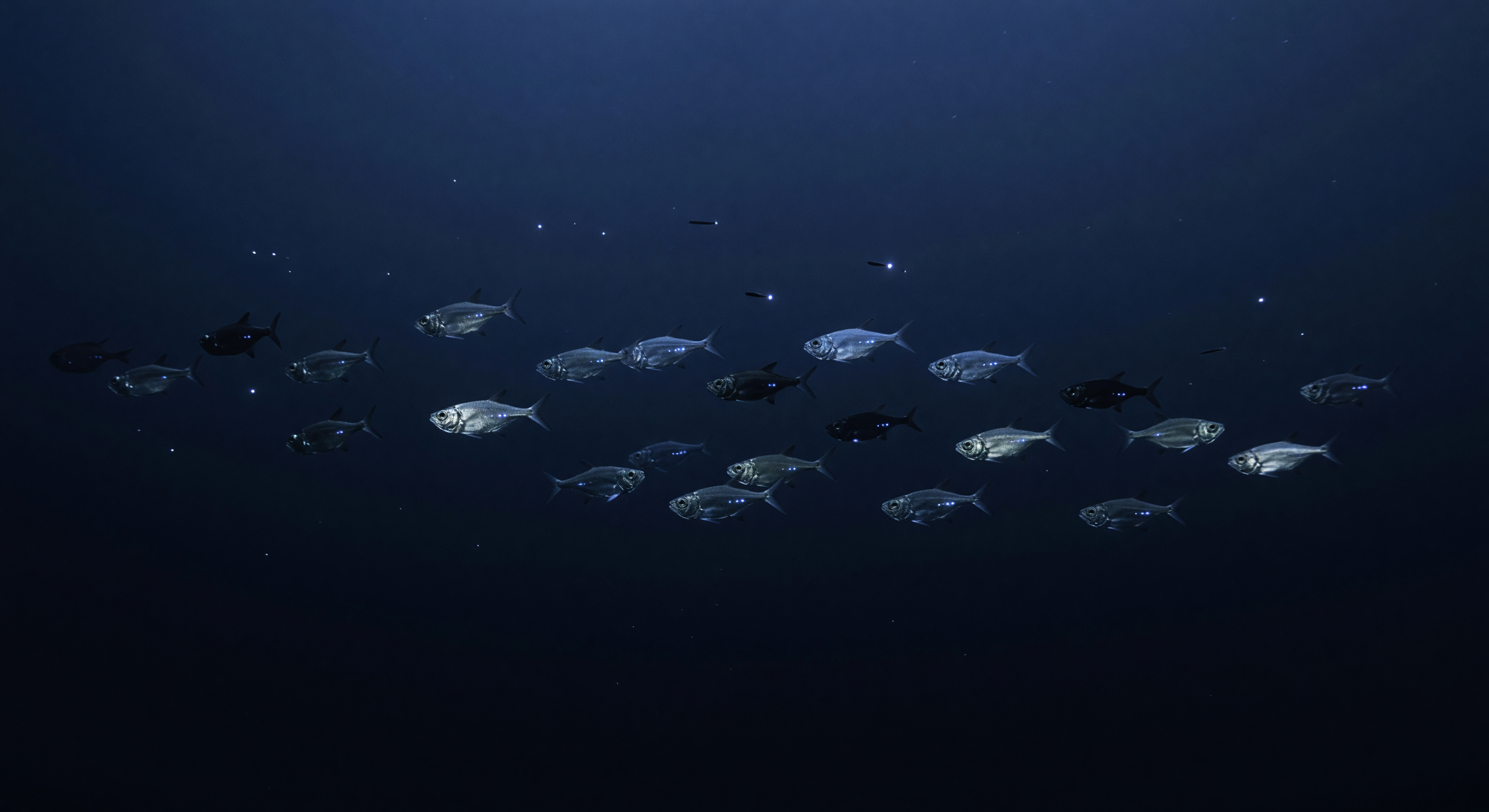
At 300 to 450 meters below the surface, the last usable fraction of sunlight arrives as a cold monochromatic blue — attenuated, directionless, barely enough to cast a pale luminance through the water column but sufficient to silhouette anything that rises above. Here, sternoptychid hatchetfish suspend themselves in a diffuse living mirror layer, their laterally compressed bodies — deep-chested, blade-thin, large-eyed — evolved into near-perfect optical instruments: the mirror-like guanine crystals tiling their flanks reflect ambient downwelling light at almost the same intensity as the surrounding water, rendering them functionally invisible until a slight tilt produces a brief cold metallic flash, a fleeting signature before they dissolve back into the blue. Pressures at this depth already exceed 30 to 45 atmospheres, yet the animals are physiologically tuned to this crushing stillness, and the orderly rows of photophores along their ventral surfaces emit a faint blue-white counterillumination — bioluminescence calibrated to cancel their own shadow against the dim glow above, an evolutionary answer to predators hunting by silhouette from below. Marine snow drifts through the open water in slow suspension, tiny organic particles descending from the sunlit world far overhead, carrying carbon and chemistry downward into the vastness beneath. This is a zone the ocean populates densely and tends silently, an immense open stratum of pressure and residual light where millions of animals hover between the bright world above and the absolute dark below, indifferent to any witness.
Twilight zone