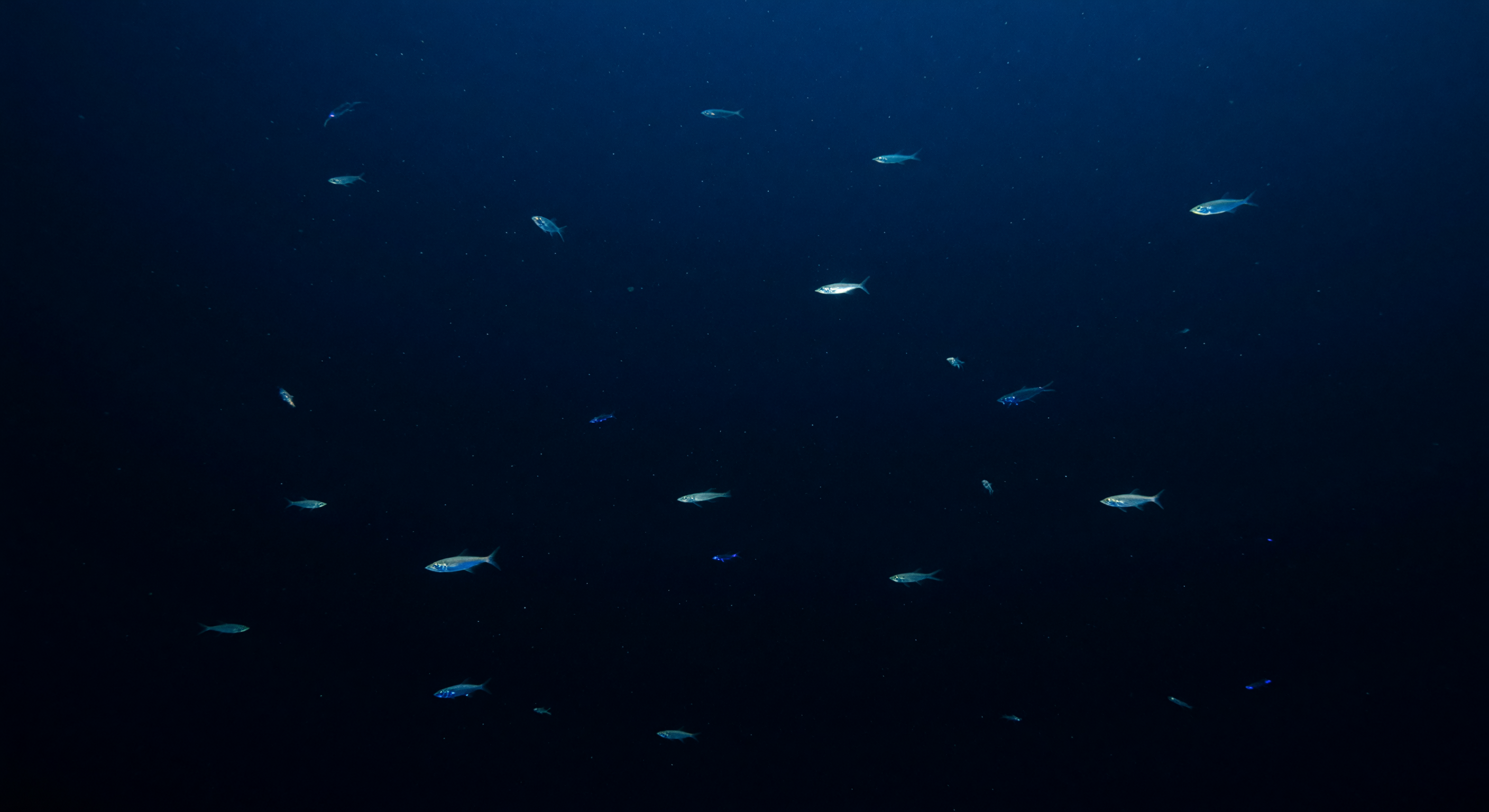
At roughly 600 to 1,000 metres below the surface, the last measurable traces of solar energy arrive as a barely perceptible cobalt wash, attenuated to near-nothing by the mass of water pressing down at pressures exceeding 60 to 100 atmospheres — enough to collapse any uncompensated air space and demand radical physiological adaptation from every organism present. Here, in this transitional lower realm, hatchetfish hold their characteristic near-vertical posture in the open water column, their laterally compressed, mirror-silvered bodies evolved to minimize reflective cross-section against the faint overhead glow, while their ventral photophores — tiny blue-emitting organs aligned along the belly — fire in subtle, asynchronous pulses, a strategy called counterillumination that erases their downward silhouette against whatever diffuse light remains from above. Alongside them drift mesopelagic squid whose tissues are nearly optically transparent, their internal organs faintly visible as shadows within glass-clear mantles, their own photophore arrays flickering with the same restrained luminescence — points of cold blue light appearing and dissolving back into the surrounding dark in no fixed rhythm. Fine marine snow, the slow rain of organic particles descending from productive surface waters, drifts freely through the enormous open space between these animals, connecting this lightless interior to the sunlit world far above in an unbroken vertical flux of carbon and life. This is an ocean that has never needed witnesses: its economies of light and camouflage, its chemical signaling and predator-prey geometries, have been operating in perfect, pressurized silence for hundreds of millions of years.
Other languages
- Français: Premiers Éclats Lumineux
- Español: Primeros Destellos Ventrales
- Português: Primeiros Clarões Subtis
- Deutsch: Erste Gegenlicht Funken
- العربية: أولى وميض الضوء المعاكس
- हिन्दी: प्रथम प्रतिदीप्ति झलक
- 日本語: 最初の反光のきらめき
- 한국어: 첫 역광의 깜빡임
- Italiano: Primi Bagliori Controluce
- Nederlands: Eerste Tegenlicht Flikkering