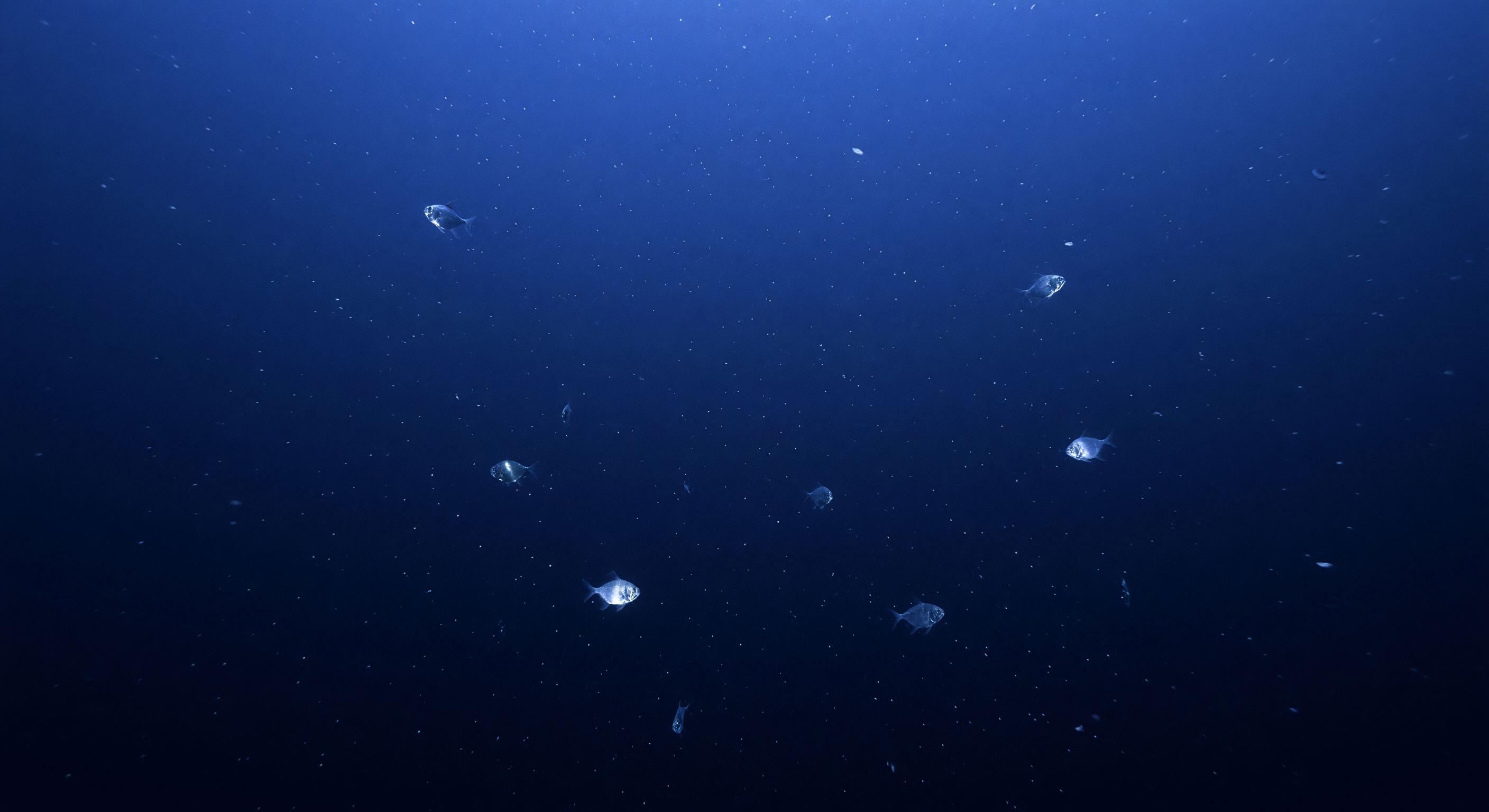
At roughly 250–320 meters below the surface, the ocean enters a realm where sunlight has surrendered nearly all its warmth and color, leaving only the last attenuated wavelengths of blue to penetrate the water column — a cold cobalt residue that fades imperceptibly into sapphire darkness below. Here, pressure approaches 30 atmospheres, compressing the world into a silence that has no equivalent on land, and the water itself is neither empty nor still: a continuous gentle fall of marine snow — fragments of dead phytoplankton, fecal pellets, mucus aggregates, and transparent organic flake — drifts downward through the entire water column, carrying fixed carbon from the sunlit surface toward the abyss in what oceanographers call the biological pump. Suspended within this perpetual drift, sternoptychid hatchetfish — Argyropelecus and allied genera — hang in loose, unhurried aggregations, their laterally compressed bodies silvered like living mirrors, each flank tuned to reflect the ambient downwelling blue and erase the shadow that would otherwise betray them to predators below. Their enormous upward-facing eyes are adapted to detect the silhouettes of prey against the faint luminous ceiling overhead, a hunting strategy made possible by the very last photons the ocean will carry this deep. Far below, scattered pinpricks of cold bioluminescent light pulse without rhythm in the deeper darkness — the self-generated signals of a community that has learned, over hundreds of millions of years, to make its own light in a world the sun has almost entirely forgotten.
Twilight zone