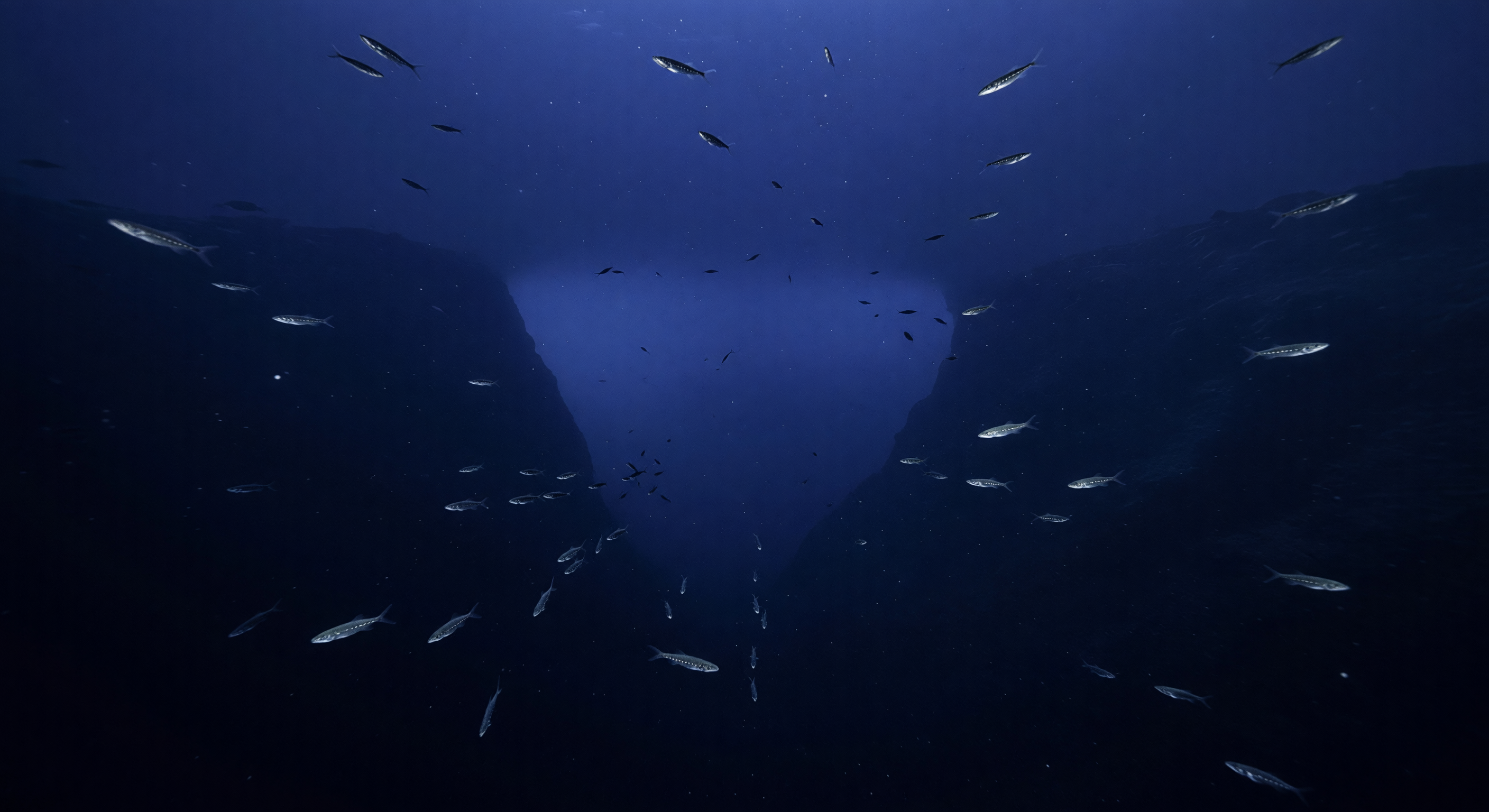
At roughly 350–500 metres depth, where the last cold residual daylight arrives as little more than a faint cobalt stain fading imperceptibly into black, the mouth of a submarine canyon opens like a wound in the water column — its steep flanks dissolving into monochromatic darkness, its geometry only barely readable as a deeper wedge against the surrounding blue-black void. Pressure here already exceeds 35–50 atmospheres, the water temperature hovers just above 4°C, and photosynthesis has long since become impossible, yet the mid-mesopelagic is anything but lifeless. Myctophids — lanternfish of the family Myctophidae, among the most numerically abundant vertebrates on Earth — stream outward from the canyon in thin wavering ribbons, their silvery flanks catching the last blue photons in brief metallic flashes, their ventral photophores arranged in species-specific rows that produce faint counterillumination, reducing their silhouettes against the dim ceiling glow above. Fine marine snow — aggregates of sinking organic particles, mucus, and the cast-off structures of surface life — drifts freely through the entire water column, a slow continuous rain of carbon connecting the sunlit ocean above to the abyss far below. The canyon itself channels deep, cold, nutrient-laden water upward into the pelagic realm, concentrating prey and predator alike at its rim, a geological structure shaping the invisible ecology of a world that has never required a witness.
Twilight zone