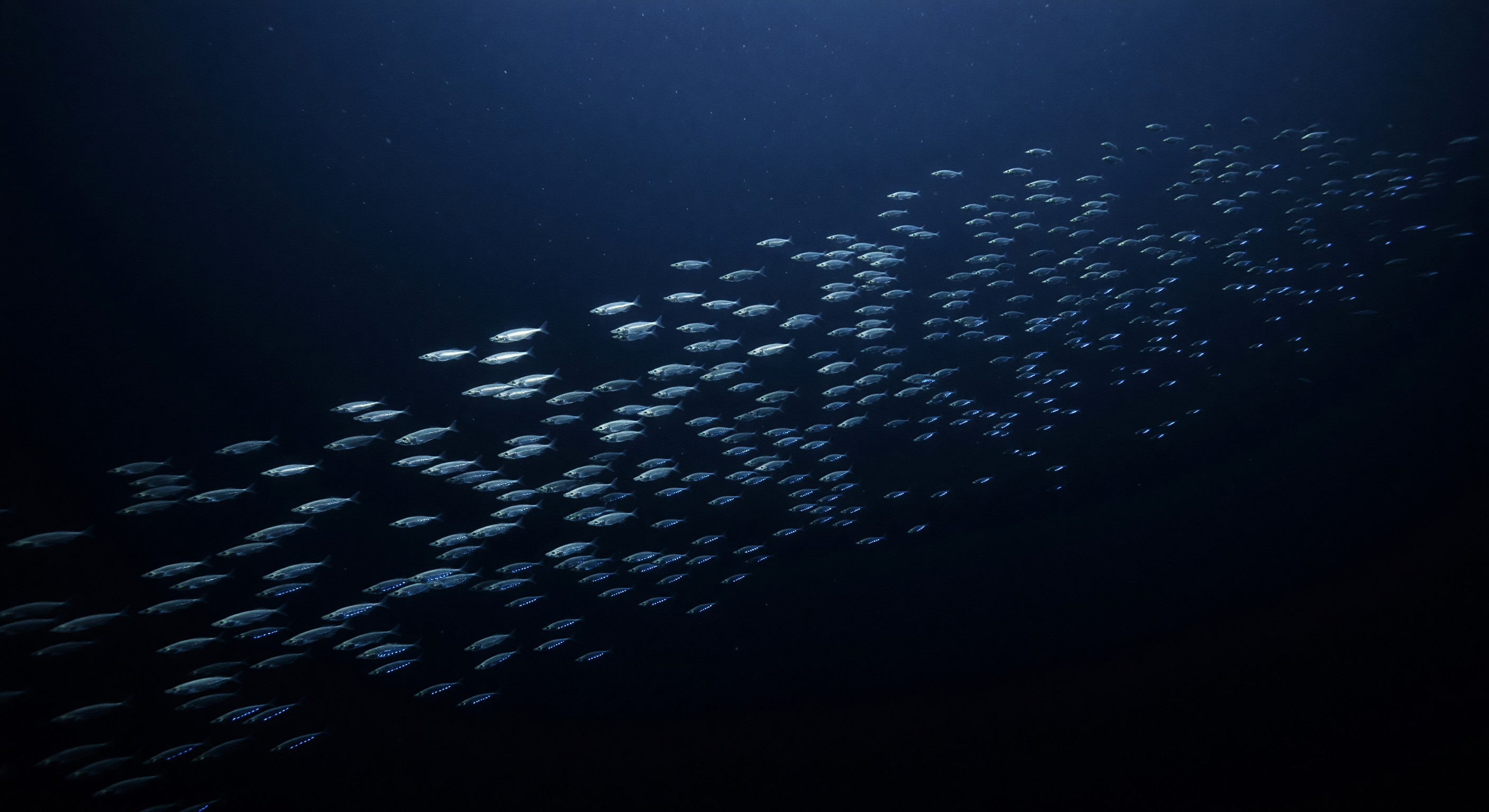
At 400–500 meters, the ocean exists as a vast pressurized column where sunlight arrives only as a faint blue residue, already stripped of every warmer wavelength by the weight of water above. Through this cobalt veil, thousands of myctophids — lanternfish of several species — ascend in a broad oblique front, their diel vertical migration carrying them upward from deeper darkness toward shallower feeding waters as the day fades. Each small body, rarely exceeding a few centimeters, is built for this twilight world: large dark eyes sensitive to the dimmest photons, flanks plated with guanine crystals that mirror the ambient blue and dissolve the fish into their surroundings, and along each belly a species-specific constellation of photophores emitting restrained blue-white points of bioluminescence, likely used for counterillumination against the faint glow from above. The sheer biomass these migrations represent is staggering — mesopelagic fish alone may constitute the largest vertebrate assemblage on Earth, yet the school moves in near-total silence, suspended in water cold enough to slow metabolism and dense enough to exert pressures exceeding forty atmospheres. Marine snow drifts through the ascending column undisturbed, and below the living sheet the ocean simply deepens into blackness, indifferent and complete.
Other languages
- Français: Front de migration des myctophes
- Español: Frente de migración de linternillas
- Português: Frente de migração de peixe-lanterna
- Deutsch: Laternenfisch Migrationsfront
- العربية: جبهة هجرة سمك الفانوس
- हिन्दी: लालटेन मछली प्रवास अग्रभाग
- 日本語: ハダカイワシの回遊前線
- 한국어: 등불고기 이동 전선
- Italiano: Fronte di migrazione dei pesci lanterna
- Nederlands: Lantaarnvis trekfront