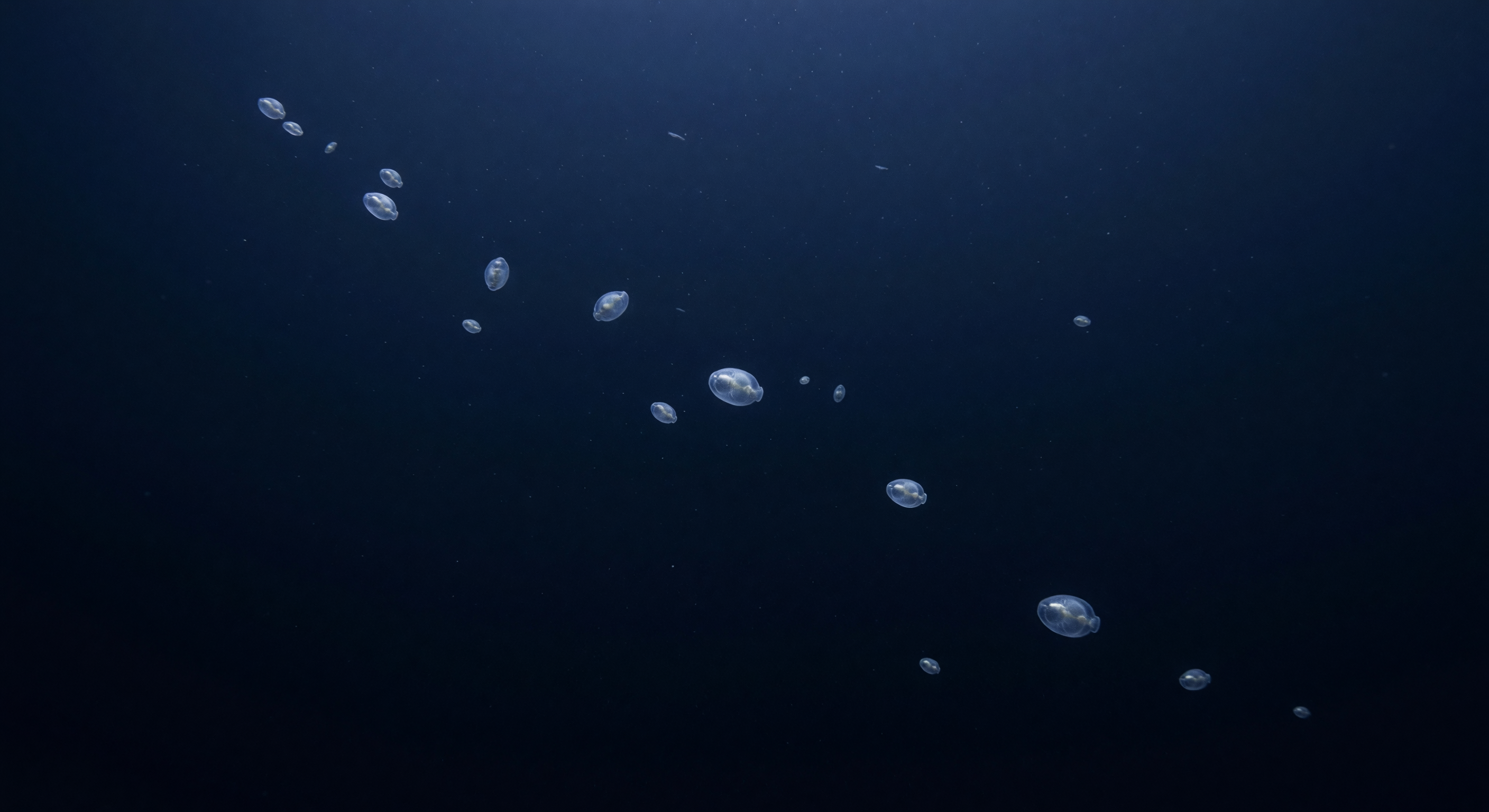
At roughly 350–450 metres below the surface, the last attenuated remnants of sunlight descend as a faint monochromatic blue wash, too weak to sustain photosynthesis yet still sufficient to silhouette the bodies of animals drifting within the water column. Here, a loose procession of salps — Thaliacea, barrel-shaped tunicates of entirely gelatinous construction — moves on a slow diagonal through the open pelagic midwater, each individual a near-invisible cylinder of seawater enclosed by delicate circular muscle bands and a translucent tunic that catches residual light along its curved rims in faint silver. Salps are filter feeders of remarkable efficiency, drawing water continuously through their bodies to extract phytoplankton and fine organic particles, and at this depth they represent one of the ocean's most important biological pumps, packaging carbon-rich fecal pellets that sink rapidly toward the seafloor far below. The pressure here exceeds 40 atmospheres, the temperature hovers just above 4 °C, and marine snow — microscopic flakes of dead organic matter, mucus, and shed cells — drifts uniformly through the water column in all directions, unguided by any current stronger than the mesopelagic's gentle internal waves. Scattered in the deep blue-black distance, cold bioluminescent pinpricks flicker from organisms unseen, marking a world of immense biological abundance that has proceeded, entirely undisturbed, across geological time.
Other languages
- Français: Procession de Salpes Translucides
- Español: Procesión de Salpas Transparentes
- Português: Procissão de Salpas Barriladas
- Deutsch: Durchsichtige Salpen Prozession
- العربية: موكب السالب الشفاف
- हिन्दी: सैल्प बैरल जुलूस
- 日本語: 透明なサルパの行列
- 한국어: 투명한 살파 행렬
- Italiano: Processione di Salpe Trasparenti
- Nederlands: Doorzichtige Salp Processie