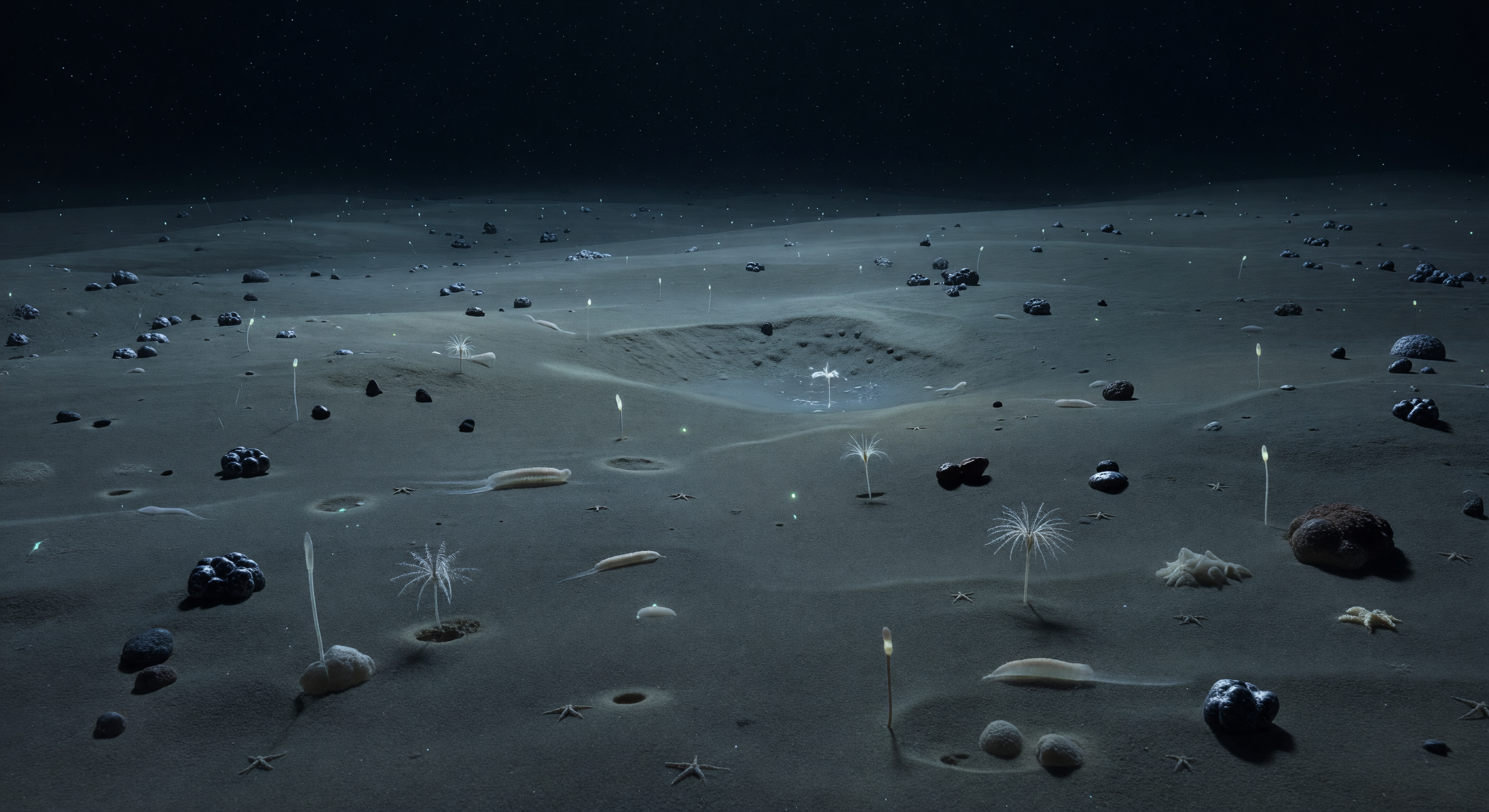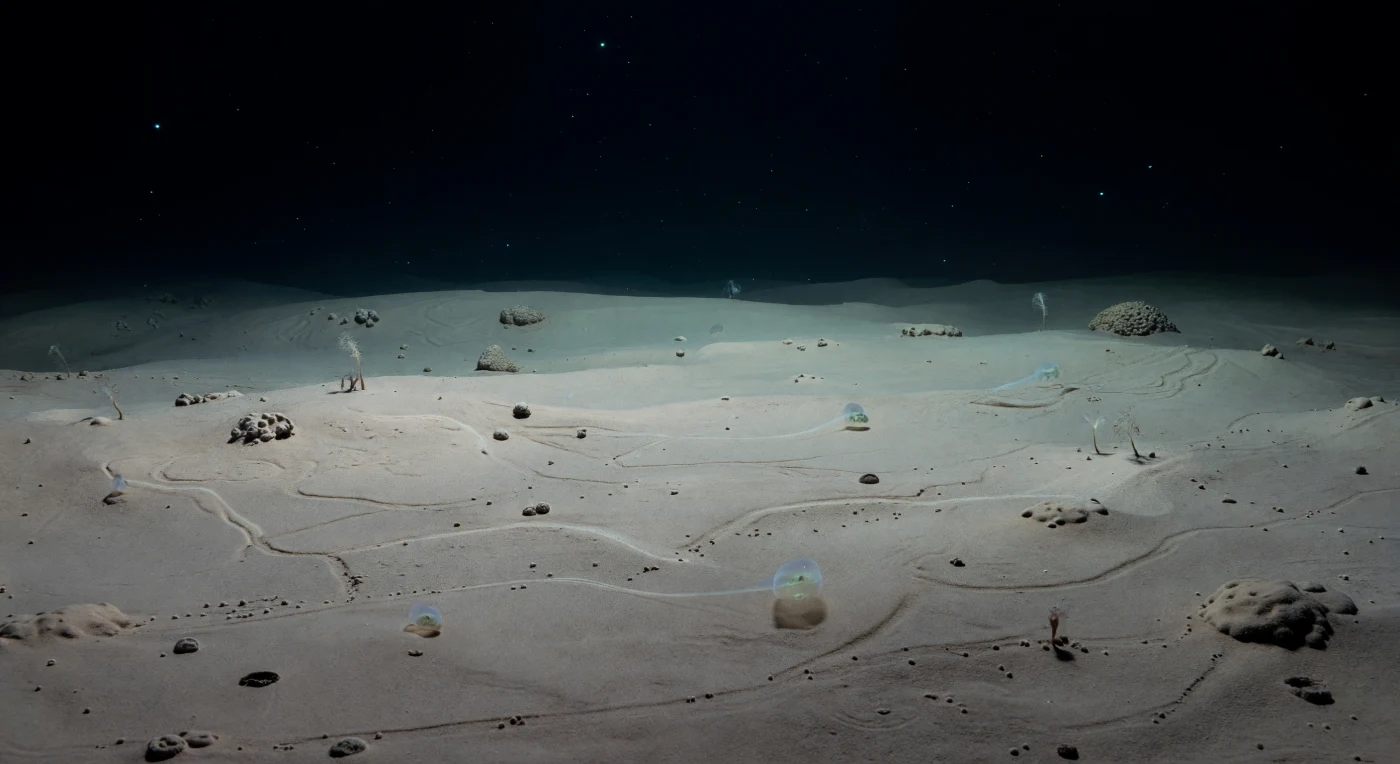
Beneath more than four kilometres of cold, lightless ocean, an immense plain of siliceous mud extends outward in every direction without interruption, its pale ash-beige surface the accumulated result of millennia of microscopic silica frustules and radiolarian tests sinking slowly from the sunlit world above — a world that exerts no influence here beyond the ceaseless slow rain of marine snow drifting through the black water column. Hydrostatic pressure exceeds four hundred atmospheres, compressing all chemistry, all movement, all biology into slow, deliberate, pressure-adapted existence; the bottom water rests near two degrees Celsius, perpetually cold, drawn from polar sources and circulating with geological patience across the basin floor. Across this sediment expanse, translucent holothurians trace looping furrows through the ooze, their soft gelatinous bodies faintly luminescent at the margins, ingesting sediment grain by grain, processing organic detritus so dilute that only the most specialized gut chemistry can extract nutrition from it, leaving behind pellet strings and meandering trails that record their passage across an otherwise undisturbed substrate. Where scattered manganese nodules offer the rare hard surface, stalked crinoids rise motionless into the water column, their feathered arms suspended against the imperceptible abyssal current, filtering whatever particulate matter chance delivers to them. Overhead, isolated bioluminescent pinpricks of blue-green light punctuate the absolute darkness of the water column — organisms signalling, luring, or simply existing — while the plain beneath them continues its ancient, silent accumulation, indifferent to observation, complete in itself.
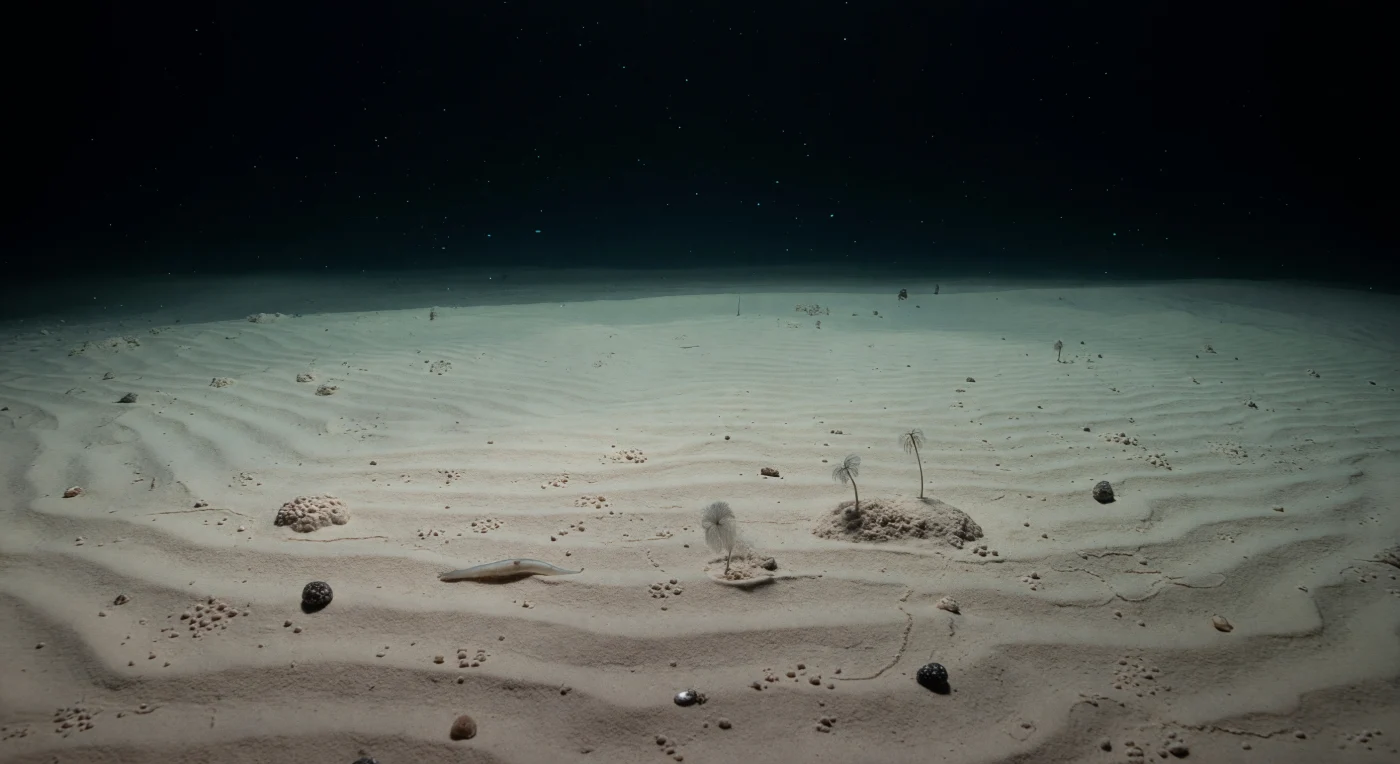
Beneath more than four kilometres of water column, the abyssal plain unfolds as one of Earth's most extensive landscapes — a near-featureless expanse of calcareous ooze composed of the compressed skeletal remains of countless foraminifera and coccolithophores that have rained down from the sunlit surface over millions of years. At pressures approaching 500 atmospheres and temperatures barely above freezing, the sediment surface is sculpted into low, delicate ripples by the faint but persistent thermohaline currents of Antarctic Bottom Water, while tiny burrow mouths and faint bioturbation traces betray the patient labour of unseen polychaetes and deposit-feeding organisms working through the cream-beige mud below. A pale holothurian moves across a shallow trough in the manner characteristic of abyssal holothurians worldwide — methodically ingesting sediment, extracting organic matter from marine snow particles that have drifted down across the entire water column, its body almost the same tone as the ooze itself. Sparse manganese nodules, each one a geological archive of slow accretion at rates of millimetres per million years, rest half-embedded in the fine sediment alongside xenophyophore-like agglutinated forms — among the largest single-celled organisms on the planet. In the water above, drifting specks of bioluminescence punctuate the absolute darkness at intervals, cold cyan pinpricks produced by organisms whose only light is their own chemistry, casting no beam but softly tracing the contours of a world that has existed in this silence, at this depth, entirely without witness.
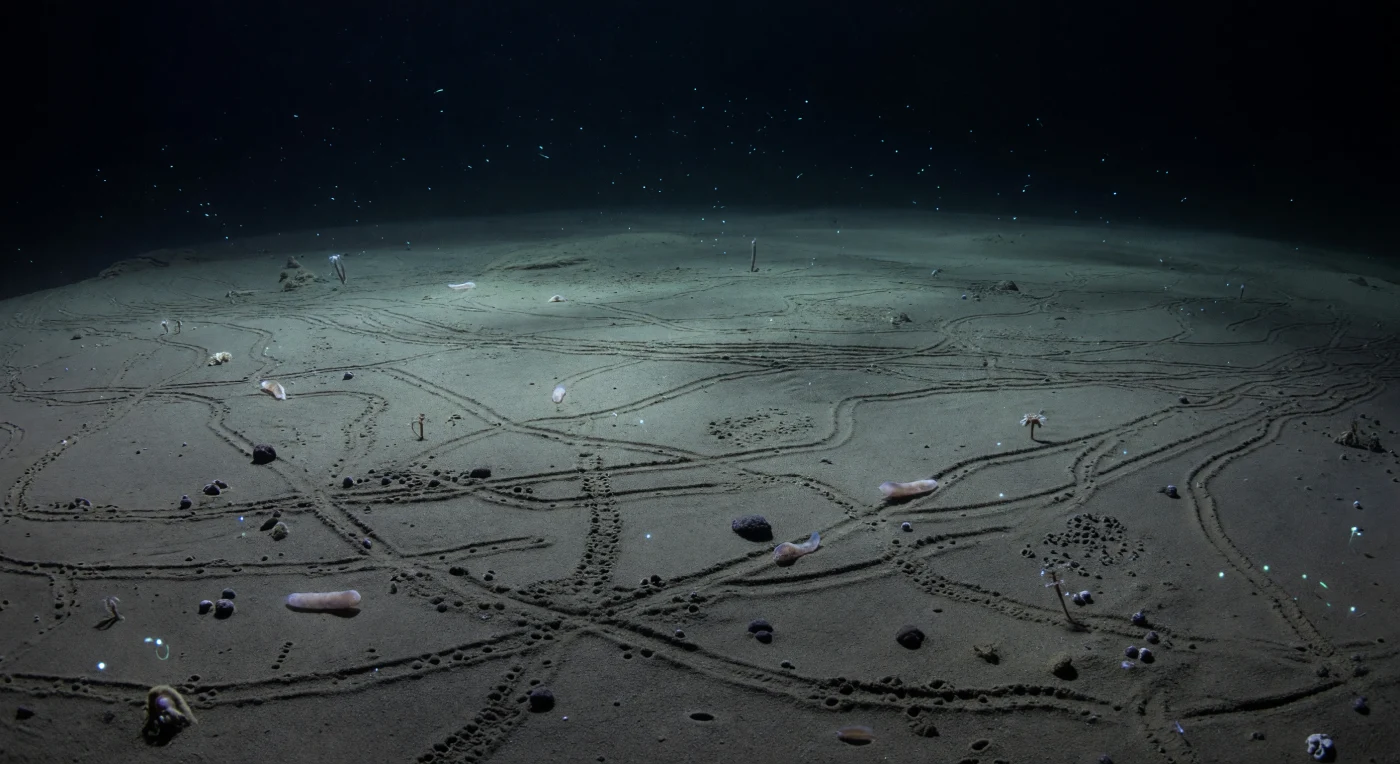
At four to six thousand metres below the surface, where hydrostatic pressure reaches forty to sixty megapascals and bottom-water temperatures hover near one to two degrees Celsius, an abyssal plain stretches in near-perfect flatness across some of the largest uninterrupted terrain on Earth. The fine siliceous and calcareous mud here is a slow archive of the ocean above — built grain by grain from the sinking remains of surface plankton, its surface inscribed now by the unhurried passage of several holothurians, their soft cream and faint lilac bodies moving just above the substrate, drawing feeding furrows and leaving chains of fecal casts that intersect older trackways in a dense, palimpsest mosaic. Scattered manganese nodules interrupt the sediment surface, each ringed by delicate erosional halos, while stalked crinoids grip rare hard fragments at the edge of visibility, and tiny burrow openings hint at a polychaete and meiofaunal world hidden entirely within the mud. Marine snow descends through the aphotic water column in slow suspension, each particle a fragment of photosynthetic life that ceased at the surface months or years ago, and the only illumination here is biological — sparse blue-green bioluminescent points adrift in the boundary layer, their scattered glow softly tracing the relief of tracks and casts before the plain dissolves, without boundary or horizon, into cold and absolute blackness.
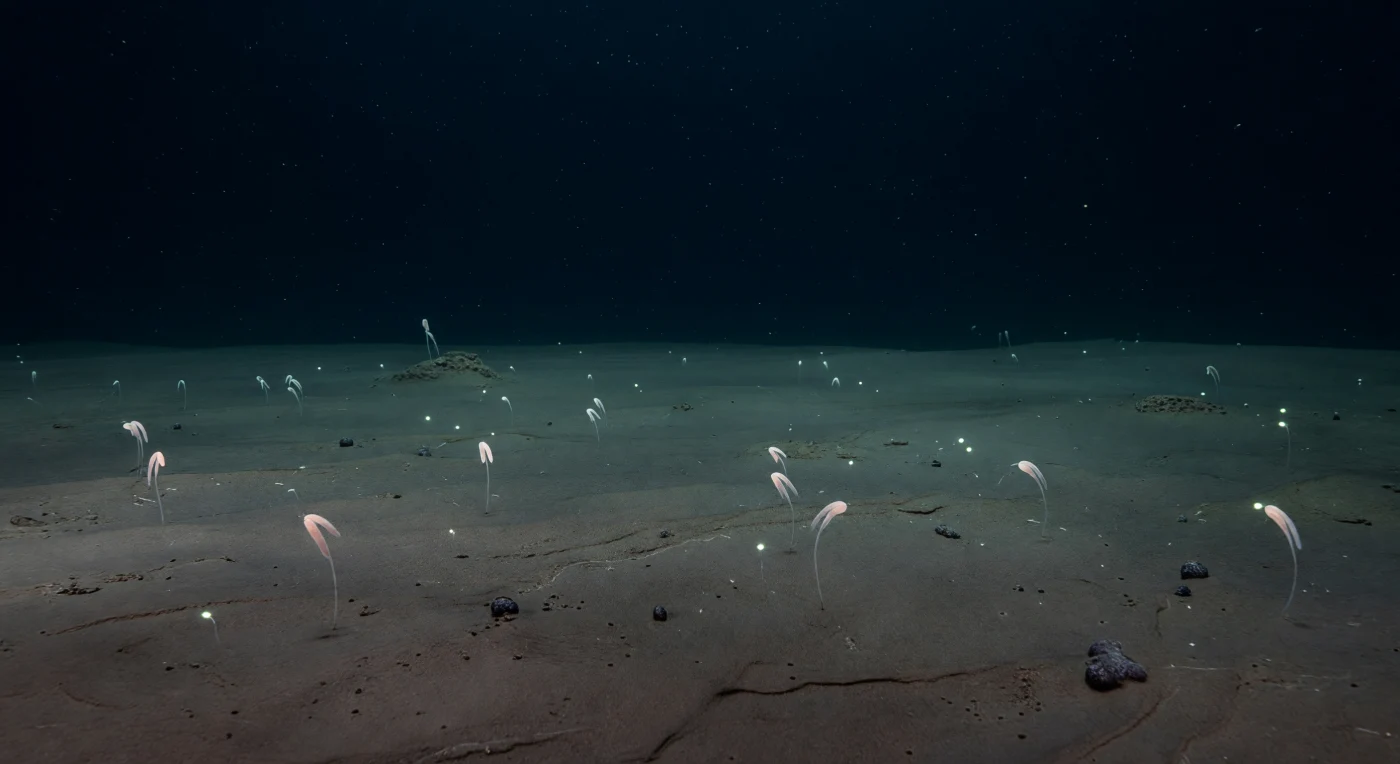
At four to six thousand metres below the surface, where hydrostatic pressure reaches forty to sixty megapascals and bottom-water temperatures hover near one to two degrees Celsius, the abyssal plain unfolds as an almost perfectly level terrain of calcareous and siliceous ooze — the accumulated slow rain of planktonic remains, settling over millions of years onto ancient oceanic crust. Sea pens, colonial octocorals of the order Pennatulacea, rise at wide intervals from the soft sediment, each one anchored by a muscular peduncle buried in the mud, its rachis angled consistently by the weak abyssal boundary-layer current that skims this lightless floor; their ghost-white and faintly peach-translucent tissues represent extraordinary biochemical adaptation to crushing pressure and near-freezing cold, with enzyme systems tuned for function where no sunlight has ever reached. Scattered across the surrounding sediment, faint fecal casts and burrow openings betray the invisible industry of holothurians and polychaetes working through the ooze, while manganese nodules — concretions built over millions of years around nuclei of bone or shell fragment — sit half-buried as dark spheres at the sediment surface. Fine marine snow drifts continuously downward through the water column above, each particle a fragment of surface productivity that has traveled weeks to arrive here, carrying the only meaningful flux of organic energy into this cold, pressurized desert. Occasional bioluminescent pulses from drifting zooplankton and small benthic organisms briefly outline the nearest sea pen quills against the ink-dark void, a world complete and ancient in its silence, utterly indifferent to any witness.
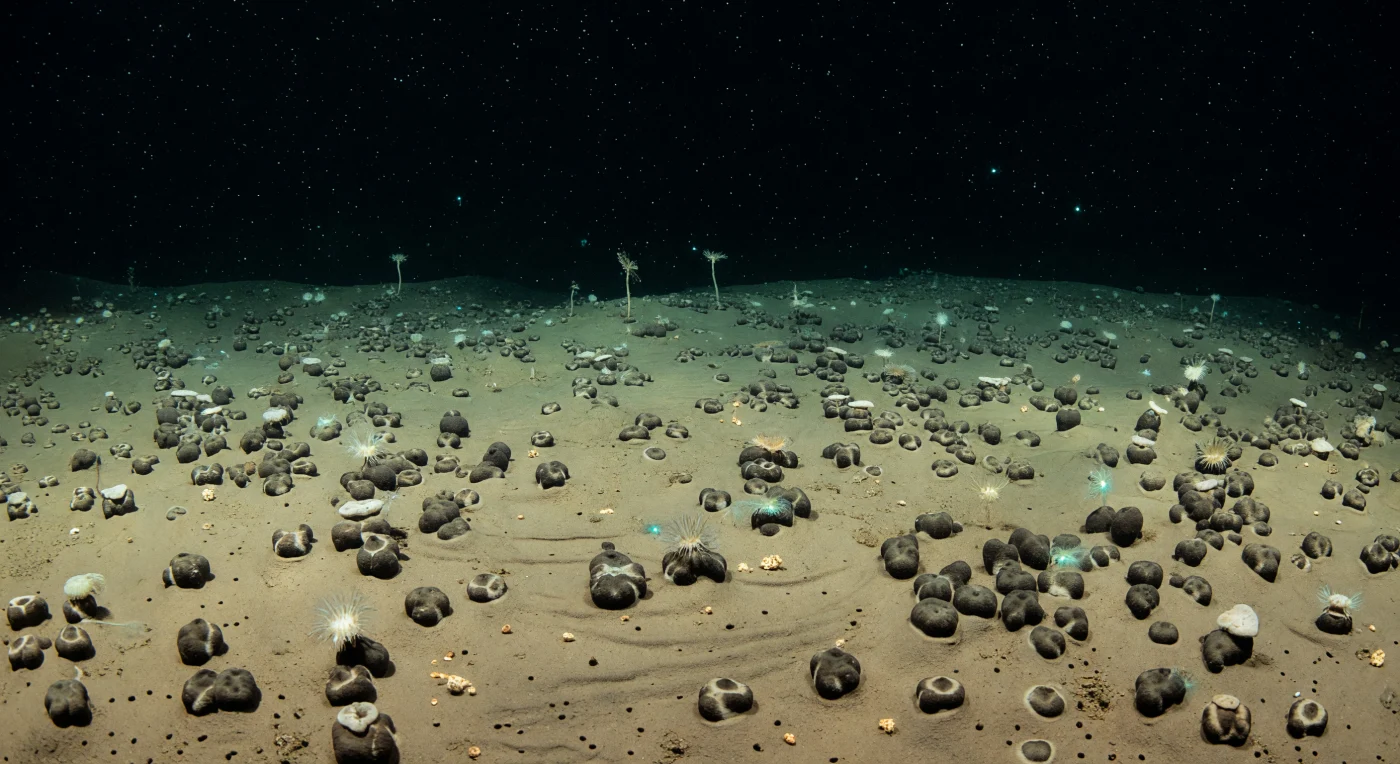
Beneath roughly 600 atmospheres of cold compression, the abyssal plain extends in every direction as one of Earth's most immense and least-disturbed landscapes — a nearly level expanse of pale calcareous-siliceous mud blanketed in the slow accumulation of millennia, where fine sediment receives a ceaseless drizzle of marine snow descending from the sunlit ocean kilometers above. Across this dim, pressurized desert, polymetallic manganese nodules crowd the seafloor in dense pavement, each concretion built over millions of years by the incremental precipitation of iron and manganese oxides around a buried nucleus — their oxide-dark surfaces catching intermittent blue-green bioluminescent flashes as microorganisms and drifting plankton pulse briefly through water held near 1–2 °C. At the nodules' bases, subtle erosional halos and fecal casts betray the quiet work of unseen infaunal communities, while ivory anemones and pale sponges cling to the highest exposed stones, exploiting hard substrate that is scarce in this otherwise featureless sedimentary expanse, with distant stalked crinoids rising on slender stalks into black water laden with slowly settling particulate. The darkness between each bioluminescent flicker is absolute and continuous, a silence measured not in sound but in pressure — a world of near-total stillness that has existed across geological time entirely without witness, governed only by cold chemistry, gravitational settling, and the patient biology of organisms shaped by an environment of almost unimaginable constraint.
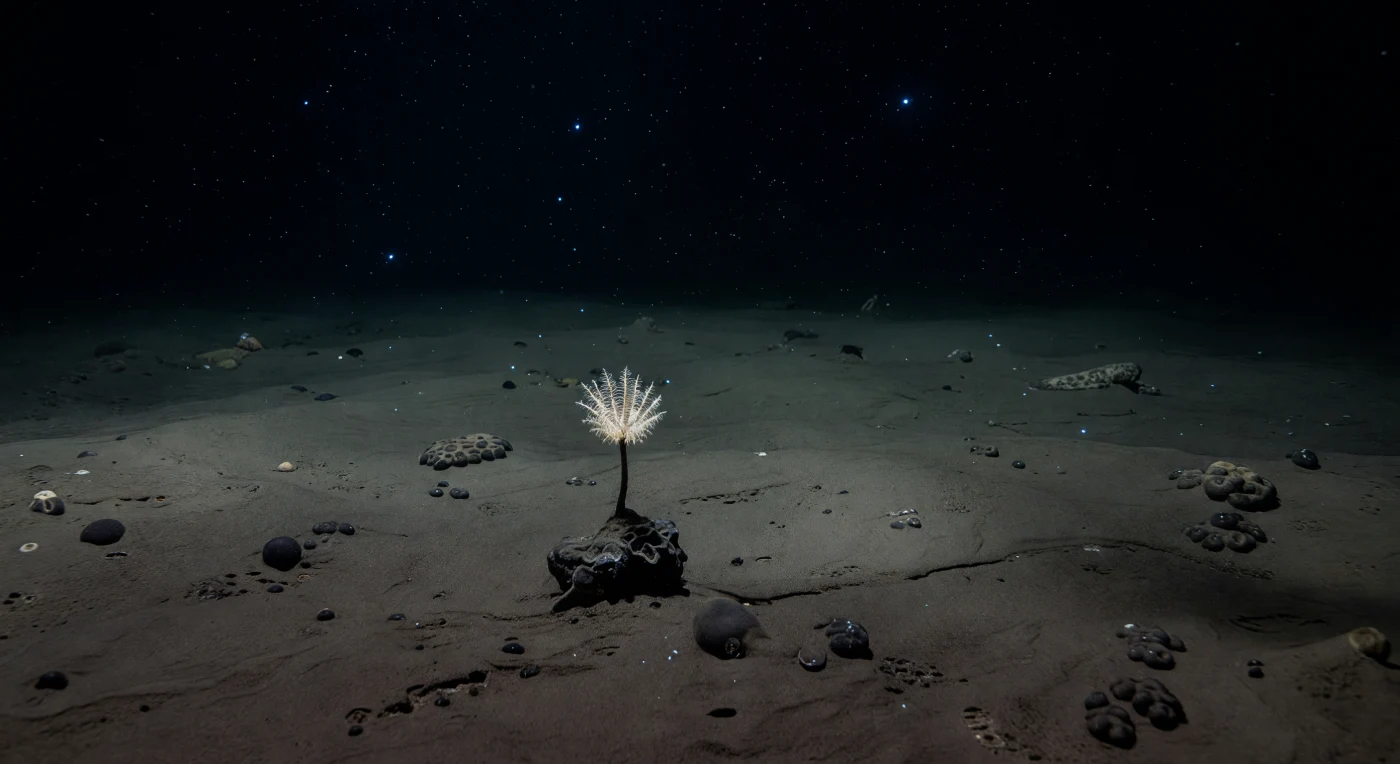
At four to six thousand metres below the surface, where hydrostatic pressure exceeds four hundred atmospheres and water temperatures hover near two degrees Celsius, a single stalked crinoid rises from a polymetallic manganese nodule — one of countless such concretions that litter the abyssal plain like scattered stones across an immense cold desert. The crinoid's slender stalk anchors it to this rare hard substrate, elevating its ivory feathered crown just enough above the surrounding siliceous mud to intercept the near-imperceptible bottom current, each pinnule fanned wide to filter the slow drift of marine snow — the ceaseless soft rain of organic particles, diatom frustules, and faecal pellets descending from the photic zone kilometres above. Across the gently undulating sediment plain, faint bioturbation traces and the distant shapes of holothurians betray the presence of a sparse but persistent benthic community, organisms piezophilic by necessity, their biochemistry tuned to function where no surface life could survive. Occasional blue-cyan bioluminescent sparks drift through the water column — brief chemical signals exchanged in total darkness by organisms that have never known sunlight — while the pale particulates of marine snow drift silently downward, the only visible motion in a world of extraordinary stillness. Here, beyond any reach of surface seasons or human timescales, the abyssal plain continues its slow, pressurized existence: ancient, vast, and absolutely indifferent to being observed.
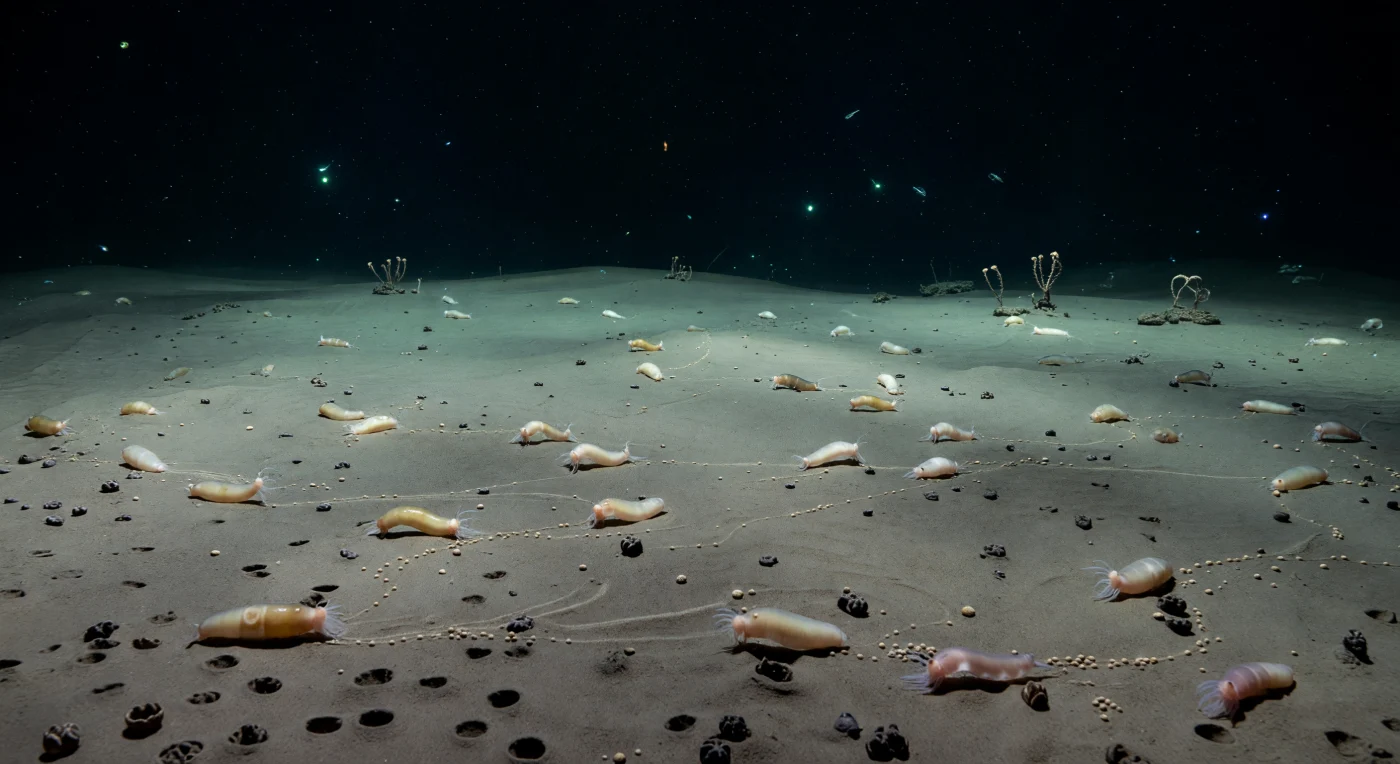
Across thousands of square kilometers of the deep ocean floor, a community of holothurians moves in near-geological slowness through sediment laid down over millions of years — calcareous and siliceous particles, the compacted remains of surface-dwelling organisms that sank through the entire water column before coming to rest here, at pressures approaching five hundred atmospheres, where temperatures hover just above freezing and have done so for longer than most surface landscapes have existed. Each sea cucumber — translucent cream, soft amber, pale pink — leaves behind it a precise record of passage: fresh swaths of disturbed mud, delicate feeding trails, strings of processed sediment pellets that constitute the primary ecological event at this scale, these animals being among the dominant reworkers of the abyssal benthos, processing enormous volumes of sediment and recycling nutrients that would otherwise remain locked in the ooze. Marine snow drifts through the benthic boundary layer in near-imperceptible descent, fine white and beige particles carrying the last organic freight of the sunlit world far above, while scattered blue-green sparks of bioluminescence pulse briefly in the water column — the cold metabolic light of organisms that have never known the sun and require none. Here and there across the vast gray-beige plain, the faint silhouettes of stalked crinoids rise from isolated patches of hard substrate, filtering particles from water that moves in currents too slow and vast to perceive, in a world of absolute calm that has no need of witness to continue its ancient work.
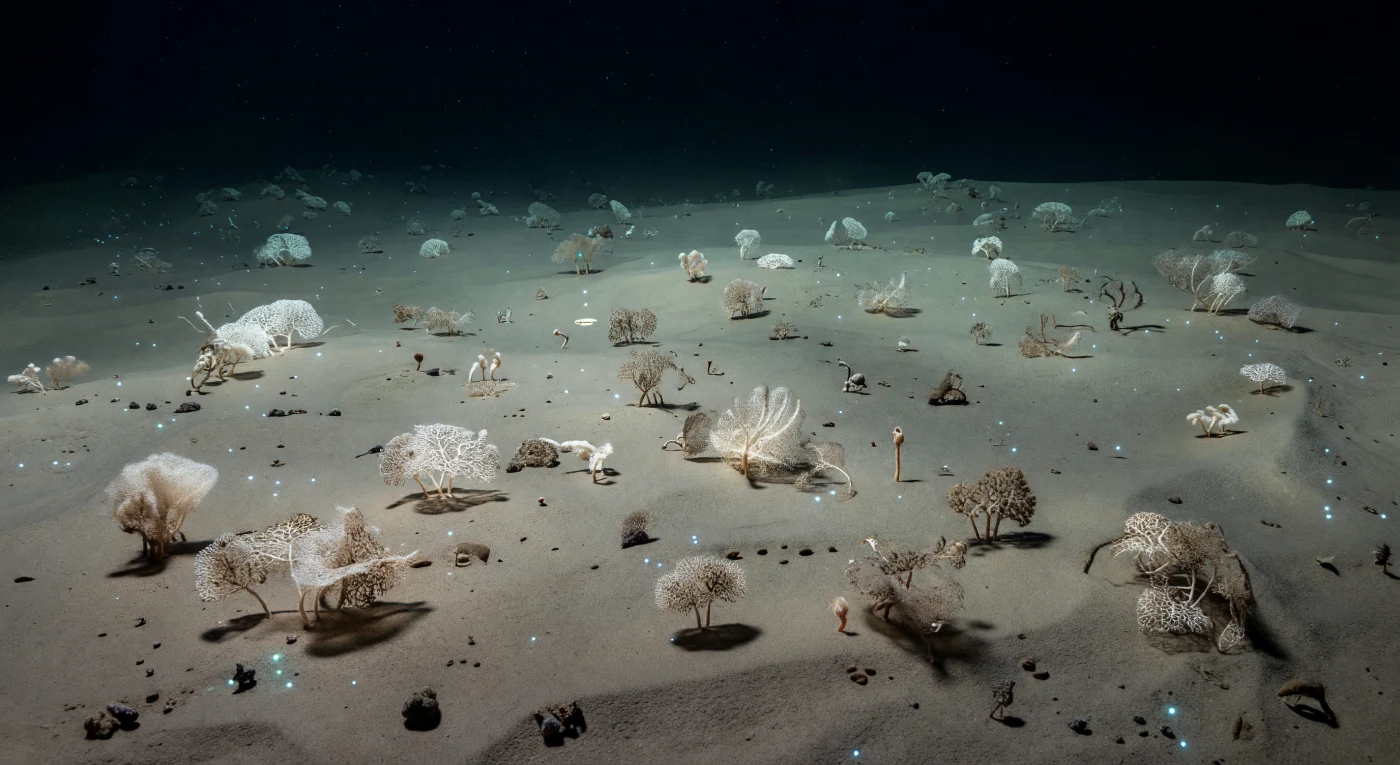
Across the abyssal plain at depths where pressure exceeds 400 atmospheres and bottom water hovers near 2°C, the finest siliceous and calcareous particles settling from the surface over millennia have built a soft, pale mud that receives the remains of the world above in the form of perpetual marine snow — tiny pale fragments drifting downward through near-freezing water in absolute silence. Resting lightly on this sediment, xenophyophores — among the largest single-celled organisms on Earth — form their characteristic reticulate frameworks of agglutinated particles, their off-white and taupe lace-like bodies accumulating barium sulfate crystals and functioning as microhabitat for meiofauna sheltering within their delicate architecture. These giant foraminifera grow slowly in the complete absence of sunlight, sustained not by photosynthesis but by the steady rain of organic detritus from the photic zone thousands of meters above, their fragile geometries scattered at irregular intervals across the plain and receding into the surrounding darkness at the scale of a vast, unpeopled desert. Sparse cold cyan and blue-green bioluminescent sparks drift just above the sediment surface — produced by the chemical signaling systems of organisms whose light serves communication, predation, and defense in a world where no solar photon has ever penetrated — faintly tracing the contours of the xenophyophore lace field and the low sediment relief of burrow casts and faint ripple marks left by weak thermohaline bottom currents. Here the biosphere continues its ancient work entirely on its own terms, governed by pressure, cold, particle flux, and chemical gradients, indifferent to anything beyond the slow accumulation of sediment and the dim, living light of its own inhabitants.
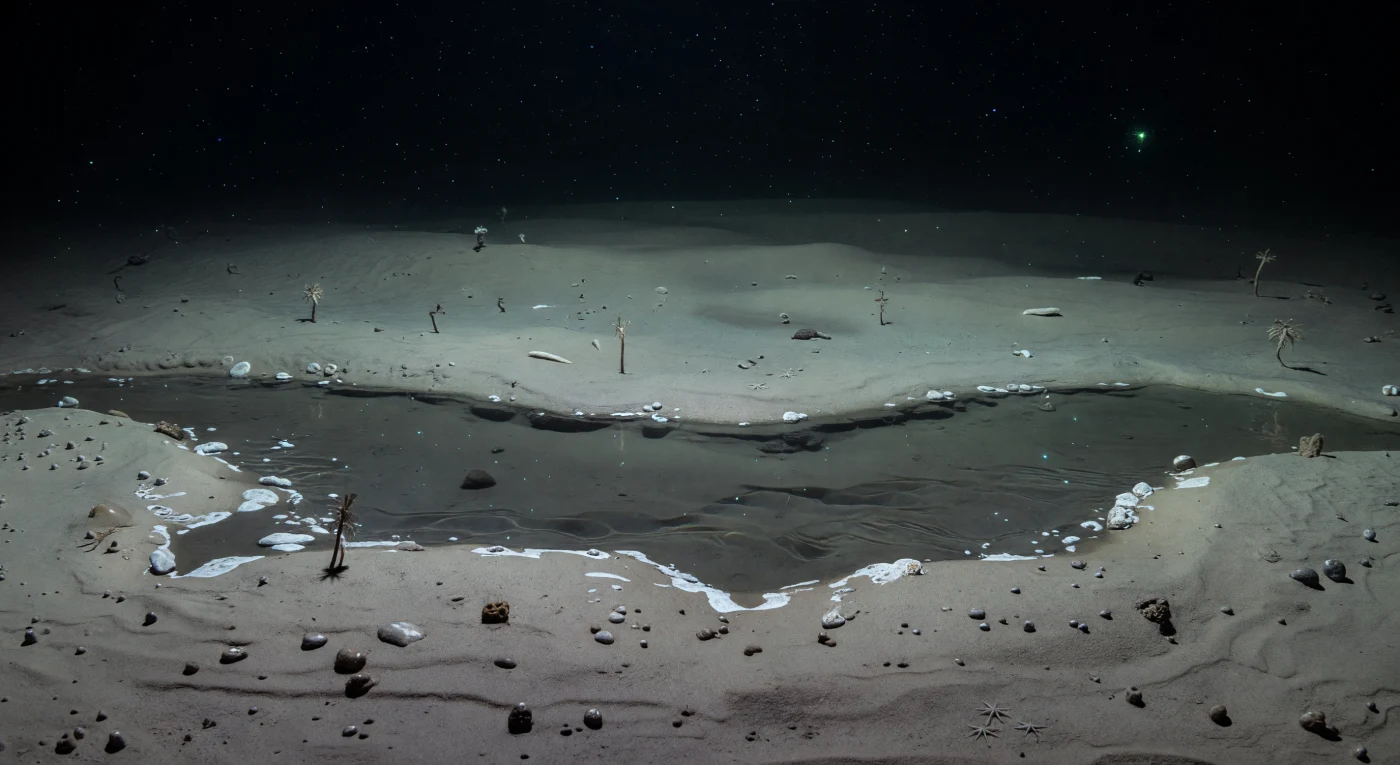
At depths between four and six thousand meters, where hydrostatic pressure exceeds four hundred atmospheres and bottom-water temperatures hover near one to two degrees Celsius, a brine pool occupies a shallow depression in the abyssal plain like a sunken sea within the sea — its surface a trembling, steel-gray interface where hypersaline water dense enough to pool and persist separates sharply from the overlying column through a refractive halocline that bends and distorts everything beneath it. Around the pool's margin, pale siliceous-calcareous sediment has been lifted into soft rims, scattered polymetallic nodules rest where slow diagenetic processes settled them over millennia, and irregular white microbial mats cling to the brine edge, metabolizing sulfur compounds and dissolved methane in a chemolithotrophic existence entirely independent of sunlight. No photon from the surface has ever reached this place; the only illumination comes from faint bioluminescent sparks drifting through the water column — ghostly cyan-green points emitted by small gelatinous organisms descending through the dark — and from the cold diffuse glow that the pale microbial films and brine interface scatter almost imperceptibly across the surrounding mud. Beyond the pool, the plain extends as a near-featureless desert of fine settling particles interrupted only by the slow passage of holothurians dragging themselves across the sediment, the delicate arms of brittle stars, and the occasional stalked crinoid anchored to a dropstone fragment — a world of extraordinary patience, pressure, and cold silence that has never required a witness.
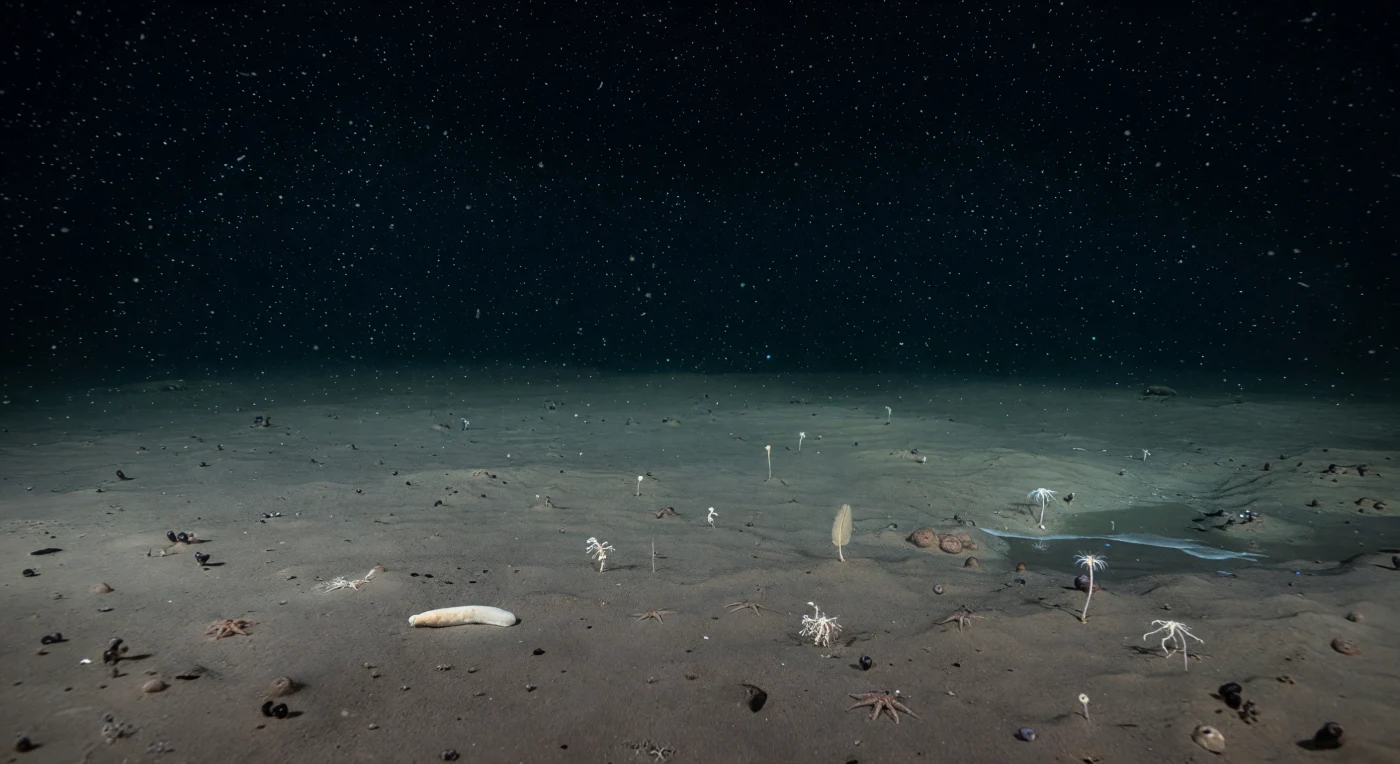
Below roughly four to six kilometers of overlying seawater, where hydrostatic pressure reaches between four and six hundred atmospheres, the abyssal plain extends in near-total silence as one of Earth's most expansive yet least-witnessed landscapes — a cold, still desert of calcareous and siliceous mud stretching without interruption into permanent darkness. Through the entire water column above, a dense pulse of marine snow descends: countless silver-gray organic flecks, aggregated fecal pellets, diatom frustules, and particulate remnants of surface productivity sinking slowly through water just above freezing, each particle a fragment of a biological cycle that links sunlit surface waters to this lightless floor. The only illumination here is biological — intermittent cyan-blue and faint green bioluminescent pinpoints emitted by pelagic organisms and benthic microfauna, so sparse and diffuse that they reveal volume rather than define it, casting no shadows, producing no beams, simply existing as cold chemical light in an otherwise absolute blackness. On the sediment surface below, a pale holothurian rests motionless on fine mud, brittle stars extend arms half-buried in the benthic boundary layer, stalked crinoids rise from rare firmer substrate near scattered manganese nodules, and xenophyophore-like forms — among the largest known single-celled organisms on Earth — occupy their slow and patient niches, all sustained by the continuous rain of organic matter descending from above. This is not emptiness but a world of extreme refinement, tuned over evolutionary time to function under immense compression and perpetual cold, receiving the ocean's slow biological inheritance without pause.
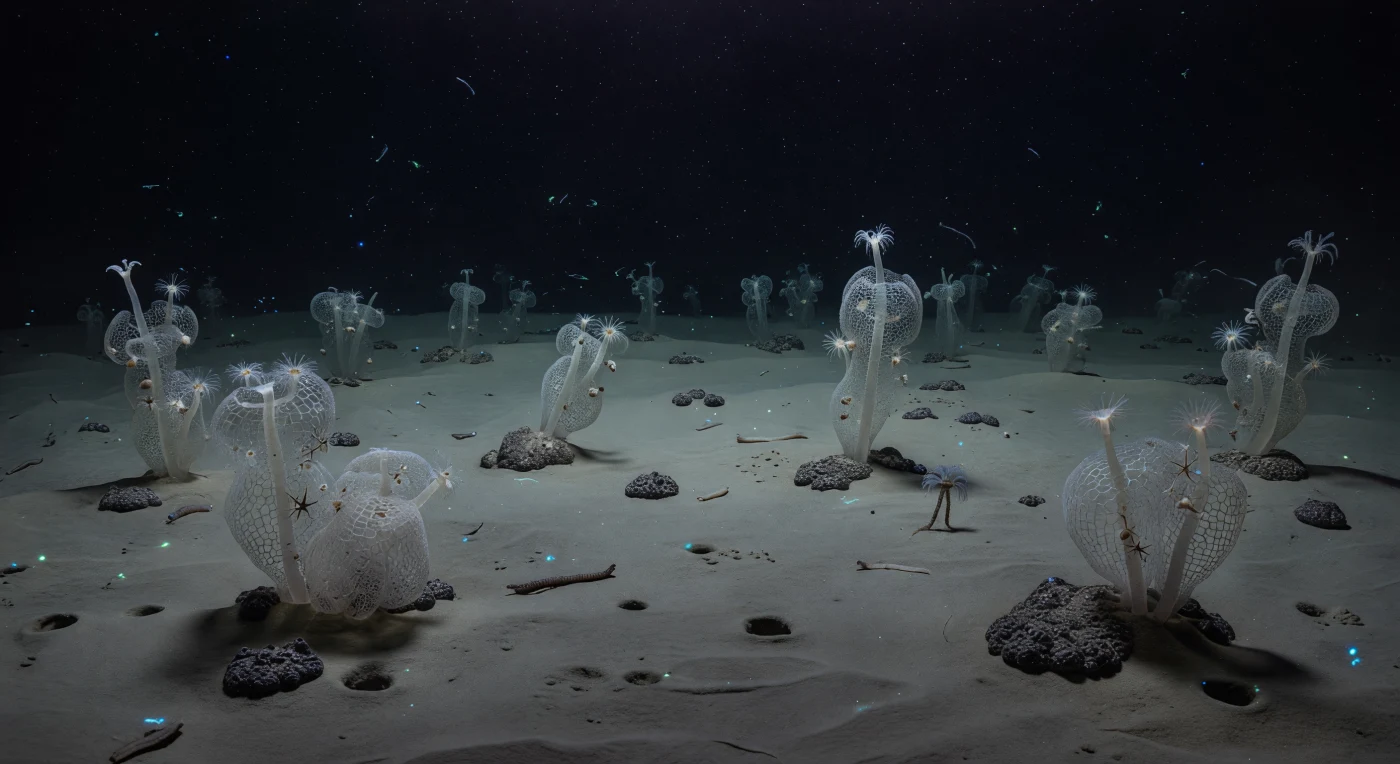
At four to six thousand metres below the surface, where hydrostatic pressure bears down at forty to sixty megapascals and bottom water hovers near two degrees Celsius, the abyssal plain stretches as one of Earth's most expansive yet least-witnessed landscapes — a gently undulating desert of pale calcareous and siliceous mud punctuated by scattered polymetallic manganese nodules that have accreted grain by grain over millions of years. From these dark, low islands of hard substrate, tall hexactinellid glass sponges — members of the class Hexactinellida — rise on delicate silica lattices, their translucent frameworks faintly opaline where the geometry of fused spicules catches the only available illumination: cold pinpoints of bioluminescence drifting in the water column from tiny organisms, and dim living glows emanating from benthic fauna themselves, too faint for any ordinary perception yet sufficient in this impossible sensitivity to reveal form, texture, and depth. Brittle stars drape across nodule surfaces, stalked crinoids extend their feathered arms into the near-still current, and holothurians move with glacial patience across sediment that records in fine detail the slow biography of this place — burrow openings, fecal casts, subtle current ripples, and the halos of winnowed mud around each hard substrate island. Marine snow descends continuously, a ceaseless gentle rain of organic particles from the sunlit world four kilometres above, sustaining this sparse community through the long patience of chemically and thermally stable deep water. Nothing here acknowledges the surface; the plain simply exists, pressurised and cold and alive in its own unhurried terms, entirely without witness.
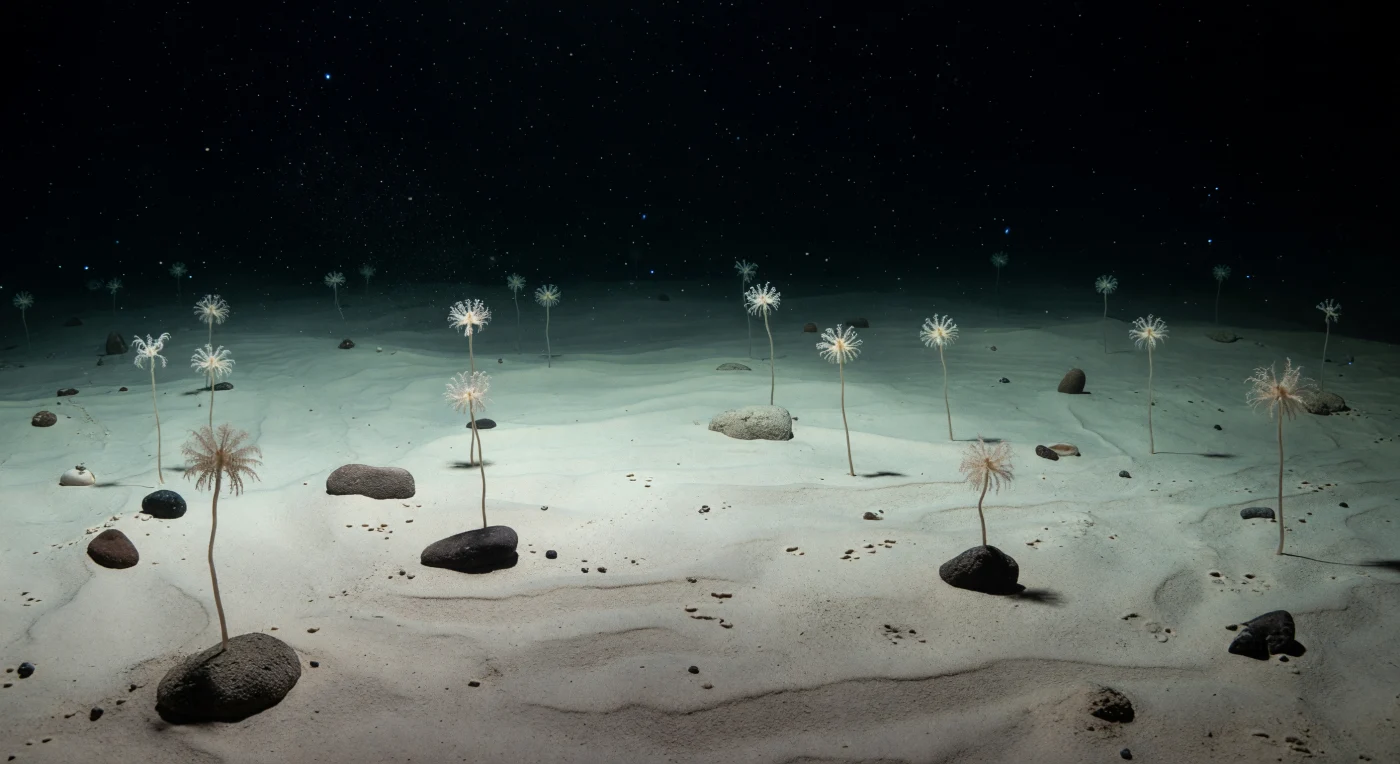
At depths between four and six thousand metres, where hydrostatic pressure exceeds four hundred atmospheres and water temperatures hover near two degrees Celsius, an immense calcareous plain extends in near-perfect flatness into absolute darkness, its cream and grey sediment shaped into low, current-sculpted ripples that record the slow drift of Antarctic Bottom Water moving imperceptibly across the abyssal floor. Isolated dark dropstones — erratic clasts rafted here long ago by icebergs and released as they melted — punctuate the mud desert as the only available hard substrate, and from each one stalked crinoids rise on slender stems, their pale, feathered arms fanned uniformly into the same weak current to intercept the sparse rain of marine snow descending from the sunlit world thousands of metres above. This continuous, gentle flux of particulate organic matter — diatom frustules, fecal pellets, aggregated mucus, the fragmented remains of zooplankton — constitutes the primary energy subsidy sustaining these suspension feeders and the broader benthic community, whose presence is otherwise betrayed only by faint burrow openings, subtle fecal casts, and the occasional dark hemisphere of a polymetallic manganese nodule accreting at geologically imperceptible rates across the siliceous mud. In the water column above, tiny planktonic organisms emit cold blue-green bioluminescent pulses — chemical signals exchanged in a world of permanent darkness, utterly indifferent to any observer — while the plain itself stretches on in crushing stillness, a landscape that has existed, metabolised, and evolved across geological time with no witness but itself.
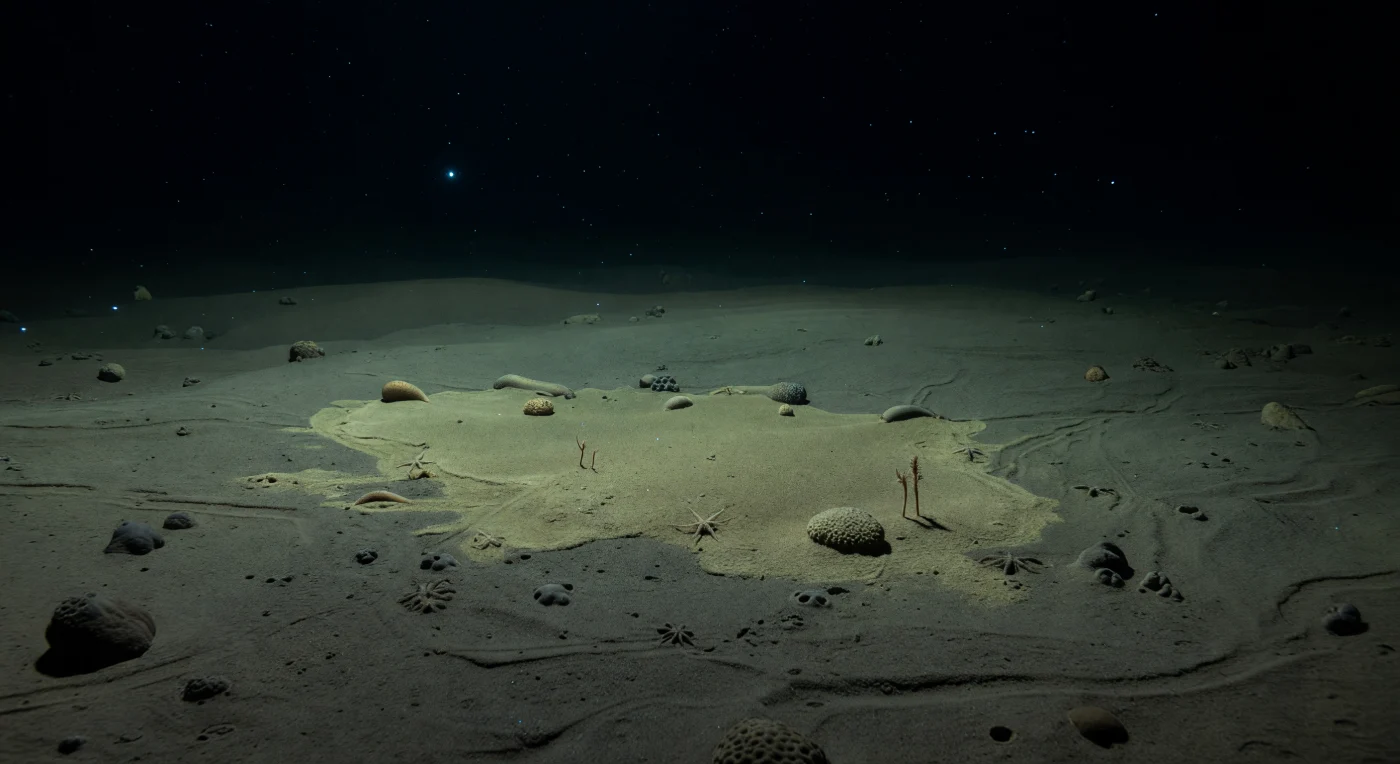
At four to six thousand metres below the surface, where hydrostatic pressure exceeds four hundred atmospheres and bottom water hovers near two degrees Celsius, a freshly settled veil of phytodetritus has transformed a broad tract of the abyssal plain into a subtly brightened olive-beige tapestry laid across the otherwise grey-brown siliceous mud. This organic film — aggregated remains of a phytoplankton bloom that sank as marine snow over days or weeks — represents a rare nutritional windfall, a pulse of carbon arriving from a sunlit world six kilometres above, and the deposit feeders have already responded: holothurians move in slow methodical arcs across the detrital surface, their feeding palps sweeping sediment, while brittle stars hold themselves low against the bottom with outstretched arms, and a solitary xenophyophore-like giant agglutinated foraminifer anchors itself at the patch margin, its delicate test accumulating particles from the perpetual slow rain above. Converging trails and faint fecal casts crisscross the fresh film, recording hours of invertebrate passage across a landscape that otherwise changes on geological timescales, where manganese nodules half-buried in mud have been accumulating one to two millimetres per million years. Overhead, scattered cool cyan bioluminescent pulses trace the movements of midwater organisms transiting the water column — a darkness so total and a stillness so absolute that this seafloor exists as a world complete in itself, ancient and unhurried, wholly indifferent to any presence beyond its own.
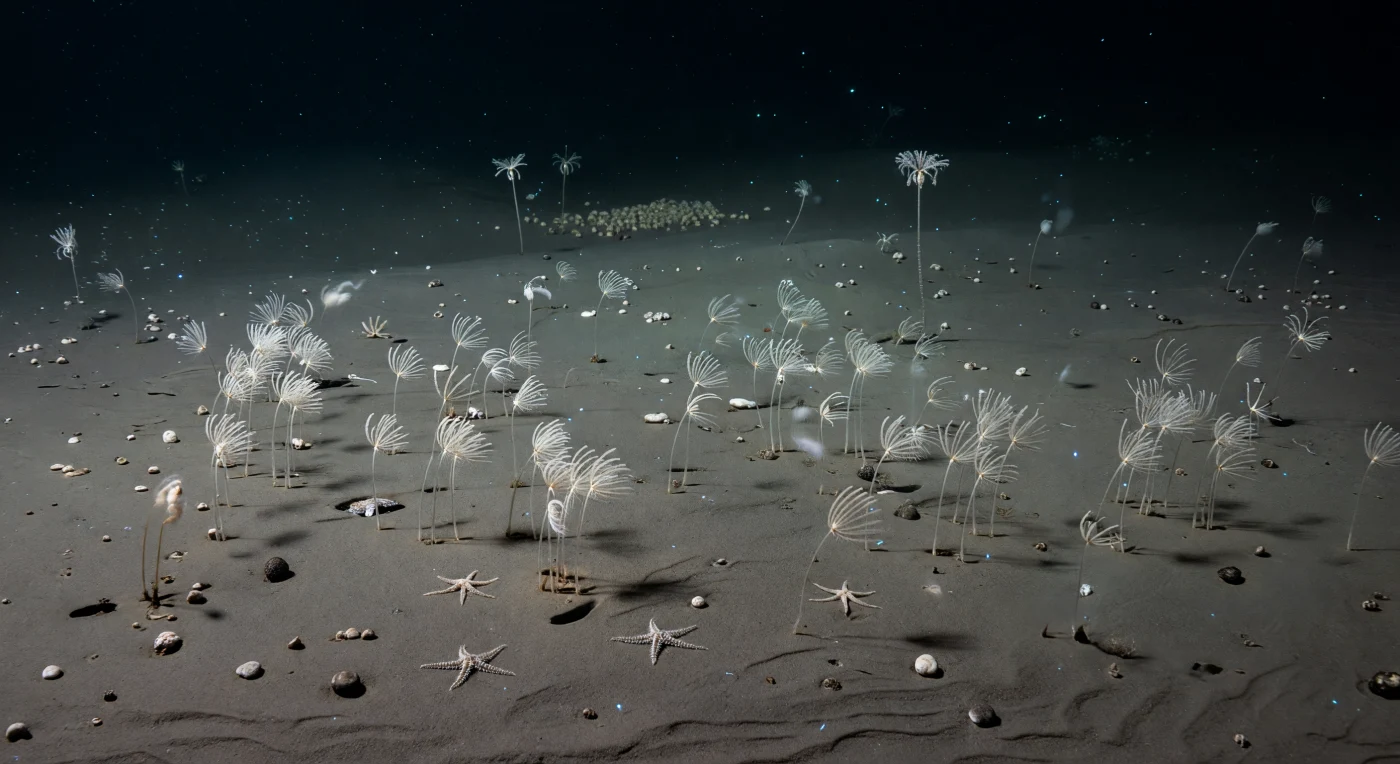
At depths where pressure exceeds 400 atmospheres and water temperatures hover near 1–2 °C, the abyssal plain unfolds as one of Earth's most expansive yet least-witnessed landscapes — a near-level expanse of siliceous and calcareous mud stretching beyond any perceivable horizon, its surface gently sculpted by current ripples and punctuated by faint burrow openings, scattered polymetallic nodules, and the minute fecal castings of invertebrates processing sediment grain by grain. Here, a colony of pale pennatulaceans rises from the soft substrate, their translucent stems and feathered fronds inclined uniformly by a slow thermohaline-driven near-bottom flow, while brittle stars lie draped low against the sediment and a stalked crinoid anchors itself to a nodule's hard surface some distance back — each organism an exquisite solution to life under crushing pressure and near-total food scarcity, sustained almost entirely by the rain of marine snow descending from the sunlit world thousands of meters above. In the absolute darkness, bioluminescent motes flicker intermittently in cold cyan and dim green — metabolic signals, defensive flashes, or chance chemical reactions — briefly edging the sea pen fronds and illuminating drifting floc as it moves silently between the colony's stems. This is an ecosystem running on geological patience, where every particle settling onto the sediment surface, every organism's slow metabolism, and every current's imperceptible push constitute the full measure of a world that has never required light, warmth, or witness to persist.
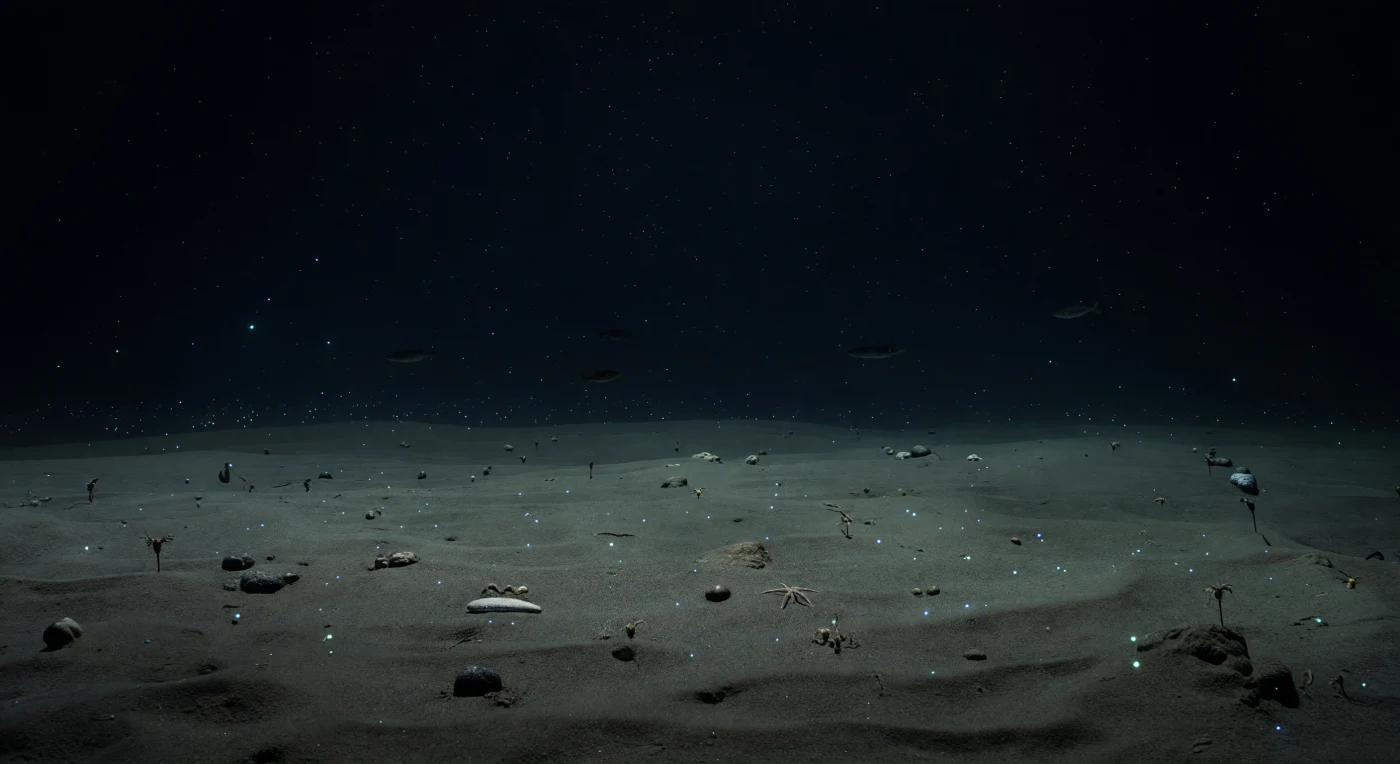
Beyond the reach of any sunlight — extinguished entirely within the uppermost few hundred metres of the ocean — an immense plain of grey-brown calcareous and siliceous mud stretches away into soft black obscurity at depths where hydrostatic pressure exceeds 400 to 600 atmospheres, cold bottom water hovers near 2 °C, and time seems to move only in the slow drift of marine snow settling from the world above. Scattered polymetallic manganese nodules, formed grain by grain over millions of years, punctuate the rippled sediment alongside faint burrow traces and fecal casts — evidence of polychaetes, holothurians, and brittle stars working the ooze in near-total darkness. In the thin benthopelagic layer just above the seafloor, small crustaceans drift and pulse, their bodies occasionally releasing blue-green bioluminescent sparks that blink and vanish — brief chemical light that serves as the only illumination this world has ever known. A few ghost-pale fish silhouettes hover at the margin between mud and water column, shaped by evolution into forms suited for crushing pressure, perpetual cold, and the scarcity of food that characterises one of Earth's largest and least-visited ecosystems. This is the abyssal plain as it has always existed: vast, patient, and entirely indifferent to being witnessed.