Beneath more than four kilometres of cold, lightless ocean, an immense plain of siliceous mud extends outward in every direction without interruption, its pale ash-beige surface the accumulated result of millennia of microscopic silica frustules and radiolarian tests sinking slowly from the sunlit world above — a world that exerts no influence here beyond the ceaseless slow rain of marine snow drifting through the black water column. Hydrostatic pressure exceeds four hundred atmospheres, compressing all chemistry, all movement, all biology into slow, deliberate, pressure-adapted existence; the bottom water rests near two degrees Celsius, perpetually cold, drawn from polar sources and circulating with geological patience across the basin floor. Across this sediment expanse, translucent holothurians trace looping furrows through the ooze, their soft gelatinous bodies faintly luminescent at the margins, ingesting sediment grain by grain, processing organic detritus so dilute that only the most specialized gut chemistry can extract nutrition from it, leaving behind pellet strings and meandering trails that record their passage across an otherwise undisturbed substrate. Where scattered manganese nodules offer the rare hard surface, stalked crinoids rise motionless into the water column, their feathered arms suspended against the imperceptible abyssal current, filtering whatever particulate matter chance delivers to them. Overhead, isolated bioluminescent pinpricks of blue-green light punctuate the absolute darkness of the water column — organisms signalling, luring, or simply existing — while the plain beneath them continues its ancient, silent accumulation, indifferent to observation, complete in itself.
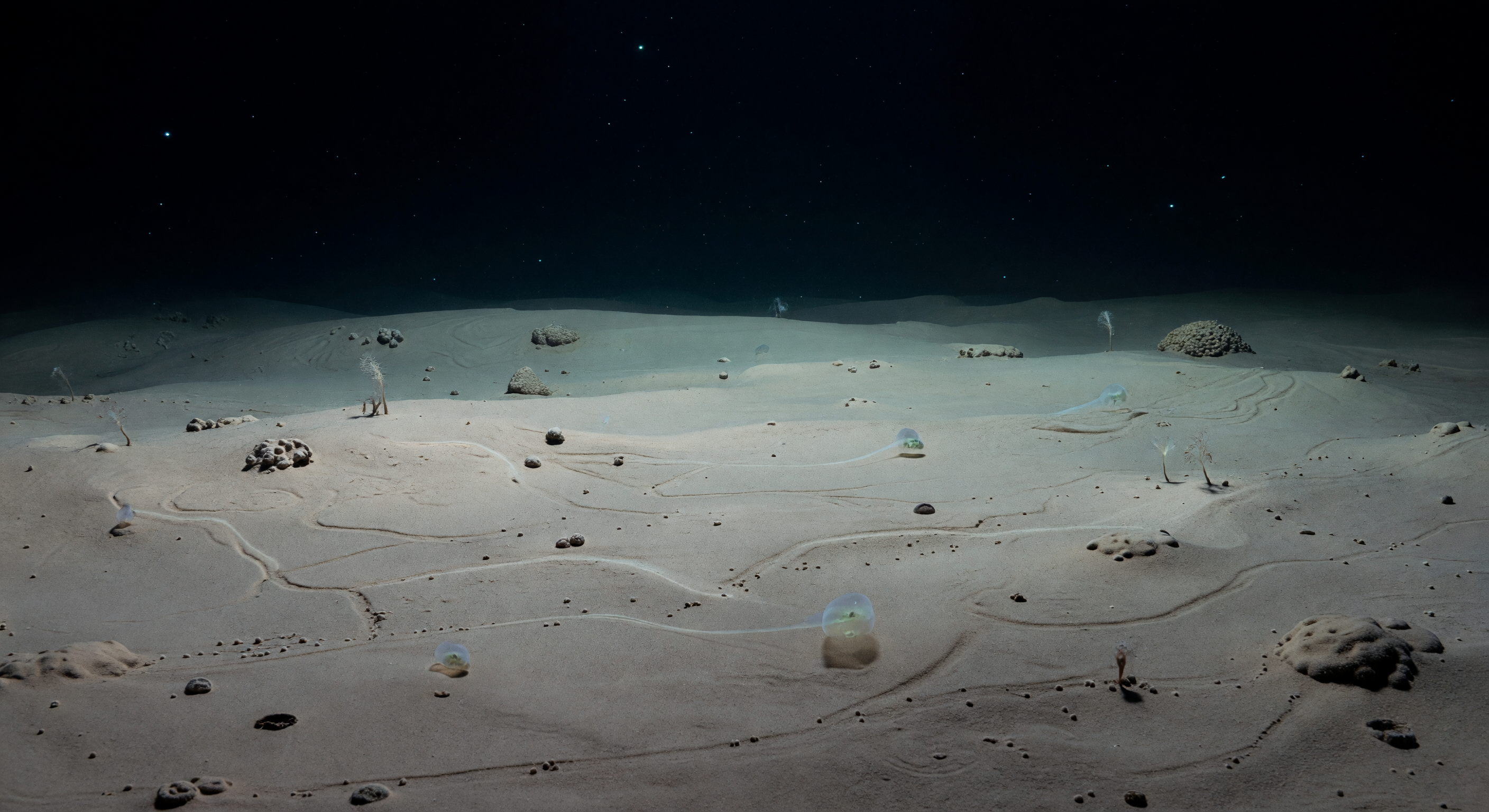
Abyssal plain