Scientific confidence: Very High
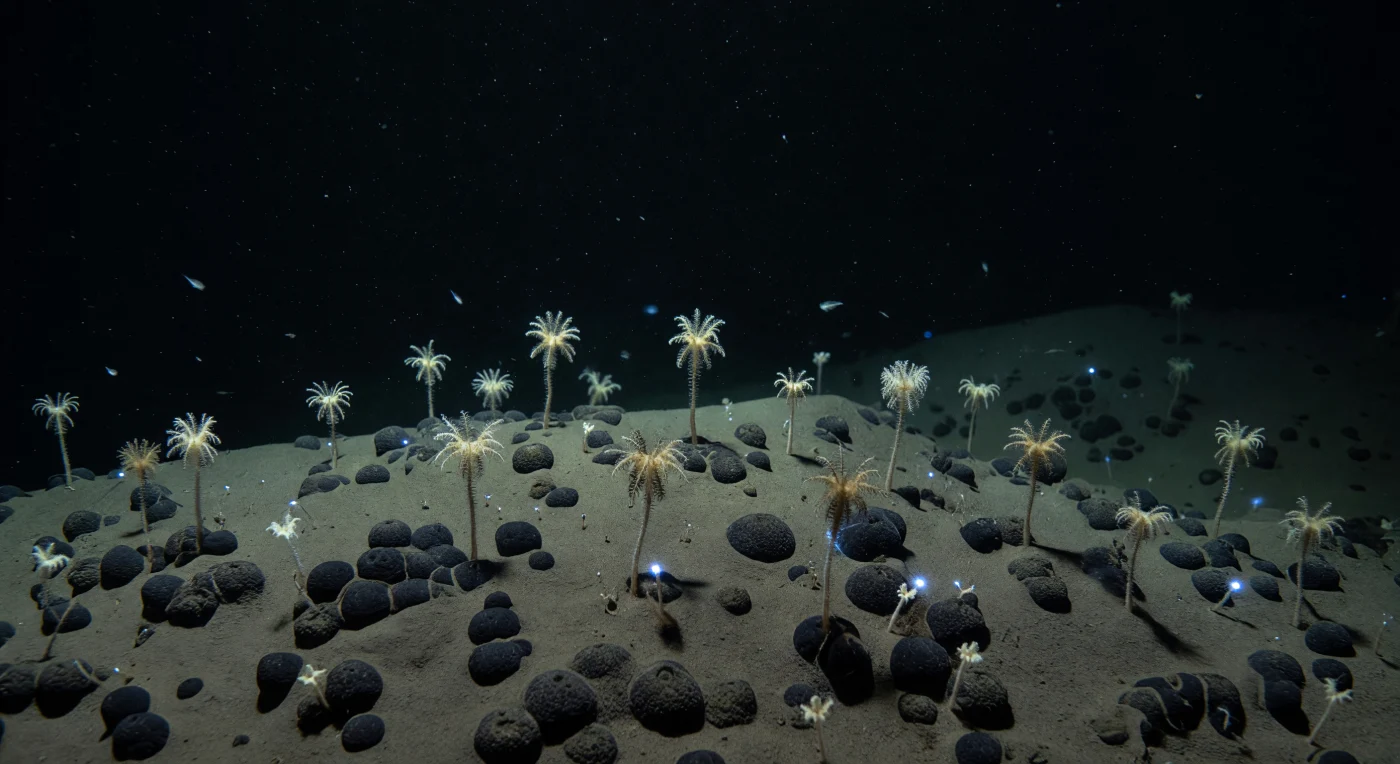
At roughly five kilometers beneath the surface of the equatorial Pacific, the abyssal plain of the Clarion–Clipperton Zone stretches away in every direction as a near-featureless expanse of pale grey-brown siliceous mud, broken only by the black, rough-surfaced manganese nodules that have been accreting, grain by imperceptible grain, for millions of years — growing at rates measured in millimeters per million years under pressures exceeding 500 atmospheres. From the surfaces of several of these nodules, stalked crinoids — living relatives of forms preserved in Paleozoic rock — rise on slender calcite stems, holding their pinnule-fringed arms in a delicate radial crown that filters passing organic particles from water barely above freezing, water that has not seen sunlight since it sank in polar seas centuries ago. Faint bioluminescent pulses — blue-cyan flickers from drifting plankton invisible except in that cold instant of self-illumination — briefly trace the curvature of a nodule, rim the translucent edges of a crinoid arm, and then vanish, leaving the sediment to its velvet silence and the slow, continuous drift of marine snow settling down from the sunlit world impossibly far above. This is one of the most extensive and least disturbed benthic ecosystems on Earth, where biomass is extraordinarily sparse but biological diversity is surprisingly high, each organism an evolutionary solution to perpetual darkness, crushing pressure, oligotrophic scarcity, and the cold patience of geological time.
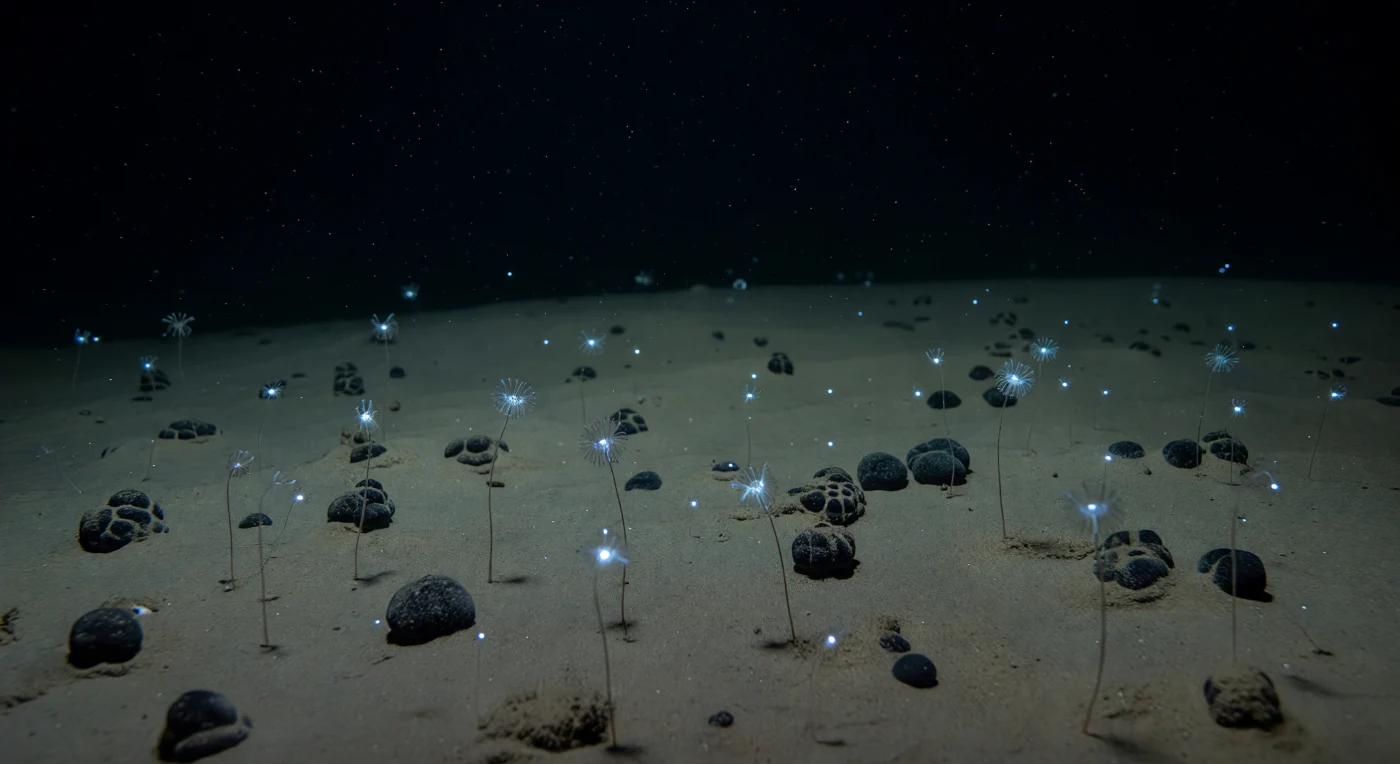
Across the abyssal plain at depths approaching five kilometres, the seafloor unfolds as an almost featureless expanse of pale grey-brown mud, its surface broken only by the scattered presence of polymetallic nodules — black, matte, manganese-rich concretions that have grown at rates of mere millimetres per million years, accreting layer by layer around shark teeth or foraminiferal tests buried in the sediment. Under pressures exceeding 500 atmospheres and in water hovering near 2 °C, a colony of sea pens rises with improbable delicacy from the fine ooze between nodules, their stalks anchored in sediment so undisturbed that the faintest benthic current is enough to incline them gently in unison; a handful of open polyps extend their feathered tentacles into water laden with descending marine snow — the slow rain of organic particles from the sunlit world thousands of metres above, the primary nutritional lifeline for virtually all life down here. Along the translucent tissue of several polyps, pulses of blue-cyan bioluminescence travel in quiet waves, a chemical language whose function — defence, predator deterrence, or intracolonial signalling — remains incompletely understood, the faint light tracing living architecture against a background of charcoal nodules and ashen mud. This is the Clarion–Clipperton-style abyss in its undisturbed state: one of the largest and most biologically fragile ecosystems on Earth, existing in total darkness, in crushing cold, in a silence so complete that the slow drift of a single marine-snow particle through still water constitutes an event.
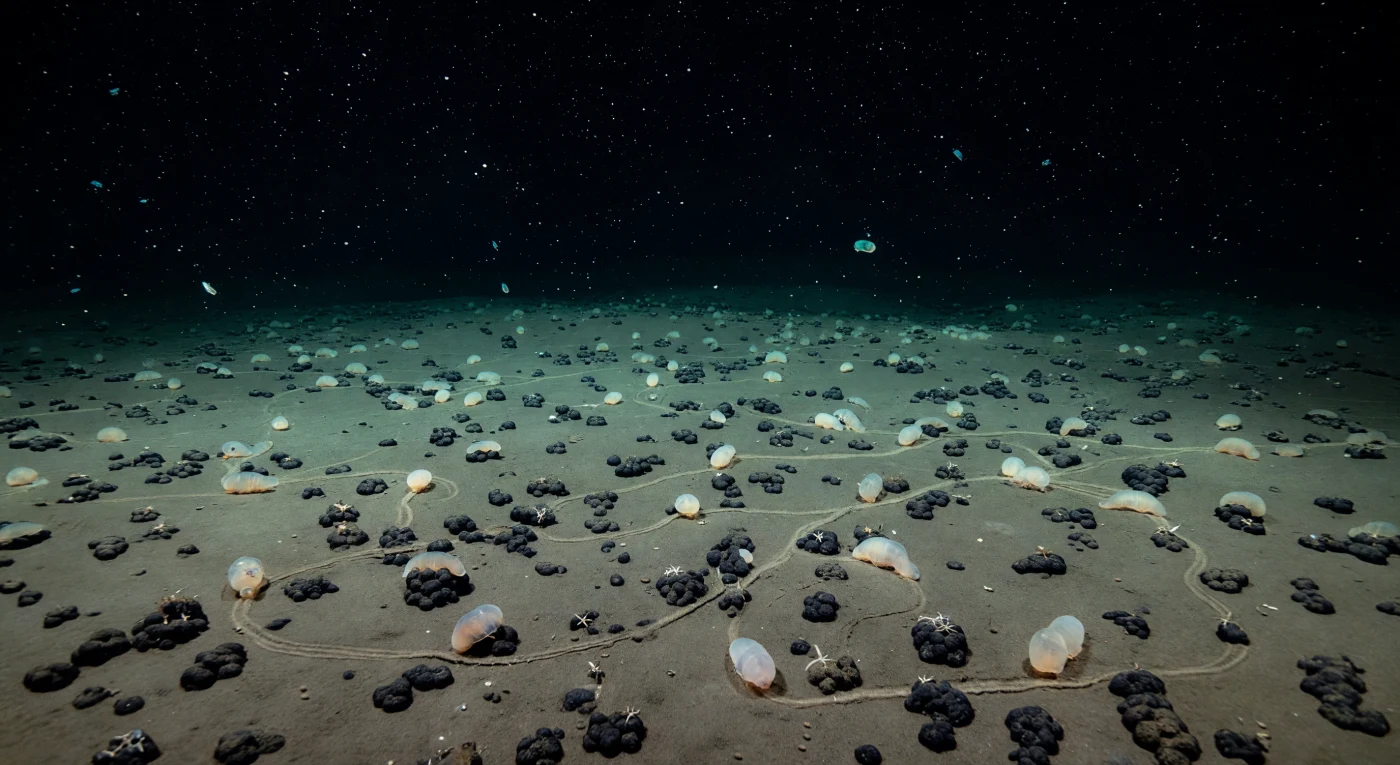
Across the abyssal plain of the Clarion–Clipperton Zone, at depths where pressure exceeds four hundred atmospheres and water temperatures hover near two degrees Celsius, a vast sediment floor lies scattered with black manganese nodules — rounded, matte, half-swallowed by pale grey-brown mud, each one the product of millions of years of slow mineral accretion. Dozens of holothurians move in near-imperceptible procession across this terrain, their gelatinous bodies translucent and ghost-pale, drawing sustenance from the organic material trapped in the sediment, leaving behind looping feeding tracks that arc and intersect between the nodules in patterns of quiet, repeated purpose. Marine snow descends continuously through the water column above — fine particles of organic detritus drifting downward from the sunlit ocean far overhead, the primary nutritional link between the surface world and this lightless plain, each mote suspended in cold, high-clarity water laden with fine particulate. Scattered pinpricks of cyan-blue bioluminescence drift among the falling particles, the only light that has ever touched this floor, produced by organisms whose chemistry generates its own faint illumination entirely independent of any distant sun. Here, beyond the reach of all but the most extreme biological adaptations, a community of fragile benthic life persists in the sediment and on the nodule surfaces — sponges, xenophyophores, soft corals, and microbes — occupying one of the largest and least disturbed ecosystems on Earth, a world that has existed in this form since long before the first human eyes could imagine it.
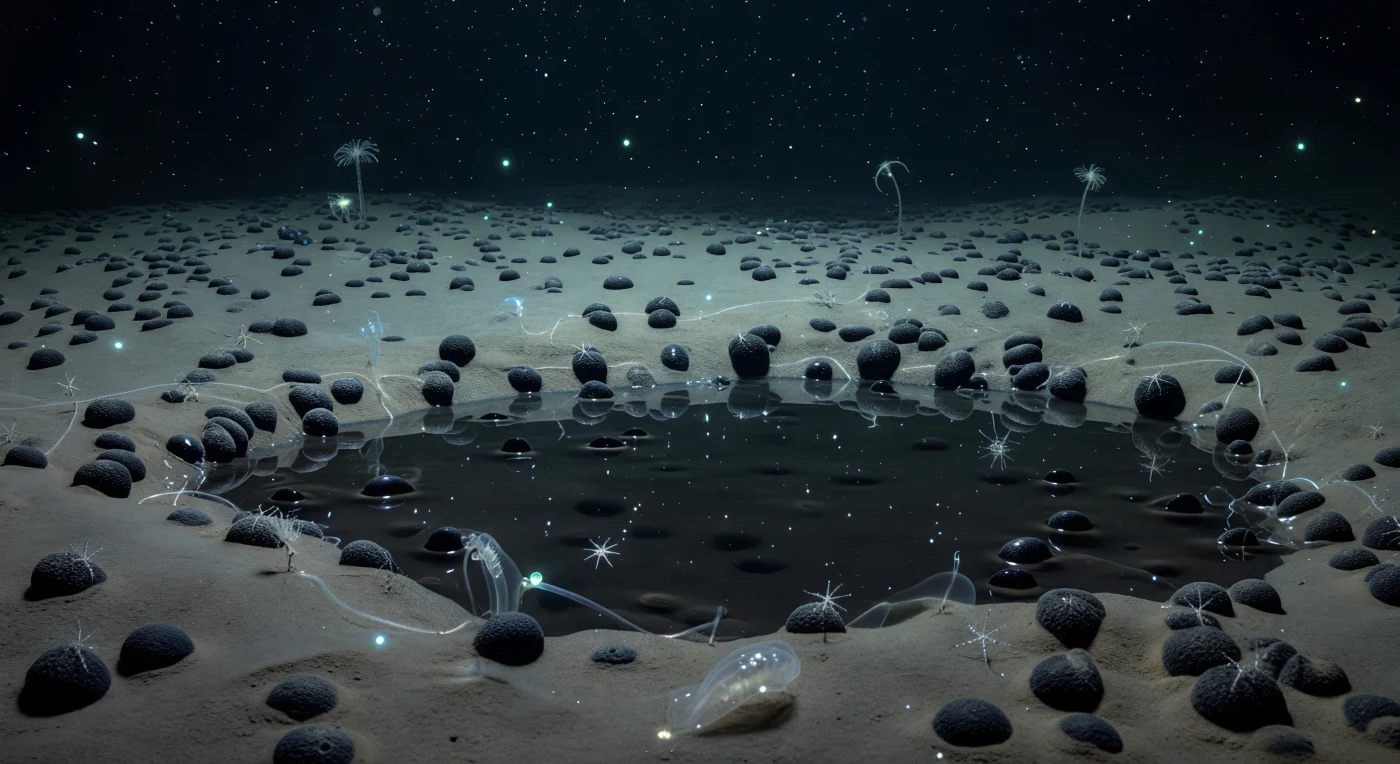
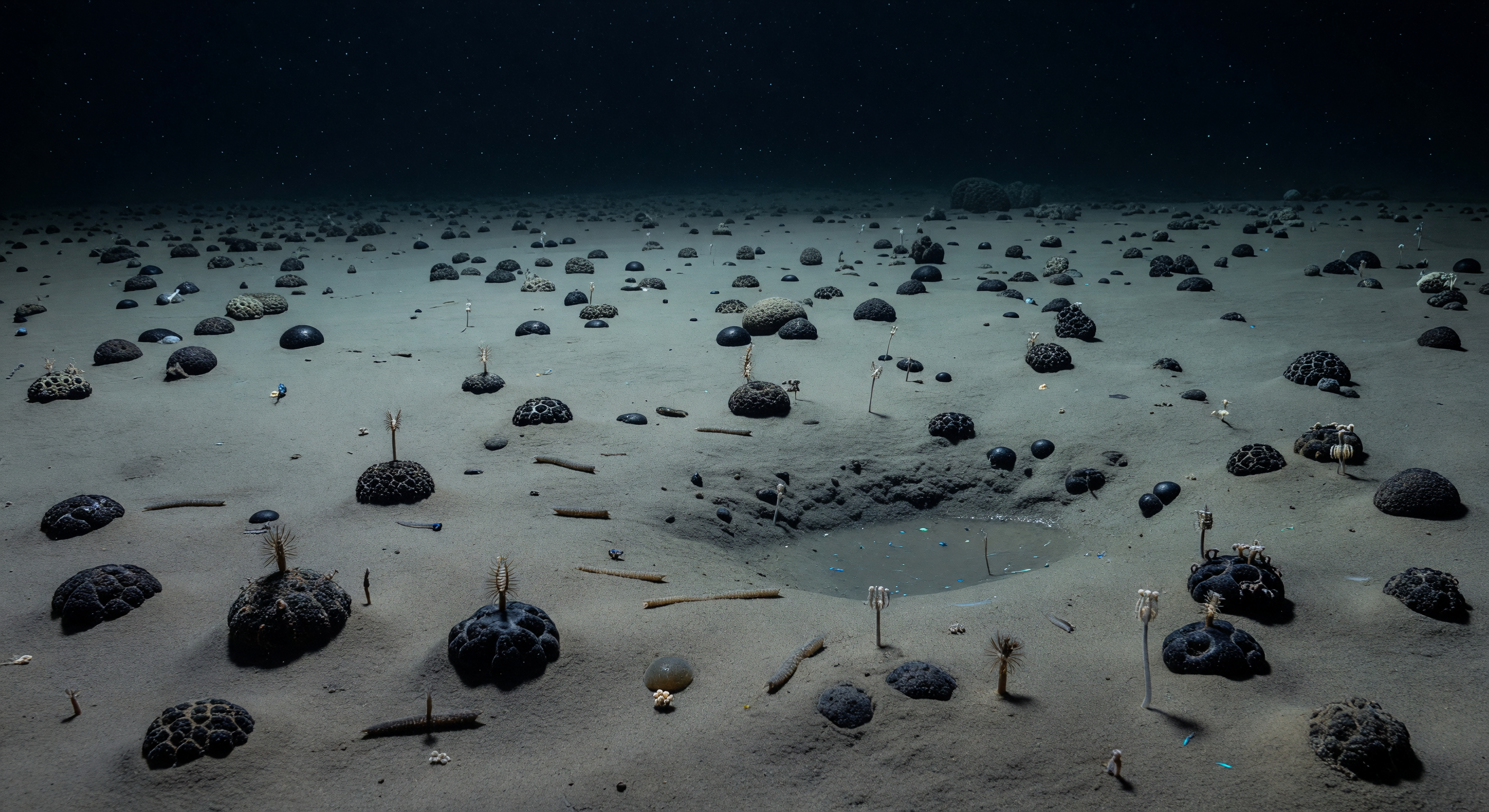
At nearly five thousand metres beneath the surface, where pressure exceeds four hundred atmospheres and temperature barely climbs above one degree Celsius, an abyssal plain stretches in near-total darkness across a vast, almost featureless expanse of pale grey-brown sediment. Scattered across this soft mud lie rounded polymetallic nodules, their matte-black manganese-rich skins accreted over millions of years through the slow precipitation of dissolved metals from seawater and pore fluids — geological time made tangible on the seafloor. The plain ends abruptly at the glassy margin of a brine pool, a hypersaline depression so dense that its surface holds like dark ink, warping the reflections of nearby nodules and drifting particles into liquid distortions, while pale microbial filaments trace irregular contours along the shoreline where chemically distinct water masses meet. Sparse benthic inhabitants — a translucent holothurian moving imperceptibly across the mud, brittle stars draped motionless over nodule surfaces, isolated stalked filter feeders extending delicate crowns into the water column — represent some of the most pressure-adapted and fragile fauna on Earth, their existence shaped entirely by this crushing, lightless permanence. Occasional cold blue-green bioluminescent pulses from drifting organisms drift freely through water otherwise resolved only by the slow, ceaseless descent of marine snow, each particle suspended in a silence so absolute and a darkness so complete that this world proceeds, as it always has, entirely without witness.
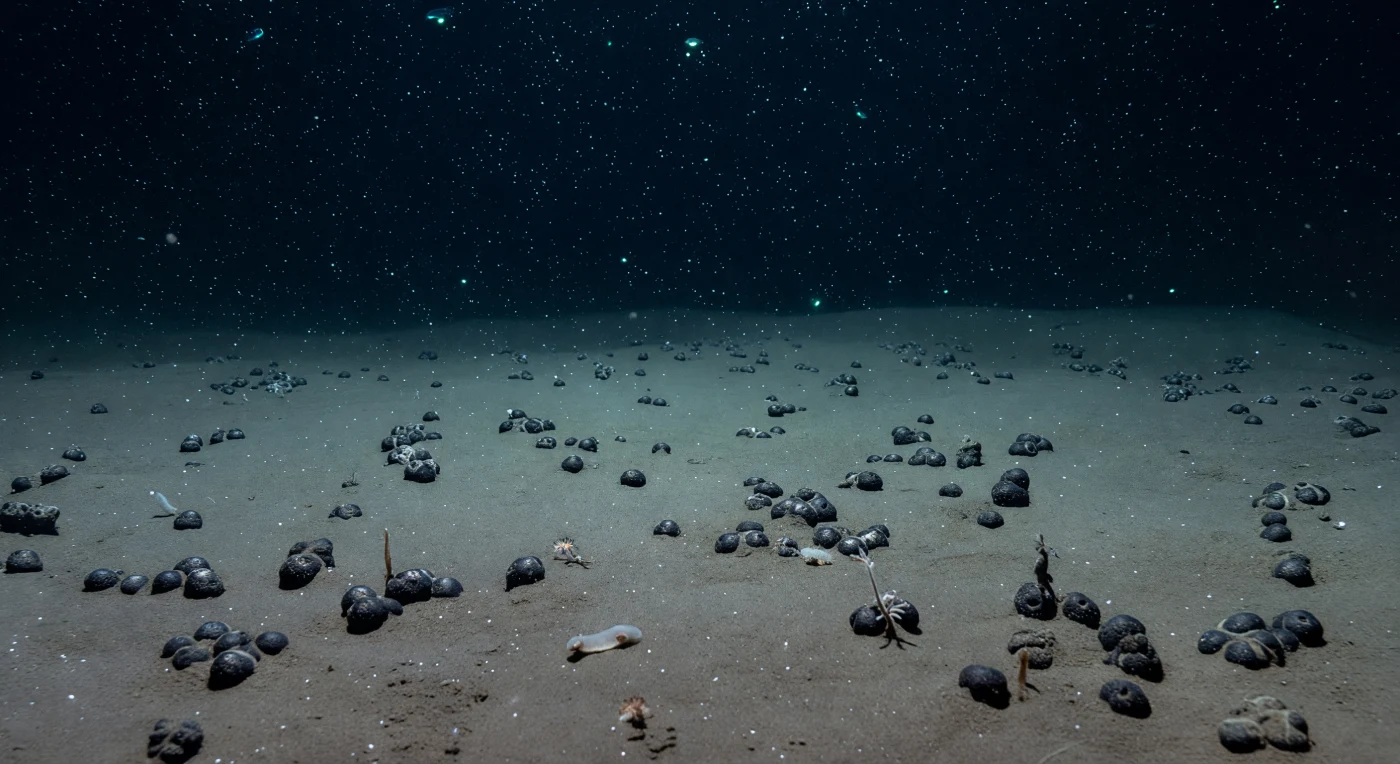
At nearly five kilometers below the surface, where pressure exceeds 500 atmospheres and the water hovers just above freezing, a vast abyssal plain stretches without boundary or relief, its pale taupe sediment dusted across geological time and scattered with dense clusters of polymetallic nodules — black, matte, and faintly metallic, each one a concretion built over millions of years around a shark tooth or fragment of shell, accreting manganese and iron one atomic layer at a time from the surrounding seawater. Marine snow falls through the entire water column in a slow, perpetual drift, each particle a fragment of biological material shed from the sunlit world far above, now descending through absolute darkness to settle on surfaces that have not known light since the Miocene. The only illumination here is the ocean's own: vanishingly faint cold blue-green pulses from gelatinous organisms suspended high in the water column, their bioluminescent flickers appearing as distant cyan specks against blue-black nothing, enough to reveal the powdery texture of the sediment and the sharp edges of the nodules without ever concentrating into a beam. A holothurian traces an imperceptibly slow path across the mud, its soft body navigating between nodule clusters, while a fragile stalked sponge rises from the surface of a single dark stone, and the slender arms of an ophiuroid lie motionless among the shadows — sparse, ancient, and exquisitely adapted to a world of cold, pressure, and near-total stillness. This landscape exists in a register of time and silence entirely its own, untouched and unhurried, as though the rest of the universe has simply not arrived yet.
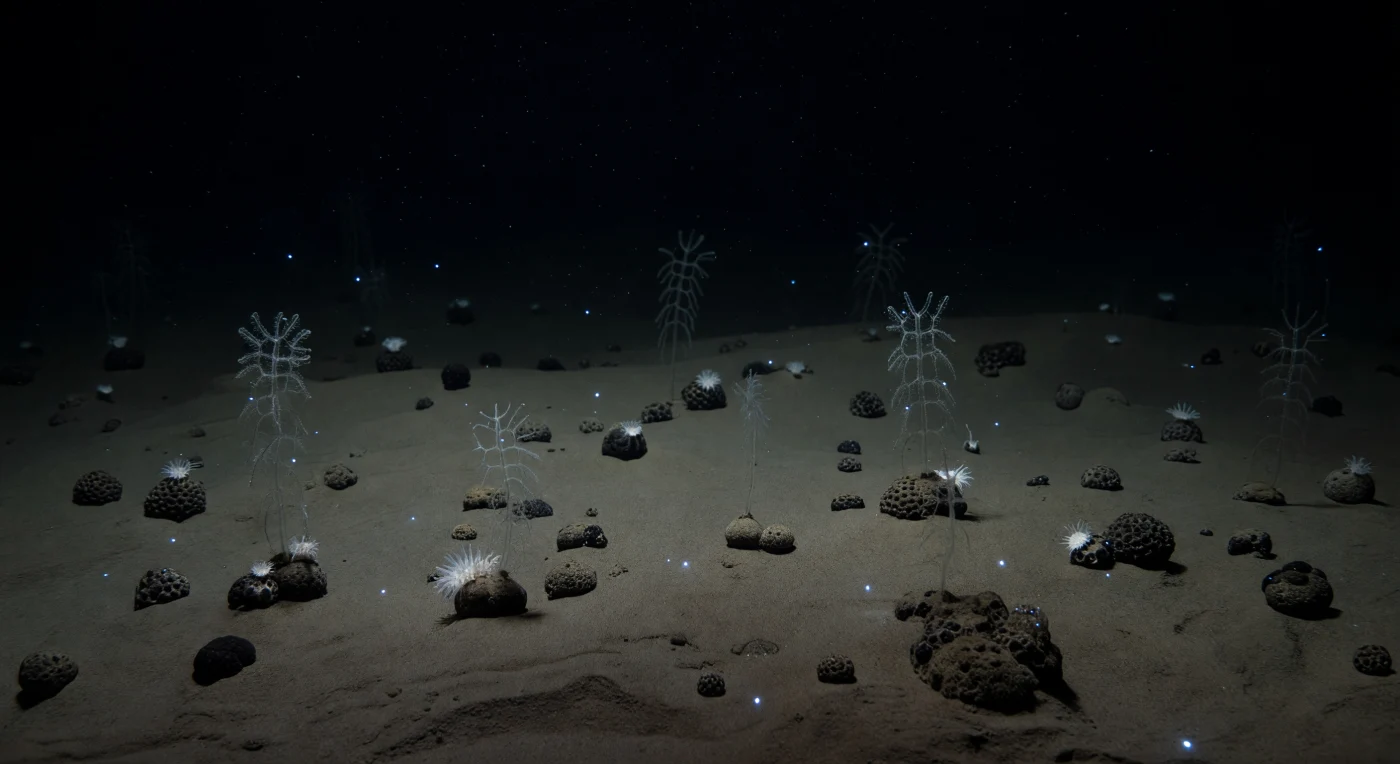
At nearly five kilometres beneath the surface, where pressure exceeds 500 atmospheres and temperatures hover barely above freezing, the abyssal plain of the equatorial Pacific unfolds as an immense, almost featureless expanse of pale grey-brown sediment — a slow accumulation of millennia of marine snow settling onto one of the oldest, quietest floors on Earth. Scattered across this silted plain like dark cobblestones, polymetallic nodules of manganese and iron oxides rise from the mud, each one a geological archive grown at a rate of mere millimetres per million years, their pitted black surfaces offering the only hard substrate for hundreds of kilometres in any direction. From a handful of these isolated nodules, tall hexactinellid sponges extend their intricate silica lattices upward into the darkness, their translucent frameworks catching faint blue-cyan bioluminescent sparks drifting freely through the water column — living flickers produced by organisms whose light has never needed witnesses. Small white actiniarians cling to nodule surfaces and sponge bases with quiet tenacity, their pale bodies barely distinguishable from the ghostly sediment around them, representatives of a benthic community so sparse and slow-growing that a single disturbance could erase centuries of ecological succession. Here, in crushing silence and permanent night, a world of extraordinary fragility persists entirely on its own terms, indifferent to the vast illuminated ocean kilometres above.
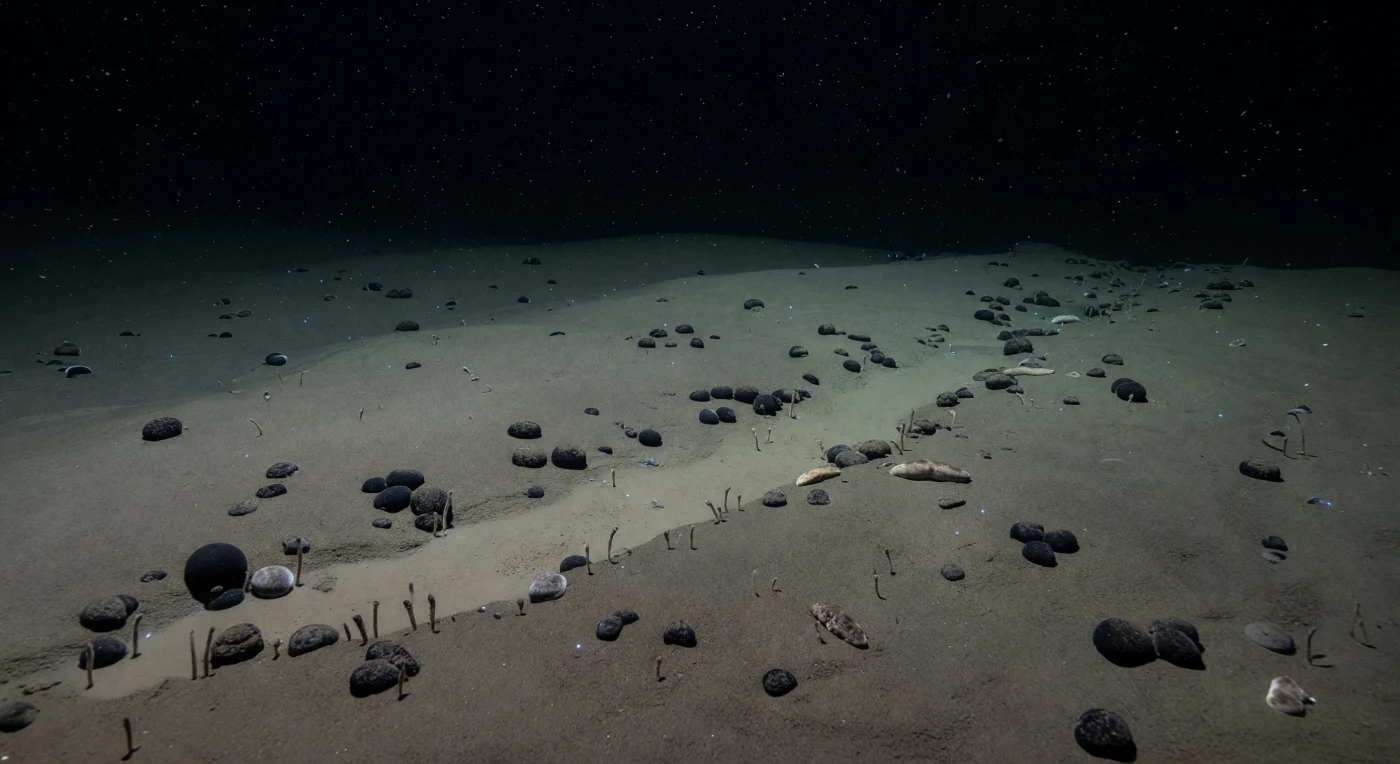
At roughly 4,800 metres below the surface, the abyssal plain of the Clarion–Clipperton Zone lies beneath a crushing hydrostatic pressure of nearly 480 atmospheres, where temperatures hover perpetually around 1.5 to 2 °C and not a photon of sunlight has reached for millions of years. Across this vast, almost featureless terrain, black manganese nodules — each one a geological record spanning thousands to millions of years of slow accretion, layer by layer, around a tiny nucleus — rest half-swallowed by pale grey-brown abyssal mud that carries the finest settling particles of a distant ocean above. In a shallow swale where sedimentation runs slightly deeper, delicate tube-dwelling polychaetes anchor themselves at the sediment margin while holothurians — sea cucumbers whose soft, elongated bodies process vast quantities of mud to extract organic detritus — lie motionless between the nodules, their metabolisms tuned to a world where energy is vanishingly scarce. The only illumination belongs to the organisms themselves: rare, fleeting points of blue bioluminescence cast by invertebrates drifting through the water column above, briefly tracing the matte mineral contours of nodules and the fragile architecture of worm tubes before fading back into absolute darkness. Marine snow — the slow, continuous rain of organic particles from the sunlit world far overhead — drifts through the black water column, sustaining this entire community in a silence so complete and so ancient it reads less like absence than like the ocean's most essential, undisturbed self.
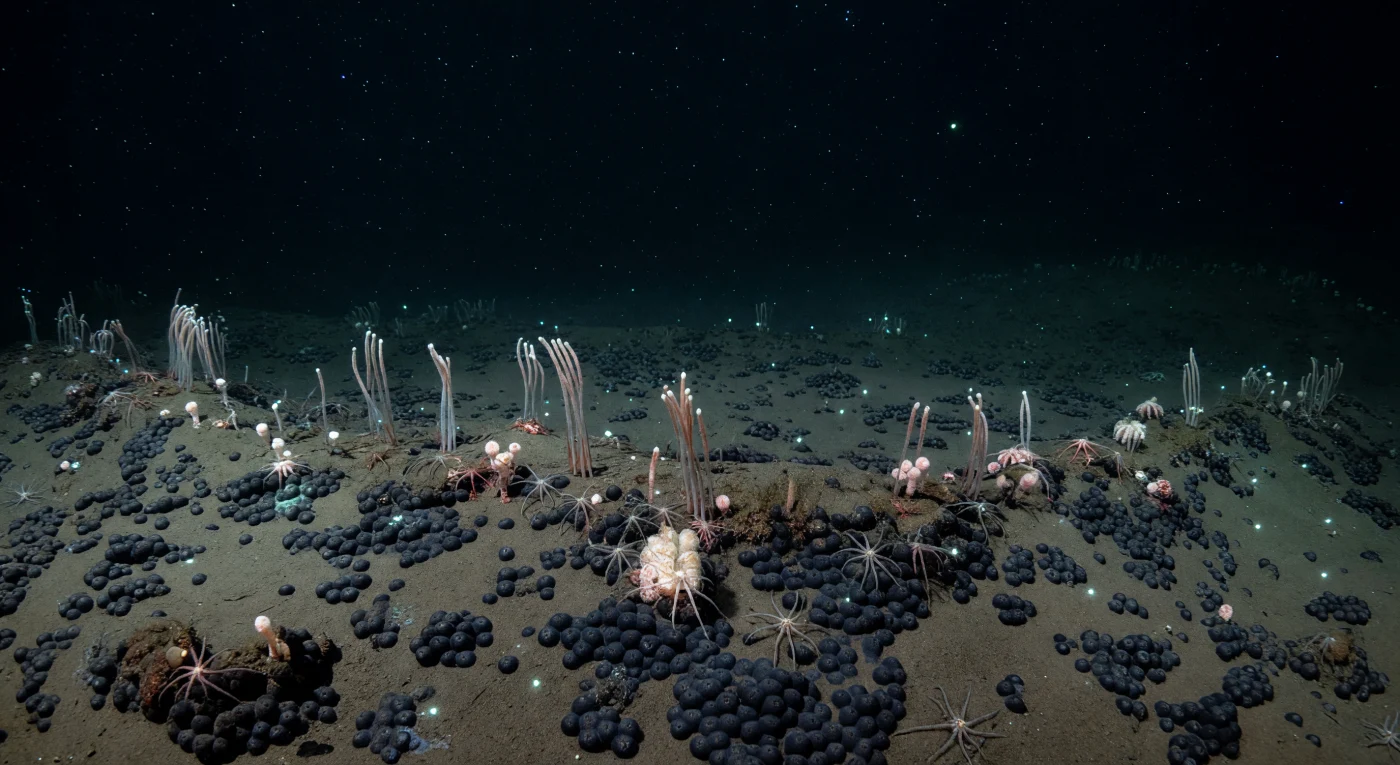
Along a low, ancient ridge rising imperceptibly from the abyssal plain of the Clarion–Clipperton Zone, black manganese nodules cluster thickly in pale silty mud, each one a concretion grown over millions of years at a rate measured in millimeters per million years — among the slowest geological processes on Earth. At roughly 4,800 meters, hydrostatic pressure exceeds 480 atmospheres, water temperatures hover near 2 °C, and not a single photon of sunlight has reached this place since the sediment beneath began accumulating in the Cretaceous; the only light is biological — faint cyan-blue glimmers drifting in the water column as suspended organisms pulse almost imperceptibly, and the softest bioluminescent shimmer tracing the translucent tissues of sea pens rooted between the nodules along the ridge crest. Brittle stars drape their articulated arms across the hard nodule surfaces, feeding on organic particles that descend as marine snow from a sunlit world nearly five kilometers overhead, while sessile sponges anchor themselves to whatever firm substrate the nodules provide in an otherwise yielding mud. The fauna here — pennatulaceans, ophiuroids, hexactinellid and demosponges — are exquisitely adapted to permanent cold, permanent darkness, and permanent stillness, constituting a community so slow-growing and so sparsely distributed that a single physical disturbance could require centuries to leave no trace. This ridge exists in a silence so complete and a darkness so total that life here has never needed to acknowledge a witness.
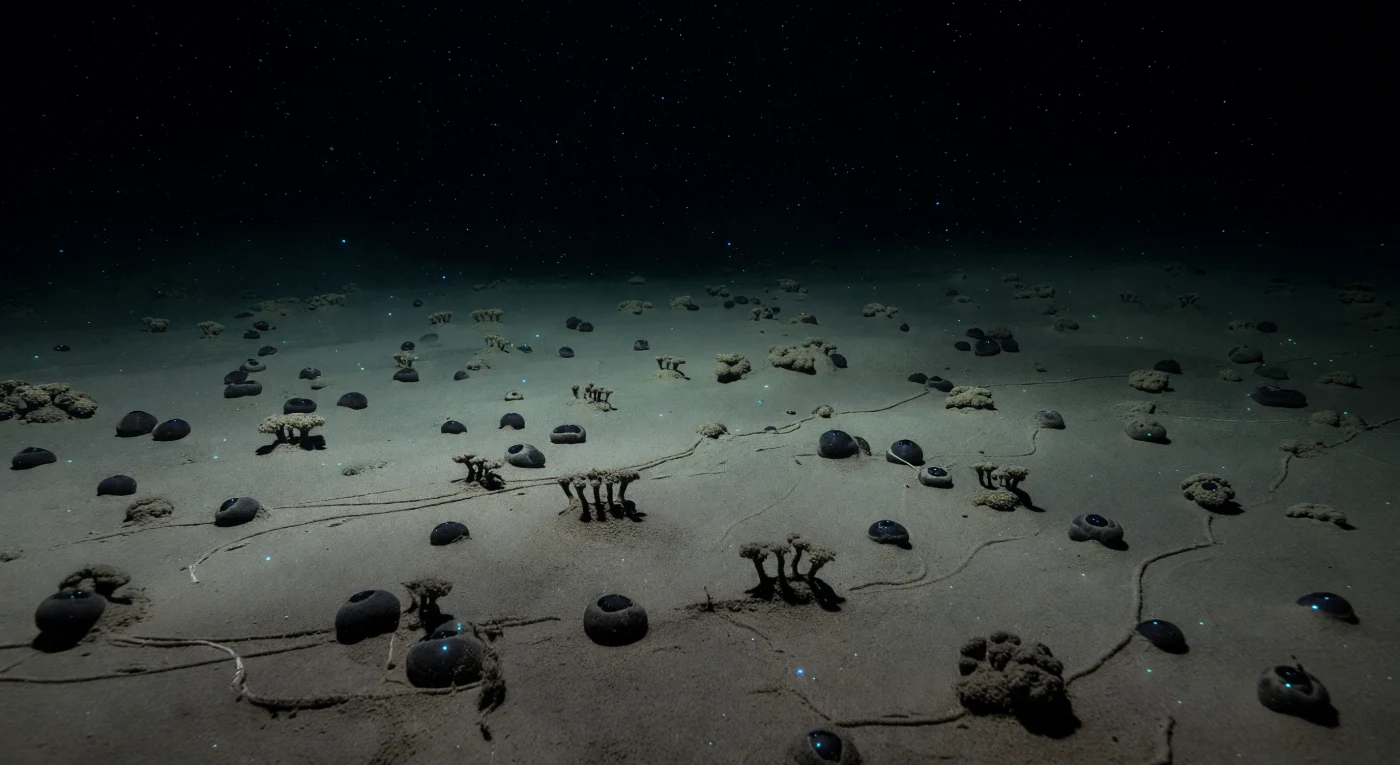
Across the abyssal plain of the Clarion–Clipperton Zone, somewhere between four and five kilometres below the surface, a fresh veil of pale sediment has recently settled over the seafloor, softening every contour into muted taupe and ash, burying the lowest manganese nodules entirely and leaving only the highest ones exposed as dark, polished islands rising from the silt. These nodules, composed of concentric layers of manganese, iron, cobalt, nickel, and copper precipitated from seawater over millions of years at rates measured in millimetres per million years, represent one of the slowest geological processes on Earth, their surfaces now dusted with the same fine detrital rain that perpetually descends from the sunlit ocean far above. Between and upon the protruding nodules, low xenophyophore mounds — giant single-celled organisms among the largest on the planet — retain their fragile irregular forms just above the new silt layer, while thread-fine feeding traces left by holothurians and polychaetes curve in looping furrows across the mud, partially erased yet still legible as evidence of life at pressures exceeding 500 atmospheres and temperatures barely above freezing. No photon from the sun has ever reached this plain; the only light here is the faint, scattered bioluminescence of drifting organisms — cold cyan-blue pinpoints moving slowly through water so stable, so cold, and so dark that the entire landscape exists in a perpetual stillness that human timescales cannot meaningfully hold. This is a world that has never needed witnessing to be complete.
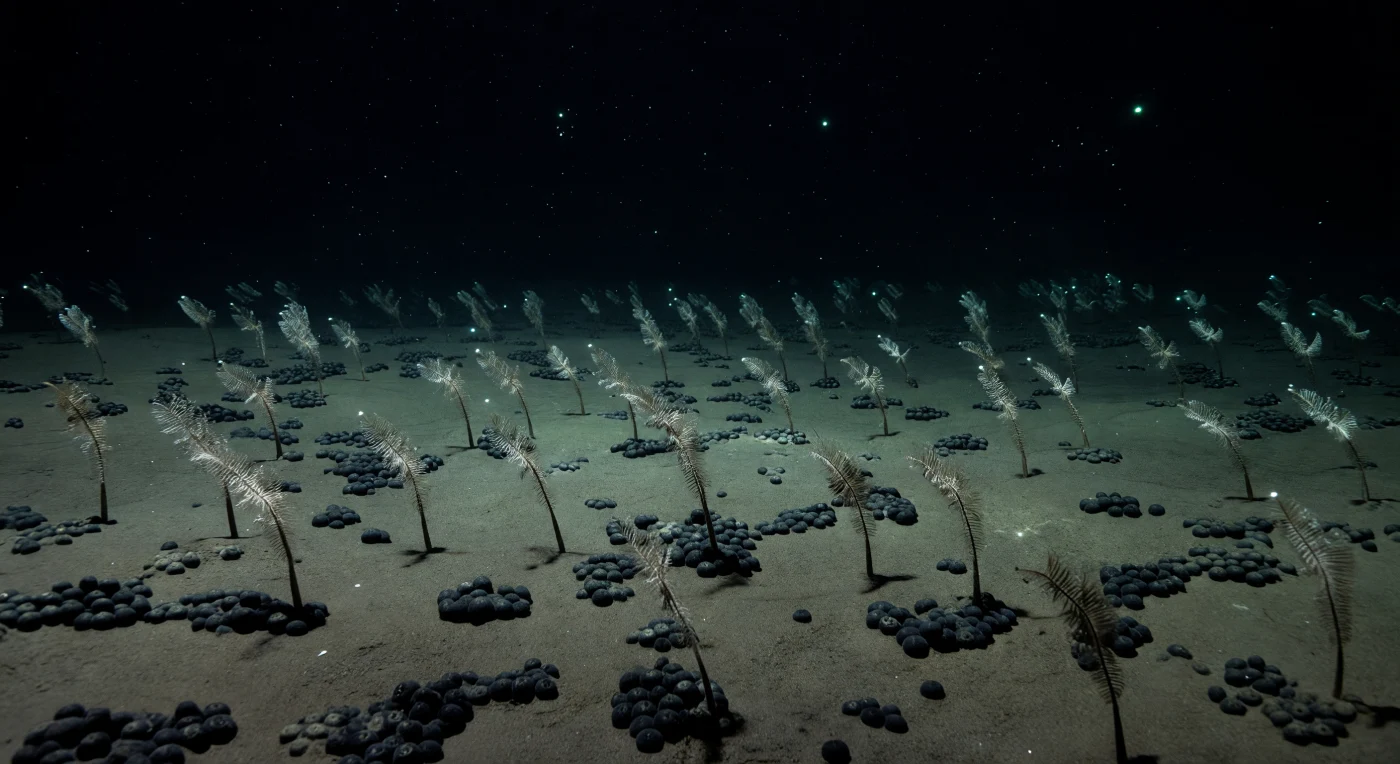
Beneath nearly five kilometres of ocean, where pressure exceeds five hundred atmospheres and the temperature hovers barely above freezing, a vast plain unfolds across the abyssal Pacific in near-total darkness. The seafloor here is a study in geological patience: black manganese nodules, each one the product of millions of years of slow accretion from seawater and sediment pore fluids, lie scattered across pale grey-brown mud like a field of ancient stones, their matte surfaces tracing the subtle topography of a landscape that has not changed in any human timescale. Among and between them, stalked crinoids rise on slender calcite stems, their feathered pinnules fanned open and tilted uniformly by a gentle bottom current — living weather vanes that betray the direction of the abyssal flow, filter-feeding on the sparse organic particles drifting down from the sunlit ocean far above. That organic rain, the marine snow, descends as faint luminous specks, while passing bioluminescent plankton cast a diffuse cyan shimmer that softly traces the rounded contours of each nodule and silvers the delicate crowns of the crinoids without ever concentrating into anything as harsh as a point of light. This is one of the largest and most fragile ecosystems on Earth, spread thinly across millions of square kilometres of abyssal plain, existing in its cold and crushing silence entirely without witness.
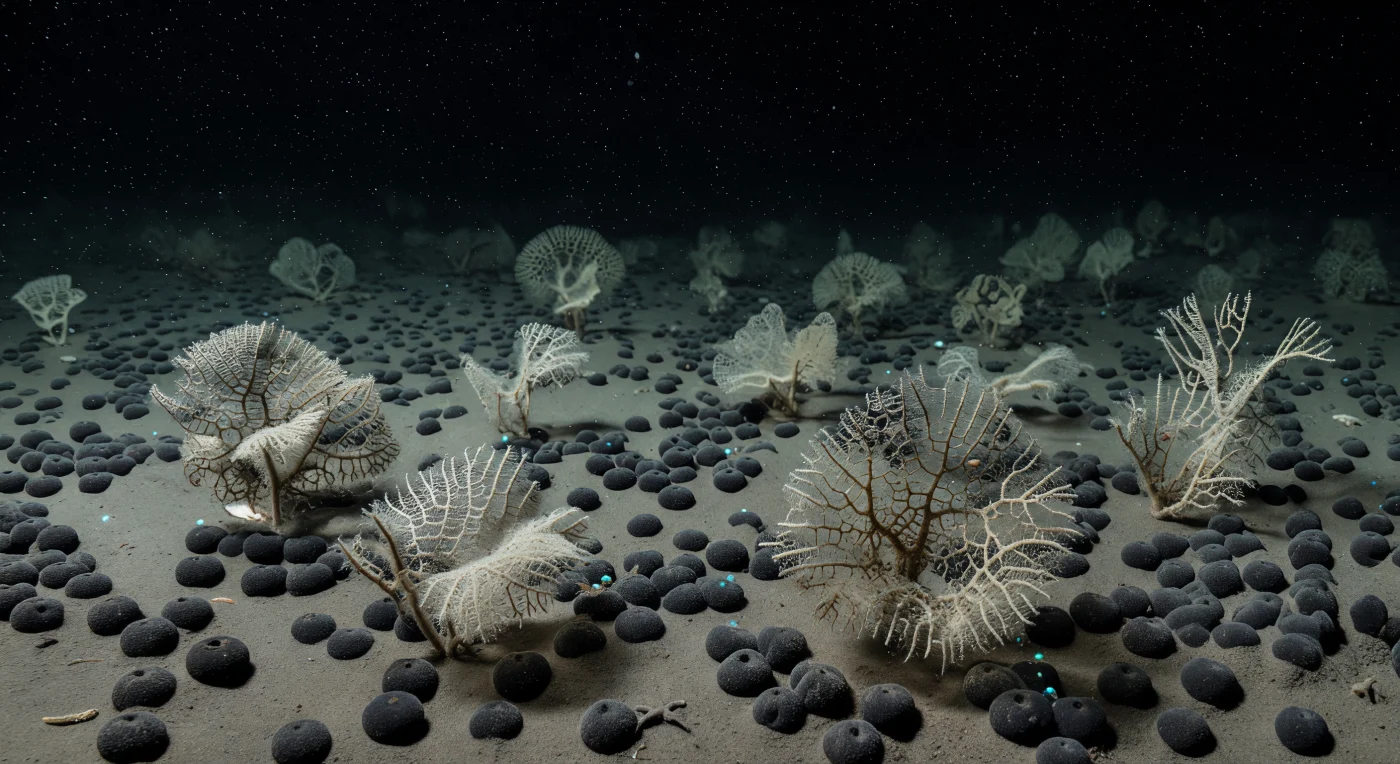
Across the abyssal plain of the Clarion–Clipperton Zone, at depths approaching five kilometers, the seafloor spreads as a near-featureless expanse of pale grey-brown sediment, its surface embedded with countless matte black manganese nodules that have grown at geological pace — accreting at mere millimeters per million years — under pressures exceeding 500 atmospheres and in water barely above freezing. Rising among them, xenophyophores construct some of the largest single-celled organisms on Earth: intricate agglutinated fans of gathered sediment grains, porous and lace-like, held in forms that intercept the perpetual slow drift of marine snow descending from the sunlit ocean far overhead. These giant protists anchor a sparse but finely adapted community — minute translucent crustaceans move through the latticed chambers, their bodies emitting intermittent cyan and blue-green bioluminescent flickers that serve as the only light source across this otherwise absolute darkness, brief cold sparks suspended against black water and black mineral. The seafloor here exists in near-perfect stillness: no photosynthesis, no seasons, no turbulence — only the slow accumulation of particles, the chemical patience of nodule formation, and the quiet metabolic rhythms of organisms that have adapted entirely to pressure, cold, and the near-total absence of energy, in a world that proceeds, immense and unhurried, entirely without witness.
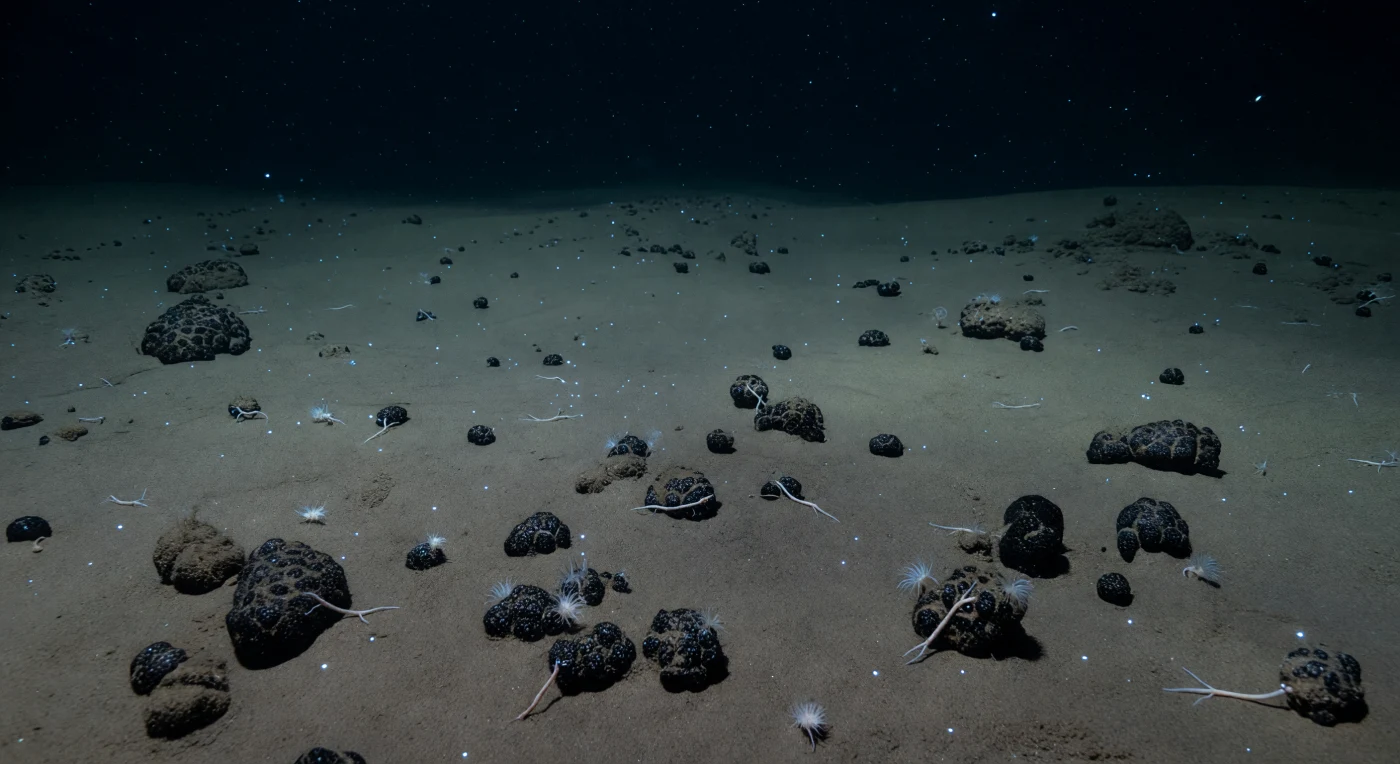
Across the abyssal plain, black polymetallic nodules lie scattered across pale grey-brown sediment in a stillness that has persisted for millions of years — each nodule grown at rates measured in millimetres per million years, accreting layers of manganese, iron, cobalt, and nickel from the slow chemistry of bottom water and sediment pore fluids. At nearly five kilometres beneath the surface, pressure exceeds four hundred atmospheres and the water hovers just above freezing, a thermally stable environment where the only motion is the near-imperceptible drift of marine snow descending from the sunlit world far above. Delicate white anemones anchor themselves to exposed nodule surfaces — the hard substrate offering rare purchase in a landscape otherwise defined by endless soft mud — while pale brittle stars drape loosely across the sediment, their arms extended to intercept organic particles that reach this depth after weeks of slow fall. The scene is not dark in the way a closed room is dark; it is alive with the cold cyan-blue pinpricks of bioluminescence from drifting organisms, the only light that has ever touched this plain, generated by the creatures themselves in a biochemical language entirely independent of the sun. This is one of the most extensive but least disturbed ecosystems on Earth, a slow, pressurized world of extraordinary ecological fragility operating on geological timescales, indifferent to and unaware of anything beyond its own silent chemistry.