At depths between four and six thousand meters, where hydrostatic pressure exceeds four hundred atmospheres and bottom-water temperatures hover near one to two degrees Celsius, a brine pool occupies a shallow depression in the abyssal plain like a sunken sea within the sea — its surface a trembling, steel-gray interface where hypersaline water dense enough to pool and persist separates sharply from the overlying column through a refractive halocline that bends and distorts everything beneath it. Around the pool's margin, pale siliceous-calcareous sediment has been lifted into soft rims, scattered polymetallic nodules rest where slow diagenetic processes settled them over millennia, and irregular white microbial mats cling to the brine edge, metabolizing sulfur compounds and dissolved methane in a chemolithotrophic existence entirely independent of sunlight. No photon from the surface has ever reached this place; the only illumination comes from faint bioluminescent sparks drifting through the water column — ghostly cyan-green points emitted by small gelatinous organisms descending through the dark — and from the cold diffuse glow that the pale microbial films and brine interface scatter almost imperceptibly across the surrounding mud. Beyond the pool, the plain extends as a near-featureless desert of fine settling particles interrupted only by the slow passage of holothurians dragging themselves across the sediment, the delicate arms of brittle stars, and the occasional stalked crinoid anchored to a dropstone fragment — a world of extraordinary patience, pressure, and cold silence that has never required a witness.
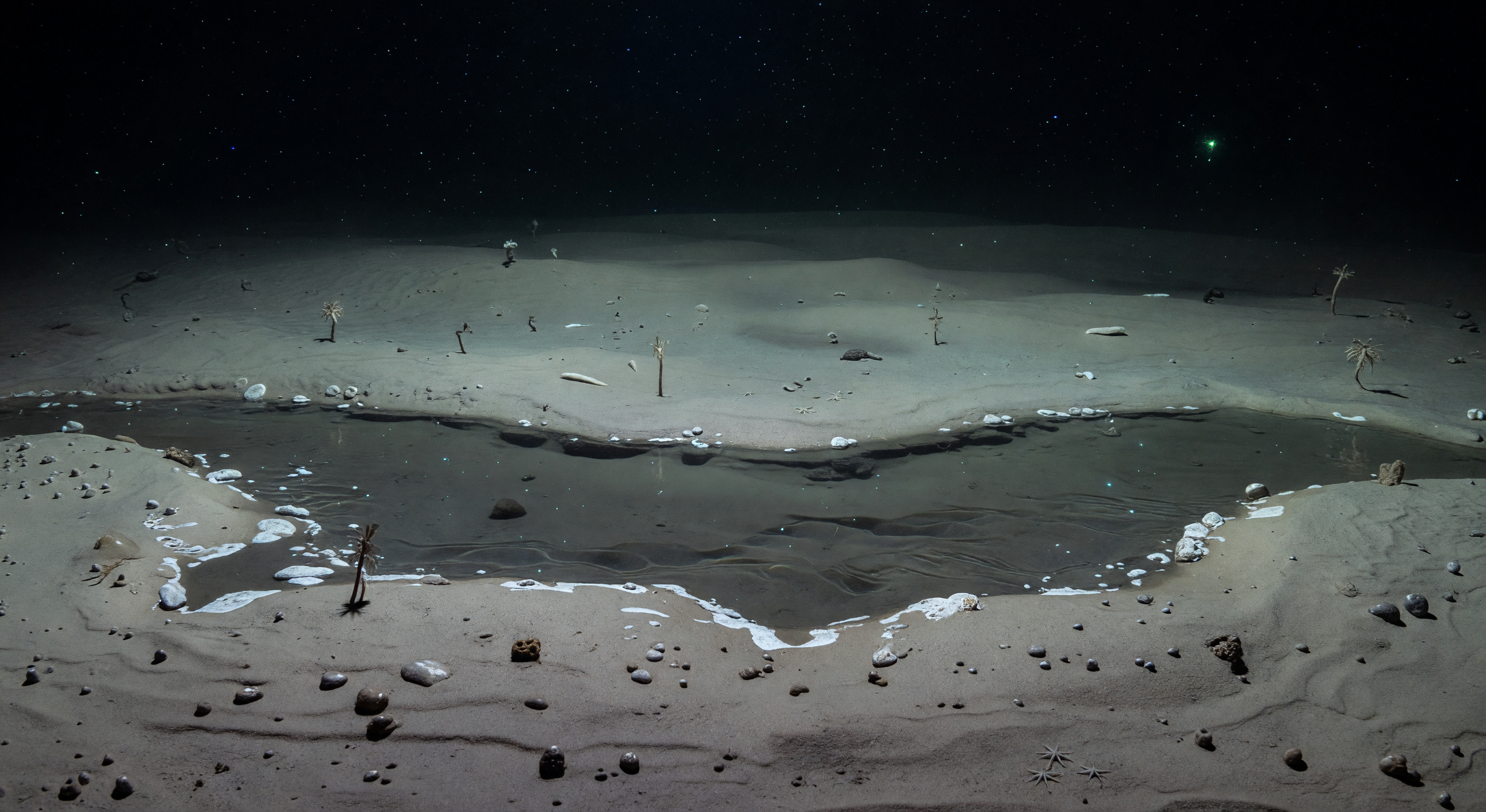
Abyssal plain