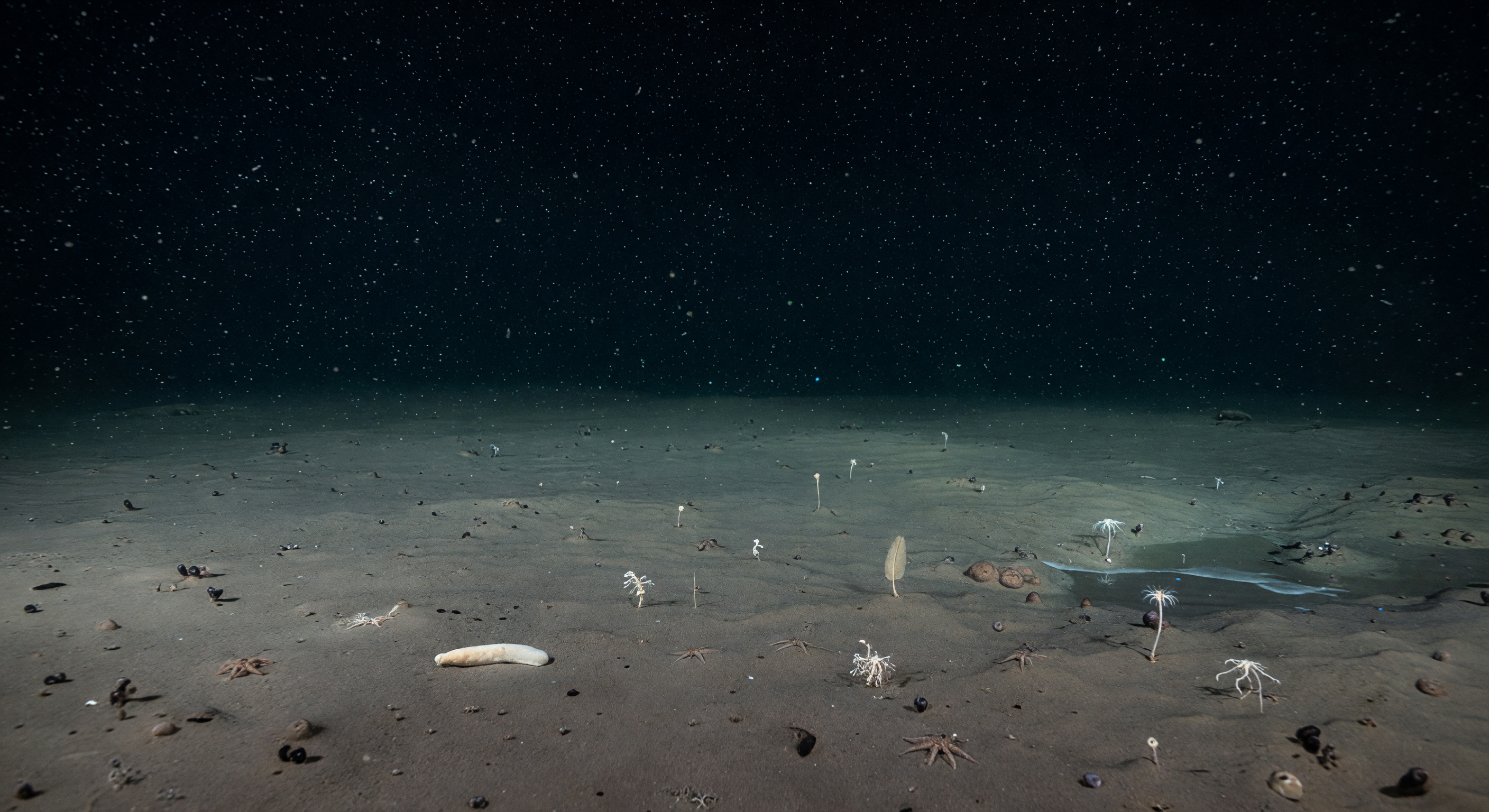
Below roughly four to six kilometers of overlying seawater, where hydrostatic pressure reaches between four and six hundred atmospheres, the abyssal plain extends in near-total silence as one of Earth's most expansive yet least-witnessed landscapes — a cold, still desert of calcareous and siliceous mud stretching without interruption into permanent darkness. Through the entire water column above, a dense pulse of marine snow descends: countless silver-gray organic flecks, aggregated fecal pellets, diatom frustules, and particulate remnants of surface productivity sinking slowly through water just above freezing, each particle a fragment of a biological cycle that links sunlit surface waters to this lightless floor. The only illumination here is biological — intermittent cyan-blue and faint green bioluminescent pinpoints emitted by pelagic organisms and benthic microfauna, so sparse and diffuse that they reveal volume rather than define it, casting no shadows, producing no beams, simply existing as cold chemical light in an otherwise absolute blackness. On the sediment surface below, a pale holothurian rests motionless on fine mud, brittle stars extend arms half-buried in the benthic boundary layer, stalked crinoids rise from rare firmer substrate near scattered manganese nodules, and xenophyophore-like forms — among the largest known single-celled organisms on Earth — occupy their slow and patient niches, all sustained by the continuous rain of organic matter descending from above. This is not emptiness but a world of extreme refinement, tuned over evolutionary time to function under immense compression and perpetual cold, receiving the ocean's slow biological inheritance without pause.
Abyssal plain