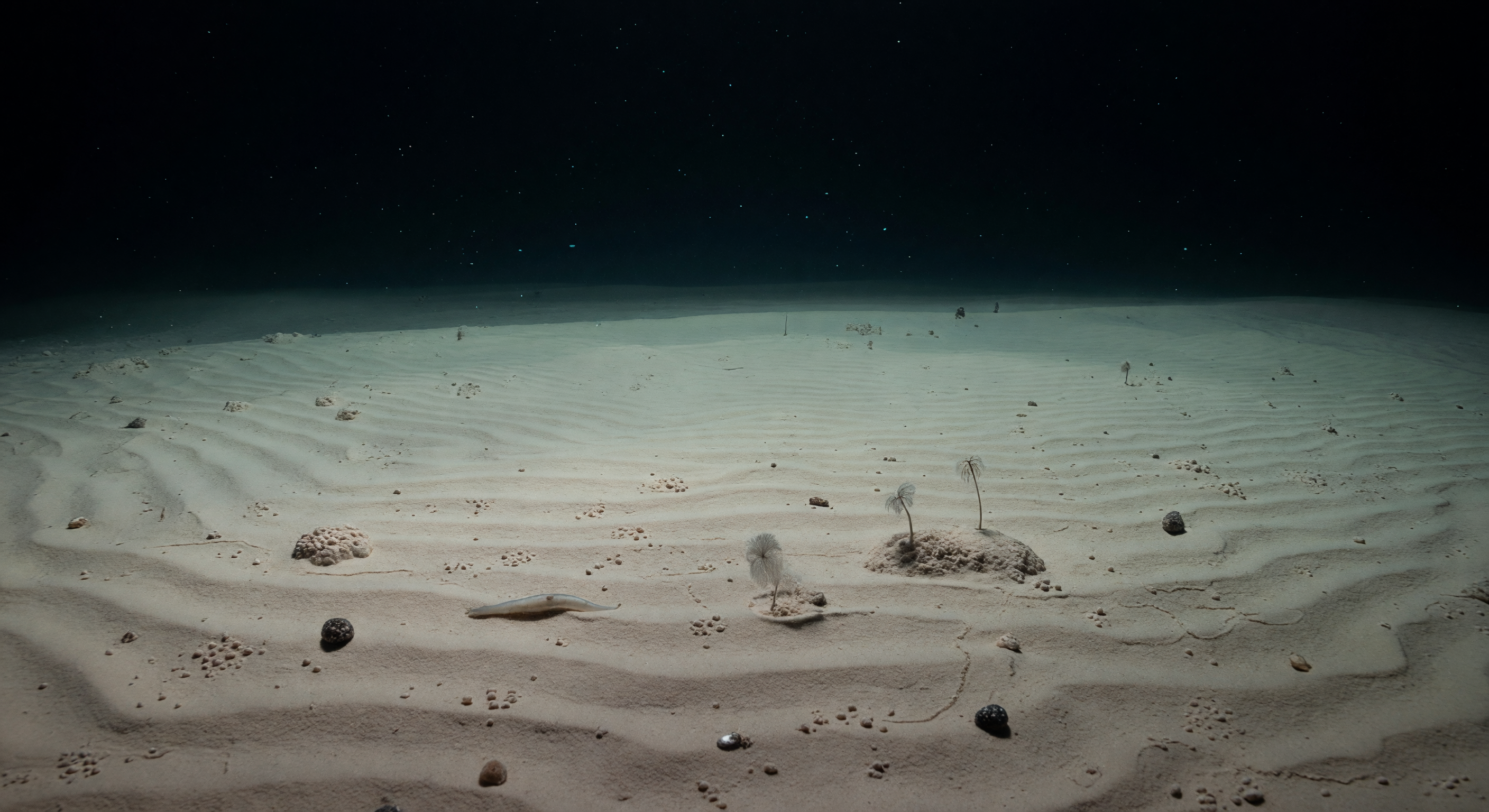
Beneath more than four kilometres of water column, the abyssal plain unfolds as one of Earth's most extensive landscapes — a near-featureless expanse of calcareous ooze composed of the compressed skeletal remains of countless foraminifera and coccolithophores that have rained down from the sunlit surface over millions of years. At pressures approaching 500 atmospheres and temperatures barely above freezing, the sediment surface is sculpted into low, delicate ripples by the faint but persistent thermohaline currents of Antarctic Bottom Water, while tiny burrow mouths and faint bioturbation traces betray the patient labour of unseen polychaetes and deposit-feeding organisms working through the cream-beige mud below. A pale holothurian moves across a shallow trough in the manner characteristic of abyssal holothurians worldwide — methodically ingesting sediment, extracting organic matter from marine snow particles that have drifted down across the entire water column, its body almost the same tone as the ooze itself. Sparse manganese nodules, each one a geological archive of slow accretion at rates of millimetres per million years, rest half-embedded in the fine sediment alongside xenophyophore-like agglutinated forms — among the largest single-celled organisms on the planet. In the water above, drifting specks of bioluminescence punctuate the absolute darkness at intervals, cold cyan pinpricks produced by organisms whose only light is their own chemistry, casting no beam but softly tracing the contours of a world that has existed in this silence, at this depth, entirely without witness.
Abyssal plain