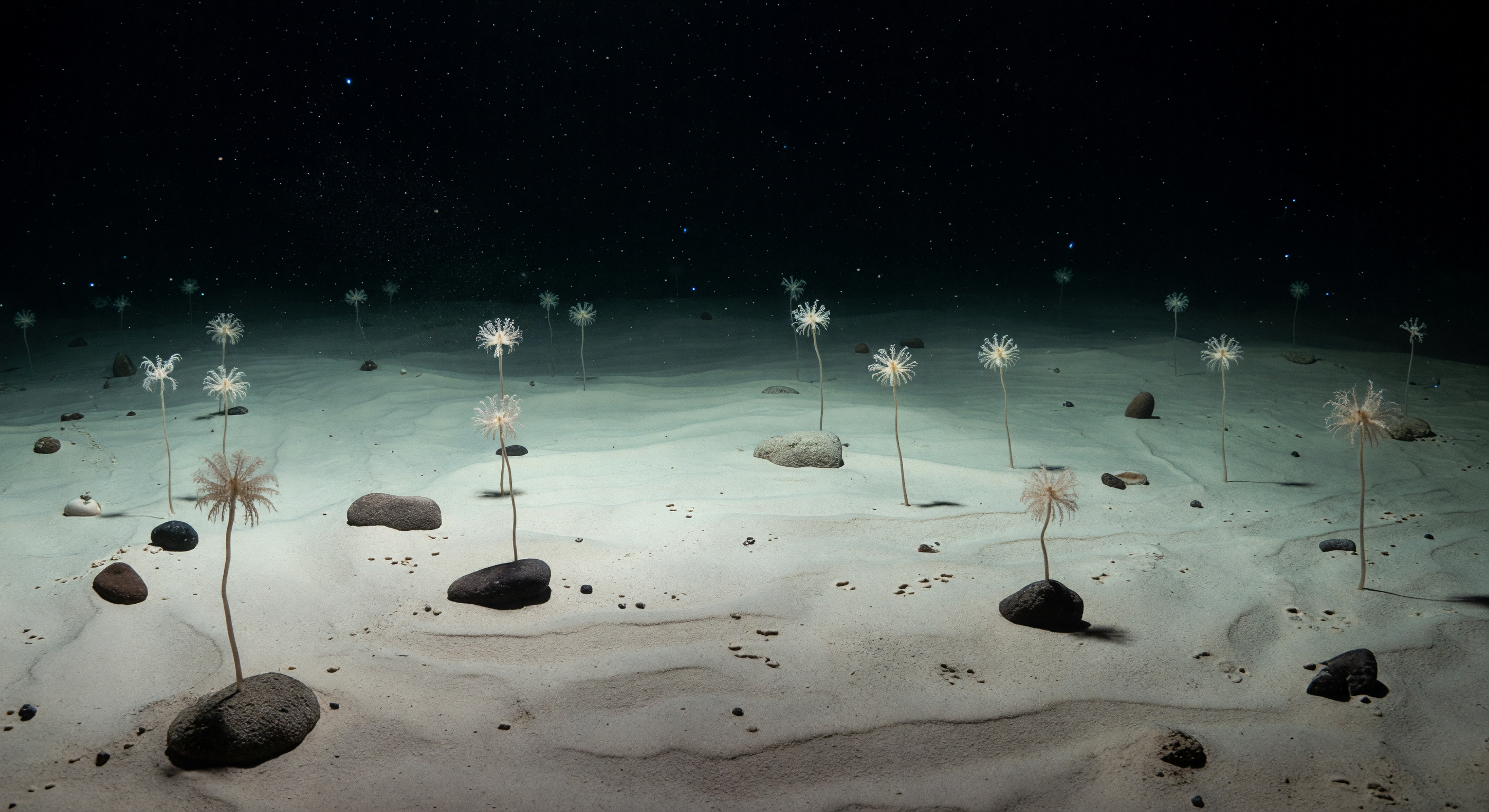
At depths between four and six thousand metres, where hydrostatic pressure exceeds four hundred atmospheres and water temperatures hover near two degrees Celsius, an immense calcareous plain extends in near-perfect flatness into absolute darkness, its cream and grey sediment shaped into low, current-sculpted ripples that record the slow drift of Antarctic Bottom Water moving imperceptibly across the abyssal floor. Isolated dark dropstones — erratic clasts rafted here long ago by icebergs and released as they melted — punctuate the mud desert as the only available hard substrate, and from each one stalked crinoids rise on slender stems, their pale, feathered arms fanned uniformly into the same weak current to intercept the sparse rain of marine snow descending from the sunlit world thousands of metres above. This continuous, gentle flux of particulate organic matter — diatom frustules, fecal pellets, aggregated mucus, the fragmented remains of zooplankton — constitutes the primary energy subsidy sustaining these suspension feeders and the broader benthic community, whose presence is otherwise betrayed only by faint burrow openings, subtle fecal casts, and the occasional dark hemisphere of a polymetallic manganese nodule accreting at geologically imperceptible rates across the siliceous mud. In the water column above, tiny planktonic organisms emit cold blue-green bioluminescent pulses — chemical signals exchanged in a world of permanent darkness, utterly indifferent to any observer — while the plain itself stretches on in crushing stillness, a landscape that has existed, metabolised, and evolved across geological time with no witness but itself.
Other languages
- Français: Crinoïdes Sur Pierres Tombées
- Español: Crinoideos Sobre Clastos
- Português: Crinoides Sobre Pedras Caídas
- Deutsch: Krinoiden Auf Treibsteinen
- العربية: زنابق البحر على الحجارة
- हिन्दी: क्रिनॉइड्स गहरे पत्थरों पर
- 日本語: 深海石に咲く海百合
- 한국어: 낙하석 위의 바다나리
- Italiano: Crinoidi Su Pietre Sommerse
- Nederlands: Crinoïden Op Drijfstenen