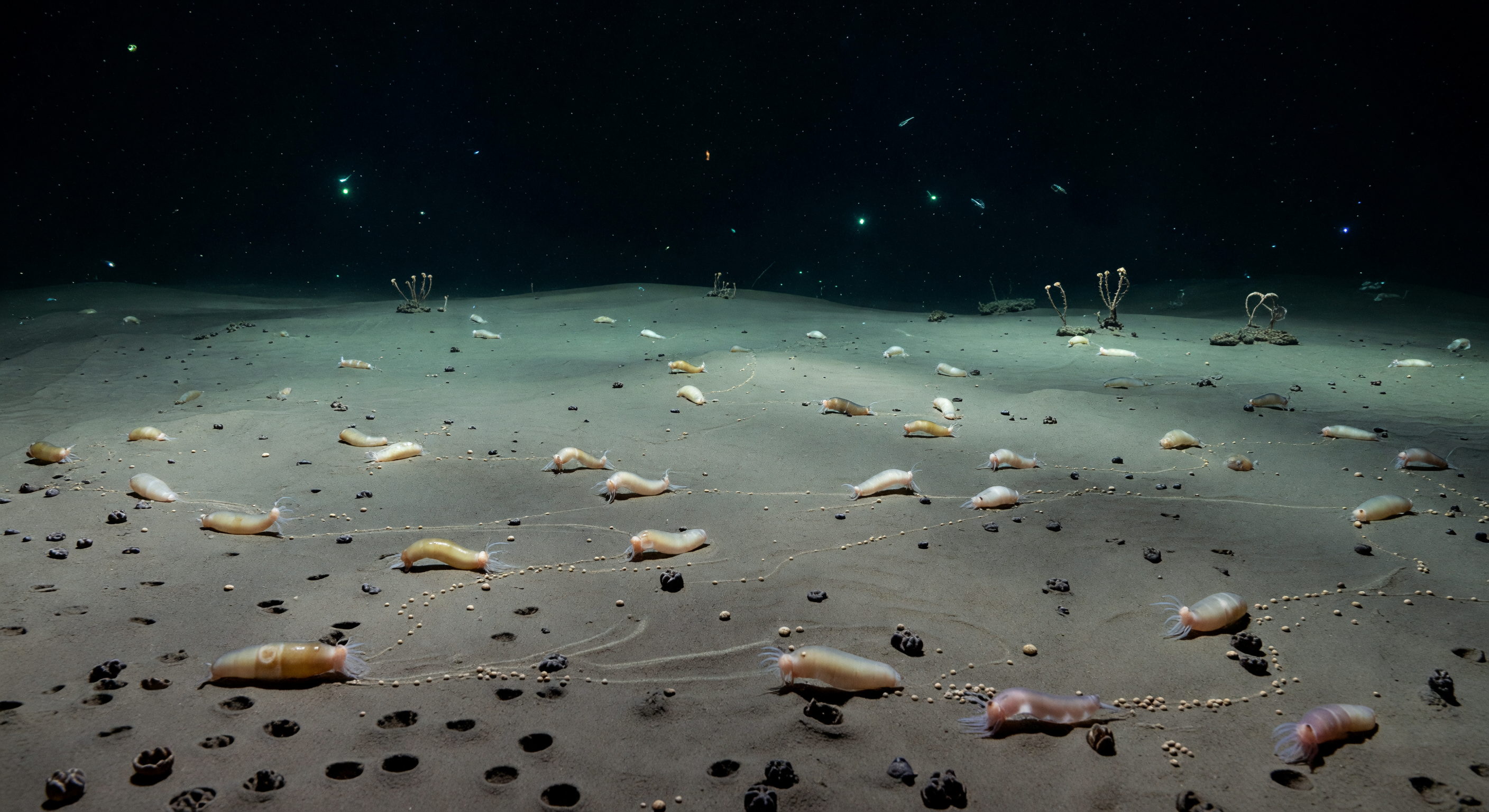
Across thousands of square kilometers of the deep ocean floor, a community of holothurians moves in near-geological slowness through sediment laid down over millions of years — calcareous and siliceous particles, the compacted remains of surface-dwelling organisms that sank through the entire water column before coming to rest here, at pressures approaching five hundred atmospheres, where temperatures hover just above freezing and have done so for longer than most surface landscapes have existed. Each sea cucumber — translucent cream, soft amber, pale pink — leaves behind it a precise record of passage: fresh swaths of disturbed mud, delicate feeding trails, strings of processed sediment pellets that constitute the primary ecological event at this scale, these animals being among the dominant reworkers of the abyssal benthos, processing enormous volumes of sediment and recycling nutrients that would otherwise remain locked in the ooze. Marine snow drifts through the benthic boundary layer in near-imperceptible descent, fine white and beige particles carrying the last organic freight of the sunlit world far above, while scattered blue-green sparks of bioluminescence pulse briefly in the water column — the cold metabolic light of organisms that have never known the sun and require none. Here and there across the vast gray-beige plain, the faint silhouettes of stalked crinoids rise from isolated patches of hard substrate, filtering particles from water that moves in currents too slow and vast to perceive, in a world of absolute calm that has no need of witness to continue its ancient work.
Other languages
- Français: Plaine des Holothuries
- Español: Llanura del Jardín Holotúrico
- Português: Planície do Jardim de Holotúrias
- Deutsch: Holothurien Gartenebene
- العربية: سهل حديقة الخيار البحري
- हिन्दी: समुद्री ककड़ी उद्यान मैदान
- 日本語: ナマコの庭の平原
- 한국어: 해삼 정원 평원
- Italiano: Pianura del Giardino di Oloturie
- Nederlands: Zeekomkommer Tuinvlakte