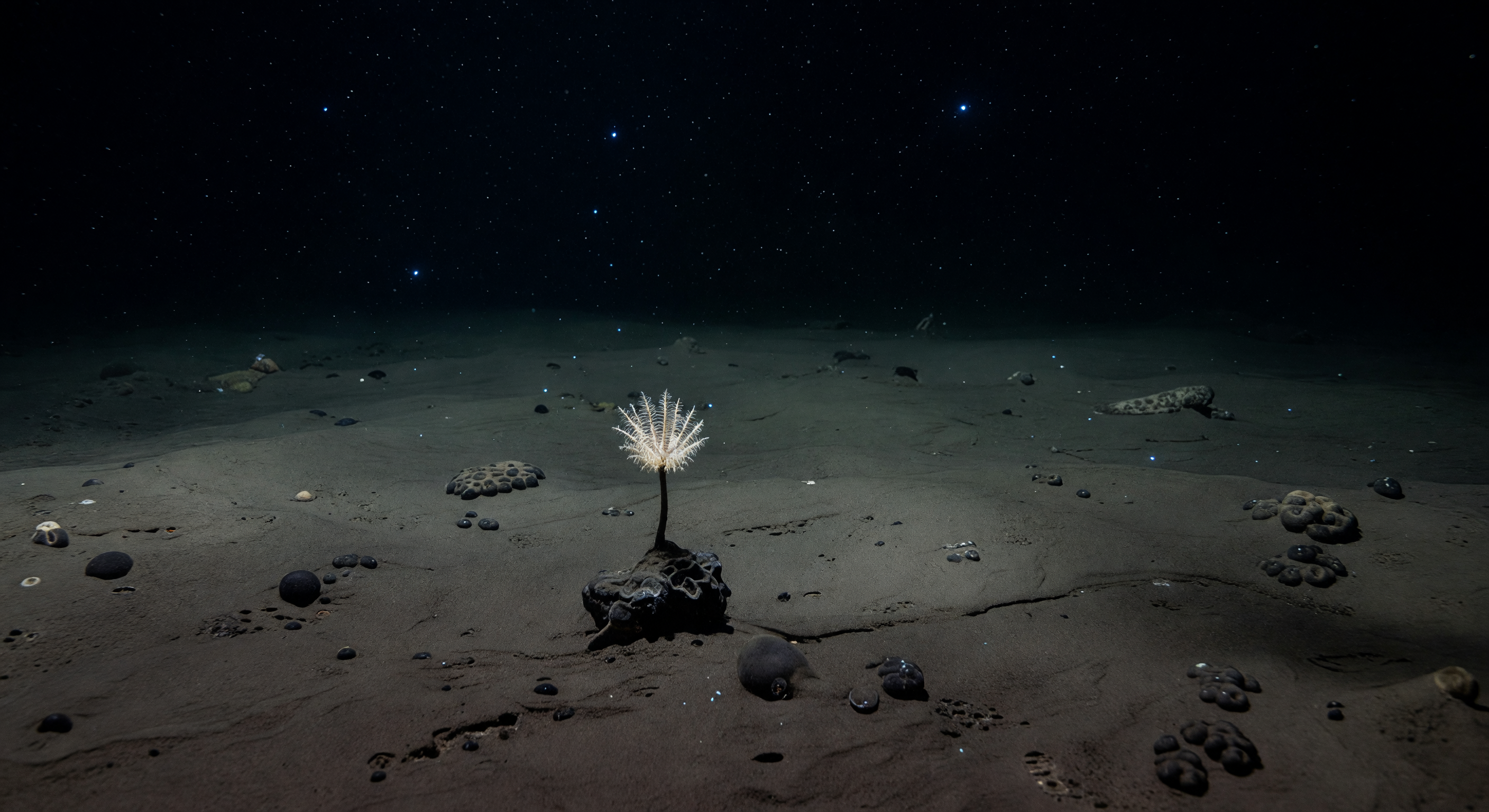
At four to six thousand metres below the surface, where hydrostatic pressure exceeds four hundred atmospheres and water temperatures hover near two degrees Celsius, a single stalked crinoid rises from a polymetallic manganese nodule — one of countless such concretions that litter the abyssal plain like scattered stones across an immense cold desert. The crinoid's slender stalk anchors it to this rare hard substrate, elevating its ivory feathered crown just enough above the surrounding siliceous mud to intercept the near-imperceptible bottom current, each pinnule fanned wide to filter the slow drift of marine snow — the ceaseless soft rain of organic particles, diatom frustules, and faecal pellets descending from the photic zone kilometres above. Across the gently undulating sediment plain, faint bioturbation traces and the distant shapes of holothurians betray the presence of a sparse but persistent benthic community, organisms piezophilic by necessity, their biochemistry tuned to function where no surface life could survive. Occasional blue-cyan bioluminescent sparks drift through the water column — brief chemical signals exchanged in total darkness by organisms that have never known sunlight — while the pale particulates of marine snow drift silently downward, the only visible motion in a world of extraordinary stillness. Here, beyond any reach of surface seasons or human timescales, the abyssal plain continues its slow, pressurized existence: ancient, vast, and absolutely indifferent to being observed.
Other languages
- Français: Crinoïde sur Roche Dure
- Español: Crinoide sobre Roca Firme
- Português: Crinóide sobre Ponto Duro
- Deutsch: Seelilie über Hartgrund
- العربية: زنبق البحر فوق القاع الصلب
- हिन्दी: कठोर बिंदु पर क्रिनॉइड
- 日本語: 硬底に立つウミユリ
- 한국어: 경암 위의 바다나리
- Italiano: Crinoide su Roccia Dura
- Nederlands: Zeelelie op Harde Bodem