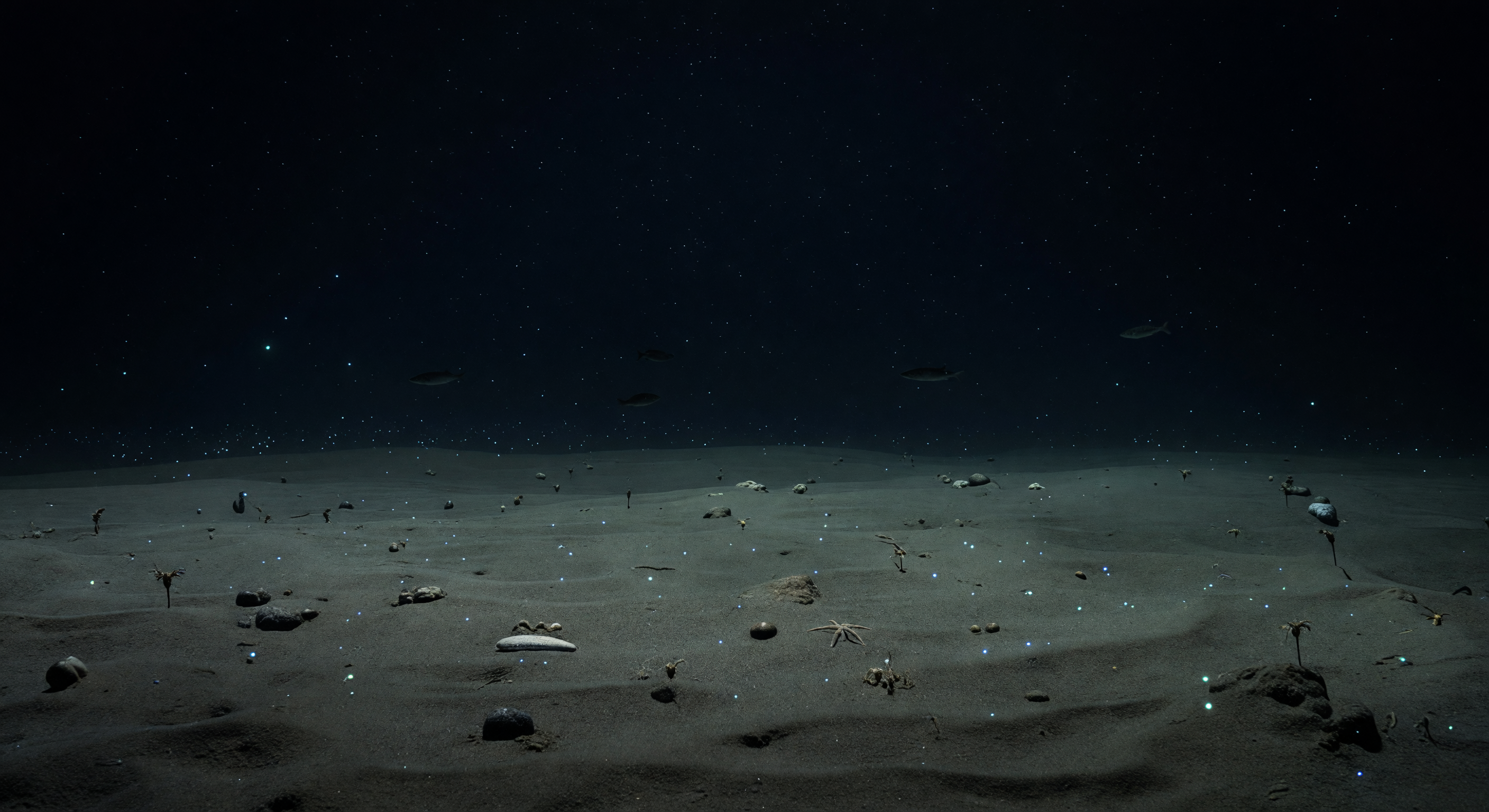
Beyond the reach of any sunlight — extinguished entirely within the uppermost few hundred metres of the ocean — an immense plain of grey-brown calcareous and siliceous mud stretches away into soft black obscurity at depths where hydrostatic pressure exceeds 400 to 600 atmospheres, cold bottom water hovers near 2 °C, and time seems to move only in the slow drift of marine snow settling from the world above. Scattered polymetallic manganese nodules, formed grain by grain over millions of years, punctuate the rippled sediment alongside faint burrow traces and fecal casts — evidence of polychaetes, holothurians, and brittle stars working the ooze in near-total darkness. In the thin benthopelagic layer just above the seafloor, small crustaceans drift and pulse, their bodies occasionally releasing blue-green bioluminescent sparks that blink and vanish — brief chemical light that serves as the only illumination this world has ever known. A few ghost-pale fish silhouettes hover at the margin between mud and water column, shaped by evolution into forms suited for crushing pressure, perpetual cold, and the scarcity of food that characterises one of Earth's largest and least-visited ecosystems. This is the abyssal plain as it has always existed: vast, patient, and entirely indifferent to being witnessed.
Other languages
- Français: Marge Benthopélagique Silencieuse
- Español: Margen Bentopelágico Quieto
- Português: Margem Bentopelágica Serena
- Deutsch: Stille Benthopelagische Grenze
- العربية: هامش قاعي هادئ
- हिन्दी: शांत गहन समुद्री सीमा
- 日本語: 静かな底層境界域
- 한국어: 고요한 심해 경계
- Italiano: Margine Bentopelágico Silenzioso
- Nederlands: Stille Benthopélagische Rand