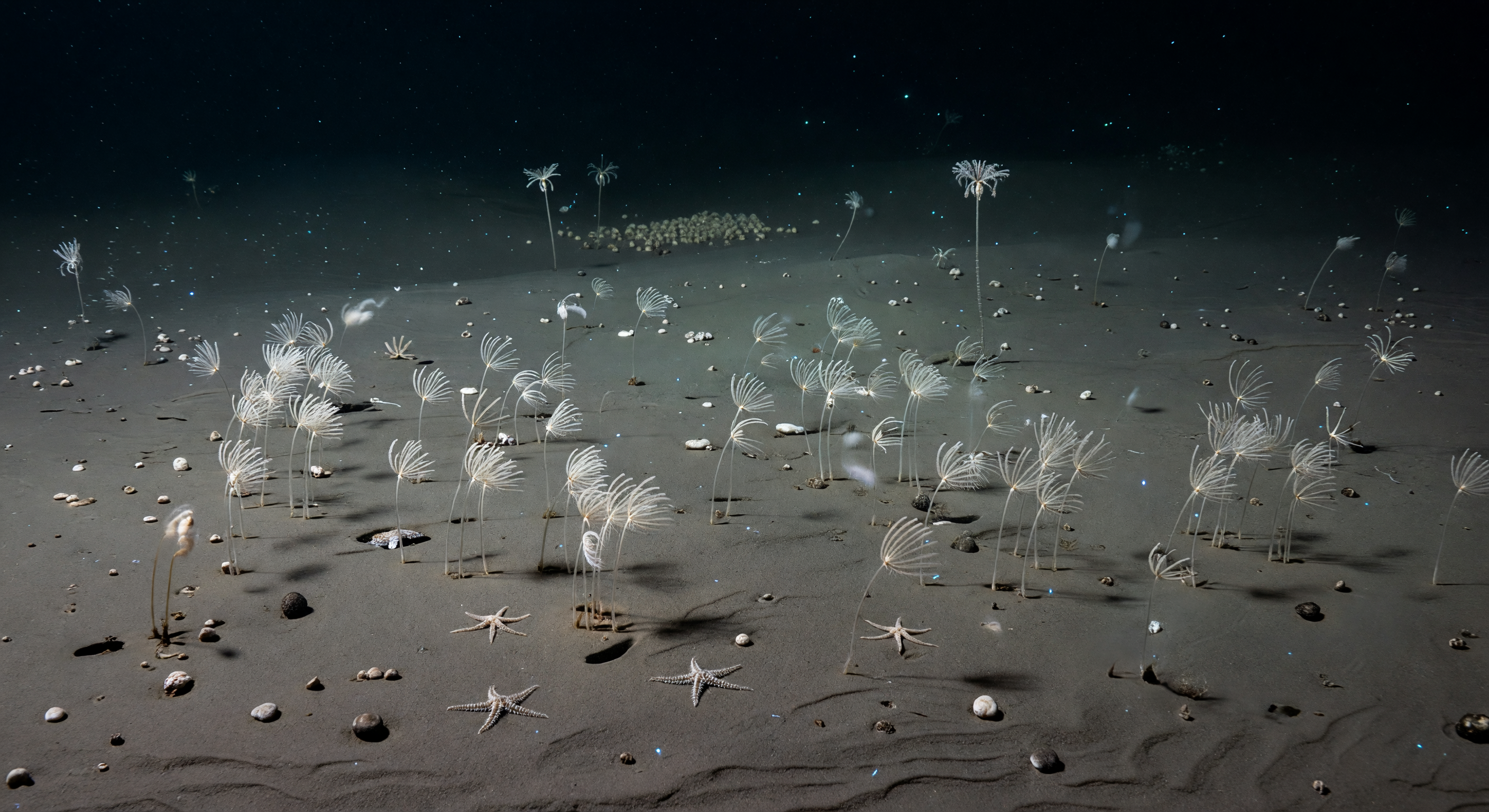
At depths where pressure exceeds 400 atmospheres and water temperatures hover near 1–2 °C, the abyssal plain unfolds as one of Earth's most expansive yet least-witnessed landscapes — a near-level expanse of siliceous and calcareous mud stretching beyond any perceivable horizon, its surface gently sculpted by current ripples and punctuated by faint burrow openings, scattered polymetallic nodules, and the minute fecal castings of invertebrates processing sediment grain by grain. Here, a colony of pale pennatulaceans rises from the soft substrate, their translucent stems and feathered fronds inclined uniformly by a slow thermohaline-driven near-bottom flow, while brittle stars lie draped low against the sediment and a stalked crinoid anchors itself to a nodule's hard surface some distance back — each organism an exquisite solution to life under crushing pressure and near-total food scarcity, sustained almost entirely by the rain of marine snow descending from the sunlit world thousands of meters above. In the absolute darkness, bioluminescent motes flicker intermittently in cold cyan and dim green — metabolic signals, defensive flashes, or chance chemical reactions — briefly edging the sea pen fronds and illuminating drifting floc as it moves silently between the colony's stems. This is an ecosystem running on geological patience, where every particle settling onto the sediment surface, every organism's slow metabolism, and every current's imperceptible push constitute the full measure of a world that has never required light, warmth, or witness to persist.
Other languages
- Français: Dérive de Colonie de Plumes
- Español: Deriva de Colonia Marina
- Português: Deriva da Colônia Abissal
- Deutsch: Seefeder Kolonie Drift
- العربية: انجراف مستعمرة قلم البحر
- हिन्दी: समुद्री पंख उपनिवेश प्रवाह
- 日本語: 海の羽根群れ漂流
- 한국어: 바다 펜 군락 표류
- Italiano: Deriva Colonia Penne Marine
- Nederlands: Zeepen Kolonie Drift