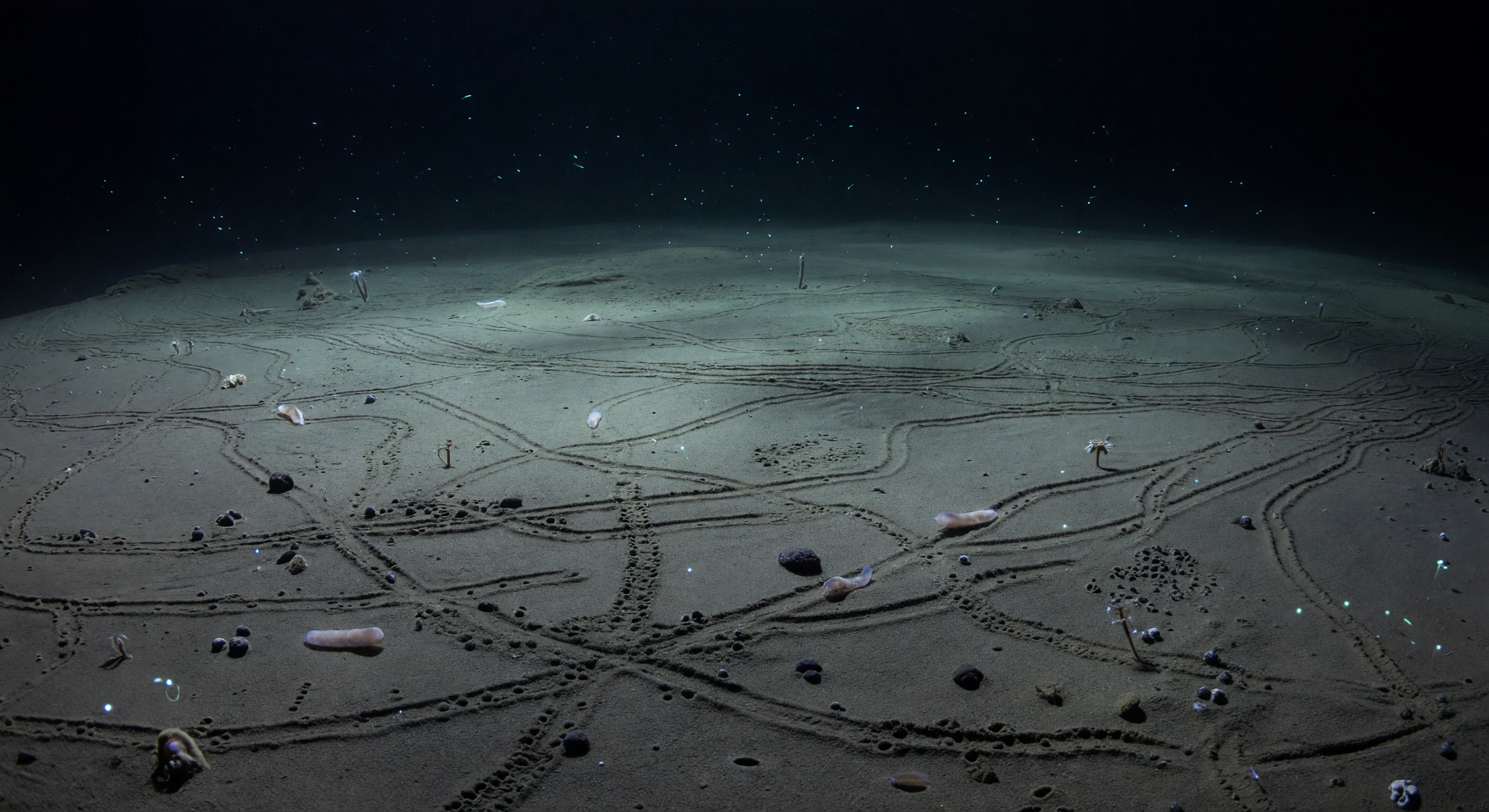
At four to six thousand metres below the surface, where hydrostatic pressure reaches forty to sixty megapascals and bottom-water temperatures hover near one to two degrees Celsius, an abyssal plain stretches in near-perfect flatness across some of the largest uninterrupted terrain on Earth. The fine siliceous and calcareous mud here is a slow archive of the ocean above — built grain by grain from the sinking remains of surface plankton, its surface inscribed now by the unhurried passage of several holothurians, their soft cream and faint lilac bodies moving just above the substrate, drawing feeding furrows and leaving chains of fecal casts that intersect older trackways in a dense, palimpsest mosaic. Scattered manganese nodules interrupt the sediment surface, each ringed by delicate erosional halos, while stalked crinoids grip rare hard fragments at the edge of visibility, and tiny burrow openings hint at a polychaete and meiofaunal world hidden entirely within the mud. Marine snow descends through the aphotic water column in slow suspension, each particle a fragment of photosynthetic life that ceased at the surface months or years ago, and the only illumination here is biological — sparse blue-green bioluminescent points adrift in the boundary layer, their scattered glow softly tracing the relief of tracks and casts before the plain dissolves, without boundary or horizon, into cold and absolute blackness.
Abyssal plain