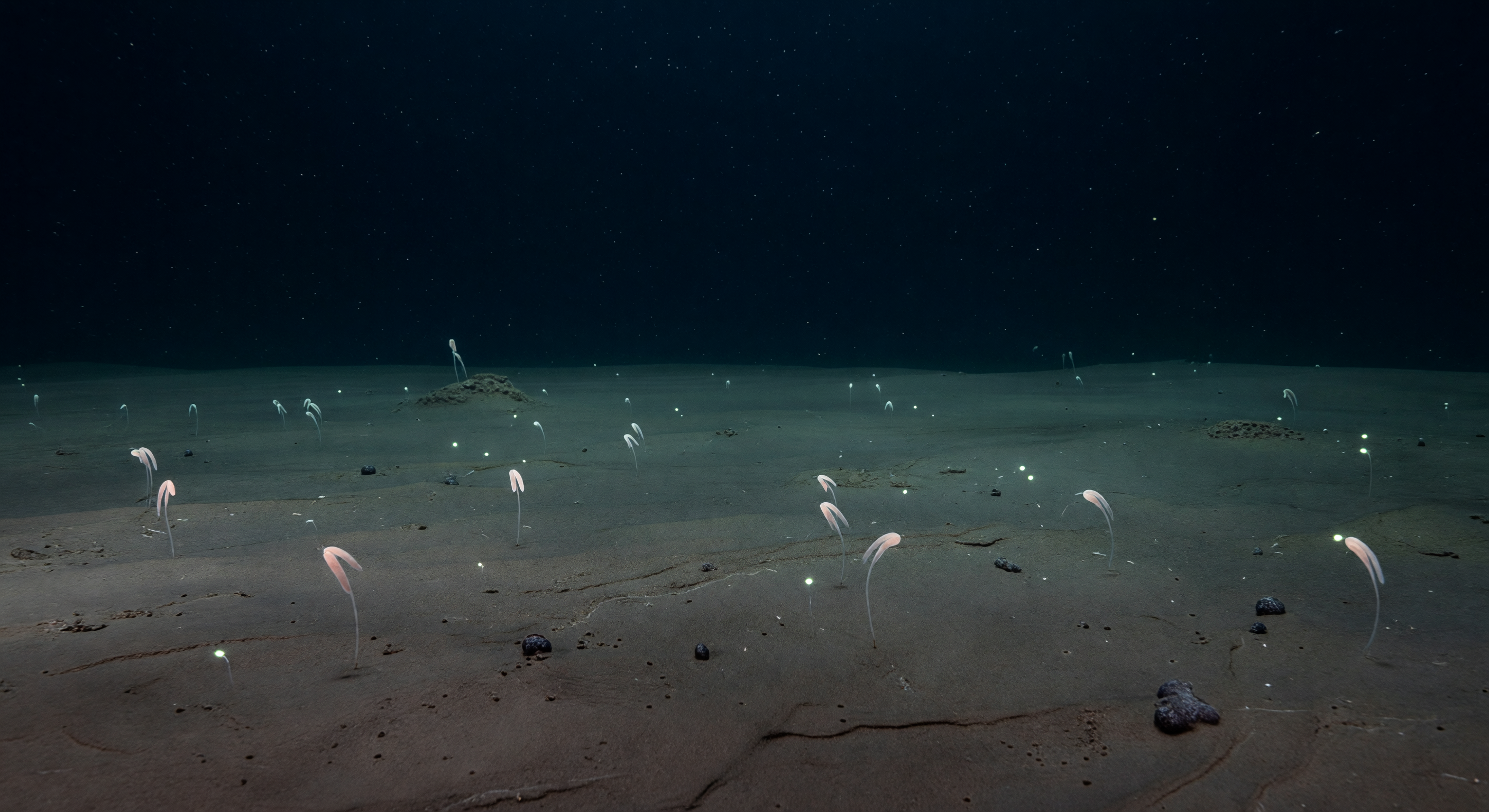
At four to six thousand metres below the surface, where hydrostatic pressure reaches forty to sixty megapascals and bottom-water temperatures hover near one to two degrees Celsius, the abyssal plain unfolds as an almost perfectly level terrain of calcareous and siliceous ooze — the accumulated slow rain of planktonic remains, settling over millions of years onto ancient oceanic crust. Sea pens, colonial octocorals of the order Pennatulacea, rise at wide intervals from the soft sediment, each one anchored by a muscular peduncle buried in the mud, its rachis angled consistently by the weak abyssal boundary-layer current that skims this lightless floor; their ghost-white and faintly peach-translucent tissues represent extraordinary biochemical adaptation to crushing pressure and near-freezing cold, with enzyme systems tuned for function where no sunlight has ever reached. Scattered across the surrounding sediment, faint fecal casts and burrow openings betray the invisible industry of holothurians and polychaetes working through the ooze, while manganese nodules — concretions built over millions of years around nuclei of bone or shell fragment — sit half-buried as dark spheres at the sediment surface. Fine marine snow drifts continuously downward through the water column above, each particle a fragment of surface productivity that has traveled weeks to arrive here, carrying the only meaningful flux of organic energy into this cold, pressurized desert. Occasional bioluminescent pulses from drifting zooplankton and small benthic organisms briefly outline the nearest sea pen quills against the ink-dark void, a world complete and ancient in its silence, utterly indifferent to any witness.
Other languages
- Français: Intervalle des Plumes Marines
- Español: Intervalo de Plumas de Mar
- Português: Intervalo das Penas do Mar
- Deutsch: Meeresfedern Zwischenraum
- العربية: فاصل أقلام البحر
- हिन्दी: समुद्री पंख अंतराल
- 日本語: 海のペンの静寂
- 한국어: 바다 펜 사이의 공간
- Italiano: Intervallo delle Penne Marine
- Nederlands: Zeepen Tussenruimte