Across the abyssal plain at depths where pressure exceeds 400 atmospheres and bottom water hovers near 2°C, the finest siliceous and calcareous particles settling from the surface over millennia have built a soft, pale mud that receives the remains of the world above in the form of perpetual marine snow — tiny pale fragments drifting downward through near-freezing water in absolute silence. Resting lightly on this sediment, xenophyophores — among the largest single-celled organisms on Earth — form their characteristic reticulate frameworks of agglutinated particles, their off-white and taupe lace-like bodies accumulating barium sulfate crystals and functioning as microhabitat for meiofauna sheltering within their delicate architecture. These giant foraminifera grow slowly in the complete absence of sunlight, sustained not by photosynthesis but by the steady rain of organic detritus from the photic zone thousands of meters above, their fragile geometries scattered at irregular intervals across the plain and receding into the surrounding darkness at the scale of a vast, unpeopled desert. Sparse cold cyan and blue-green bioluminescent sparks drift just above the sediment surface — produced by the chemical signaling systems of organisms whose light serves communication, predation, and defense in a world where no solar photon has ever penetrated — faintly tracing the contours of the xenophyophore lace field and the low sediment relief of burrow casts and faint ripple marks left by weak thermohaline bottom currents. Here the biosphere continues its ancient work entirely on its own terms, governed by pressure, cold, particle flux, and chemical gradients, indifferent to anything beyond the slow accumulation of sediment and the dim, living light of its own inhabitants.
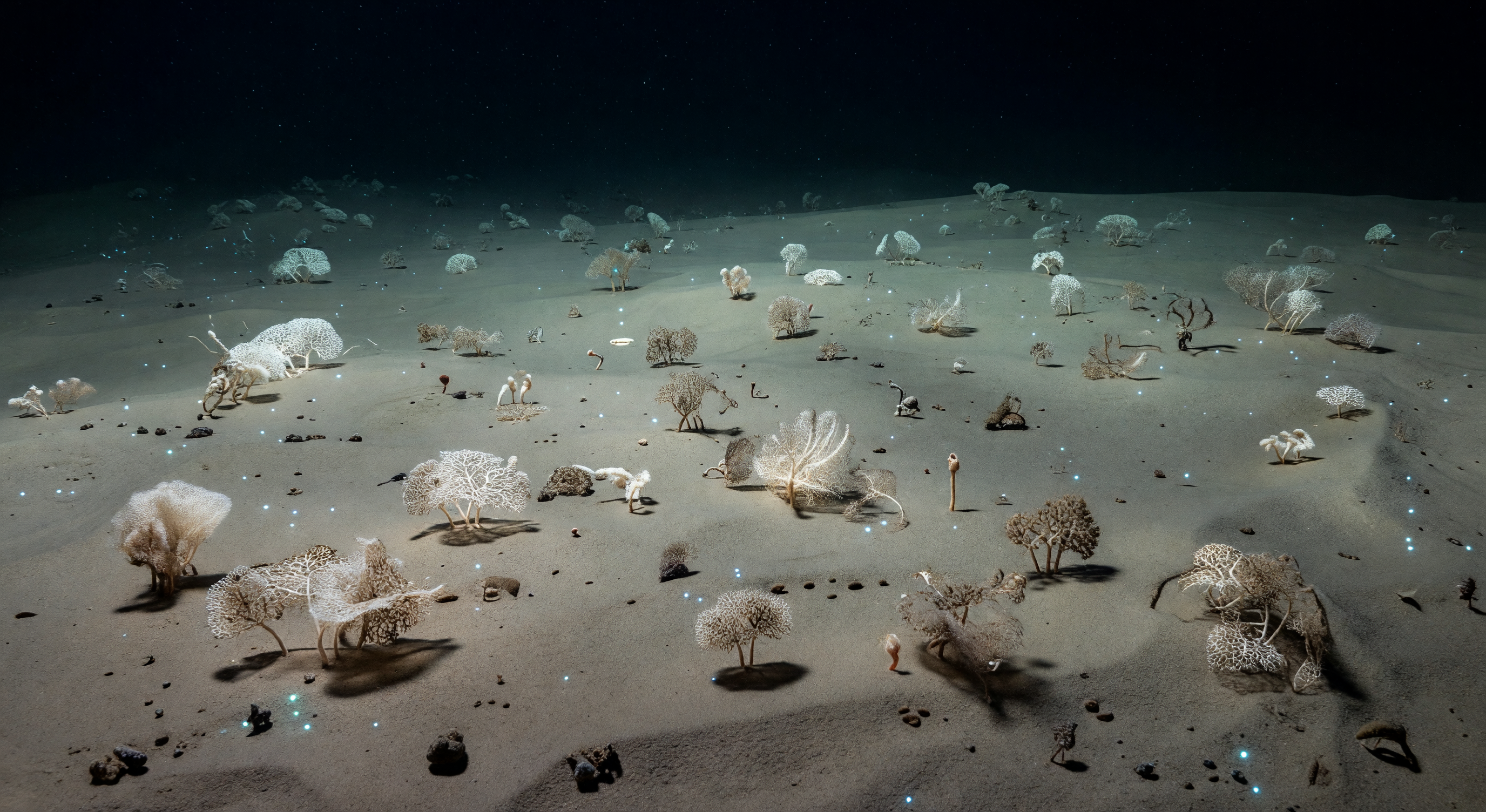
Abyssal plain