Beneath roughly 600 atmospheres of cold compression, the abyssal plain extends in every direction as one of Earth's most immense and least-disturbed landscapes — a nearly level expanse of pale calcareous-siliceous mud blanketed in the slow accumulation of millennia, where fine sediment receives a ceaseless drizzle of marine snow descending from the sunlit ocean kilometers above. Across this dim, pressurized desert, polymetallic manganese nodules crowd the seafloor in dense pavement, each concretion built over millions of years by the incremental precipitation of iron and manganese oxides around a buried nucleus — their oxide-dark surfaces catching intermittent blue-green bioluminescent flashes as microorganisms and drifting plankton pulse briefly through water held near 1–2 °C. At the nodules' bases, subtle erosional halos and fecal casts betray the quiet work of unseen infaunal communities, while ivory anemones and pale sponges cling to the highest exposed stones, exploiting hard substrate that is scarce in this otherwise featureless sedimentary expanse, with distant stalked crinoids rising on slender stalks into black water laden with slowly settling particulate. The darkness between each bioluminescent flicker is absolute and continuous, a silence measured not in sound but in pressure — a world of near-total stillness that has existed across geological time entirely without witness, governed only by cold chemistry, gravitational settling, and the patient biology of organisms shaped by an environment of almost unimaginable constraint.
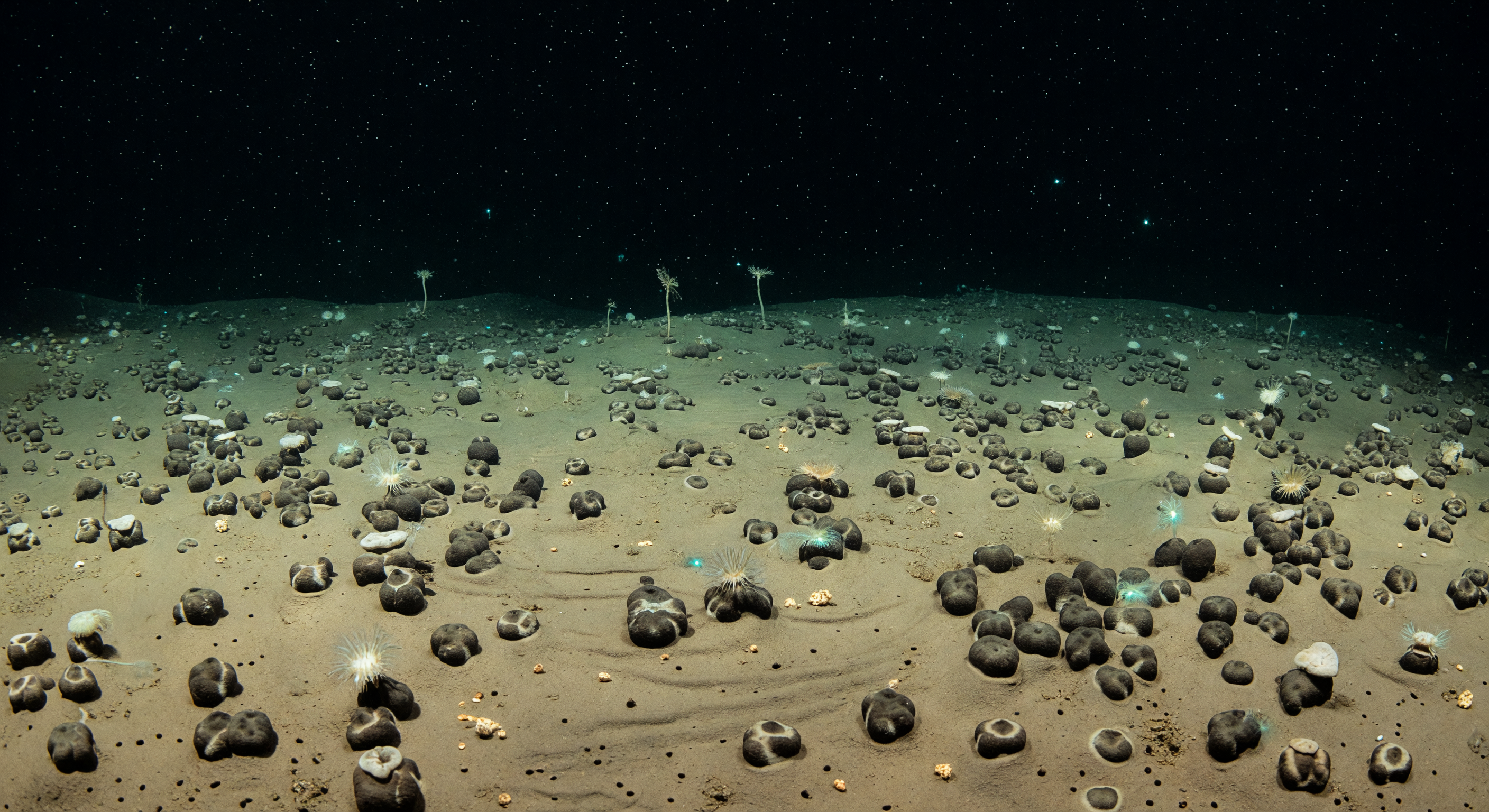
Abyssal plain