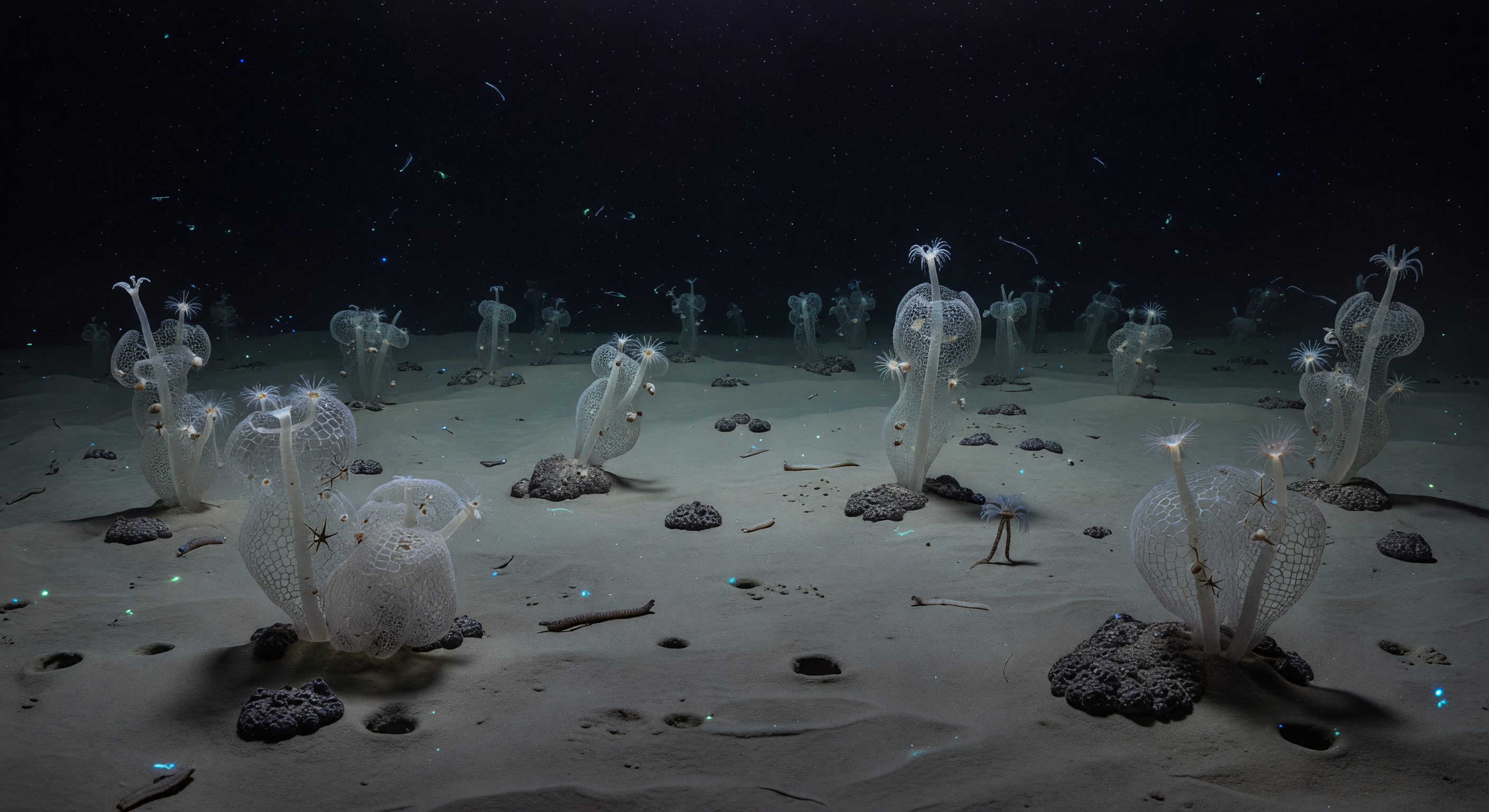
At four to six thousand metres below the surface, where hydrostatic pressure bears down at forty to sixty megapascals and bottom water hovers near two degrees Celsius, the abyssal plain stretches as one of Earth's most expansive yet least-witnessed landscapes — a gently undulating desert of pale calcareous and siliceous mud punctuated by scattered polymetallic manganese nodules that have accreted grain by grain over millions of years. From these dark, low islands of hard substrate, tall hexactinellid glass sponges — members of the class Hexactinellida — rise on delicate silica lattices, their translucent frameworks faintly opaline where the geometry of fused spicules catches the only available illumination: cold pinpoints of bioluminescence drifting in the water column from tiny organisms, and dim living glows emanating from benthic fauna themselves, too faint for any ordinary perception yet sufficient in this impossible sensitivity to reveal form, texture, and depth. Brittle stars drape across nodule surfaces, stalked crinoids extend their feathered arms into the near-still current, and holothurians move with glacial patience across sediment that records in fine detail the slow biography of this place — burrow openings, fecal casts, subtle current ripples, and the halos of winnowed mud around each hard substrate island. Marine snow descends continuously, a ceaseless gentle rain of organic particles from the sunlit world four kilometres above, sustaining this sparse community through the long patience of chemically and thermally stable deep water. Nothing here acknowledges the surface; the plain simply exists, pressurised and cold and alive in its own unhurried terms, entirely without witness.
Abyssal plain