At four to six thousand metres below the surface, where hydrostatic pressure exceeds four hundred atmospheres and bottom water hovers near two degrees Celsius, a freshly settled veil of phytodetritus has transformed a broad tract of the abyssal plain into a subtly brightened olive-beige tapestry laid across the otherwise grey-brown siliceous mud. This organic film — aggregated remains of a phytoplankton bloom that sank as marine snow over days or weeks — represents a rare nutritional windfall, a pulse of carbon arriving from a sunlit world six kilometres above, and the deposit feeders have already responded: holothurians move in slow methodical arcs across the detrital surface, their feeding palps sweeping sediment, while brittle stars hold themselves low against the bottom with outstretched arms, and a solitary xenophyophore-like giant agglutinated foraminifer anchors itself at the patch margin, its delicate test accumulating particles from the perpetual slow rain above. Converging trails and faint fecal casts crisscross the fresh film, recording hours of invertebrate passage across a landscape that otherwise changes on geological timescales, where manganese nodules half-buried in mud have been accumulating one to two millimetres per million years. Overhead, scattered cool cyan bioluminescent pulses trace the movements of midwater organisms transiting the water column — a darkness so total and a stillness so absolute that this seafloor exists as a world complete in itself, ancient and unhurried, wholly indifferent to any presence beyond its own.
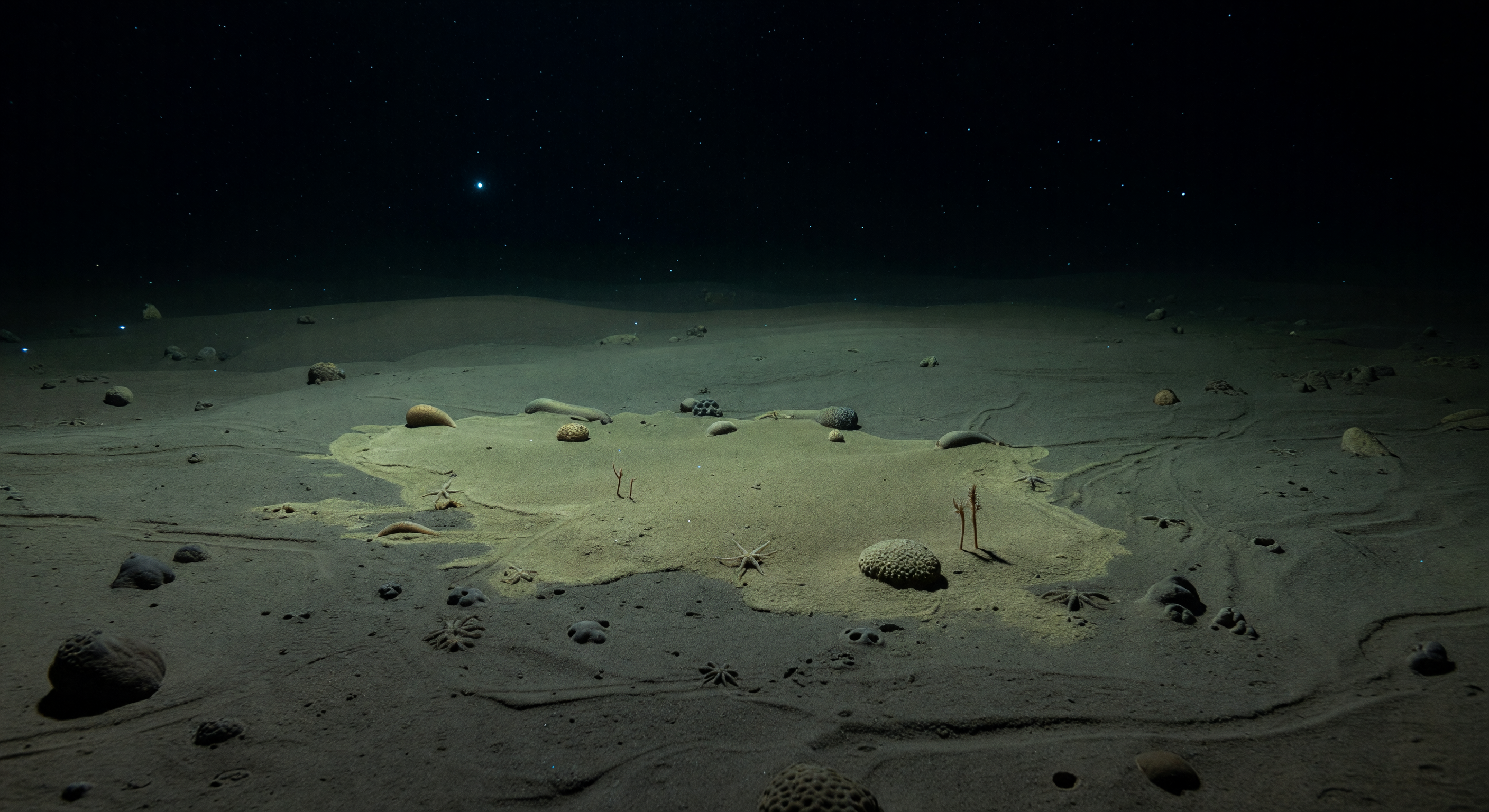
Abyssal plain