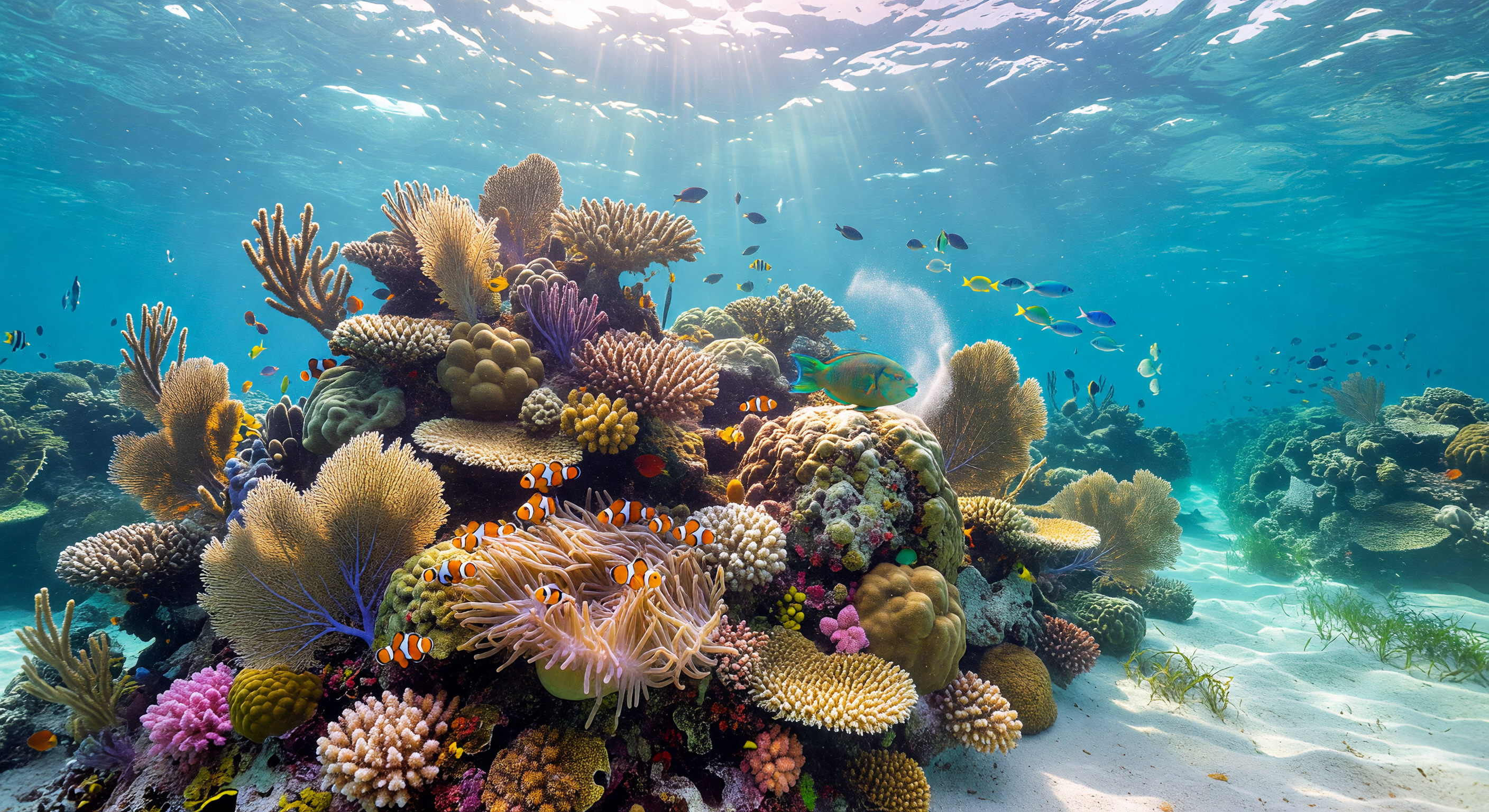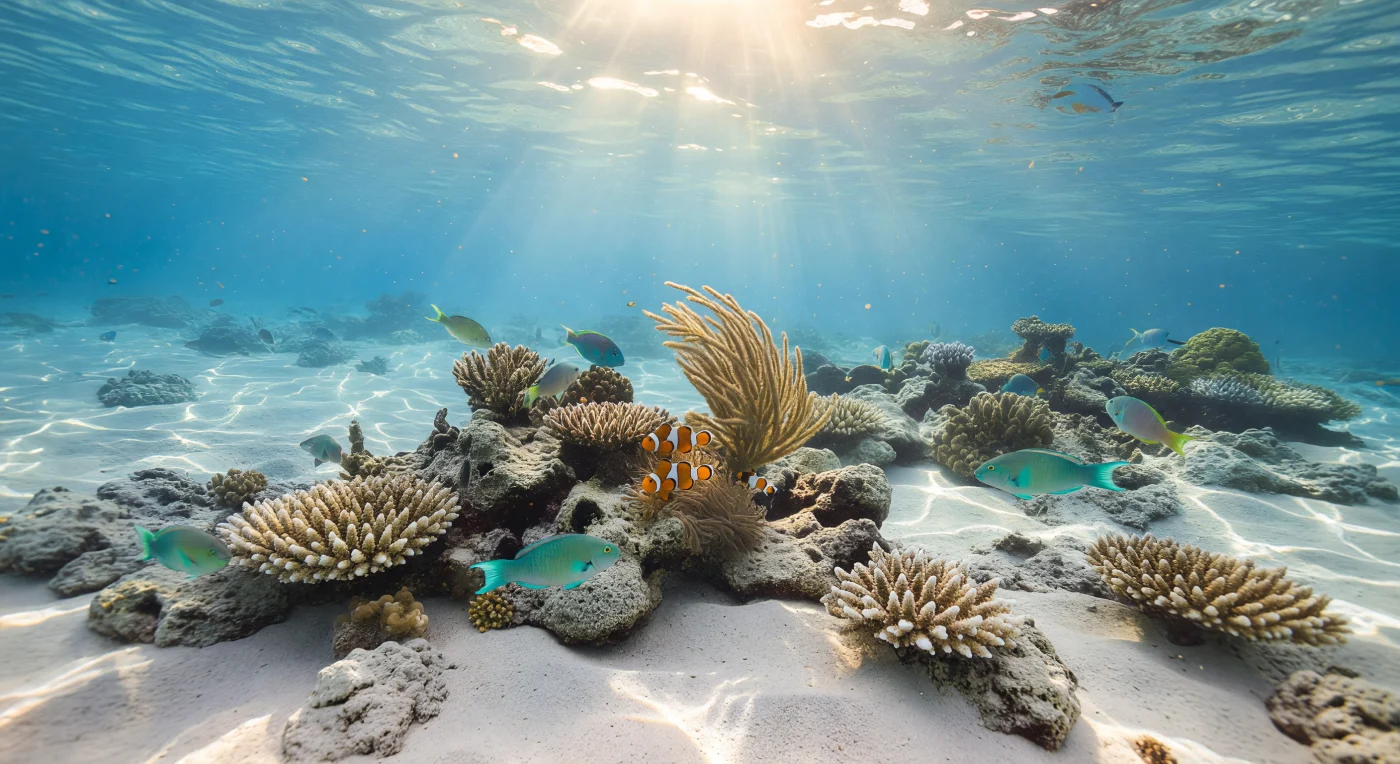
At just two meters beneath the surface, the reef crest exists in a world of almost violent luminosity: white-gold sunrays shatter through the rippled interface above and cascade downward as shifting curtains of light, their caustic patterns racing ceaselessly across pale limestone, branching Acropora thickets, and drifts of clean carbonate sand. Here the full solar spectrum still burns unfiltered — reds, oranges, and yellows intact — illuminating the true pigmentation of every organism, from the electric turquoise and rose flanks of parrotfish grinding their beak-like teeth across the carbonate framework to the vivid orange of clownfish nestled within the tentacles of a column anemone tucked into a sheltered pocket of the limestone architecture. The acropora colonies themselves are engineering marvels of colonial polyp biology: each branch fringed with extended zooxanthellae-hosting polyps harvesting photons and dissolved nutrients simultaneously, their skeletal calcium carbonate laid down at rates possible only within this narrow sunlit window where symbiotic algae can thrive. Wave surge rolls across the crest in long rhythmic pulses, bending a current-swept gorgonian fan back from its holdfast and suspending fine plankton particles in the water column where they drift through shafts of natural light, ungathered and unobserved. This shallow carbonate ridge — product of millennia of skeletal secretion, bioerosion, and cementation — endures entirely on its own terms, pressured by heat, surge, and season, indifferent to any witness.
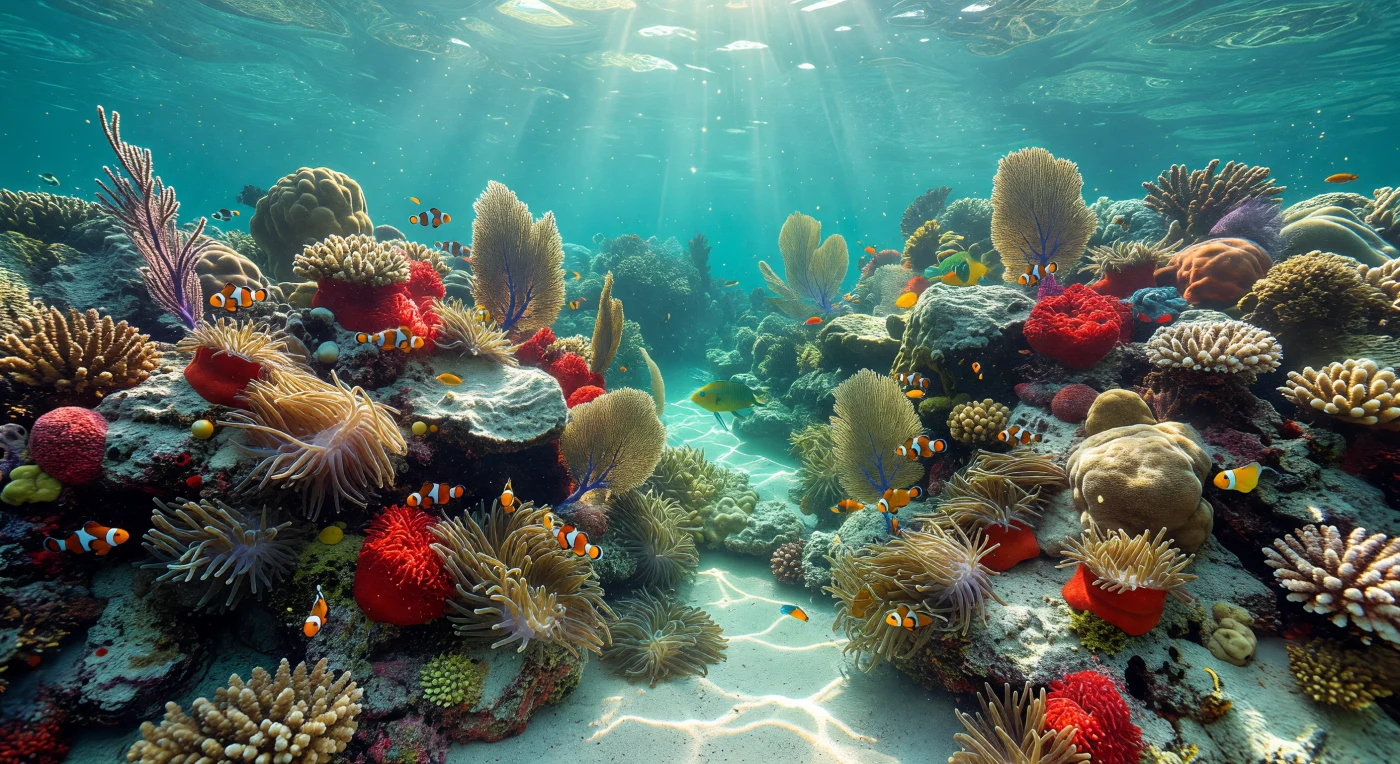
At four to eight meters in a sun-drenched Indo-Pacific pass, tidal current funnels through a canyon of living limestone, streaming the tentacles of crimson and olive sea anemones into silk-like ribbons while orange-and-white clownfish — *Amphiprion* species maintaining their lifelong mutualism with the host *Heteractis* or *Stichodactyla* — dart with precise, flickering turns among those stinging filaments, immune through a protective mucous coating that prevents nematocyst discharge. At this depth the full solar spectrum still reaches the substrate, and rippled surface waves act as a field of natural lenses, casting shifting caustic bands across coral heads, pale carbonate sand, and gorgonian fans that lean in unison with the accelerating pass current — a hydrodynamic signature of tidal exchange between lagoon and open ocean that concentrates planktonic food, oxygen, and larvae. The coral architecture itself is a centuries-old biogenic structure: branching *Acropora*, massive *Porites*, and encrusting coralline algae collectively fixing calcium carbonate into a three-dimensional reef framework that supports one of Earth's highest densities of marine species per unit area. Across the reef crest, a parrotfish methodically grazes exposed carbonate with fused beak-like teeth, producing the fine white sand drifting in slow suspension through the luminous blue-green column — a quiet act of bioerosion that has been reshaping these reefs long before any witness existed to observe it.
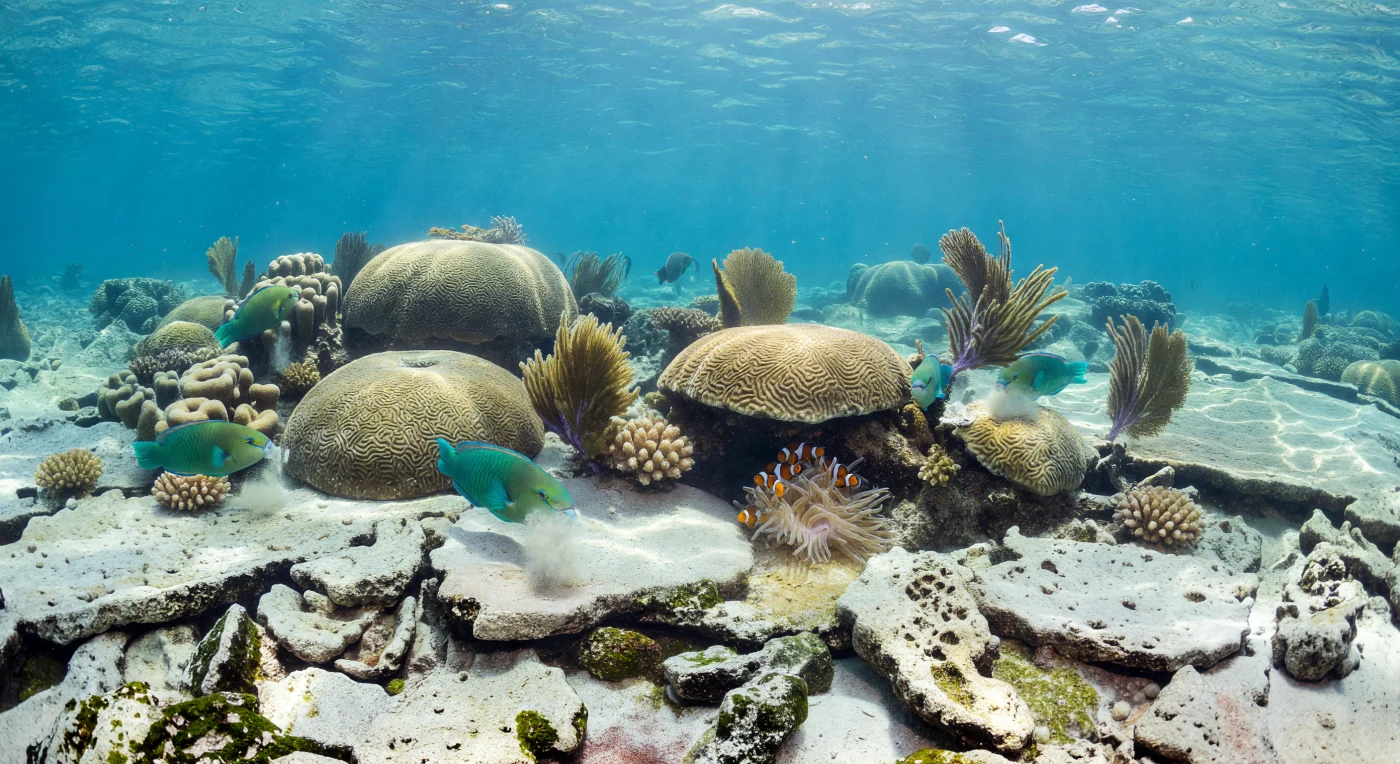
Sunlight descends through the shallow water column in shifting sheets, its caustic patterns rippling ceaselessly across the carbonate pavement in a choreography that has played out over this terrace for millennia without pause. Several parrotfish work the reef's surface with their fused, beak-like dental plates — dermal teeth evolved specifically to excavate calcium carbonate — releasing small bursts of fine white sediment that bloom and slowly settle, a process that, collectively across the reef, generates tonnes of the white tropical sand that accumulates in pockets between coral heads. The massive dome corals here are themselves geological structures: centuries-old colonies of polyps secreting aragonite skeletons at only a few millimetres per year, their surfaces textured with living tissue and encrusting algae that together form a carbonate framework hosting extraordinary biological density, from gorgonian fans swaying in the gentle current to an anemone — its column anchored in a sheltered crevice — holding clownfish that dart among translucent tentacles armed with nematocysts. At this shallow depth, pressure reaches only two to three atmospheres and the full spectrum of sunlight still floods the water column with blue-green clarity, supporting the zooxanthellae — photosynthetic dinoflagellates living within coral tissues — upon which the entire biochemical architecture of the reef ultimately depends. This terrace exists as it has always existed: a world of extraordinary biological complexity, structurally ancient, continuously alive, and entirely indifferent to any observer.
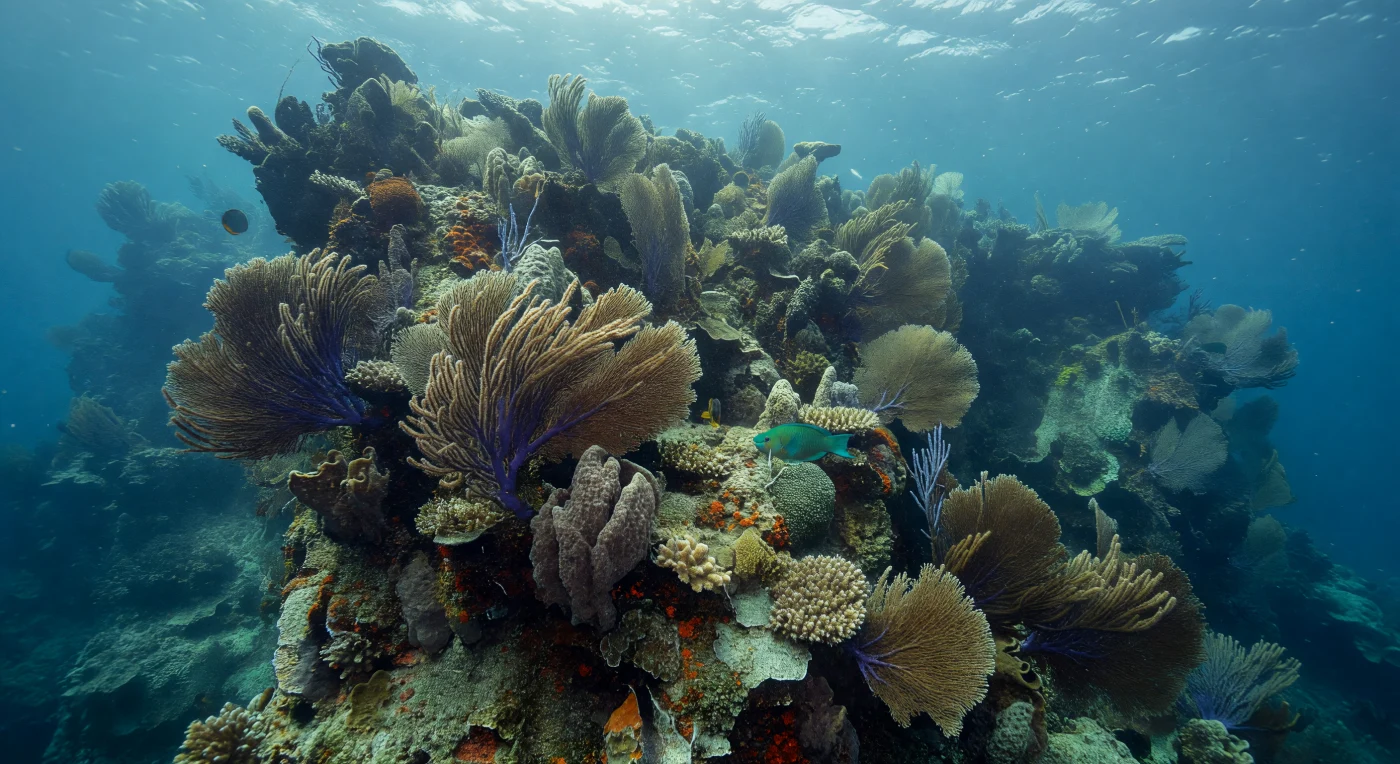
Along a near-vertical fore-reef wall dropping through some twenty-five to thirty metres of clear tropical water, tall gorgonian sea fans — their branches spanning purple and amber against open blue — stream seaward in one unbroken gesture, shaped by a steady geostrophic current that also carries fine particles of marine snow drifting slowly downward through the water column. The limestone substrate itself is a palimpsest of carbonate time: polyp-laid skeleton upon skeleton, now colonised by barrel sponges whose porous walls filter the passing current, encrusting coralline algae painting the rock in pink and mauve, and compact hard corals anchoring themselves to every available ledge. Natural sunlight from the rippled surface far above filters down in attenuated cyan, pale god rays touching the upper ledges and caustic patterns rippling faintly across sponge surfaces before the wall fades, with depth, into an unlit cobalt hush where photosynthesis quietly surrenders to suspension-feeding. A parrotfish moves along the rock face with the unhurried confidence of an animal at the centre of its own world, its pharyngeal teeth ready to grind carbonate into the white sand that will eventually drift down into the deep — one thread in the unending biological and geological conversation this reef conducts entirely without witness.
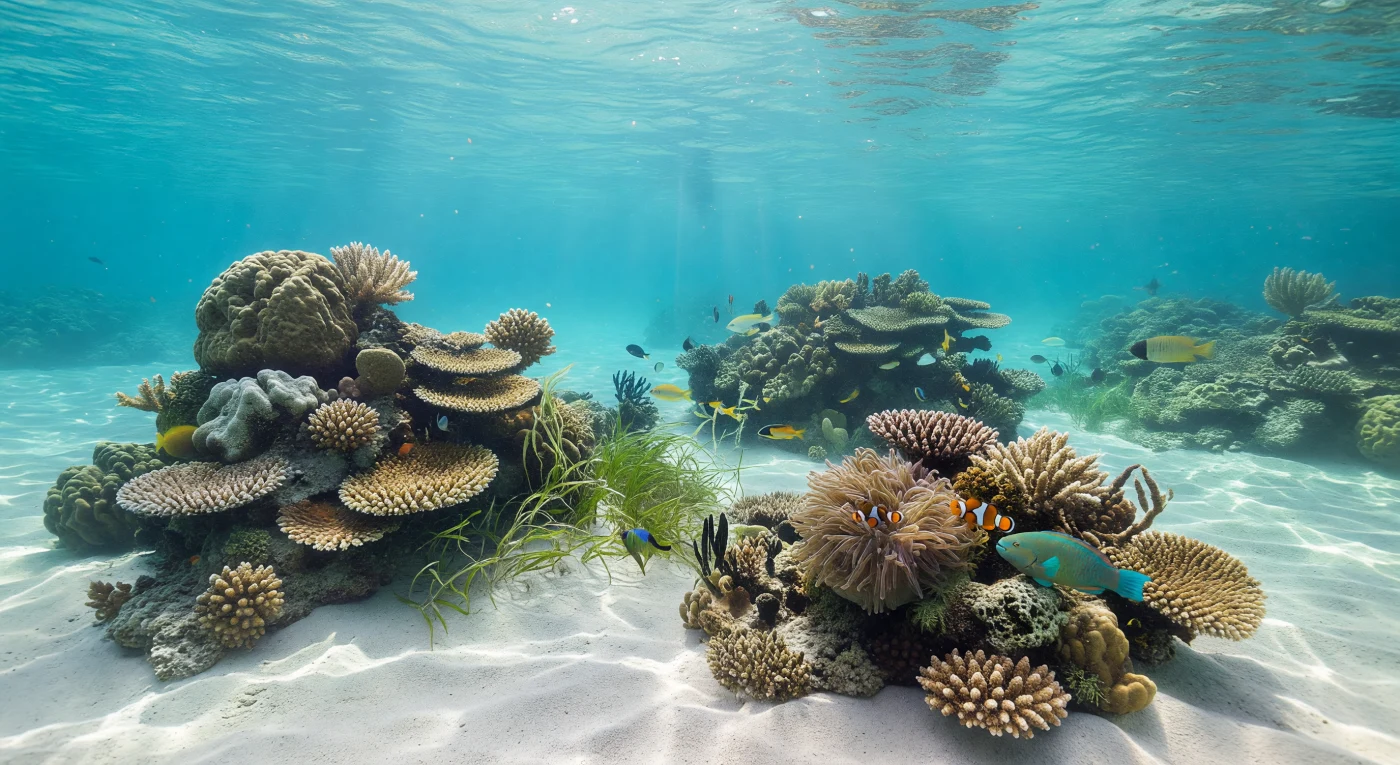
Noon light pours through the rippled surface of this shallow lagoon in broad, shifting shafts, the entire water column glowing a luminous blue-green as caustic patterns race and dissolve across white carbonate sand only three to eight meters below. These patch reefs are the accumulated limestone labor of millions of coral polyps — tiny cnidarian animals housing symbiotic zooxanthellae algae that harvest the abundant sunlight and fuel the calcification engine that builds, centimeter by patient centimeter, the massive boulder heads and cantilevered plate forms rising from the lagoon floor. Parrotfish rasp the coral surface with their fused beak-like teeth, converting limestone and algae alike into the fine white sand that drifts in slow suspension around the reef bases, while juvenile chromis and damselfish hold station above seagrass ribbons, their scales catching the fractured noon light, and a pair of clownfish move in short, bobbing arcs within the stinging embrace of an anemone's translucent tentacles. Gorgonian fans angle gently into the lagoon's faint tidal current, their polyps extended to capture passing plankton, and the whole community pulses with metabolic intensity — photosynthesis, respiration, predation, and growth — sustained entirely by sunlight and seawater chemistry. At the lagoon's far edge, the turquoise shallows deepen toward cyan-blue, and the reef's architectural complexity fades quietly into open water, indifferent and complete, existing entirely without witness.
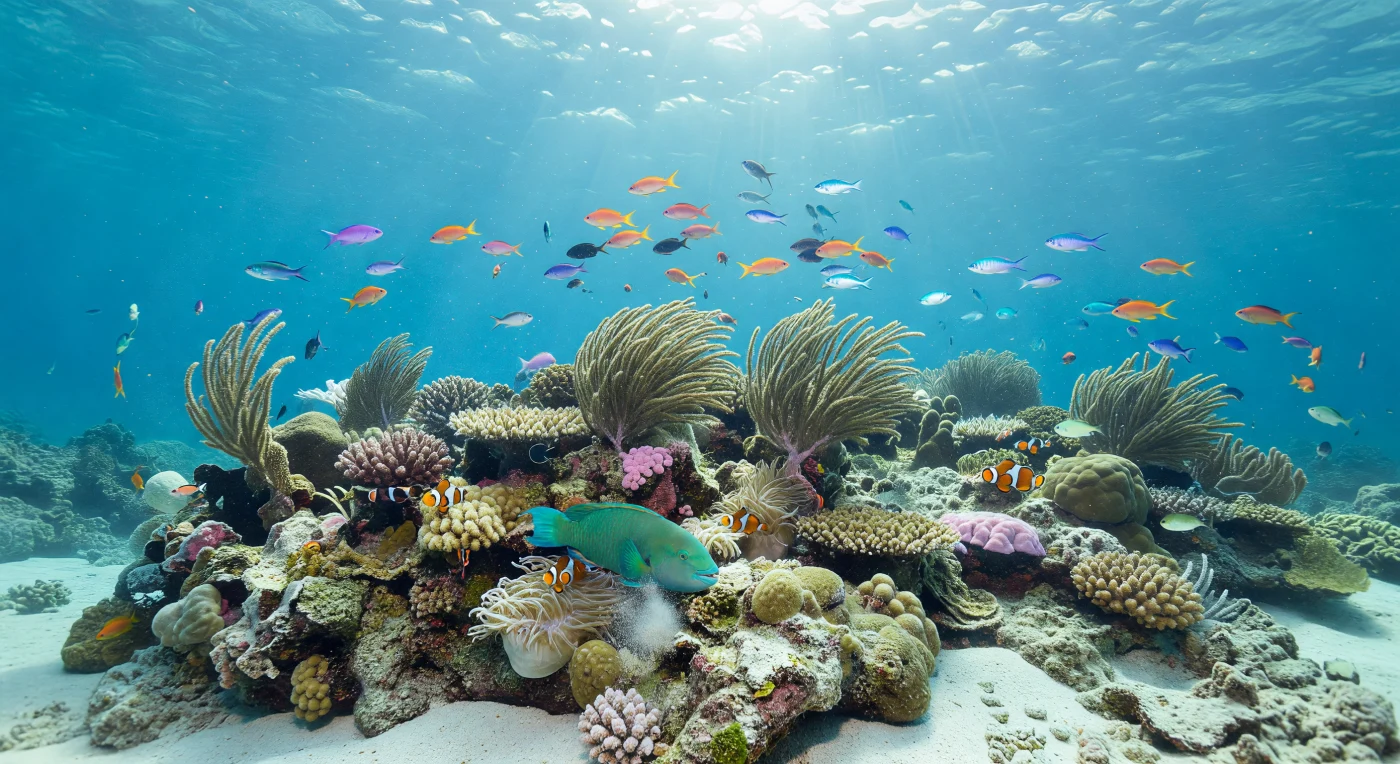
At the crest of an open-ocean seamount, where the carbonate platform rises to within ten or twenty meters of the surface, full-spectrum tropical sunlight pours through the rippled interface above and shatters into shifting god rays and dancing caustics across every encrusting surface below. The reef structure here is a dense mosaic of low mounded hard coral colonies, crustose coralline algae staining the limestone in dusty rose and lavender, and knobby ledges worn smooth by a persistent unidirectional current that combs every gorgonian and sea fan into elegant, polyp-bristled arcs — each tiny filter-feeding animal extended into the flow, drawing plankton from a thin living haze that softens the otherwise crystalline blue-green column. Above the reef crest, dense flickering clouds of anthias and chromis hang suspended in the sunlit water, their scales catching and releasing light in shifting silver-orange pulses, while at reef level a stout parrotfish methodically scrapes the carbonate substrate with its fused beak, releasing faint plumes of biogenic sand that drift slowly downslope. In sheltered pockets between coral heads, sea anemones anchor themselves among the living rock, their tentacles swaying in the residual current while clownfish dart in tight orbits around them — a relationship shaped by millions of years of co-evolution on precisely these sunlit carbonate summits, far from any shore, in water that has never been anything but wild.
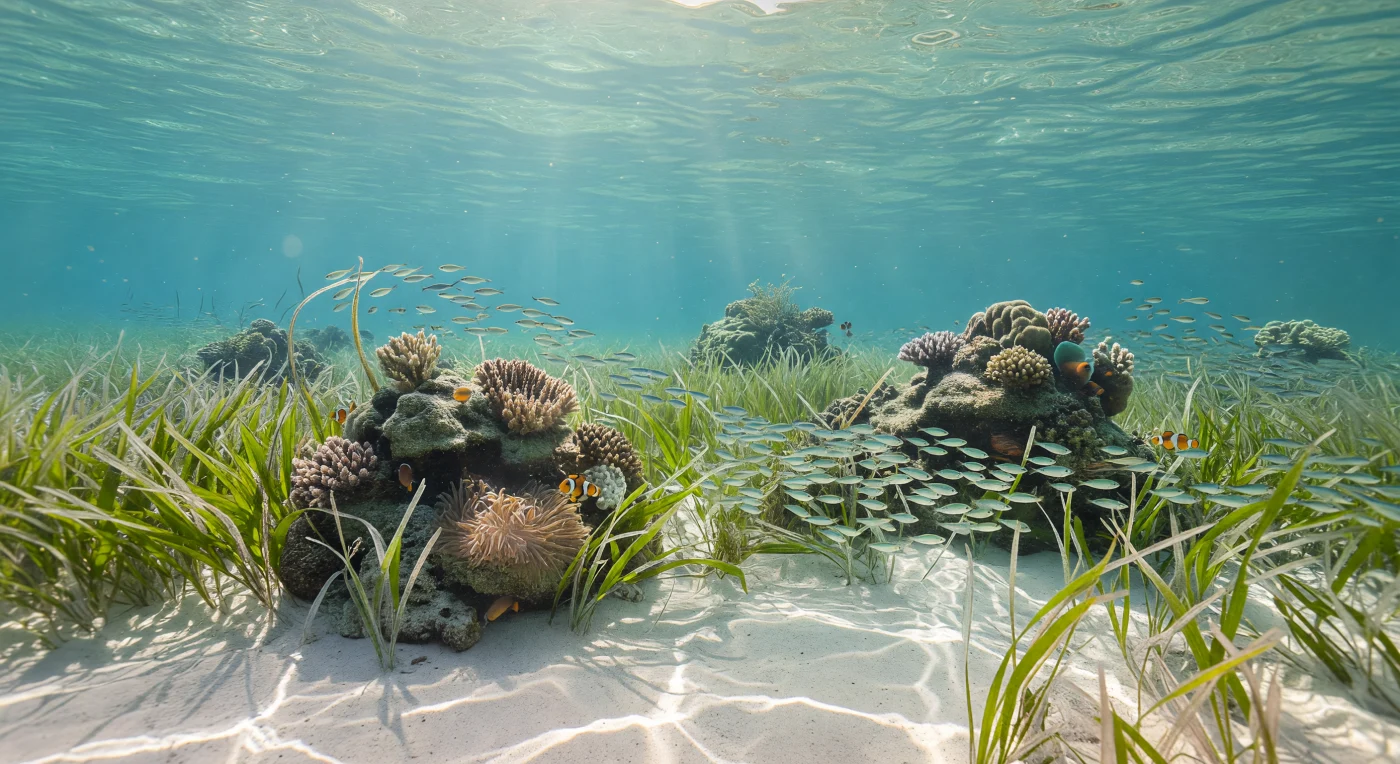
In the shallows of this sunlit lagoon, long blades of turtle grass (*Thalassia testudinum*) sway in a gentle tidal current, their translucent green surfaces catching the full spectrum of tropical light that pours unimpeded from the surface just two to five meters above. At this negligible depth, pressure barely exceeds one atmosphere, and virtually no wavelength of sunlight is lost — warm golds, vivid greens, and piercing blues all reach the sandy substrate simultaneously, generating shifting cautic nets and god rays that sweep continuously across ripple-marked carbonate sand and the rugose limestone flanks of isolated coral heads. Isolated massive corals rise from the meadow floor like self-built citadels of calcium carbonate, their polyp surfaces alive with zooxanthellae-driven photosynthesis, while gorgonian fans stream in the passing water and a sea anemone shelters a pair of clownfish (*Amphiprioninae*) among its nematocyst-armed tentacles. At the meadow's edge, a polarized school of juvenile fish — their silvery scales functioning as adaptive mirrors that confuse visual predators — pivots and flashes as a single liquid entity in the brilliance, while a parrotfish (*Scaridae*) methodically rasps algae and coral tissue with its fused beak-like teeth, excreting the fine white carbonate sand that carpets the lagoon floor beneath them. This mosaic of seagrass, coral, and open sand is one of the most productive and biodiverse ecosystems on Earth, a place where sunlight is so abundant it becomes the very architecture of life, and where the reef exists in full, elaborate expression entirely on its own terms.
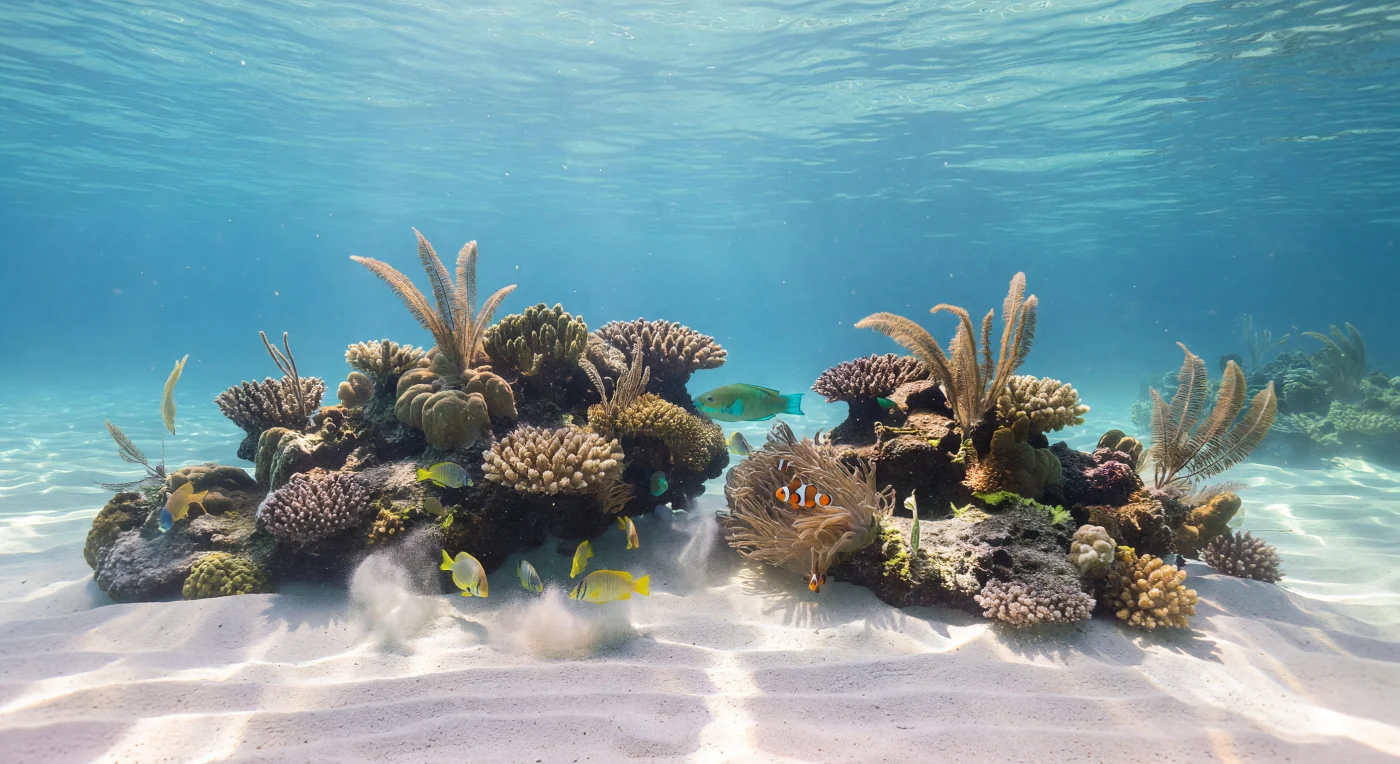
Where the carbonate sand has been sculpted by gentle surge into fine rippled wavelets, the reef margin exists as a borderland between the open sandy rubble zone and the living architecture of coral bommies — knobby massive heads of *Porites*, delicate branching *Acropora*, and encrusting sponges in ochre and purple, all rooted in the limestone substrate they have collectively secreted over centuries. Caustic light patterns race and shiver across sand grains and coral surfaces in shifting golden nets, the product of a wind-ruffled surface far above bending and focusing tropical sunlight into this turquoise column of roughly 25°C ocean water at a pressure barely above two atmospheres. Yellow goatfish probe the sand with chemosensory barbels, their foraging raising small pale plumes of carbonate dust that drift and dissolve in the gentle current, while a parrotfish moves methodically across a bommie, its beak-like fused teeth scraping at the limestone matrix with the quiet industry that makes these fish among the reef's principal architects of sediment. In the shelter of a branching colony, the rhythmic pulse of anemone tentacles holds two clownfish — an intimate mutualism embedded within a community of extraordinary biological density, where every surface is contested space, and the reef itself is simultaneously animal, mineral, and the accumulated geological record of generations building upward toward the light.
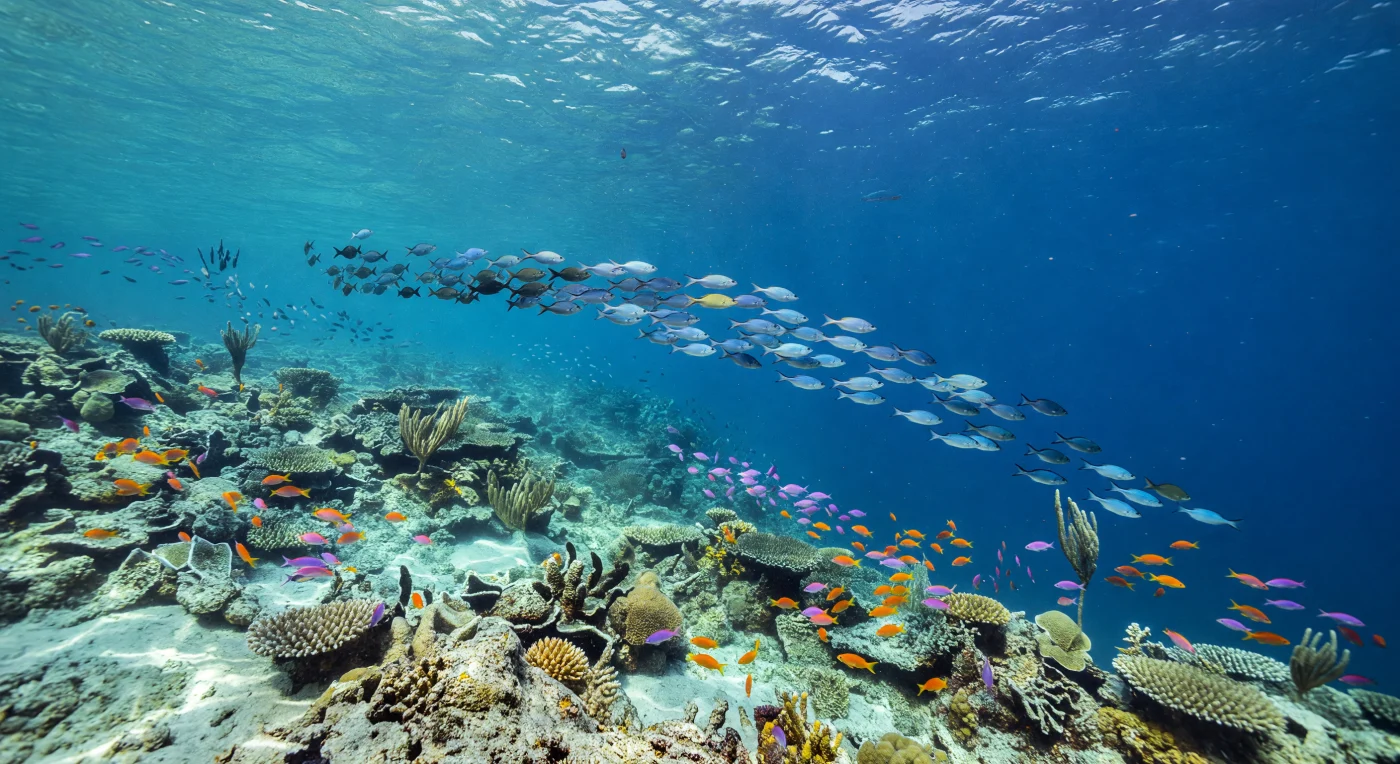
Where the reef's outer limestone wall falls away into open ocean, a living architecture of hard corals, encrusting growth, and gorgonian fans streams in the invisible pull of current along the slope, while fine carbonate sediment drifts lazily into sandy pockets between outcrops. Filtered through a rippled surface somewhere high above, natural sunlight descends in angled rays that shift and bend across coral heads and pale rock faces, painting caustic patterns of light and shadow before surrendering to the deepening indigo that opens beyond the wall's edge. Above the dropoff lip, a massive shoal of fusiliers wheels in fluid synchrony, their flanks catching the blue-green light and throwing it back as flashes of silver and slate, tens of thousands of small bodies moving as a single breathing entity governed by pressure waves and the physics of schooling. Below them, clouds of anthias — orange, pink, and lavender — hold station against the reef structure, suspending themselves within millimeters of the living carbonate using precise adjustments of their fins, their swim bladders compressed by the weight of the water column above. At this depth, still well within the sunlit epipelagic zone, photosynthesis drives the entire architecture: the zooxanthellae locked inside coral tissue converting captured light into the calcium carbonate that built this wall, grain by grain, over thousands of years of unwitnessed accumulation.
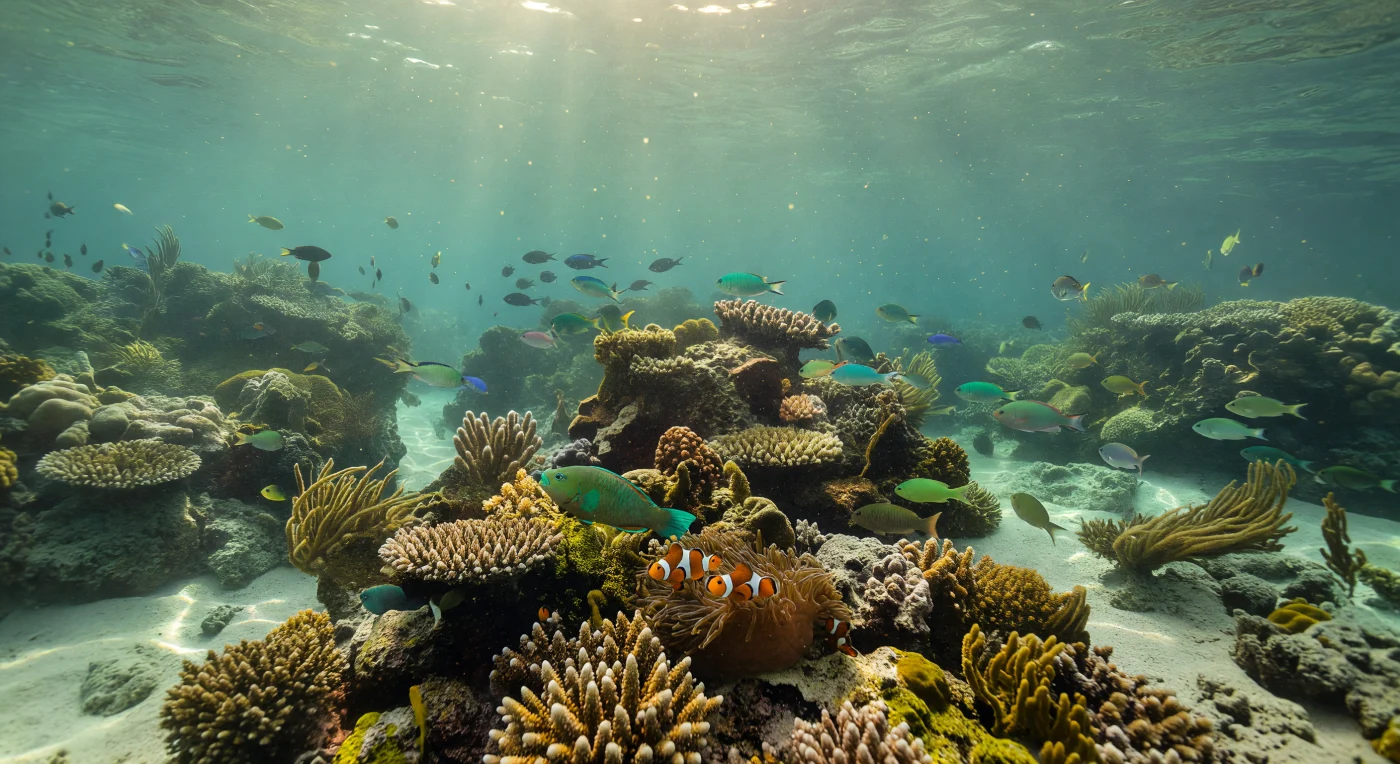
At six to ten metres on the upper fore reef, the early sun cuts through a rippled surface at a low angle, scattering god rays through water rendered green-blue by a dense suspension of phytoplankton and zooplankton that drifts in slow, invisible currents. At roughly two atmospheres of pressure, this is still the fully sunlit world, where zooxanthellae locked inside coral tissue convert that filtered tropical light into the carbonate architecture of branching Acropora and encrusting Porites, their knobby tips and textured surfaces flickering with caustic light patterns projected down from the wave-broken surface above. Wrasses and electric-blue chromis work the midwater plankton column with precise, darting efficiency, while a parrotfish below grinds at the limestone with its fused beak, producing the fine white carbonate sediment that fills the sand pockets between coral heads. Tucked within the reef structure, a sea anemone anchors itself to the substrate, its symbiotic clownfish moving in small, purposeful arcs through its tentacles — a partnership shaped by millions of years of co-evolution in exactly this saturated, sun-warmed, plankton-hazed shallowness. The living haze softens the reef's far edges into a warm green distance, a reminder that abundance here is not stillness but perpetual biological negotiation, carried out in full light, entirely without witness.
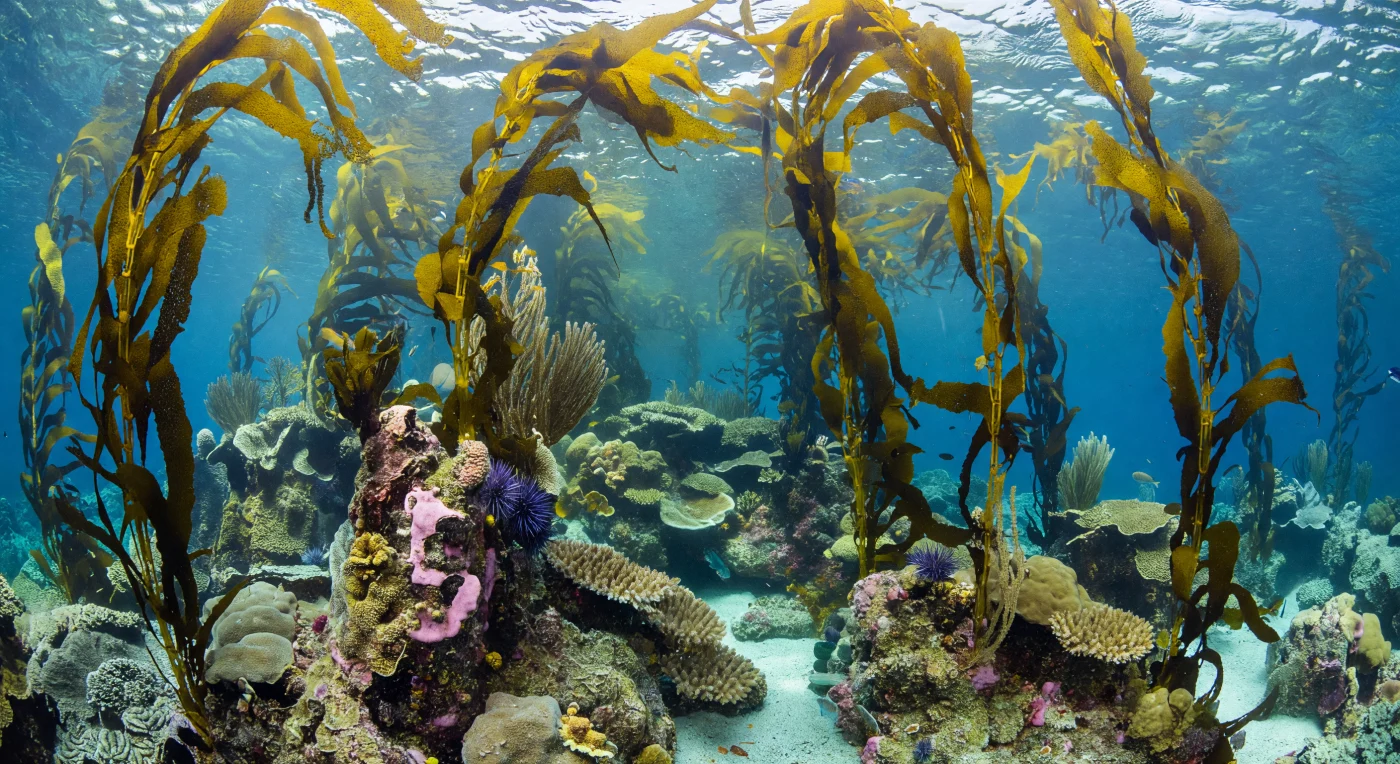
Where sunlight still commands the sea, a carbonate spur rises through water so clear that every wavelength of the spectrum—warm amber, aquamarine, cobalt—remains at play simultaneously. Towering kelp stipes, anchored by holdfasts gripping the reef's encrusting coralline algae and wedged sea urchins, ascend toward the surface in olive-gold columns; their broad amber blades overlap overhead, refracting the downwelling light into layered bands of shadow and brilliance that shift with every surface ripple, a phenomenon ecologists call a dynamic light environment and reef organisms have spent millions of years navigating. Gorgonian fans tilt at precise angles to intercept the current flowing across the spur's outer edge, while crustose pink algae cement the carbonate framework beneath them, and small reef fish—wrasses, perhaps, or juvenile groupers—thread the kelp pillars where the structural complexity of the reef multiplies available microhabitats by orders of magnitude. At the spur's seaward margin the substrate drops away into open cobalt water, a gradient that traces the transition from shallow photosynthetic abundance to a deeper, cooler world where light begins its slow surrender—but here, in these upper tens of meters, pressure barely doubles above the surface, temperatures hold in the mid-twenties, and the reef asserts itself as one of the most structurally and biologically dense ecosystems the ocean is capable of building, thriving entirely on sunlight and carbonate chemistry, indifferent to any witness.
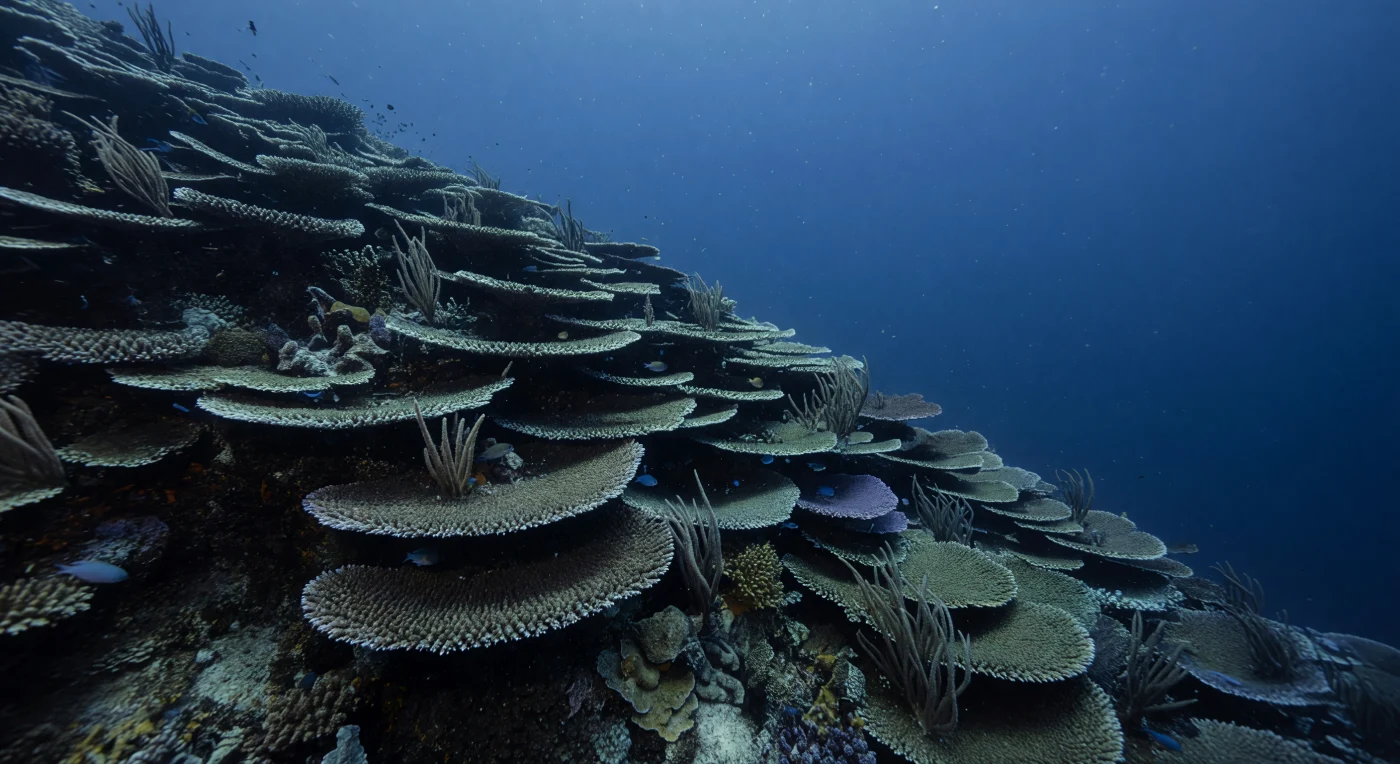
Where the reef slope angles away into the deep, plate corals spread their thin, irregular rims in wide horizontal fans, each one angled to catch what little light filters down from the distant surface — a last, attenuated wash of blue-green that has surrendered every warm wavelength to the water column above. At these mesophotic depths, roughly between thirty and one hundred and fifty metres in clear tropical seas, pressure climbs toward several atmospheres, water temperature drops into the low twenties, and the spectrum narrows to cobalt and indigo alone, draining the reef of reds and oranges and leaving stone, sponge, and coral tissue in muted olives, dusky violets, and cool blue-grey. The plate corals have evolved this flat, shelf-like architecture precisely for this light regime, maximising surface area to gather photons that arrive as little more than a dim, directionless ambient glow, while their undersides and the channels between them shelter cryptic fauna — small reef fish pressed against the limestone, encrusting coralline algae, and pale sponge patches drawing nutrients from the slow downslope current bending the whip corals and gorgonians into a single, silent lean. Fine particulate drifts freely through the open water column, a natural snow of organic material settling toward deeper darkness, and beyond the last visible plate the reef dissolves into ultramarine and then blue-black — a world of extraordinary structural complexity existing entirely on its own terms, indifferent to the surface above it.
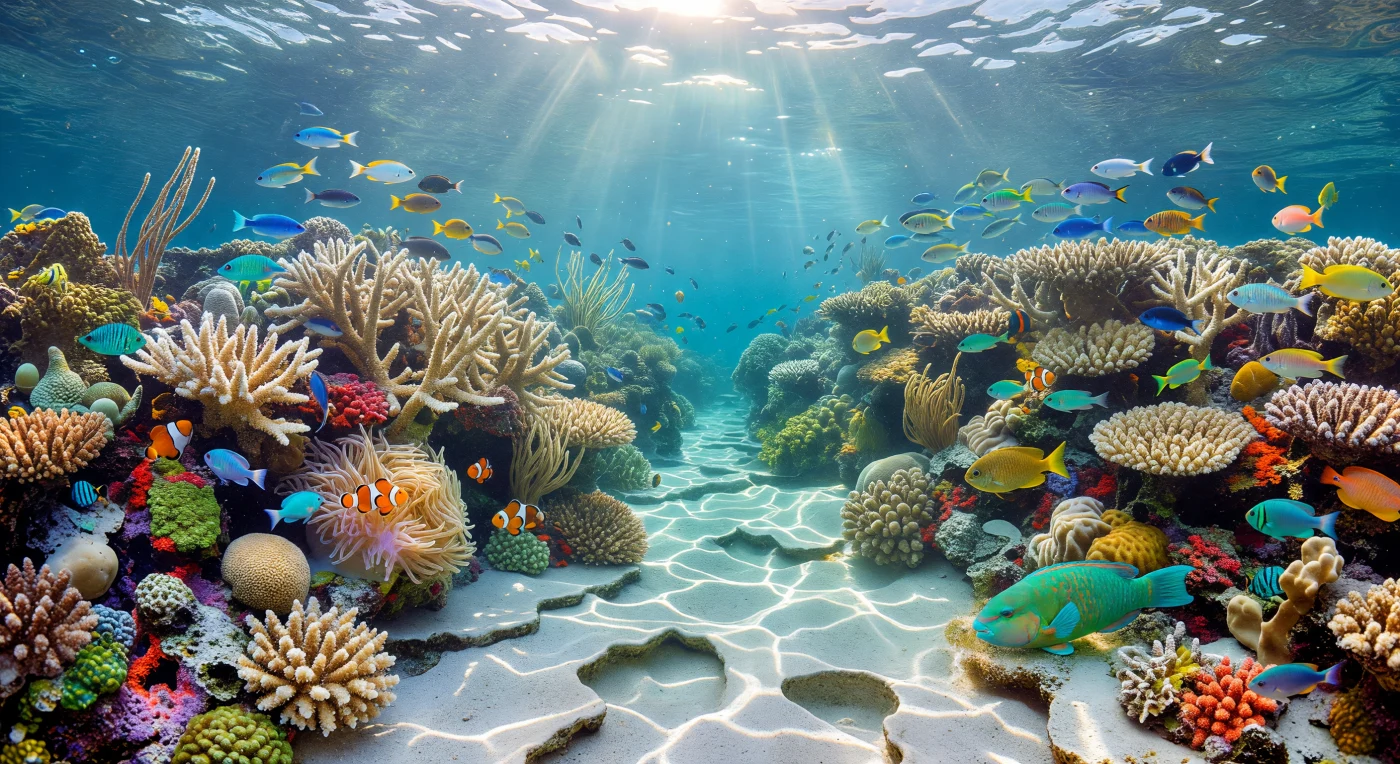
Sunlight pours through the rippled surface overhead in shifting nets of caustic light, fracturing across pale polished limestone and the branching arms of staghorn coral in the upper few meters of the water column — a zone where solar radiation still delivers its full photosynthetic force and pressure remains barely above one atmosphere. The channel itself is a product of reef geomorphology: carbonate dissolved, abraded, and scoured over millennia by tidal surge, the limestone smoothed into scallops and grooves by the relentless oscillation of water that carries dissolved oxygen and planktonic food with every pulse. Dense thickets of *Acropora* rise on both flanks, their living surfaces studded with extended polyps feeding in the current, while schools of anthias and chromis sweep overhead in coordinated ribbons — a behavioral response to both surge energy and predator pressure — and a parrotfish methodically grazes the reef margin, its pharyngeal jaws grinding carbonate into the fine white sand accumulating between coral bases. In a sheltered pocket along the channel wall, an anemone anchored to encrusting coralline substrate houses a pair of clownfish within its mucus-coated tentacles, a mutualism sustained entirely by the warm, clear, nutrient-threaded water flowing through this reef architecture that was built, grain by grain and polyp by polyp, by the organisms still living within it.
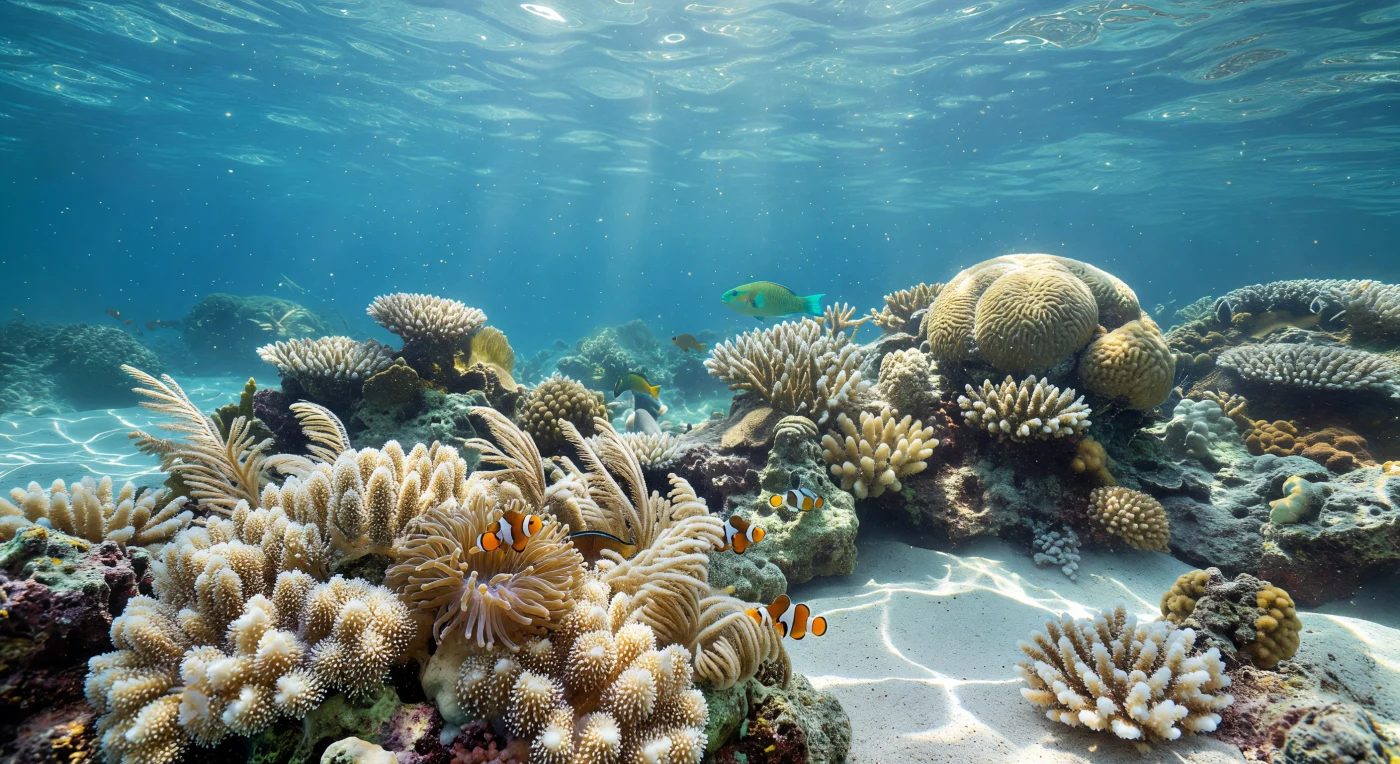
At the heart of a sheltered fore reef, the midday sun pours through a few meters of crystalline tropical water, painting the seafloor in shifting nets of caustic light that slide across massive porites heads and branching acropora colonies in slow, luminous ripples. Each coral head is a living city: thousands of tiny polyps extend their tentacled crowns from their limestone cups, drawing zooplankton and dissolved nutrients from the passing current, their tissues harboring the symbiotic dinoflagellates — zooxanthellae — that power the reef's prodigious calcium carbonate production through photosynthesis. At perhaps two to three atmospheres of pressure, a parrotfish moves through the middle distance with unhurried purpose, its beak-like fused teeth designed to rasp algae and carbonate alike, the fine white sediment drifting in its wake a product of that same biological grinding that slowly manufactures the pale sand pockets between colonies. A pair of anemonefish weave through the trailing tentacles of their host anemone, sheltered by a chemical mutualism refined over millions of years, while slender gorgonian fans trace slow arcs in the mild fore-reef surge. Fine planktonic particles drift and glitter in the ambient blue-green light, each mote a reminder that this sunlit, warm, salt-heavy water column is itself alive — a medium teeming with larvae, bacteria, and organic snow that feeds the reef's seemingly solid architecture from within.
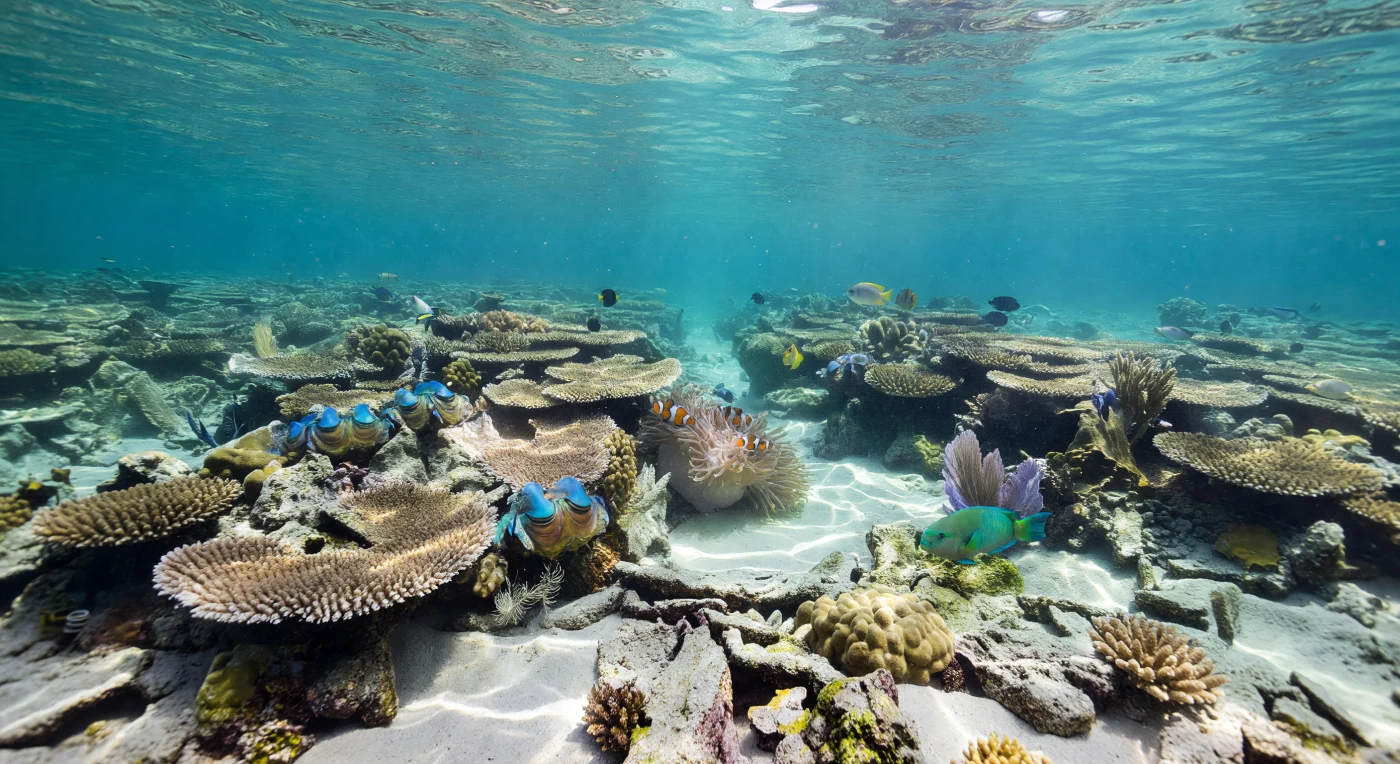
At just a few metres below the surface, the reef flat exists in a state of perpetual oscillation between light and shadow, governed entirely by the slow passage of cumulus clouds above — a natural dimmer switch that alters the entire chromatic register of the scene within seconds. Where the shadow falls, the broad plates of *Acropora* table corals cool into muted blue-green silhouettes, their intricate branching architecture casting lace-like shadows across pale carbonate rubble and pockets of coarse biogenic sand; where the sun breaks through, the same structures ignite with warmth, and the mantles of giant clams (*Tridacna* spp.) flare with iridescent teal, bronze, and electric blue — pigments produced by their symbiotic zooxanthellae, the same photosynthetic partnership that underwrites the entire reef-building enterprise. The water column above is alive with dancing caustics and diffuse god rays, refracting through a wind-rippled surface only two to five metres overhead, while fine suspended particulate drifts freely through the ambient light, testament to the biological productivity of one of Earth's most complex benthic ecosystems — a place where calcium carbonate accumulates grain by grain into geological structure, where parrotfish rasp living coral and excrete the white sand underfoot, and where a pair of clownfish retreat among anemone tentacles that pulse gently with the reef's shallow, warm current. This shallow carbonate platform, built over millennia at the precise intersection of sunlight, warm oligotrophic water, and biological cooperation, exists in complete indifference to any witness — a world that has elaborated itself in darkness, in storm, and in radiant tropical noon alike, with sovereign continuity.
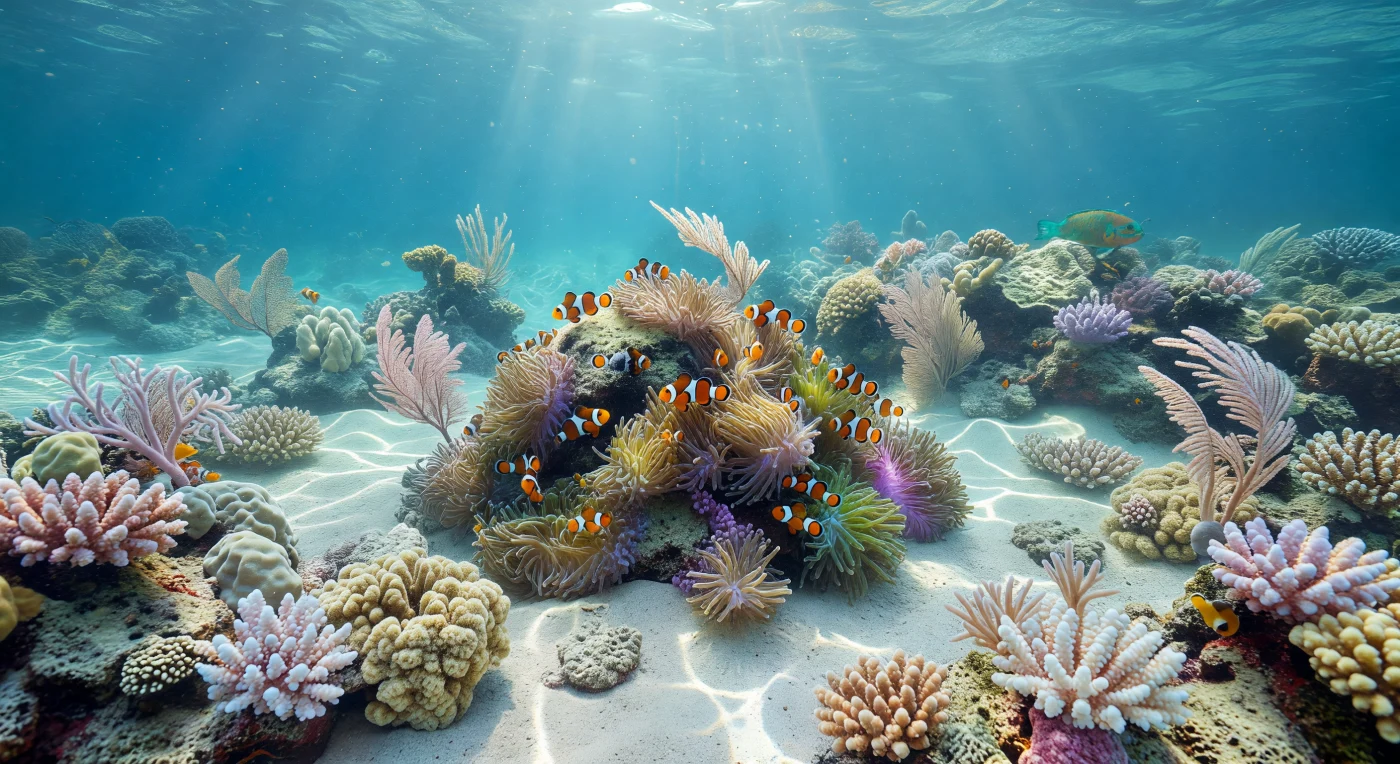
At roughly six to eight metres below the surface, the Indo-Pacific reef exists in a state of perpetual, unhurried abundance. A single coral bommie rises from pale rippled carbonate sand — itself the slow product of millennia of skeletal accumulation — encircled by a clustered field of sea anemones whose cnidocyte-laden tentacles flex gently in the prevailing current, each column hosting small family groups of *Amphiprion* species whose orange-and-white banding is kept vivid by the full-spectrum tropical sunlight still pouring powerfully through only a few metres of warm, saline water column above. The surrounding reef mosaic — branching *Acropora*, massive *Porites* heads, and encrusting limestone plates colonised to their margins — represents the accumulated carbonate architecture of zooxanthellate corals working at near-peak photosynthetic efficiency, the symbiotic algae within their tissues driving calcification at rates that make shallow tropical reefs the most biologically productive carbonate factories on Earth. Caustic light patterns slide and fracture across anemone columns, coral heads, and open sand in shifting geometries produced by surface wave refraction, animating a scene where pressure is barely above one atmosphere and dissolved oxygen and temperature hover comfortably within the narrow thermal window — roughly twenty-six to twenty-eight degrees Celsius — that sustains both coral health and the dense invertebrate and fish communities sheltering within it. A parrotfish moves unhurriedly along the reef edge, its pharyngeal jaws grinding carbonate substrate into the fine white sediment that will eventually drift and settle, returning the reef's own skeleton to the sand that cradles it.
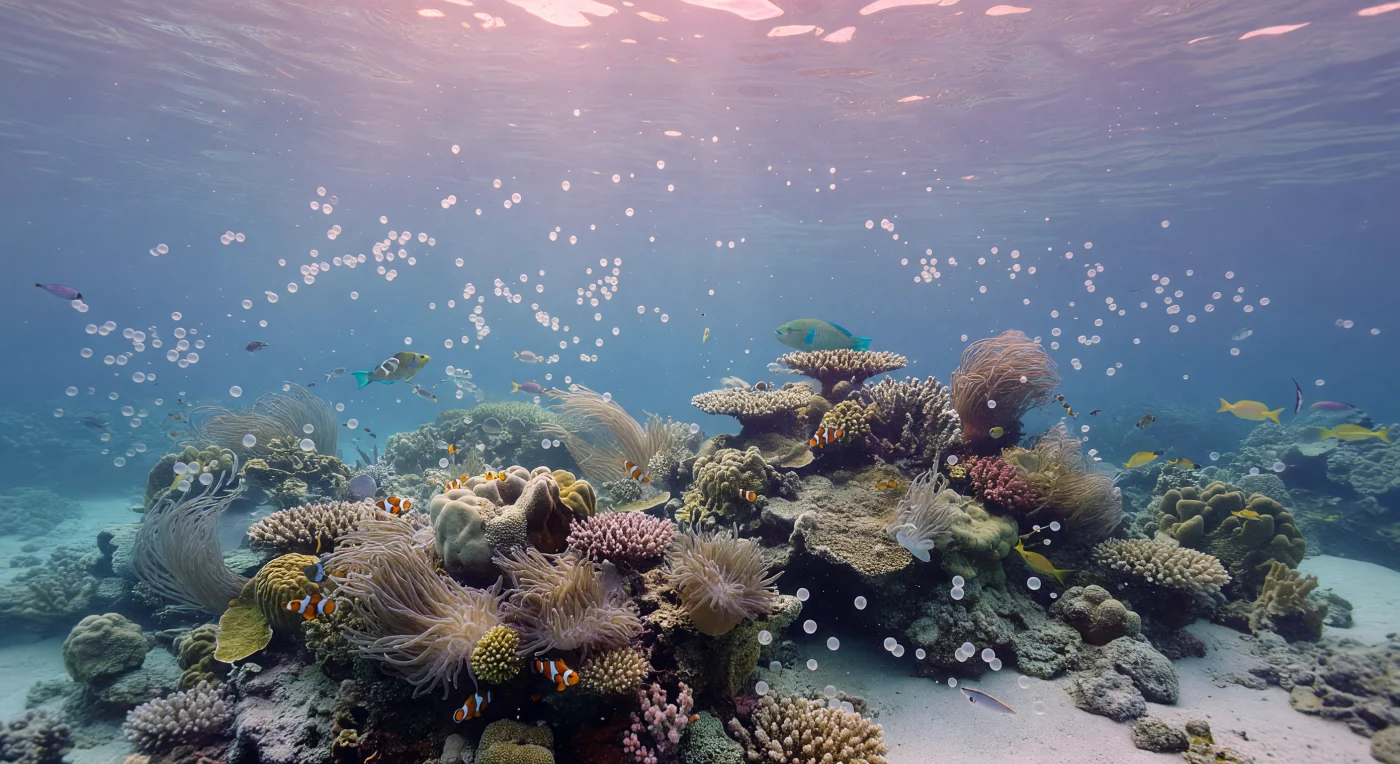
Along the outer fore-reef slope at dusk, the last warm light of the sun filters down through a gently rippled surface in diffuse rose-lavender shafts, growing bluer and cooler with each meter of depth as red wavelengths are stripped away by the water column — at even ten meters, the spectrum has already narrowed, and what remains is a luminous blue-green clarity alive with fine suspended particles. This is a mass coral spawning event, a synchronised reproductive broadcast triggered by lunar phase and sea temperature, in which colonies of scleractinian corals simultaneously release buoyant bundles of eggs and sperm that drift upward through the water column in pale, slow constellations, each sphere a few millimetres across, catching what ambient light remains. Polyp-built limestone bommies rise from the carbonate substrate in dense architectural crowding — massive Porites heads worn smooth by decades of growth, branching Acropora thickets, and gorgonian sea fans angled perpendicular to the current to maximise particle capture — while clownfish shelter within the stinging tentacles of their host anemones, a mutualism refined across millions of years of co-evolution. Small planktivorous anthias and chromis hang motionless in the spawn veil, feeding opportunistically on passing bundles and zooplankton drawn upward by the same thermoclines that concentrate prey at this hour, while a parrotfish moves unhurried across the reef crest, its beak-fused teeth grinding algae-encrusted limestone into the pale sand below. Here, at less than twenty metres, pressure is barely three atmospheres, water temperature holds near twenty-seven degrees Celsius, and the reef exists in its ancient rhythm — reproducing, grazing, filtering, building — indifferent to any observer, complete in itself.
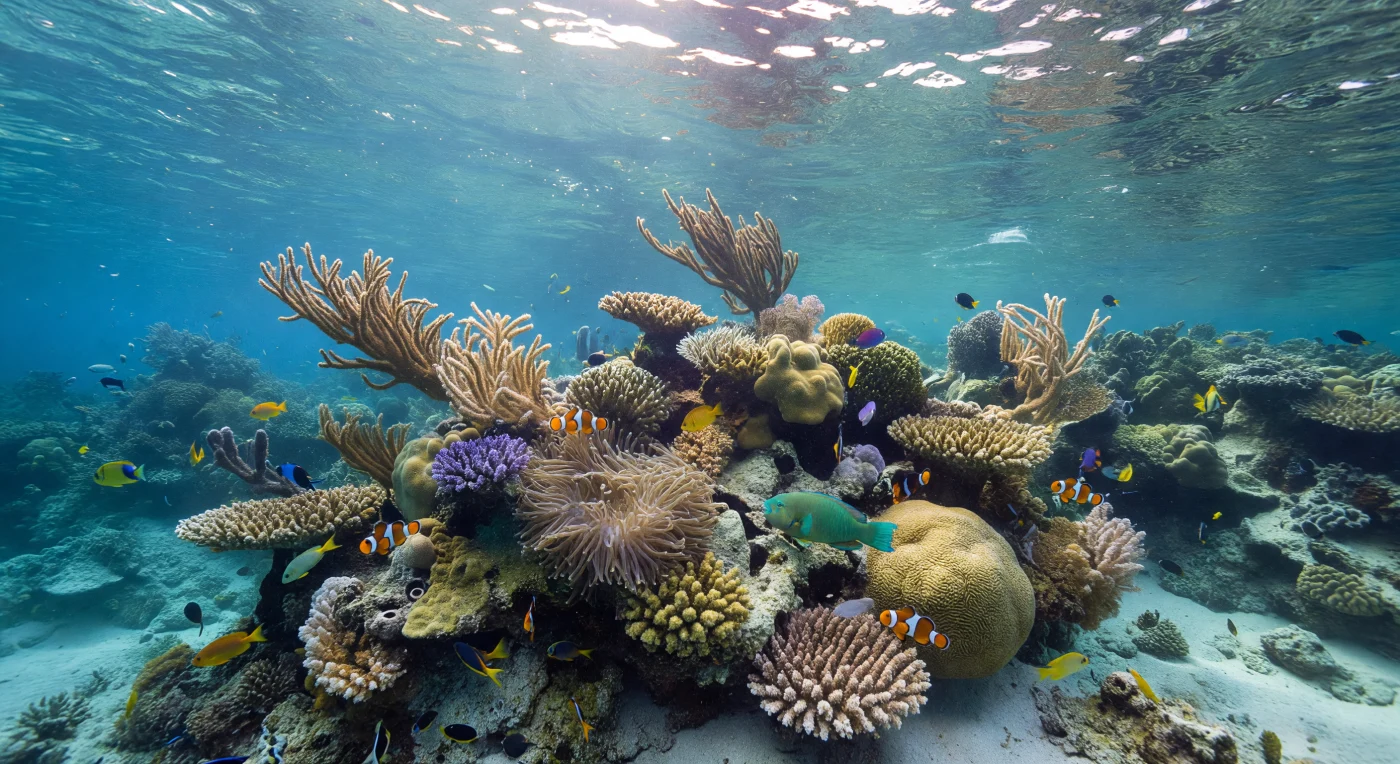
Along the upper reef slope, a mass of cooler, denser water slides beneath the sunlit layer like a silent tide within the tide — an internal wave front made briefly visible as it refracts the ambient light into silver-edged bands, bending gorgonians and soft-coral colonies in one direction and then the other as the pressure field passes. At roughly two to three atmospheres, the water column holds extraordinary clarity, shifting from vivid turquoise near the surface to a deepening cobalt downslope, with god rays fracturing across limestone architecture — branching Acropora, massive Porites heads, sand pockets and ledges built over millennia by the calcification of countless individual polyps. A parrotfish works methodically at the carbonate substrate, its pharyngeal teeth grinding algae and skeleton alike into the fine white sediment that drifts freely in the ambient light, while an anemone shelters clownfish among its translucent tentacles, the pair locked in their ancient mutualism of shared chemistry and protection. Suspended particles trace the invisible shear layer where water masses meet, marking the front with ghostly precision, and the reef's dense community of small fish and invertebrates continues its ceaseless negotiation of current, light, and competition, entirely indifferent to the passing hydrodynamic event reshaping the water around them.
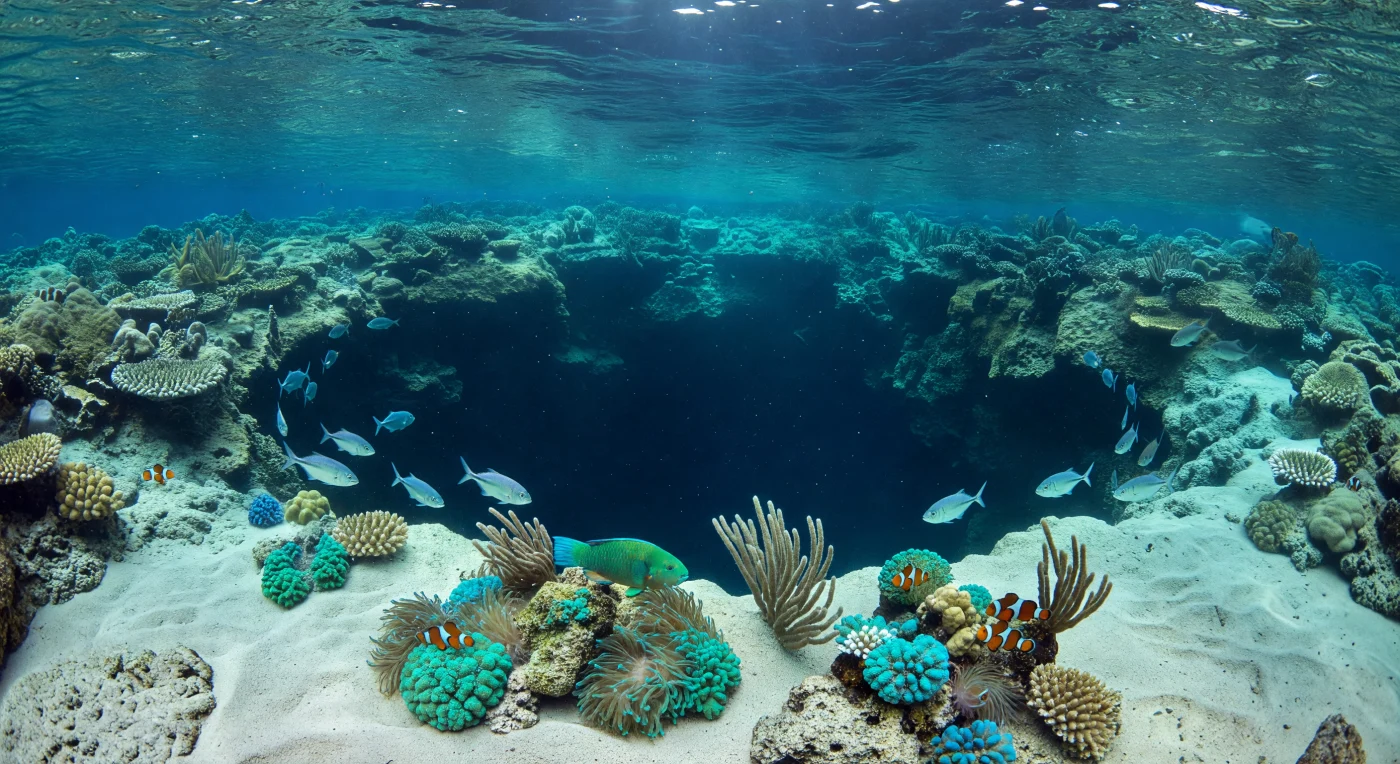
At the lip of a blue hole — a flooded karst sinkhole formed when sea levels were far lower and limestone was dissolved by freshwater — the shallow reef platform abruptly surrenders to an almost perfectly circular vertical shaft, its walls of ancient carbonate pitted and undercut by millennia of chemical weathering. In the foreground, the sunlit rim teems with the compressed energy of a tropical reef: massive coral heads etched with caustic light patterns cast by the rippled surface above, gorgonian sea fans angled into the current to filter passing plankton, a parrotfish methodically excavating limestone with fused beak-like teeth, and anemones sheltering their resident clownfish among waving tentacles — all bathed in water at perhaps 27 °C and barely two atmospheres of pressure. A circling band of horse-eye jacks holds station precisely at the boundary between sunlit clarity and the descending indigo void, exploiting the thermal and current interface where prey concentrate, their silver flanks catching the last of the reef's blue-green light before color bleeds away. Downward, the shaft walls transition from vivid cream carbonate to muted cyan to deep cobalt, the existing ambient light recorded here at its natural limits as photons scatter and absorb across an expanding column of warm tropical ocean. This place exists in complete independence — a self-sustaining carbonate architecture built by colonial polyps over thousands of years, a geological memory of exposed Pleistocene land now drowned and colonized, indifferent to any gaze.
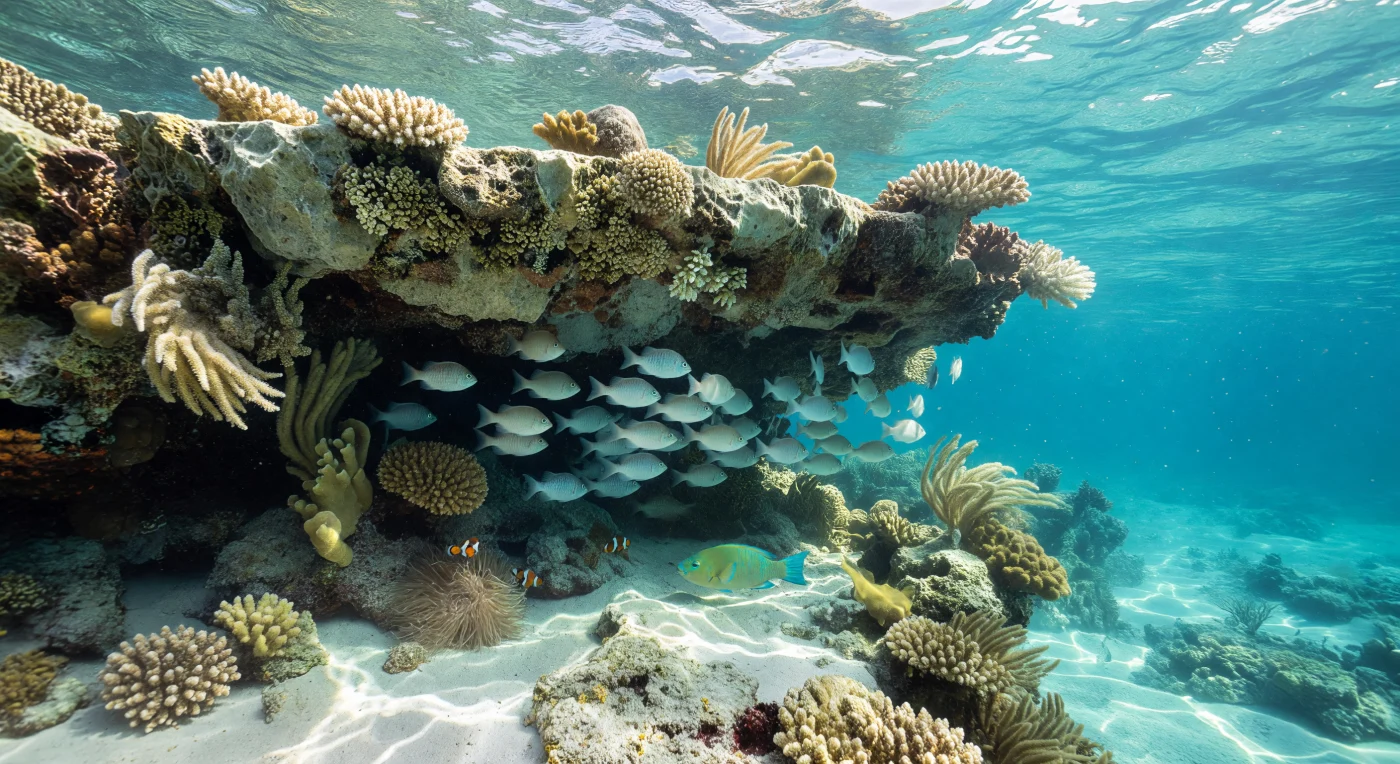
Along the atoll's seaward rim, a deeply undercut carbonate ledge juts outward into the open Indo-Pacific water column, its pale cream and weathered-gold ceiling pitted by centuries of dissolution and surge, packed with solitary cup corals and encrusting polyps that require no photosynthesis to thrive in persistent shadow. Beneath the overhang, a dense aggregation of glassy sweepers hangs motionless in layered formation, their translucent flanks and silver eyes lit only by the diffuse turquoise glow spilling in from the open sea beyond — ambient light bounced and scattered through a water column of extraordinary clarity, where caustic patterns ripple continuously across every carbonate surface as surface waves far above refract the tropical sun. On the outer lip, branching hard corals and slender gorgonians extend into the current, filter-feeding on the plankton-rich upwelling water that sweeps around atoll rims, while a parrotfish works the sunlit rock face with its fused beak, grinding carbonate substrate and extracting endolithic algae — a process that, multiplied across millions of individuals over millennia, contributes meaningfully to reef sediment production. Beyond the ledge, the fore reef drops away into deepening cobalt, pressure climbing steadily with every meter of descent, the temperature cooling slightly as solar warming gives way to the thermal structure of open oceanic water, and the entire structure — polyp by polyp, layer by layer — continues its slow biological construction of a limestone world that predates any human witness by millions of years.