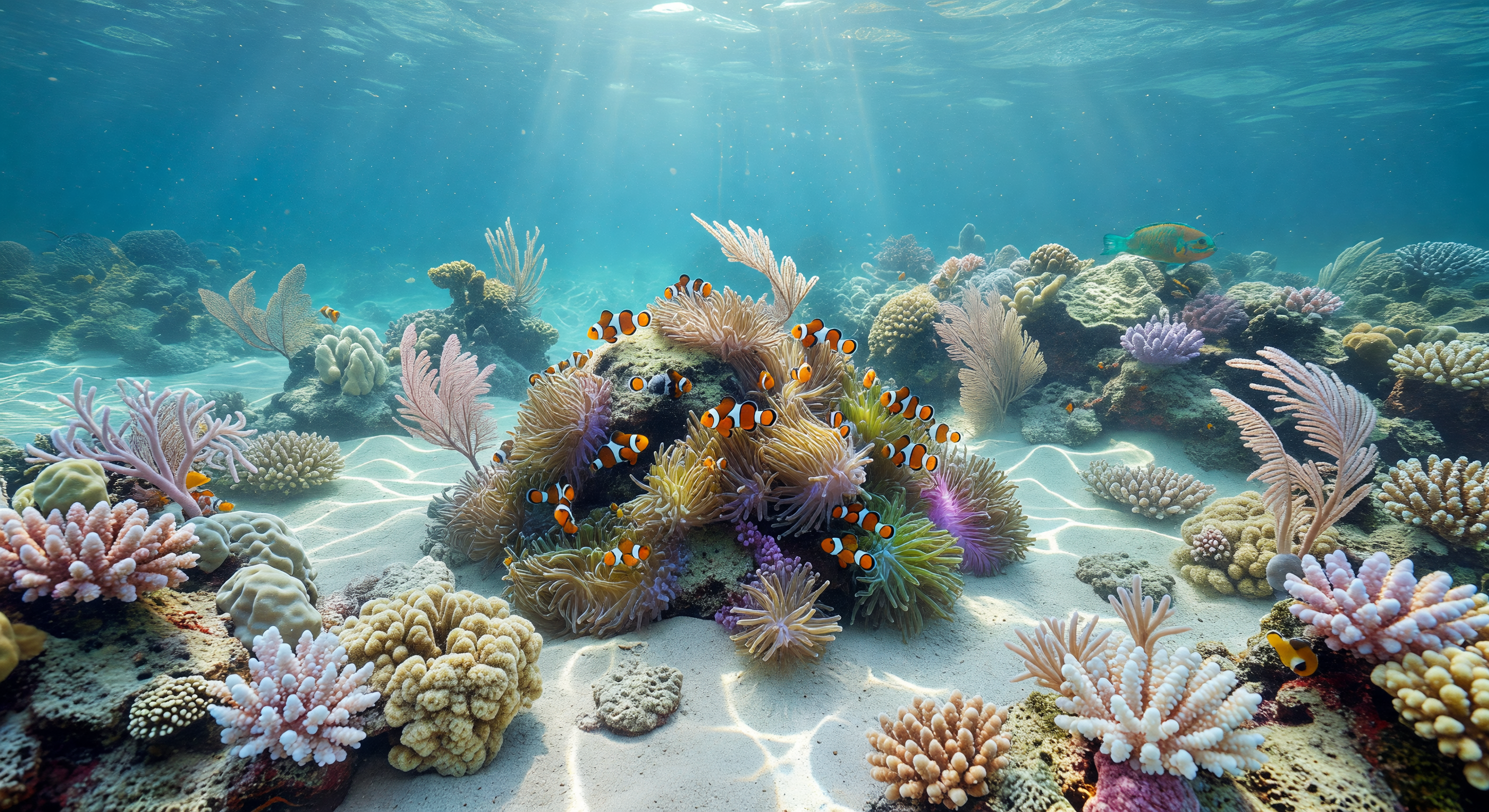
At roughly six to eight metres below the surface, the Indo-Pacific reef exists in a state of perpetual, unhurried abundance. A single coral bommie rises from pale rippled carbonate sand — itself the slow product of millennia of skeletal accumulation — encircled by a clustered field of sea anemones whose cnidocyte-laden tentacles flex gently in the prevailing current, each column hosting small family groups of *Amphiprion* species whose orange-and-white banding is kept vivid by the full-spectrum tropical sunlight still pouring powerfully through only a few metres of warm, saline water column above. The surrounding reef mosaic — branching *Acropora*, massive *Porites* heads, and encrusting limestone plates colonised to their margins — represents the accumulated carbonate architecture of zooxanthellate corals working at near-peak photosynthetic efficiency, the symbiotic algae within their tissues driving calcification at rates that make shallow tropical reefs the most biologically productive carbonate factories on Earth. Caustic light patterns slide and fracture across anemone columns, coral heads, and open sand in shifting geometries produced by surface wave refraction, animating a scene where pressure is barely above one atmosphere and dissolved oxygen and temperature hover comfortably within the narrow thermal window — roughly twenty-six to twenty-eight degrees Celsius — that sustains both coral health and the dense invertebrate and fish communities sheltering within it. A parrotfish moves unhurriedly along the reef edge, its pharyngeal jaws grinding carbonate substrate into the fine white sediment that will eventually drift and settle, returning the reef's own skeleton to the sand that cradles it.
Coral reef