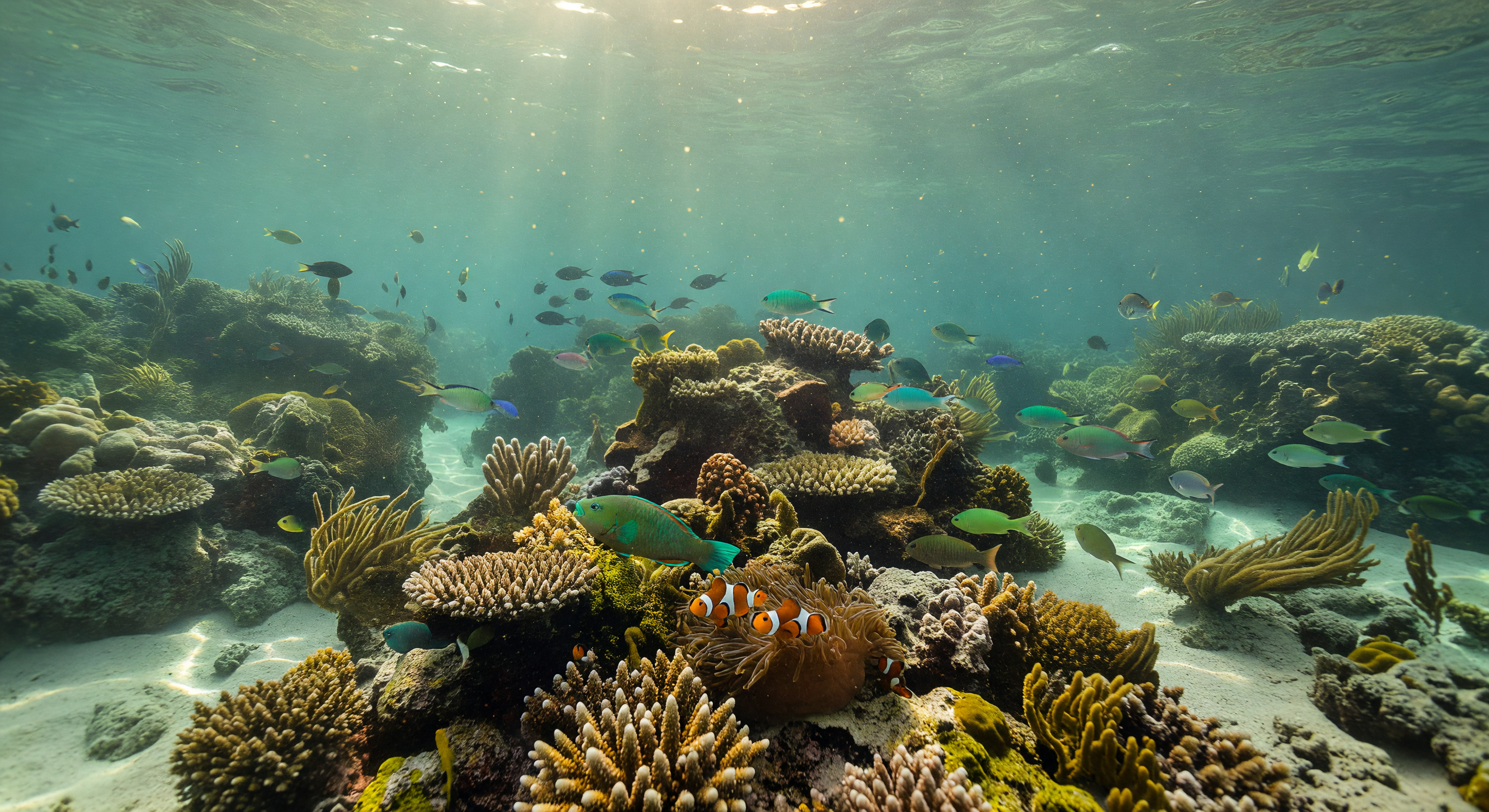
At six to ten metres on the upper fore reef, the early sun cuts through a rippled surface at a low angle, scattering god rays through water rendered green-blue by a dense suspension of phytoplankton and zooplankton that drifts in slow, invisible currents. At roughly two atmospheres of pressure, this is still the fully sunlit world, where zooxanthellae locked inside coral tissue convert that filtered tropical light into the carbonate architecture of branching Acropora and encrusting Porites, their knobby tips and textured surfaces flickering with caustic light patterns projected down from the wave-broken surface above. Wrasses and electric-blue chromis work the midwater plankton column with precise, darting efficiency, while a parrotfish below grinds at the limestone with its fused beak, producing the fine white carbonate sediment that fills the sand pockets between coral heads. Tucked within the reef structure, a sea anemone anchors itself to the substrate, its symbiotic clownfish moving in small, purposeful arcs through its tentacles — a partnership shaped by millions of years of co-evolution in exactly this saturated, sun-warmed, plankton-hazed shallowness. The living haze softens the reef's far edges into a warm green distance, a reminder that abundance here is not stillness but perpetual biological negotiation, carried out in full light, entirely without witness.
Coral reef