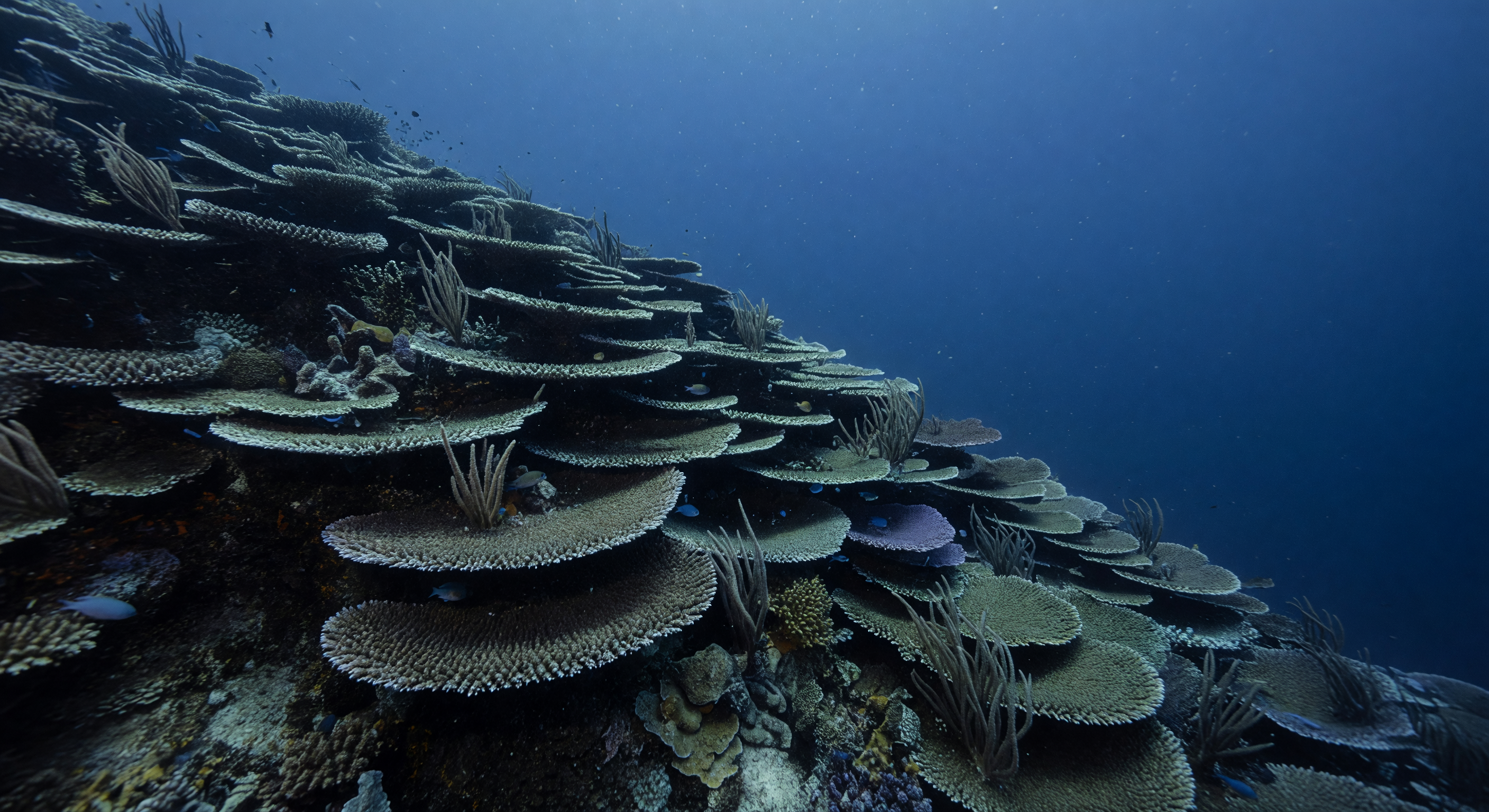
Where the reef slope angles away into the deep, plate corals spread their thin, irregular rims in wide horizontal fans, each one angled to catch what little light filters down from the distant surface — a last, attenuated wash of blue-green that has surrendered every warm wavelength to the water column above. At these mesophotic depths, roughly between thirty and one hundred and fifty metres in clear tropical seas, pressure climbs toward several atmospheres, water temperature drops into the low twenties, and the spectrum narrows to cobalt and indigo alone, draining the reef of reds and oranges and leaving stone, sponge, and coral tissue in muted olives, dusky violets, and cool blue-grey. The plate corals have evolved this flat, shelf-like architecture precisely for this light regime, maximising surface area to gather photons that arrive as little more than a dim, directionless ambient glow, while their undersides and the channels between them shelter cryptic fauna — small reef fish pressed against the limestone, encrusting coralline algae, and pale sponge patches drawing nutrients from the slow downslope current bending the whip corals and gorgonians into a single, silent lean. Fine particulate drifts freely through the open water column, a natural snow of organic material settling toward deeper darkness, and beyond the last visible plate the reef dissolves into ultramarine and then blue-black — a world of extraordinary structural complexity existing entirely on its own terms, indifferent to the surface above it.
Coral reef