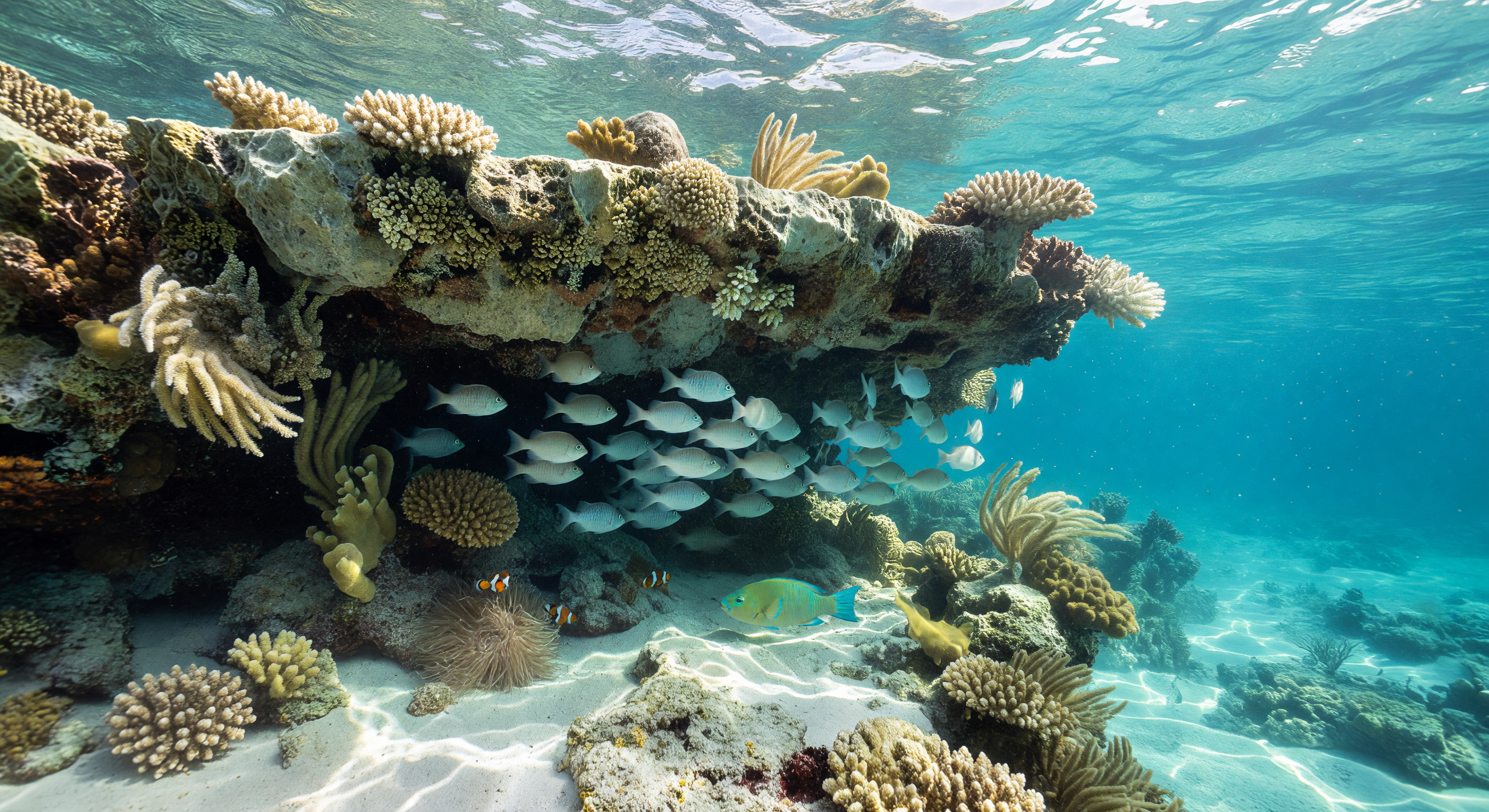
Along the atoll's seaward rim, a deeply undercut carbonate ledge juts outward into the open Indo-Pacific water column, its pale cream and weathered-gold ceiling pitted by centuries of dissolution and surge, packed with solitary cup corals and encrusting polyps that require no photosynthesis to thrive in persistent shadow. Beneath the overhang, a dense aggregation of glassy sweepers hangs motionless in layered formation, their translucent flanks and silver eyes lit only by the diffuse turquoise glow spilling in from the open sea beyond — ambient light bounced and scattered through a water column of extraordinary clarity, where caustic patterns ripple continuously across every carbonate surface as surface waves far above refract the tropical sun. On the outer lip, branching hard corals and slender gorgonians extend into the current, filter-feeding on the plankton-rich upwelling water that sweeps around atoll rims, while a parrotfish works the sunlit rock face with its fused beak, grinding carbonate substrate and extracting endolithic algae — a process that, multiplied across millions of individuals over millennia, contributes meaningfully to reef sediment production. Beyond the ledge, the fore reef drops away into deepening cobalt, pressure climbing steadily with every meter of descent, the temperature cooling slightly as solar warming gives way to the thermal structure of open oceanic water, and the entire structure — polyp by polyp, layer by layer — continues its slow biological construction of a limestone world that predates any human witness by millions of years.
Coral reef