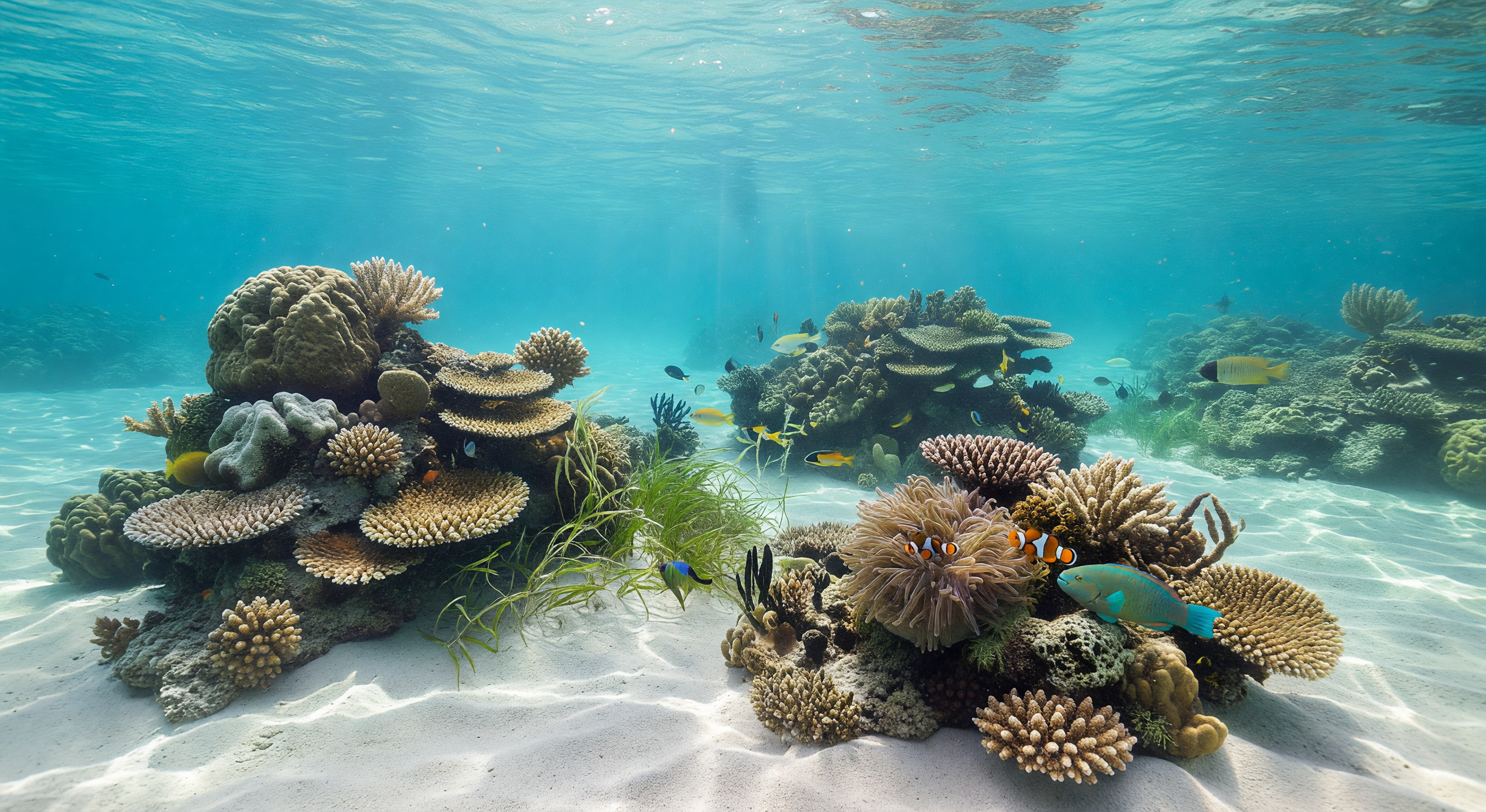
Noon light pours through the rippled surface of this shallow lagoon in broad, shifting shafts, the entire water column glowing a luminous blue-green as caustic patterns race and dissolve across white carbonate sand only three to eight meters below. These patch reefs are the accumulated limestone labor of millions of coral polyps — tiny cnidarian animals housing symbiotic zooxanthellae algae that harvest the abundant sunlight and fuel the calcification engine that builds, centimeter by patient centimeter, the massive boulder heads and cantilevered plate forms rising from the lagoon floor. Parrotfish rasp the coral surface with their fused beak-like teeth, converting limestone and algae alike into the fine white sand that drifts in slow suspension around the reef bases, while juvenile chromis and damselfish hold station above seagrass ribbons, their scales catching the fractured noon light, and a pair of clownfish move in short, bobbing arcs within the stinging embrace of an anemone's translucent tentacles. Gorgonian fans angle gently into the lagoon's faint tidal current, their polyps extended to capture passing plankton, and the whole community pulses with metabolic intensity — photosynthesis, respiration, predation, and growth — sustained entirely by sunlight and seawater chemistry. At the lagoon's far edge, the turquoise shallows deepen toward cyan-blue, and the reef's architectural complexity fades quietly into open water, indifferent and complete, existing entirely without witness.
Other languages
- Français: Jardin Mosaïque du Lagon
- Español: Jardín Mosaico Lagunar
- Português: Jardim Mosaico da Lagoa
- Deutsch: Lagune Flickenteppich Garten
- العربية: حديقة البحيرة المرقطة
- हिन्दी: लैगून पैचवर्क उद्यान
- 日本語: ラグーンパッチワーク庭園
- 한국어: 석호 패치워크 정원
- Italiano: Giardino Mosaico della Laguna
- Nederlands: Lagune Lappendeken Tuin