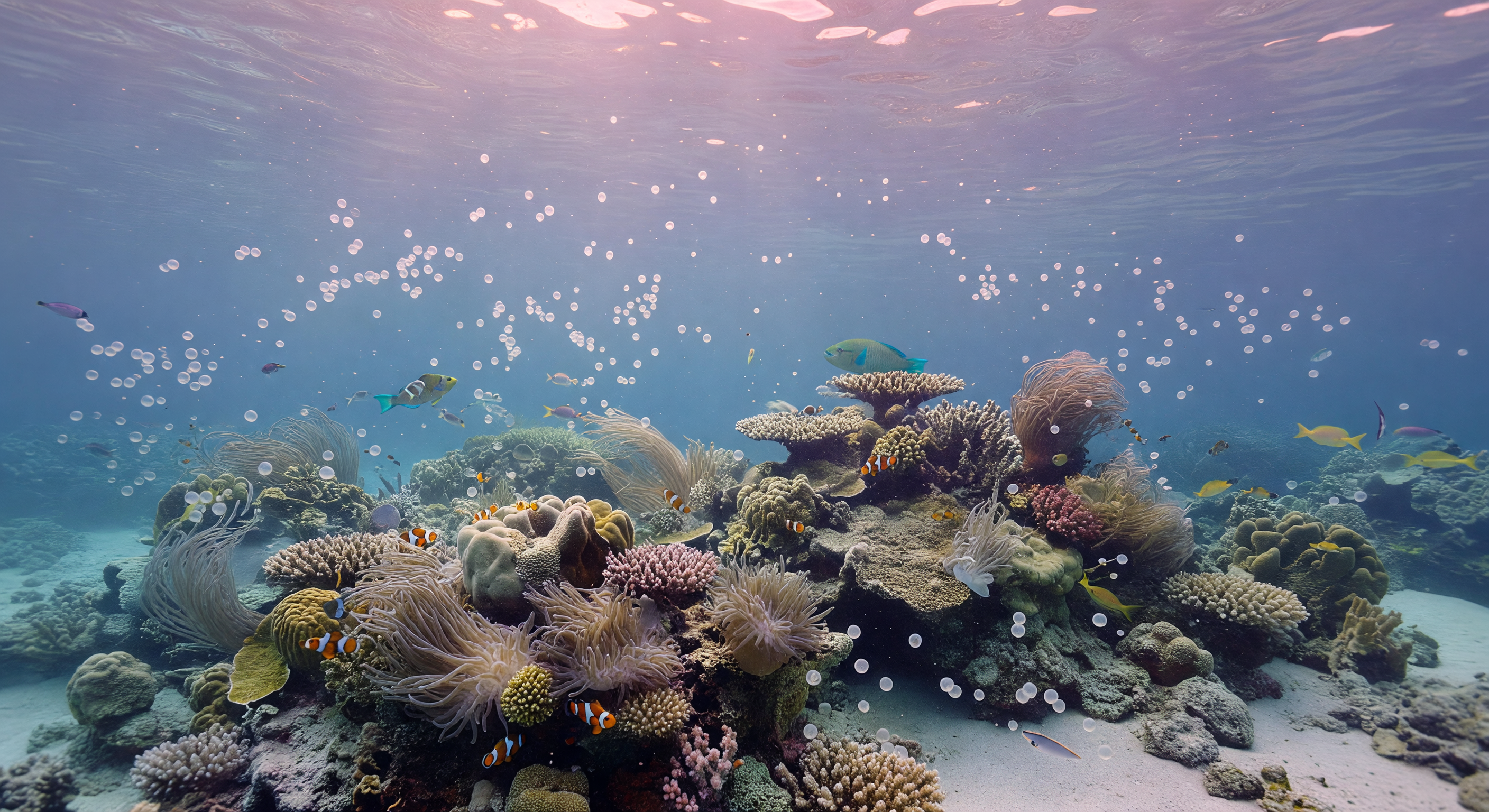
Along the outer fore-reef slope at dusk, the last warm light of the sun filters down through a gently rippled surface in diffuse rose-lavender shafts, growing bluer and cooler with each meter of depth as red wavelengths are stripped away by the water column — at even ten meters, the spectrum has already narrowed, and what remains is a luminous blue-green clarity alive with fine suspended particles. This is a mass coral spawning event, a synchronised reproductive broadcast triggered by lunar phase and sea temperature, in which colonies of scleractinian corals simultaneously release buoyant bundles of eggs and sperm that drift upward through the water column in pale, slow constellations, each sphere a few millimetres across, catching what ambient light remains. Polyp-built limestone bommies rise from the carbonate substrate in dense architectural crowding — massive Porites heads worn smooth by decades of growth, branching Acropora thickets, and gorgonian sea fans angled perpendicular to the current to maximise particle capture — while clownfish shelter within the stinging tentacles of their host anemones, a mutualism refined across millions of years of co-evolution. Small planktivorous anthias and chromis hang motionless in the spawn veil, feeding opportunistically on passing bundles and zooplankton drawn upward by the same thermoclines that concentrate prey at this hour, while a parrotfish moves unhurried across the reef crest, its beak-fused teeth grinding algae-encrusted limestone into the pale sand below. Here, at less than twenty metres, pressure is barely three atmospheres, water temperature holds near twenty-seven degrees Celsius, and the reef exists in its ancient rhythm — reproducing, grazing, filtering, building — indifferent to any observer, complete in itself.
Other languages
- Français: Voile de Frai Crépusculaire
- Español: Velo de Desove Crepuscular
- Português: Véu da Desova Crepuscular
- Deutsch: Zwielicht Laich Schleier
- العربية: حجاب التفريخ الغسقي
- हिन्दी: संध्या अंडे का घूंघट
- 日本語: 黄昏産卵の帳
- 한국어: 황혼 산란의 베일
- Italiano: Velo di Schiusa Crepuscolare
- Nederlands: Schemering Kuit Sluier