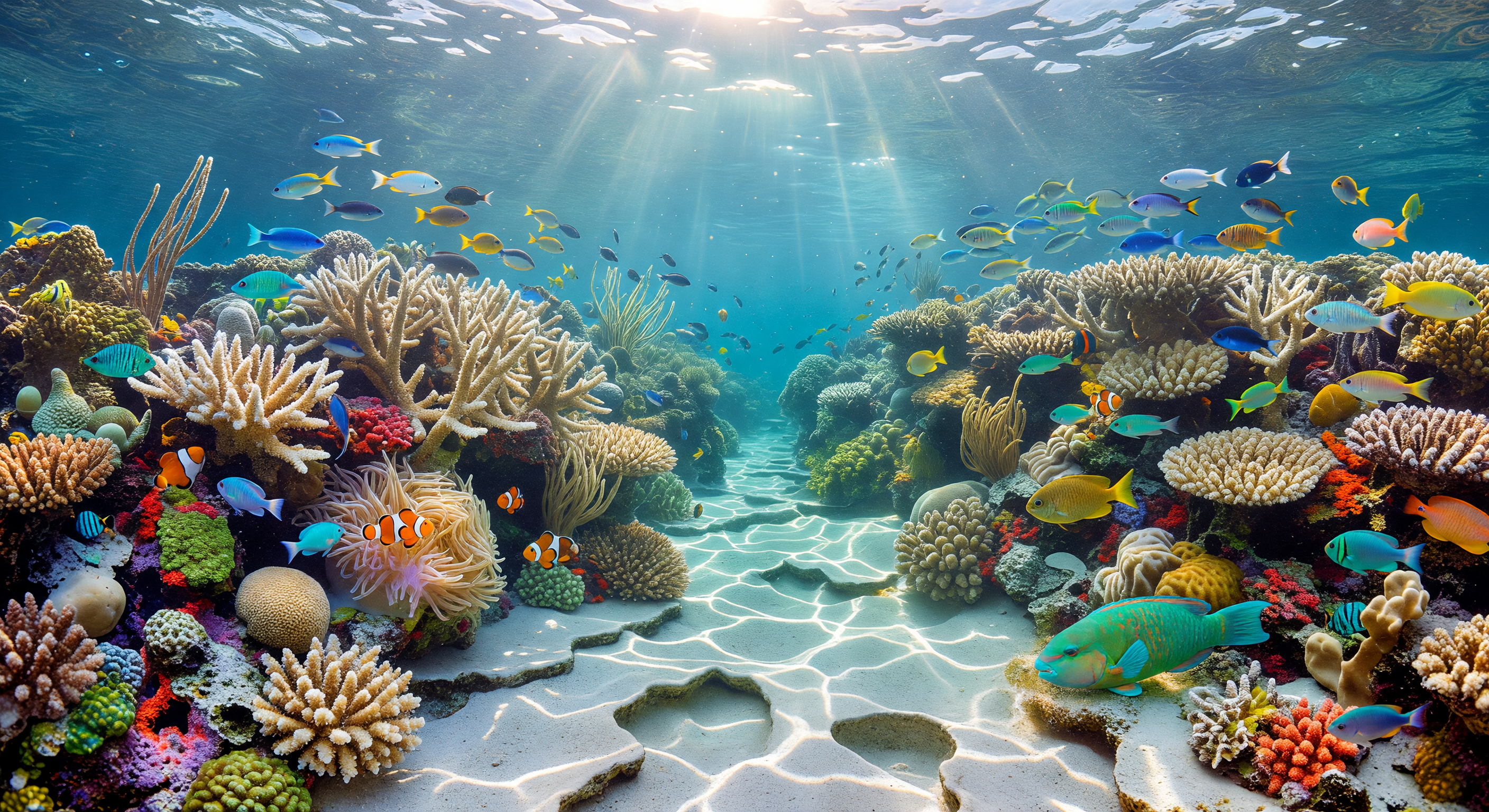
Sunlight pours through the rippled surface overhead in shifting nets of caustic light, fracturing across pale polished limestone and the branching arms of staghorn coral in the upper few meters of the water column — a zone where solar radiation still delivers its full photosynthetic force and pressure remains barely above one atmosphere. The channel itself is a product of reef geomorphology: carbonate dissolved, abraded, and scoured over millennia by tidal surge, the limestone smoothed into scallops and grooves by the relentless oscillation of water that carries dissolved oxygen and planktonic food with every pulse. Dense thickets of *Acropora* rise on both flanks, their living surfaces studded with extended polyps feeding in the current, while schools of anthias and chromis sweep overhead in coordinated ribbons — a behavioral response to both surge energy and predator pressure — and a parrotfish methodically grazes the reef margin, its pharyngeal jaws grinding carbonate into the fine white sand accumulating between coral bases. In a sheltered pocket along the channel wall, an anemone anchored to encrusting coralline substrate houses a pair of clownfish within its mucus-coated tentacles, a mutualism sustained entirely by the warm, clear, nutrient-threaded water flowing through this reef architecture that was built, grain by grain and polyp by polyp, by the organisms still living within it.
Coral reef