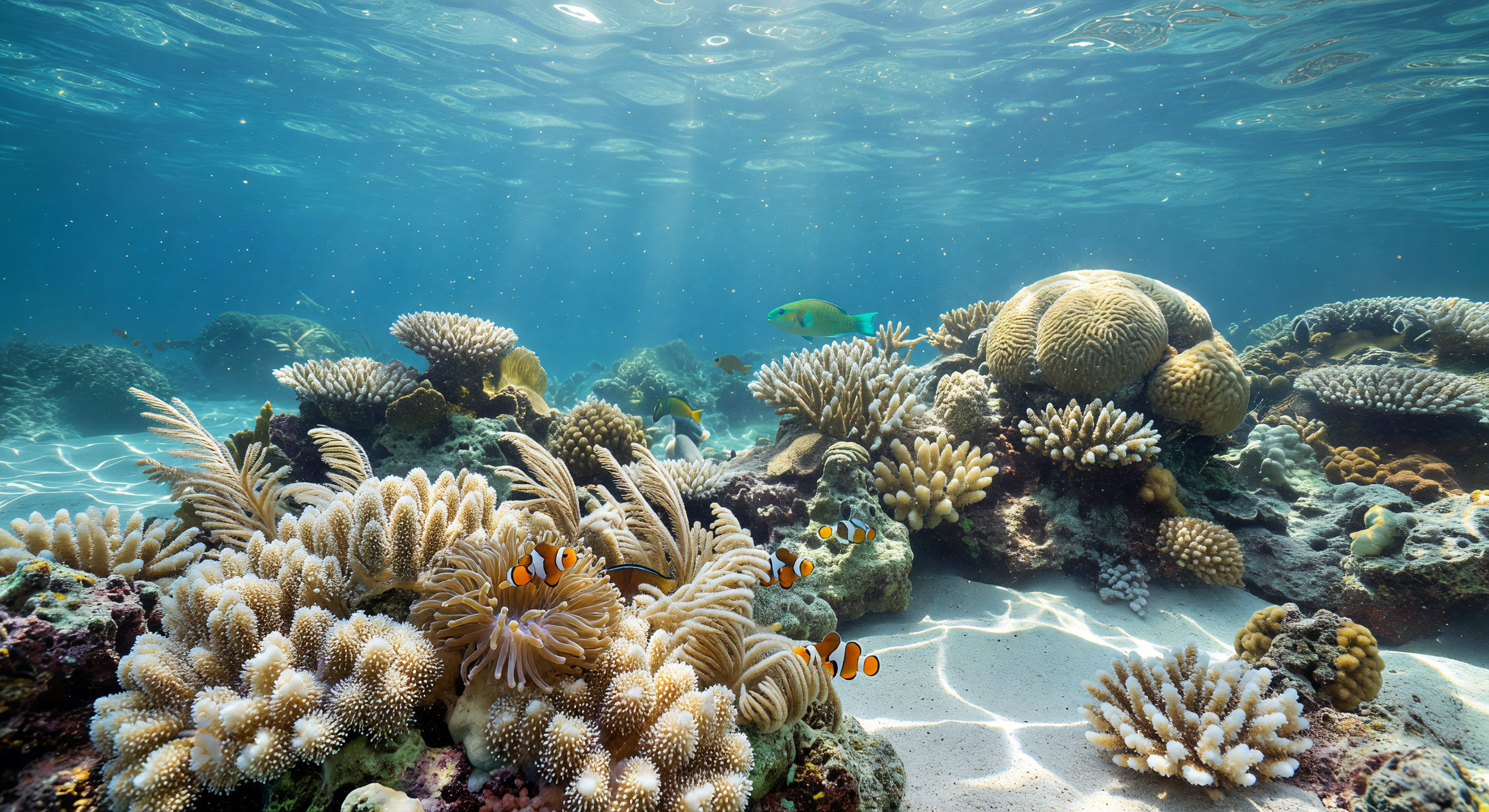
At the heart of a sheltered fore reef, the midday sun pours through a few meters of crystalline tropical water, painting the seafloor in shifting nets of caustic light that slide across massive porites heads and branching acropora colonies in slow, luminous ripples. Each coral head is a living city: thousands of tiny polyps extend their tentacled crowns from their limestone cups, drawing zooplankton and dissolved nutrients from the passing current, their tissues harboring the symbiotic dinoflagellates — zooxanthellae — that power the reef's prodigious calcium carbonate production through photosynthesis. At perhaps two to three atmospheres of pressure, a parrotfish moves through the middle distance with unhurried purpose, its beak-like fused teeth designed to rasp algae and carbonate alike, the fine white sediment drifting in its wake a product of that same biological grinding that slowly manufactures the pale sand pockets between colonies. A pair of anemonefish weave through the trailing tentacles of their host anemone, sheltered by a chemical mutualism refined over millions of years, while slender gorgonian fans trace slow arcs in the mild fore-reef surge. Fine planktonic particles drift and glitter in the ambient blue-green light, each mote a reminder that this sunlit, warm, salt-heavy water column is itself alive — a medium teeming with larvae, bacteria, and organic snow that feeds the reef's seemingly solid architecture from within.
Other languages
- Français: Midi des Polypes Coralliens
- Español: Mediodía de Pólipos Coralinos
- Português: Meio-Dia dos Pólipos Corais
- Deutsch: Korallenpolypen Mittag
- العربية: ظهيرة حيوانات المرجان
- हिन्दी: प्रवाल पॉलिप दोपहर
- 日本語: サンゴポリプの正午
- 한국어: 산호 폴립 정오
- Italiano: Mezzogiorno dei Polipi Corallini
- Nederlands: Koraalpoliep Middag