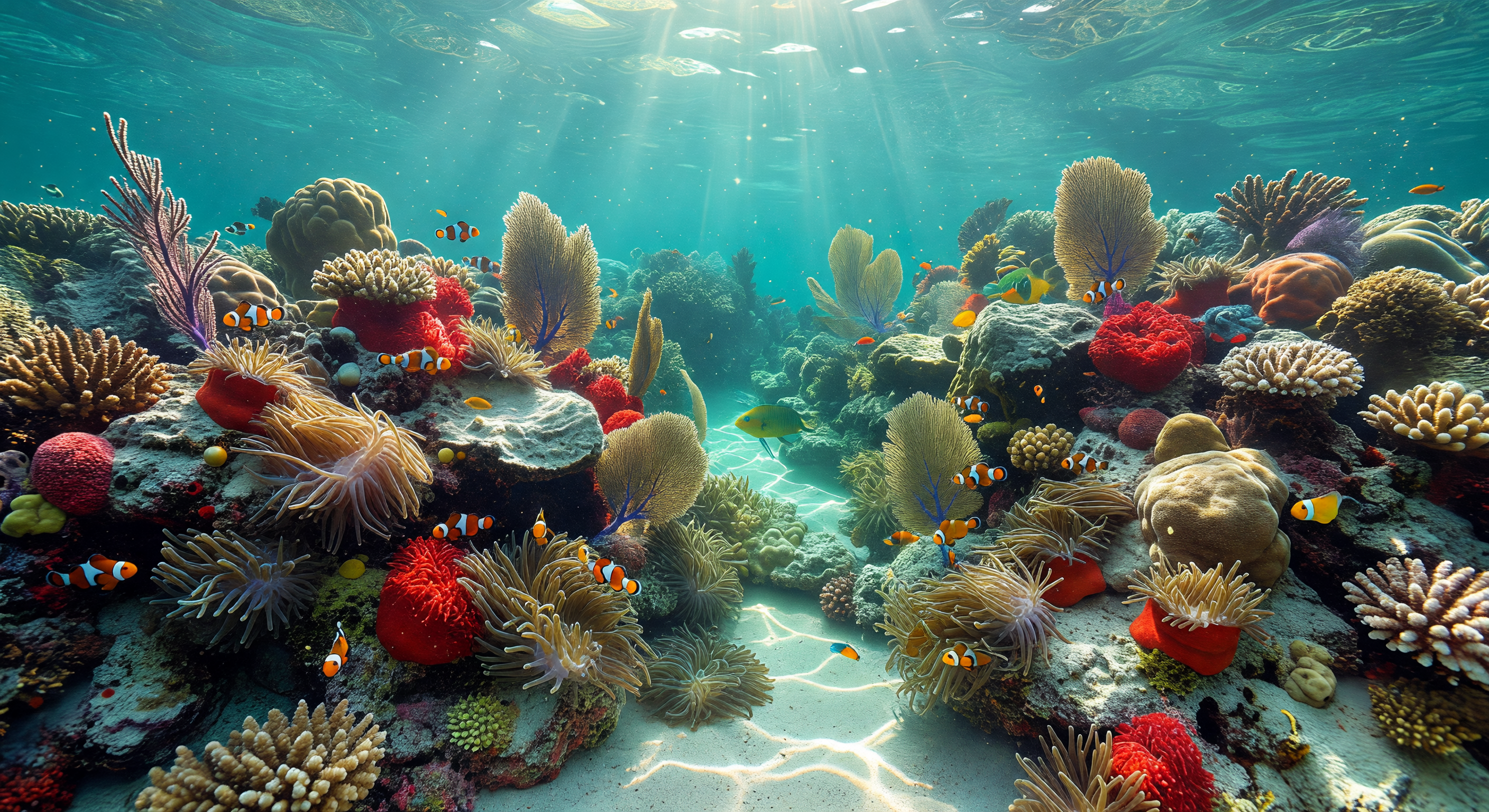
At four to eight meters in a sun-drenched Indo-Pacific pass, tidal current funnels through a canyon of living limestone, streaming the tentacles of crimson and olive sea anemones into silk-like ribbons while orange-and-white clownfish — *Amphiprion* species maintaining their lifelong mutualism with the host *Heteractis* or *Stichodactyla* — dart with precise, flickering turns among those stinging filaments, immune through a protective mucous coating that prevents nematocyst discharge. At this depth the full solar spectrum still reaches the substrate, and rippled surface waves act as a field of natural lenses, casting shifting caustic bands across coral heads, pale carbonate sand, and gorgonian fans that lean in unison with the accelerating pass current — a hydrodynamic signature of tidal exchange between lagoon and open ocean that concentrates planktonic food, oxygen, and larvae. The coral architecture itself is a centuries-old biogenic structure: branching *Acropora*, massive *Porites*, and encrusting coralline algae collectively fixing calcium carbonate into a three-dimensional reef framework that supports one of Earth's highest densities of marine species per unit area. Across the reef crest, a parrotfish methodically grazes exposed carbonate with fused beak-like teeth, producing the fine white sand drifting in slow suspension through the luminous blue-green column — a quiet act of bioerosion that has been reshaping these reefs long before any witness existed to observe it.
Coral reef