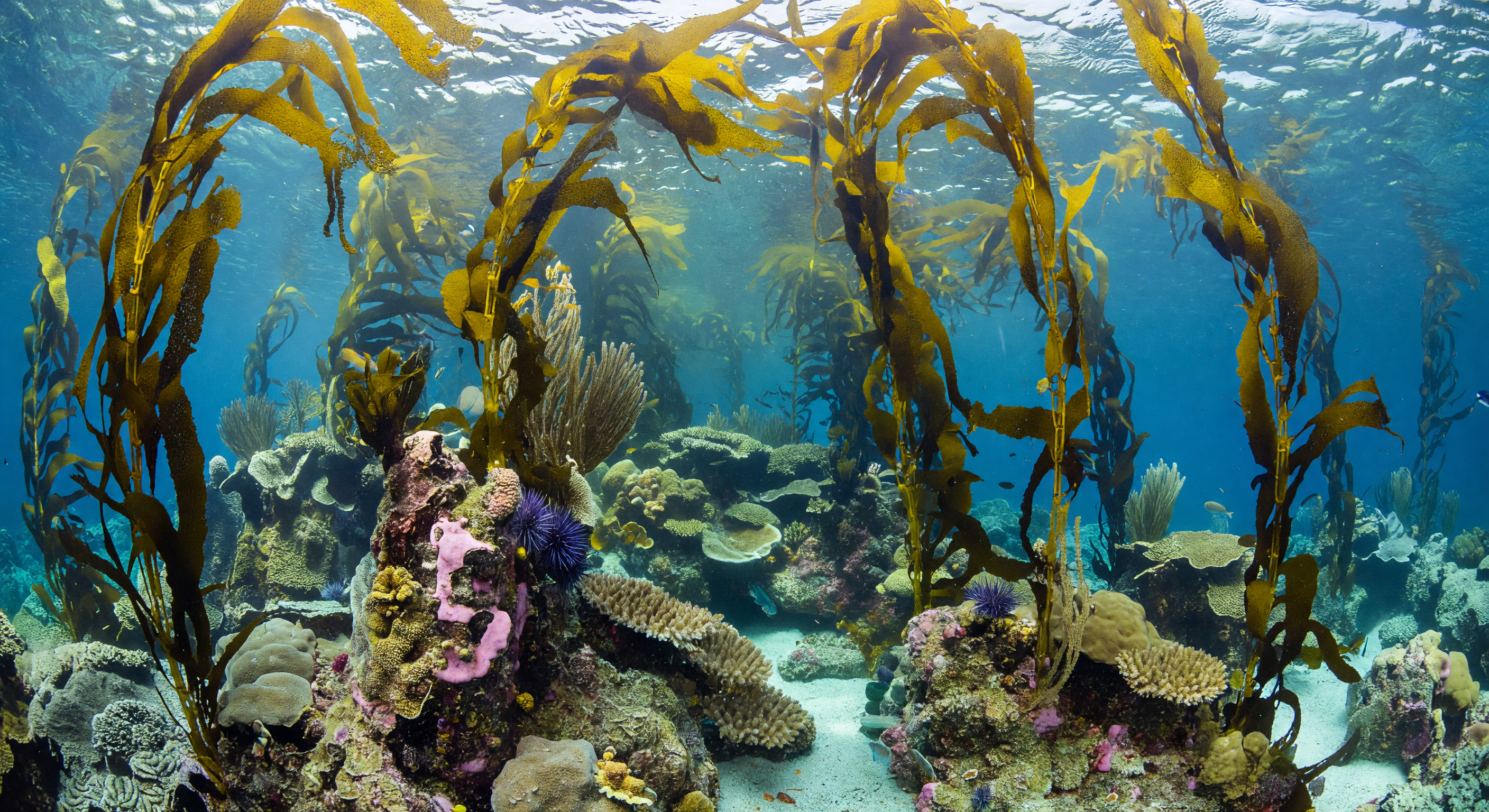
Where sunlight still commands the sea, a carbonate spur rises through water so clear that every wavelength of the spectrum—warm amber, aquamarine, cobalt—remains at play simultaneously. Towering kelp stipes, anchored by holdfasts gripping the reef's encrusting coralline algae and wedged sea urchins, ascend toward the surface in olive-gold columns; their broad amber blades overlap overhead, refracting the downwelling light into layered bands of shadow and brilliance that shift with every surface ripple, a phenomenon ecologists call a dynamic light environment and reef organisms have spent millions of years navigating. Gorgonian fans tilt at precise angles to intercept the current flowing across the spur's outer edge, while crustose pink algae cement the carbonate framework beneath them, and small reef fish—wrasses, perhaps, or juvenile groupers—thread the kelp pillars where the structural complexity of the reef multiplies available microhabitats by orders of magnitude. At the spur's seaward margin the substrate drops away into open cobalt water, a gradient that traces the transition from shallow photosynthetic abundance to a deeper, cooler world where light begins its slow surrender—but here, in these upper tens of meters, pressure barely doubles above the surface, temperatures hold in the mid-twenties, and the reef asserts itself as one of the most structurally and biologically dense ecosystems the ocean is capable of building, thriving entirely on sunlight and carbonate chemistry, indifferent to any witness.
Other languages
- Français: Éperon Cathédrale de Varech
- Español: Espolón Catedral de Quelpo
- Português: Esporão Catedral de Algas
- Deutsch: Seetang Kathedrale Sporn
- العربية: نتوء كاتدرائية العشب البحري
- हिन्दी: केल्प गिरजाघर शिखर
- 日本語: ケルプ大聖堂の岩礁
- 한국어: 켈프 대성당 암초
- Italiano: Sperone Cattedrale di Kelp
- Nederlands: Kelp Kathedraal Spoor