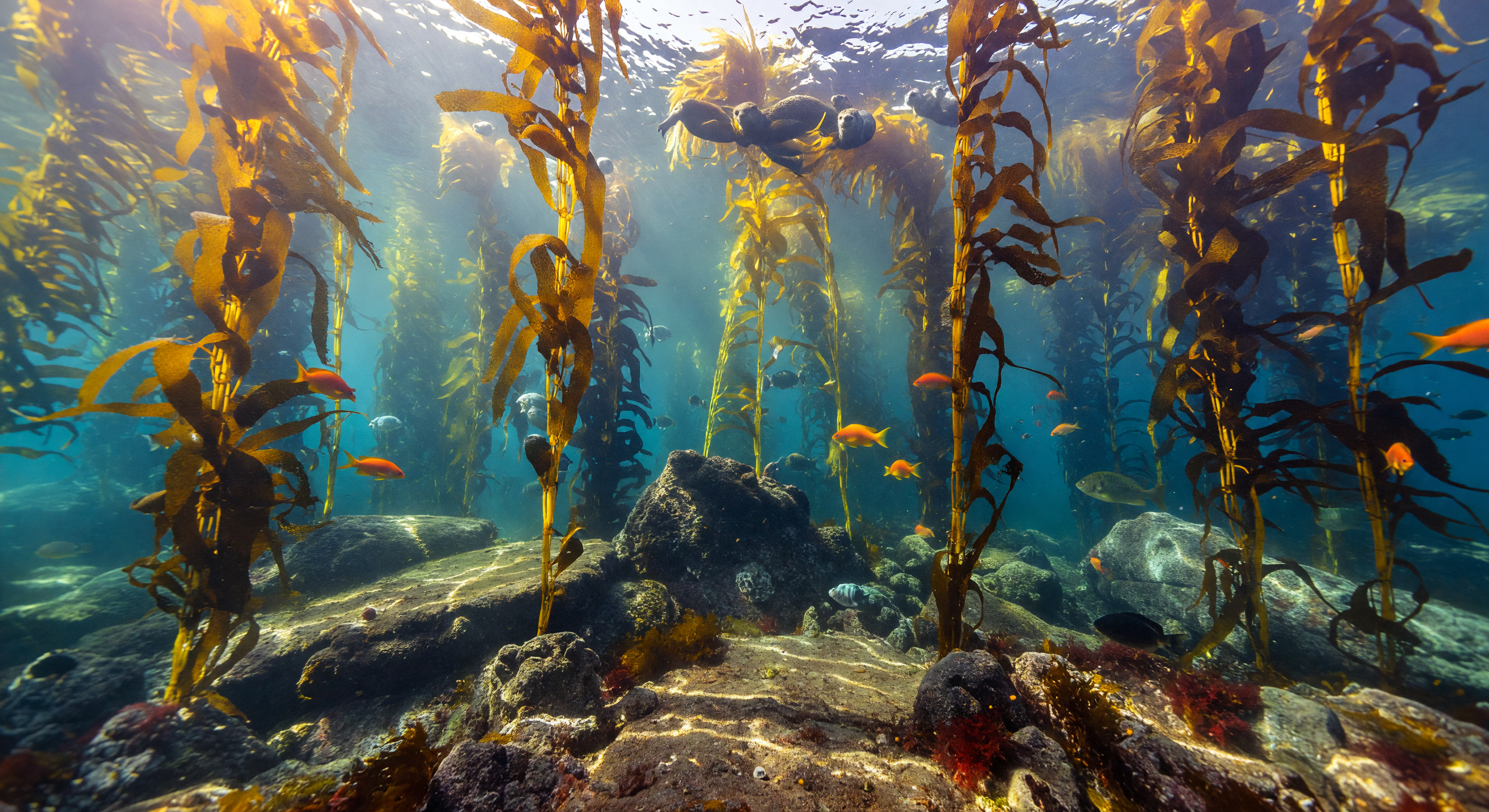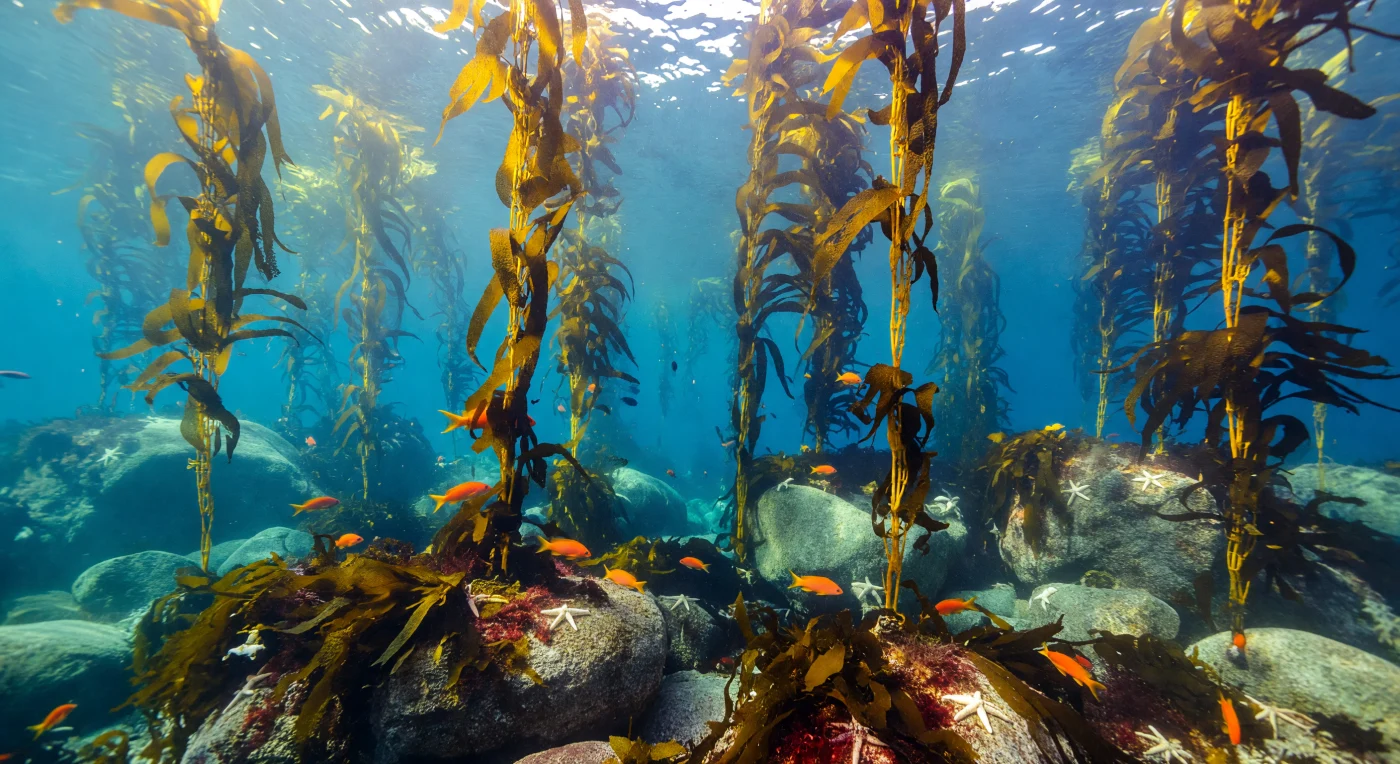
Sunlight arrives at this depth not as a distant rumor but as a living architecture — rippling caustics slide ceaselessly across rounded granite boulders, bending and fracturing with each passing swell, illuminating a world of extraordinary clarity and color. Towering columns of giant kelp, *Macrocystis pyrifera*, rise from their holdfasts like the pillars of a drowned cathedral, their pneumatocyst-studded blades backlit amber and gold where they approach the canopy, cooling through emerald and into cobalt in the shadowed intervals between them. In the bright clearing between these living columns, territorial garibaldis — *Hypsypops rubicundus*, the only damselfish of the northeastern Pacific — burn an improbable cadmium orange against the blue-green water, each individual defending its patch of reef with the quiet authority of a creature that has never needed to fear the dark. Beneath them, feather boa kelp and low understory algae carpet the reef in layered olive and red, while white sea stars cling motionless to sunlit stone, and fine suspended particles drift through the water column, catching the ambient light like slow snow in a world without winter. This is one of the most productive shallow marine ecosystems on Earth, where upwelled nutrients, oxygenated water, and relentless solar energy converge to sustain a benthic forest that shelters thousands of species and has been growing, collapsing, and regrowing along this coast for millions of years without witness.
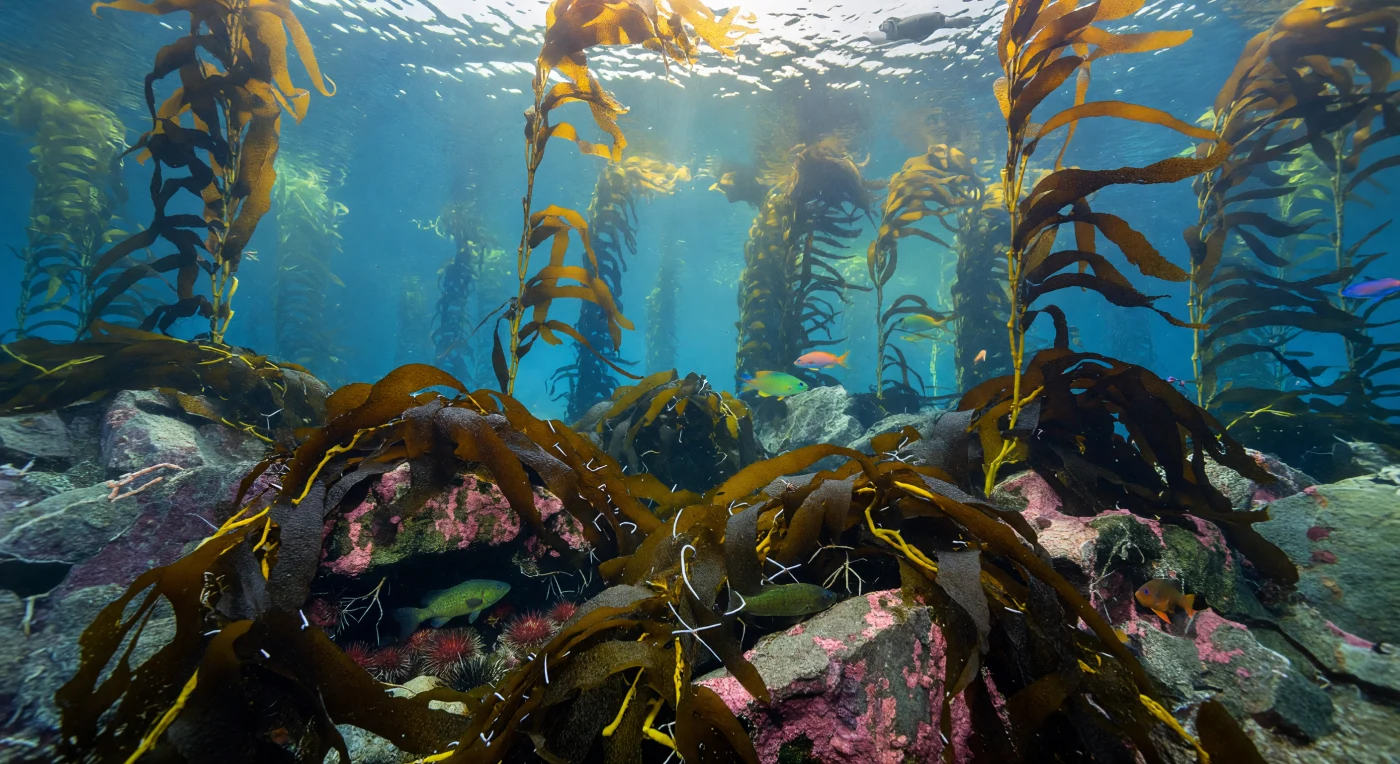
At the base of the giant-kelp forest, where sunlit stipes give way to the reef floor, massive Macrocystis pyrifera holdfasts grip fractured stone with haptera spread like bronze-brown crowns — root-analogue structures that anchor individual kelp blades against surge and current, though the alga draws no nutrients from the rock itself. Pressure here is modest, barely two to four atmospheres, yet the ecological architecture is extraordinary: pink coralline algae crust every exposed surface between the holdfasts, while red sea urchins (Mesocentrotus franciscanus) wedge themselves into crevices, their rasping mouthparts slowly grazing encrusting algae and drifting kelp fragments. Brittle stars thread their five delicate arms through the tangled haptera in perpetual, low-energy scavenging, exploiting the shelter that the holdfast labyrinth provides against predators and flow; a kelp bass (Paralabrax clathratus) hovers half-concealed in olive shadow, its countershaded flanks dissolving into the dim patchwork of filtered sunlight and holdfast geometry. Overhead, stipes rise toward a distant canopy of pneumatocyst-buoyed blades that intercept most incoming solar energy, so only narrow god rays and caustic flickers penetrate to this lowest stratum, creating a perpetual blue-green twilight even in the shallows — a cathedral of living architecture rooted in stone, shaped by cold upwelled water, and sustained entirely by light arriving from above.
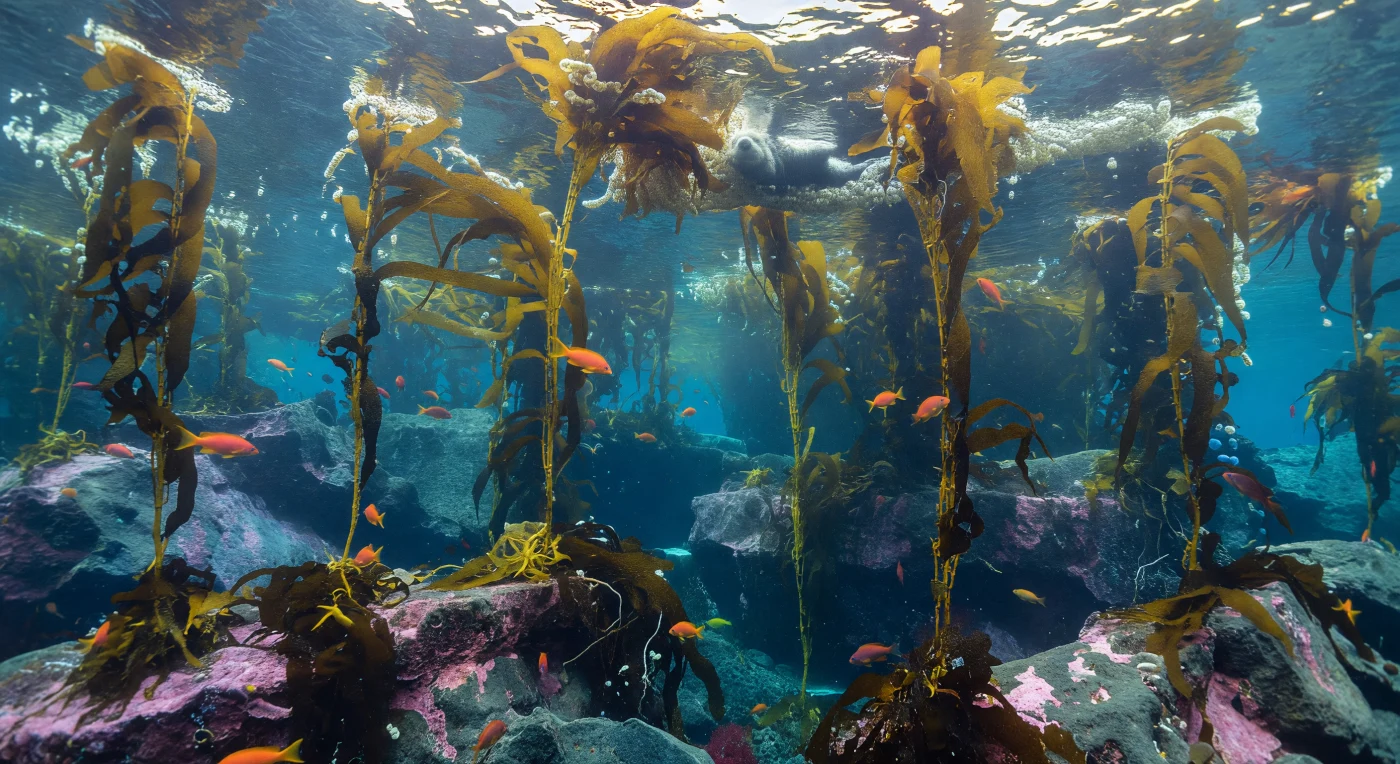
Shafts of filtered sunlight descend through the floating canopy of *Macrocystis pyrifera* in long, trembling columns of blue-green light, fracturing into dancing caustics across basalt ledges crusted with coralline pink algae — a liquid cathedral reaching from rocky seafloor to shimmering surface, rooted at depths of ten to fifteen metres where pressure is modest but biological complexity is extraordinary. Long, flexible stipes rise like living architecture from intricate holdfast tangles gripping volcanic rock, their bronze-gold blades unfurling in slow rhythmic ribbons as nutrient-rich, cool upwelled water moves gently through the forest; chains of pearl-white pneumatocysts — gas-filled floats packed with carbon monoxide — gather beneath the canopy roof, keeping the entire structure vertical and taut. Vivid orange garibaldis, *Hypsypops rubicundus*, the only federally protected marine fish in California, hover and wheel between the stipes, their pigmentation absorbing the blue-shifted light and re-emitting a saturated warmth that glows against the cobalt water column, while a sea otter rests motionless among the surface fronds overhead, backlit by rippled sunlight filtering through the canopy above. At this depth, primary production through photosynthesis is intense — giant kelp can grow up to sixty centimetres per day under optimal conditions — making these forests among the most productive ecosystems on the planet, sustaining layered communities of rockfish, invertebrates, and understory algae in a world of oxygen, light, and silent, perpetual motion.
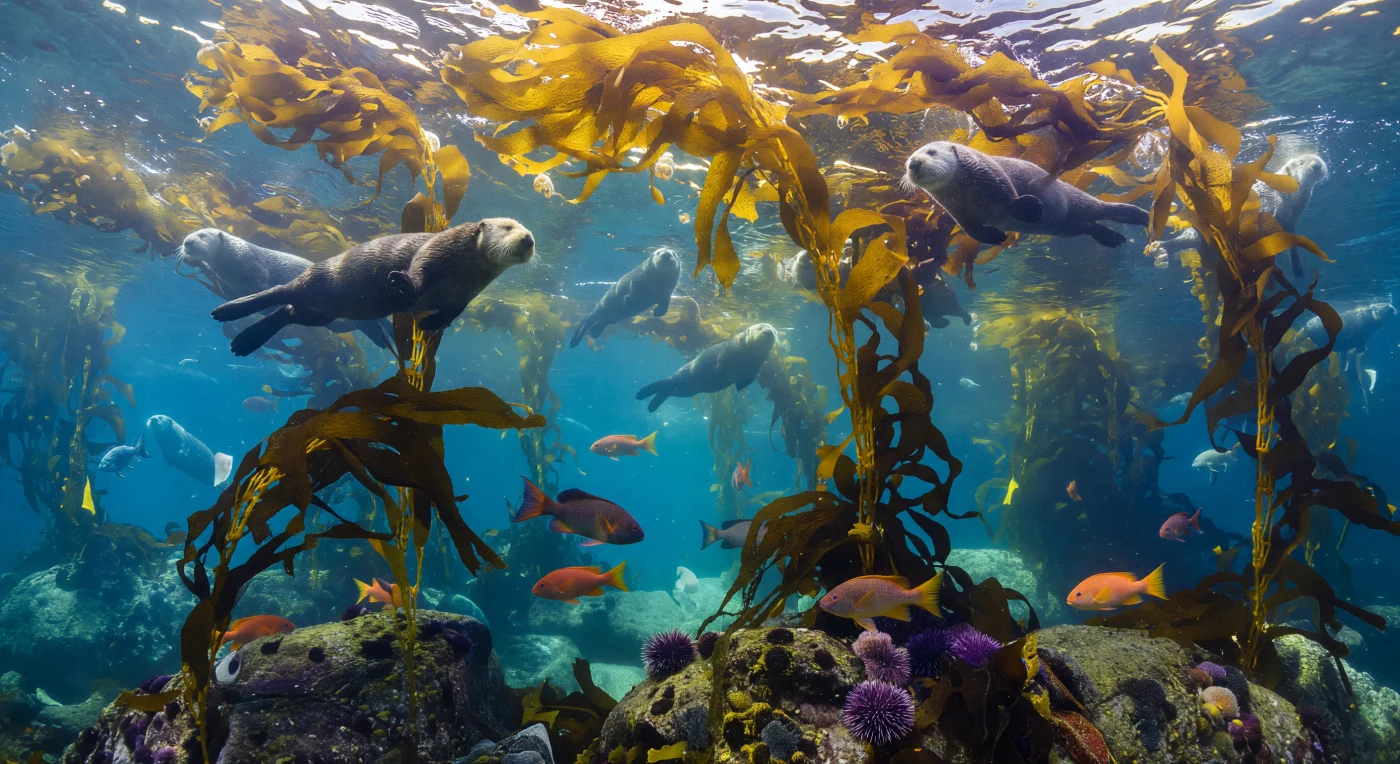
Beneath a rippling amber canopy of *Macrocystis pyrifera*, sunlight fractures into shifting god rays that slide down bronze-gold stipes toward a rocky reef below, where purple urchins cluster in patient battalions among holdfasts and encrusting algae. Sea otters rest loosely among the pneumatocysts at the surface, their dense fur trapping silvery micro-bubbles, their unhurried movements barely disturbing the slow sway of the kelp blades above. Garibaldi damselfish burn orange between the columnar stipes, their color almost impossible against the cool blue-green of the interior water column, where fine particles of organic snow drift without direction or destination. This is a foundation ecosystem — *Macrocystis* rooted to hard substrate at depths of ten to twenty meters, the holdfasts gripping basalt and cobble while the entire living architecture rises through three dimensions of lit water, generating oxygen, sheltering juvenile fish, and cycling nutrients at rates rivaling tropical rainforests. The forest exists in complete indifference, its internal light shifting with every passing swell, its quiet only broken by the tick of urchin spines and the soft exhalation of rising kelp gas.
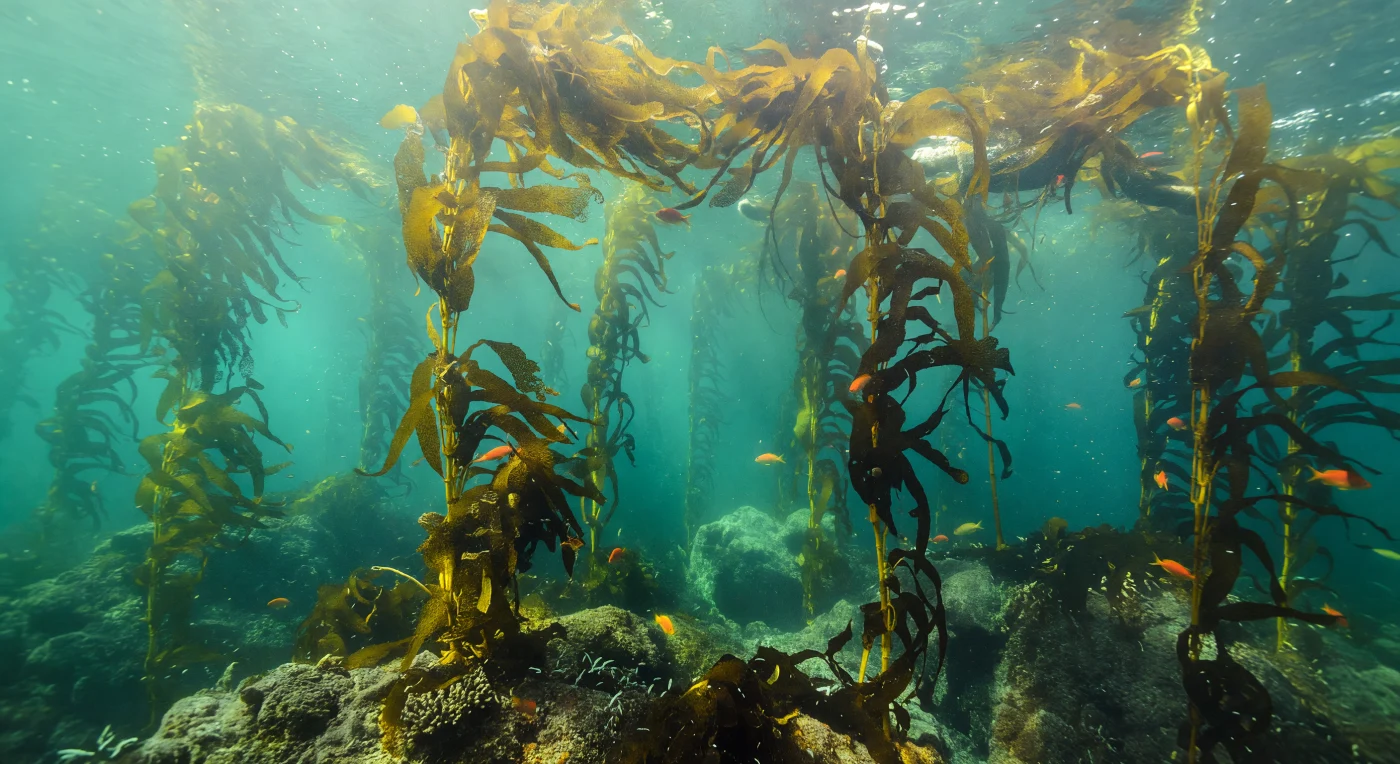
At roughly 8 to 15 meters depth along the California coast, spring upwelling floods the water column with nitrates, triggering a phytoplankton bloom that transforms the sea into a luminous jade veil — billions of microscopic diatoms and dinoflagellates suspended in the full force of unfiltered Pacific sunlight. Macrocystis pyrifera rises from holdfasts gripping coralline-encrusted boulders, stipes climbing through emerald god-rays toward a canopy where pneumatocysts keep the fronds aloft, the entire structure photosynthesizing at peak seasonal productivity in water still brisk from winter upwelling near 12°C. Dense copepod clouds, Calanus pacificus and kin, drift in slow gyres around sunlit blades, their translucent bodies catching and scattering light, part of a zooplankton biomass so thick it creates its own opaline shimmer throughout the water column. Garibaldis, Hypsypops rubicundus, hold territory among the amber stipes while small rockfish thread the vertical corridors, and near the canopy's outer edge a sea otter rests among floating fronds, wrapped in the quiet oxygen-saturated surge of a forest that has existed on this reef entirely on its own terms — rooted, breathing, and complete.
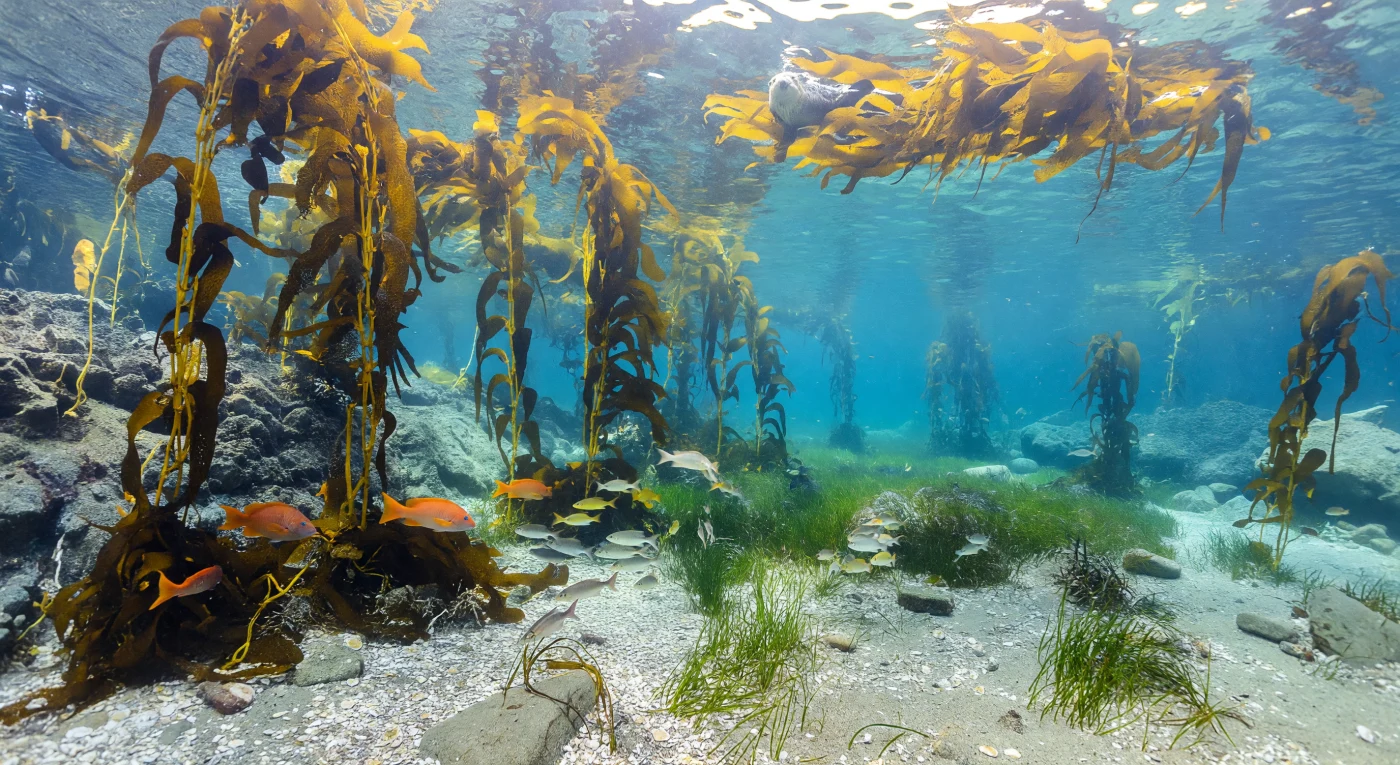
In the sheltered waters of a California cove, giant kelp — *Macrocystis pyrifera* — rises from holdfasts locked onto rocky reef in dense, cathedral-like pillars, its long stipes threaded with gas-filled pneumatocysts that buoy each frond toward a canopy shimmering at the surface, where photosynthesis proceeds with extraordinary intensity in the fully sunlit epipelagic zone. Here, at depths rarely exceeding twenty meters, pressure remains gentle — no more than three atmospheres — and the governing forces are wave surge, nutrient-rich upwelling, and the quality of light filtering down through layered fronds, shifting from vivid open-ocean turquoise to the softer, diffuse green that pools over the eelgrass meadow beyond. That meadow, woven from ribbons of *Zostera marina* anchored in pale sand and shell hash, forms a distinct transitional habitat: a nursery ecosystem where fine organic particles settle, invertebrates colonize shell fragments, and small silver juvenile fishes hover in loose aggregations, exploiting the shelter before dispersing into deeper reef communities. Bright garibaldis — *Hypsypops rubicundus*, the only truly territorial damselfish of the eastern Pacific — hold station near the rocky kelp edge, their vivid orange bodies catching the caustic light patterns that dance across stone and algal blade alike. A sea otter rests motionless among surface fronds above, its presence an ecological signature of this coast — a predator whose appetite for sea urchins keeps grazing pressure in check and the kelp forest itself intact, the entire scene existing in a continuous, self-sustaining cycle entirely indifferent to any witness.
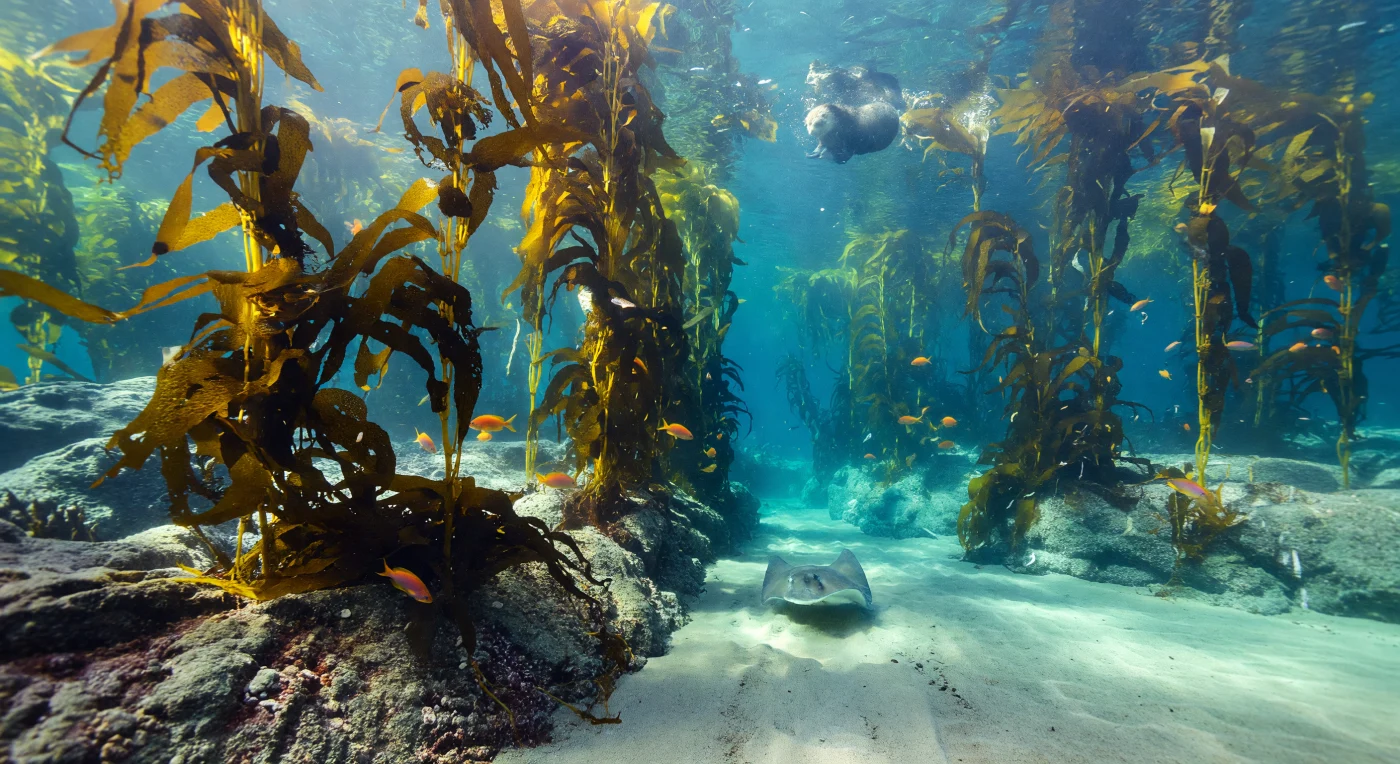
Along the sun-drenched shallows of the California coast, a cathedral of giant kelp — Macrocystis pyrifera — rises from a rocky reef where holdfasts grip encrusted stone, the long bronze-gold stipes ascending through cool, nutrient-rich water toward a shimmering canopy that fractures sunlight into cascading god rays and dancing caustic patterns across the seafloor below. Here, at depths between roughly six and twenty-five meters, the water temperatures hover near twelve to sixteen degrees Celsius, sustained by coastal upwelling that delivers the cold, nitrate-laden currents on which the kelp depends for its extraordinary growth. At the forest's abrupt edge, the reef yields entirely to pale rippled sand, and a round bat ray — Myliobatis californica — glides in effortless silence just above the bottom, its passage leaving a soft, fading inscription in the sediment along this bright open margin where structural complexity collapses into spacious clarity. Orange garibaldis, Hypsypops rubicundus, burn like embers among the kelp columns, while high in the surface canopy a sea otter rests entwined in fronds, anchored against the gentle surge in water that is rich with dissolved oxygen and threaded with drifting organic particles suspended in the ambient blue-green light. This boundary between rock and sand, between dense living architecture and open water, is one of the most ecologically charged transitions in temperate seas — a place of quiet, unwitnessed abundance that has existed, in this form, long before anything named it.
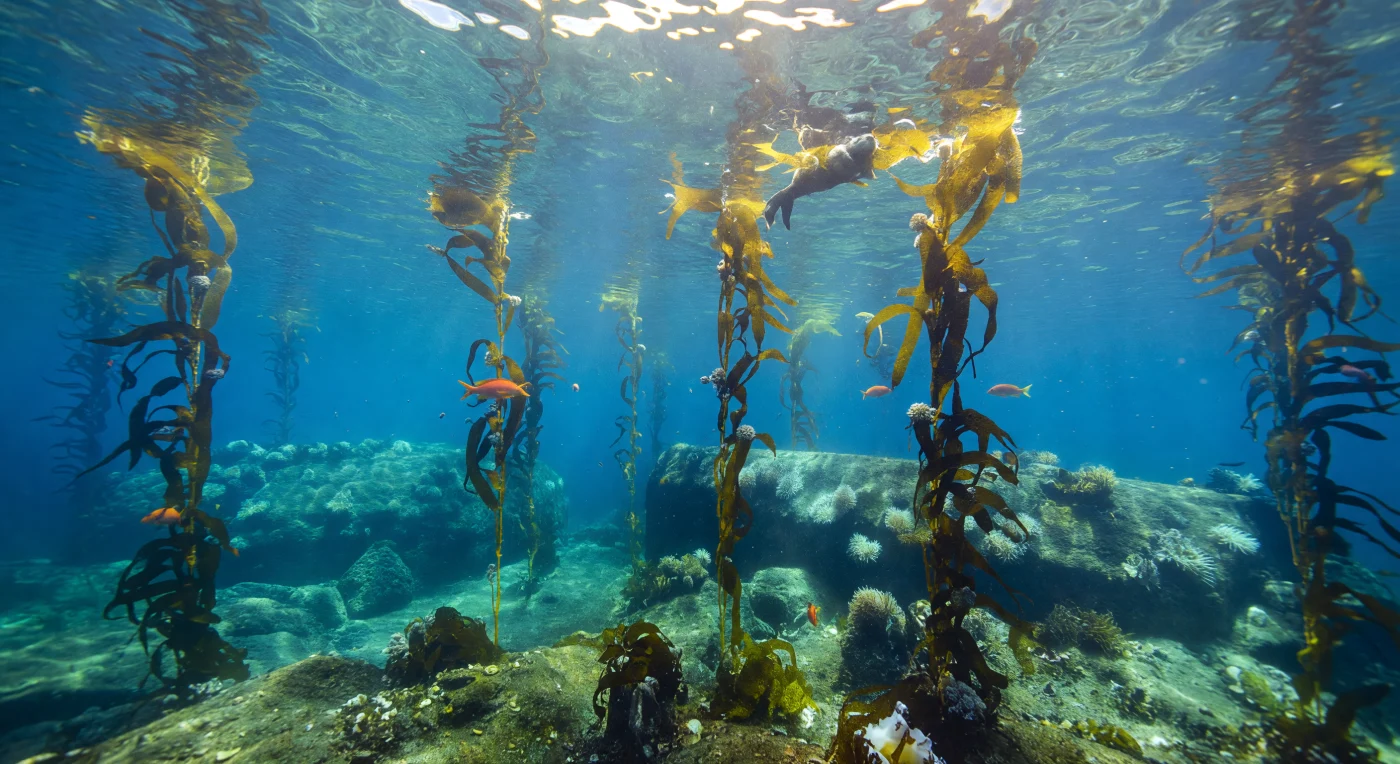
Cold, nutrient-laden water surges upward from depth along the California coast, sharpening the sea to a vivid blue-green clarity that makes every structure within the forest legible with unusual precision — the giant kelp *Macrocystis pyrifera*, rooted to bedrock at twelve to eighteen meters, stretches its stipes taut toward the surface like columns in a submerged cathedral, each pneumatocyst pearled and buoyant, lifting bronze-gold blades into the flickering canopy where broken sunlight refracts into shifting caustics and god rays. Upwelling delivers cold water near ten to twelve degrees Celsius along with dissolved nitrates that fuel kelp growth rates of up to thirty centimeters per day, sustaining one of the ocean's most productive benthic foundation ecosystems at pressures only two to three atmospheres above the surface world. Across the water column, bright orange garibaldis — *Hypsypops rubicundus*, the only reef fish with protected status in California — hover among the stipe shafts, their vivid coloration evolved in a world already flooded with natural light, while fine marine snow drifts slowly downward through the clarified water column, carrying particulate organic matter toward the reef below. On the seafloor, bedrock and boulders bear a dense understory of coralline algae and shell fragments, their shadows broken by the rhythmic surge that gently sways each frond overhead, and the distant reef ledges dissolve into clean blue-green haze dotted with open white plumose anemones, *Metridium senile*, filtering the oxygen-rich current with hundreds of feathered tentacles. Near the surface canopy, a sea otter rests unwrapped in fronds, part of a predator guild whose presence or absence reshapes the entire forest by controlling the urchin populations that, unchecked, can reduce this cathedral of living algae to bare rock.
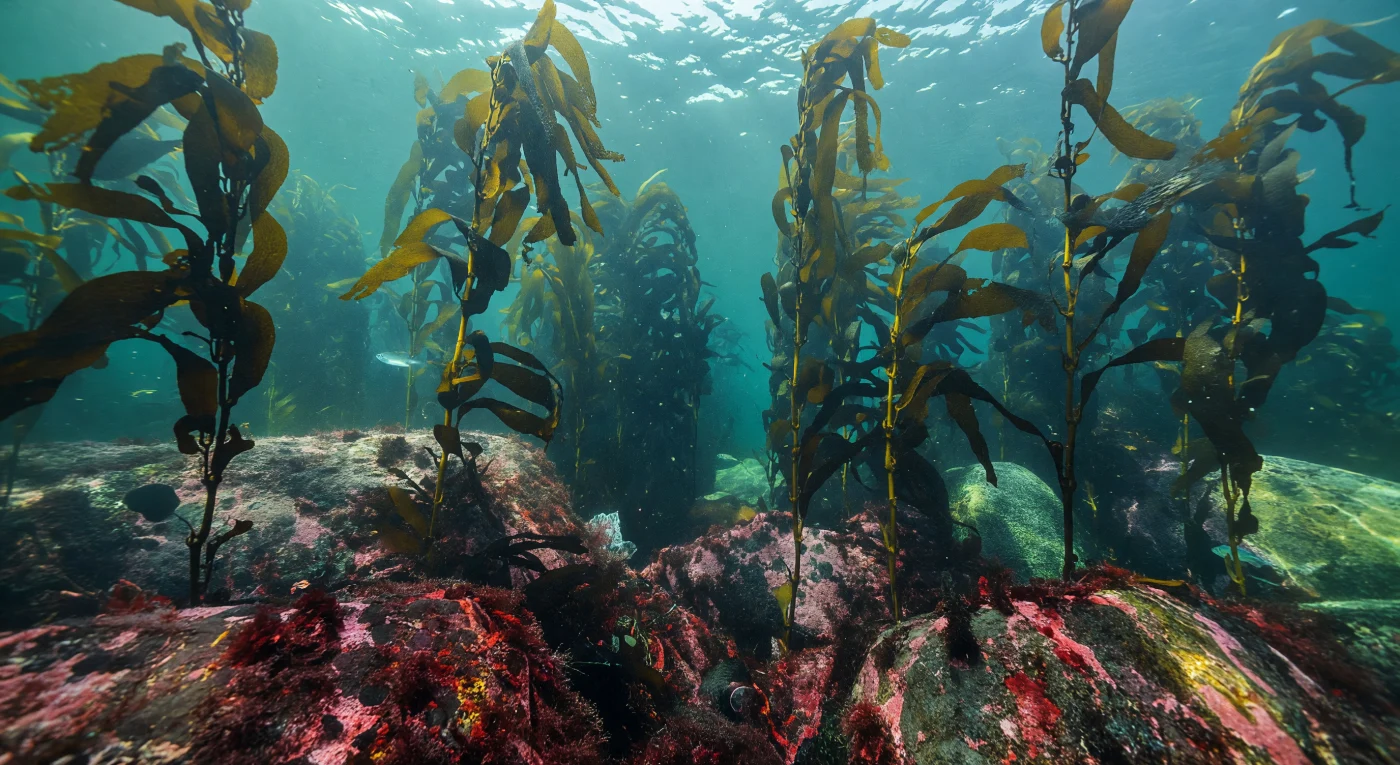
Between roughly eight and fifteen metres depth along the northeastern Atlantic coast, where wave surge still bends every frond and sunlight arrives as shifting green fire, Laminaria hyperborea anchors itself by muscular holdfasts to a boulder field encrusted with crimson red algae, pale pink corallines, and dark epilithic films that have been building for decades. The water here carries around two atmospheres of pressure — modest by oceanic standards, yet enough to give it a cool, pressing weight — and its temperature rarely climbs above twelve or thirteen degrees Celsius, conditions that suit this cold-adapted macroalga perfectly, fuelling growth rates that can exceed half a metre of new blade each year. Sunlight fractures at the surface and descends as animated caustic patterns, striping the leathery olive-brown blades and the pale undersides of small pollack drifting in loose aggregations between the stipes, their scales catching and releasing brief sparks of green light. The canopy is lower and darker than its Pacific counterparts, its broad blades overlapping to create a dimmed understory where fine marine snow drifts freely downward and red algal understory species — Delesseria, Phycodrys, dense mats of Lithothamnion — persist in the filtered illumination. This is one of the most productive coastal ecosystems on the planet, a foundation habitat that fixes carbon, oxygenates the surrounding water, and sustains food webs from sea urchins and tophknots to harbour seals patrolling the outer edges, all of it existing in complete indifference to any observer.
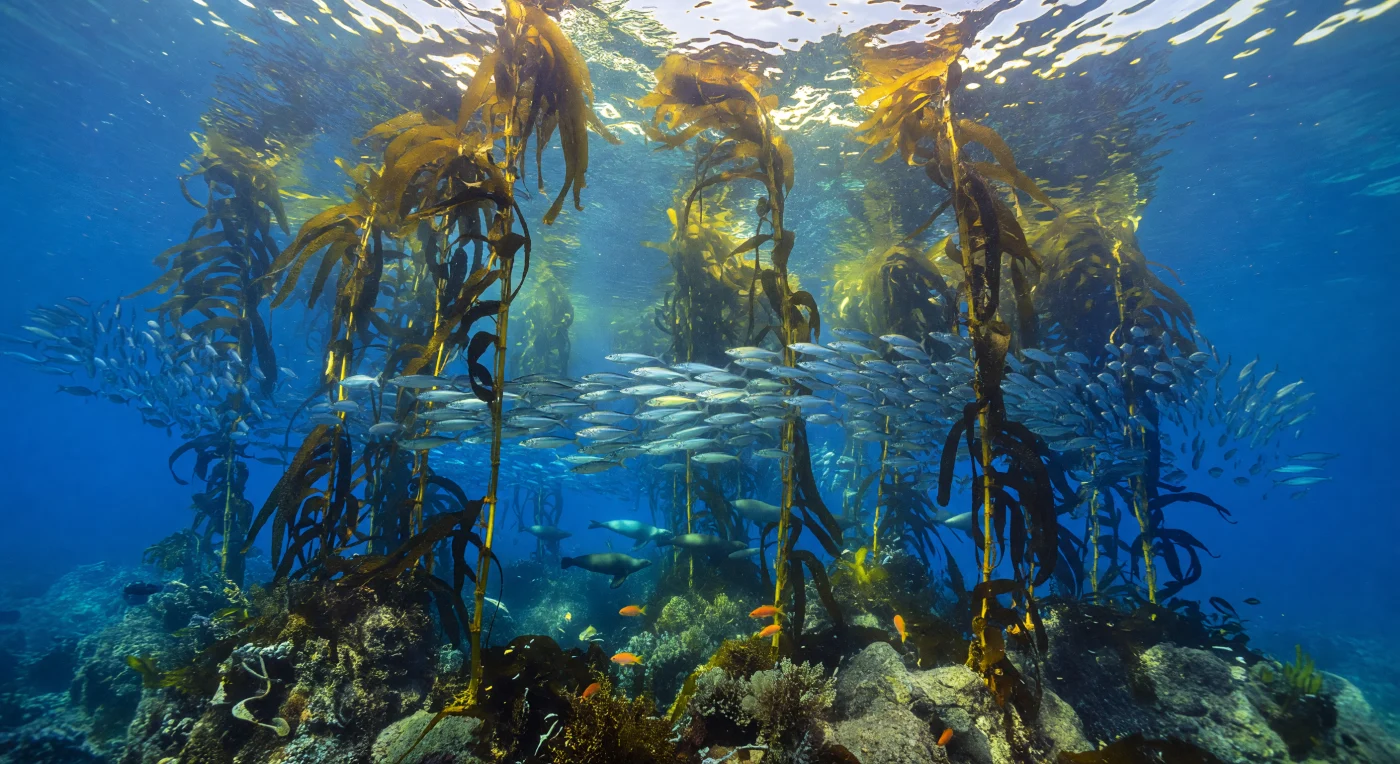
At the seaward edge of a California giant kelp forest, Macrocystis pyrifera rises from coralline-encrusted boulders in great flexible columns, their pneumatocyst-buoyed fronds gathering into a shimmering canopy just below the surface — a living architecture that can grow more than thirty centimeters in a single day under ideal conditions. Sunlight descends through this upper canopy in shifting caustic nets and blue-green shafts, fracturing into gold highlights along the bronze stipes and cooler teal shadow in the midwater, while fine suspended plankton drift through water both nutrient-rich and oxygen-saturated, fed by the cold coastal upwelling that makes this system among the most productive on Earth. Along the forest's outer face, a dense shoal of Pacific sardines — Sardinops sagax — executes a single synchronized arc, thousands of laterally flattened bodies turning in unison, their guanine-crystal scales flashing mirror-bright in a collective antipredator display that transforms individual fish into one cohesive sheet of liquid silver. California sea lions, Zalophus californianus, cut beneath the sardine mass in near-silent torpedo passes, dark fusiform bodies flickering through cold shafts of filtered light as they exploit the confusion effect at the shoal's edge, while garibaldis hover in territorial amber near the holdfast zone below. This reef fringe — where structured kelp architecture dissolves into open cobalt water — concentrates predator and prey in a dynamic boundary layer shaped entirely by sunlight, cold Pacific currents, and the patient geometry of algae rooted in stone.
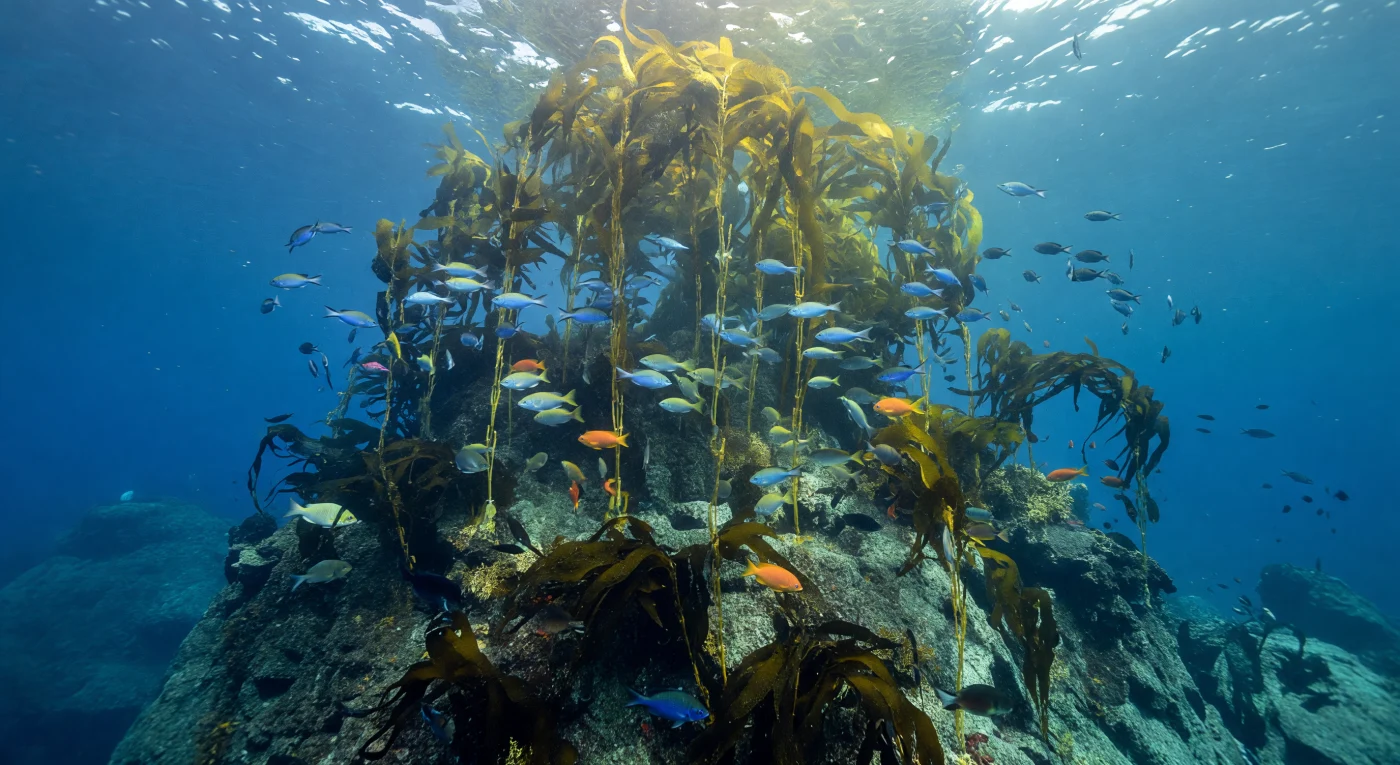
At the summit of a submerged offshore pinnacle, giant kelp — *Macrocystis pyrifera* — erupts from the rock in a dense crown, each stipe anchored by a gnarled holdfast gripping dark basalt before climbing through a dozen meters of water toward a canopy that shimmers and sways at the surface above. Natural sunlight pours down through that canopy in shifting god rays, casting moving caustic patterns across the coralline-encrusted rock and setting the bronze-gold fronds alternately aglow and in shadow, creating a liquid cathedral of extraordinary structural complexity. Schools of blacksmith, *Chromis punctipinnis*, sweep in coordinated arcs around the kelp crown, their dark forms flickering as they turn broadside to the filtered sun, while slender senorita, *Oxyjulis californica*, thread between the stipes in quick purposeful dashes, and solitary garibaldis, *Hypsypops rubicundus*, burn orange-red against the cold blue water at the reef edge. Beyond the pinnacle summit, the rock face drops away abruptly into open cobalt, the reef walls textured with encrusting coralline algae and patches of sessile invertebrates, a geological highpoint on an otherwise sunken landscape where upwelled, cold, nutrient-rich Pacific water sustains one of the most productive foundation ecosystems on the continental shelf — thriving in full oxygen, full light, and complete indifference to any witness.
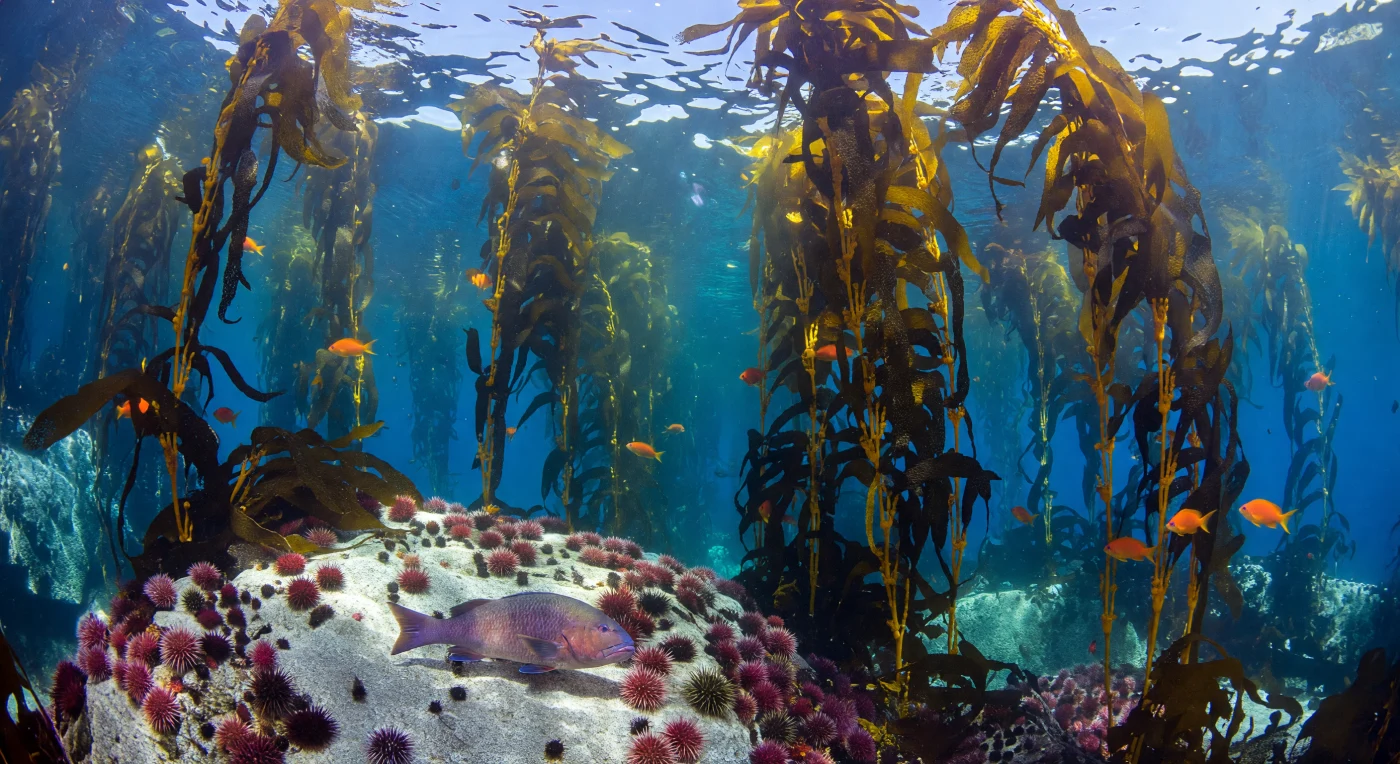
Along the dim inner boundary where grazed rock gives way to standing forest, a large California sheephead — its body divided into the deep charcoal and rose-red blocks characteristic of a mature male — glides unhurriedly above a pavement of sea urchins, both red and purple, their spines catching what little diffuse light filters down through the canopy overhead. That canopy belongs to *Macrocystis pyrifera*, the world's fastest-growing macroalga, its round gas-filled pneumatocysts buoying bronze-gold blades all the way to the surface some ten to fifteen meters above, where broken sunlight enters as shifting blue-green caustics that stripe the pale, surge-scoured rock below in slow, wavering bands. The urchin front itself is an ecological boundary of quiet drama: where herbivory has gone unchecked, kelp has been grazed to bare substrate, yet only meters away the stipes still rise in dense vertical corridors, sheltering garibaldis — California's only legally protected marine fish, flame-orange against olive-blue shadow — darting between the blades in the brighter water beyond the barren patch. At this depth, pressure sits near two atmospheres and wave surge still shapes everything, rocking the kelp columns in long, slow pulses while fine suspended particles and drifting plankton drift uniformly through a water column that is oxygen-rich, cold from upwelling, and indifferent to any witness.
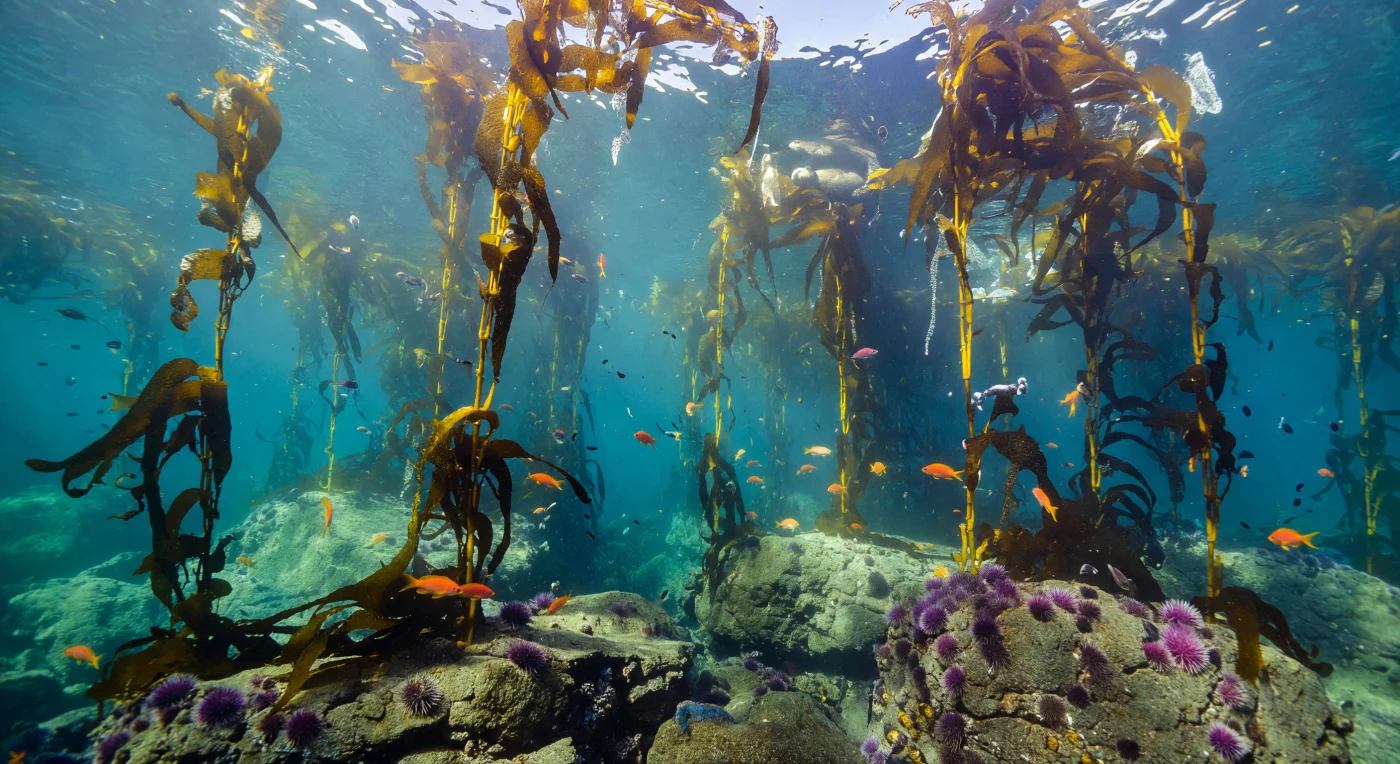
In the aftermath of a powerful Pacific swell, the giant kelp forest reassembles itself in slow motion: snapped stipes and torn pneumatocyst chains drift through vertical corridors of water where the canopy has been ripped open, tumbling in soft arcs as the surge dissipates and surface energy finally releases its grip on the reef. Natural sunlight descends through those newly opened gaps in fractured shafts of blue-green light, casting mobile caustic patterns across freshly scoured bedrock — boulder faces stripped clean of softer encrusting organisms by hours of violent surge, their exposed surfaces now cool and bare, the kind of geological reset that happens on shallow rocky reefs when swells generated hundreds of kilometers offshore finally arrive with full force at the coast. Purple sea urchins, *Strongylocentrotus purpuratus*, have packed themselves into every available crevice and crack in the exposed rock, their dense violet spines precisely oriented, exploiting the shelter that the newly abraded substrate provides while fine particles of silt, plankton, and organic debris — the suspended signature of the storm — drift freely through the water column in the ambient light. Bright orange garibaldis, *Hypsypops rubicundus*, the territorial damselfish emblematic of this ecosystem, move deliberately among the remaining *Macrocystis pyrifera* stipes, their color intensified against the jade and cobalt of the recovering water column, while far above, near the torn canopy, a sea otter floats in a returning patch of surface sunlight, small and unhurried against the vast, still-breathing architecture of kelp.
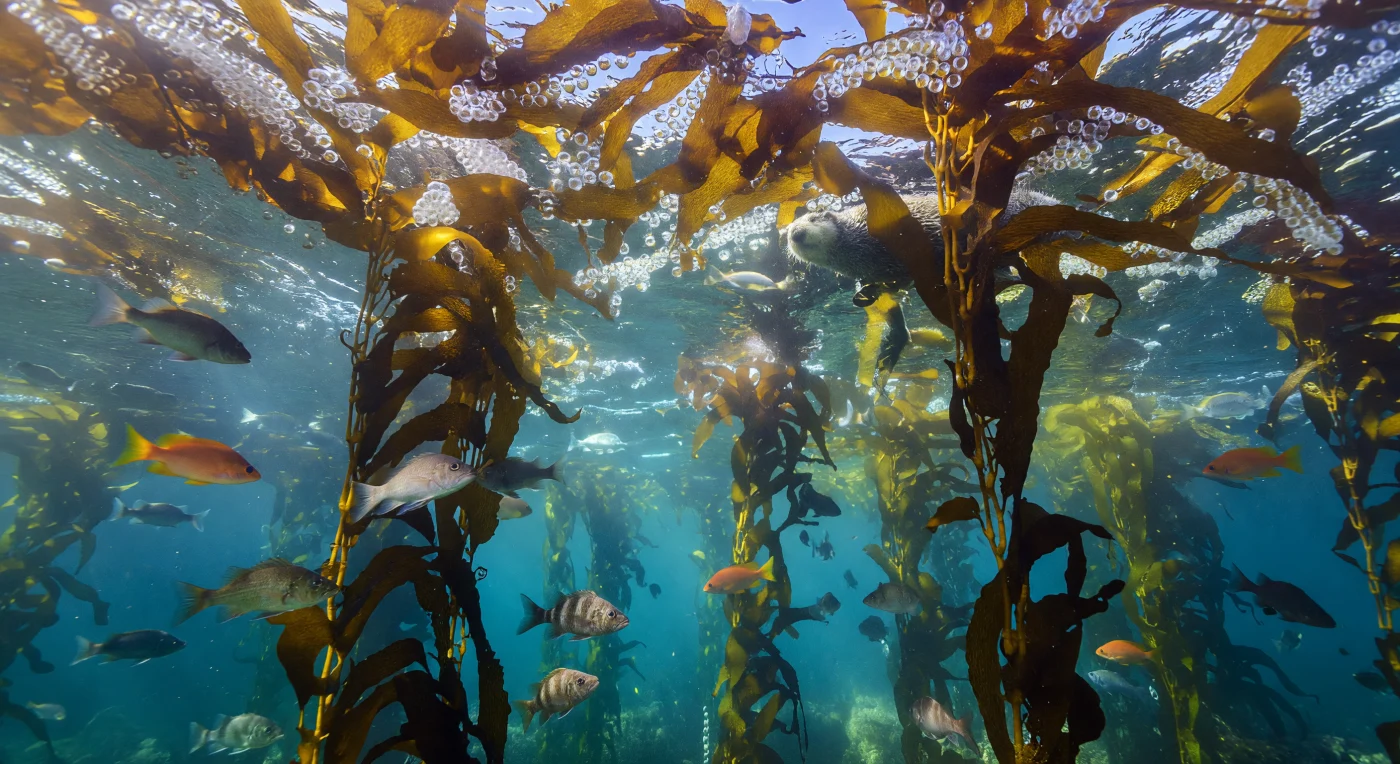
Just beneath the surface of a California coastal reef, the giant kelp *Macrocystis pyrifera* rises from rocky substrate in dense vertical stipes, its gas-filled pneumatocysts buoying fronds upward until they spread across the water's surface in an interlocking bronze-and-gold canopy, filtering the midday sun into shifting caustic patterns and god rays that ripple through the blue-green water column below. At this shallow depth — a few meters at most — pressure barely exceeds one atmosphere, oxygen saturation is high, and full-spectrum sunlight penetrates with enough intensity to drive extraordinary rates of photosynthesis, making kelp forests among the most productive ecosystems on the planet. Juvenile rockfish, their translucent fins and mottled flanks perfectly camouflaged against the dappled light, hold station among the pneumatocyst chains, exploiting the structural complexity of the canopy as refuge from predation while feeding on the dense clouds of zooplankton suspended in the illuminated water. Deeper between the stipes, garibaldi — the brilliant orange damselfish endemic to the northeastern Pacific — patrol their algal territories against olive-shadowed backgrounds, their vivid coloration a product of carotenoid-rich diets in these nutrient-upwelled nearshore waters. Above, a sea otter rests half-concealed within the canopy lanes, an ecological keystone whose predation on sea urchins protects the kelp holdfasts from the grazing pressure that, unchecked, can reduce this entire cathedral of living architecture to barren rock.
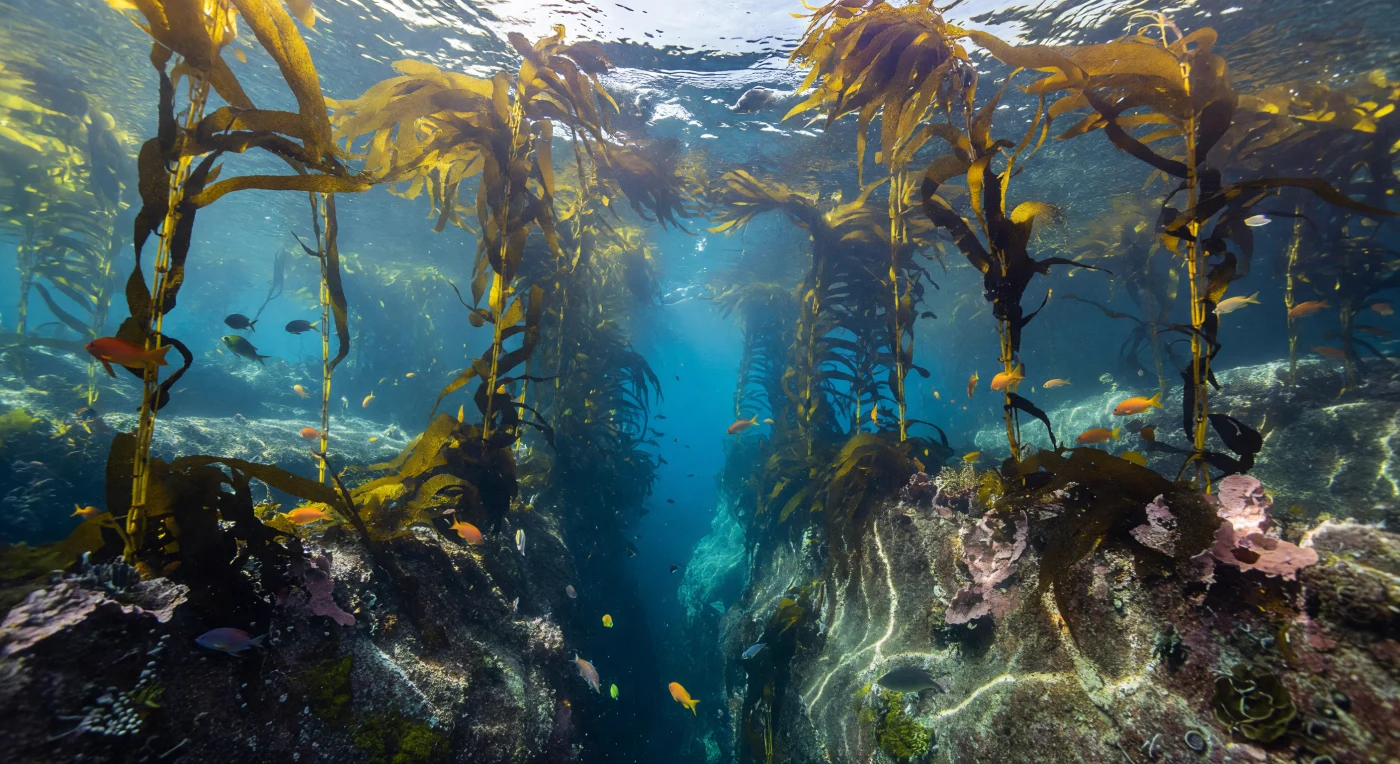
Between roughly six and twenty-five metres below the surface, a narrow cleft cut through ancient reef bedrock channels the full muscular force of open Pacific swell, compressing it so that every pulse of water sweeps the cathedral passage in unison — bowing the long, flexible stipes of *Macrocystis pyrifera* as a single breathing organism, then releasing them in slow recoil. Natural sunlight, refracted through the wind-rippled surface above, pours down into water that registers a vivid blue-green at depth, fracturing into shifting caustic ribbons and broad god rays that sweep across dark stone walls crusted with pink coralline algae and patches of olive understory growth — the only illumination this world has ever needed. Brilliant orange garibaldis (*Hypsypops rubicundus*), the sole fish protected by California law, hover with territorial calm near crevice shadows and among the kelp columns, while smaller reef fish scatter deeper into the passage and a sea otter drifts unhurried just beneath the silver mirror of the canopy, wrapped in the oxygen-rich, upwelling-cooled water that sustains this entire system. The holdfasts gripping the channel floor anchor stipes that rise like the columns of a flooded basilica, their gas-filled pneumatocysts buoying fronds of bronze-gold tissue overhead in an arching, light-filtering vault — a biological architecture shaped entirely by geology, surge, cold nutrient-laden current, and the patient upward drive toward light. Fine suspended particles drift freely through the water column, tracing depth and motion in a world of enormous productive complexity that assembles, dismantles, and reassembles itself with every tide, entirely indifferent to any witness.