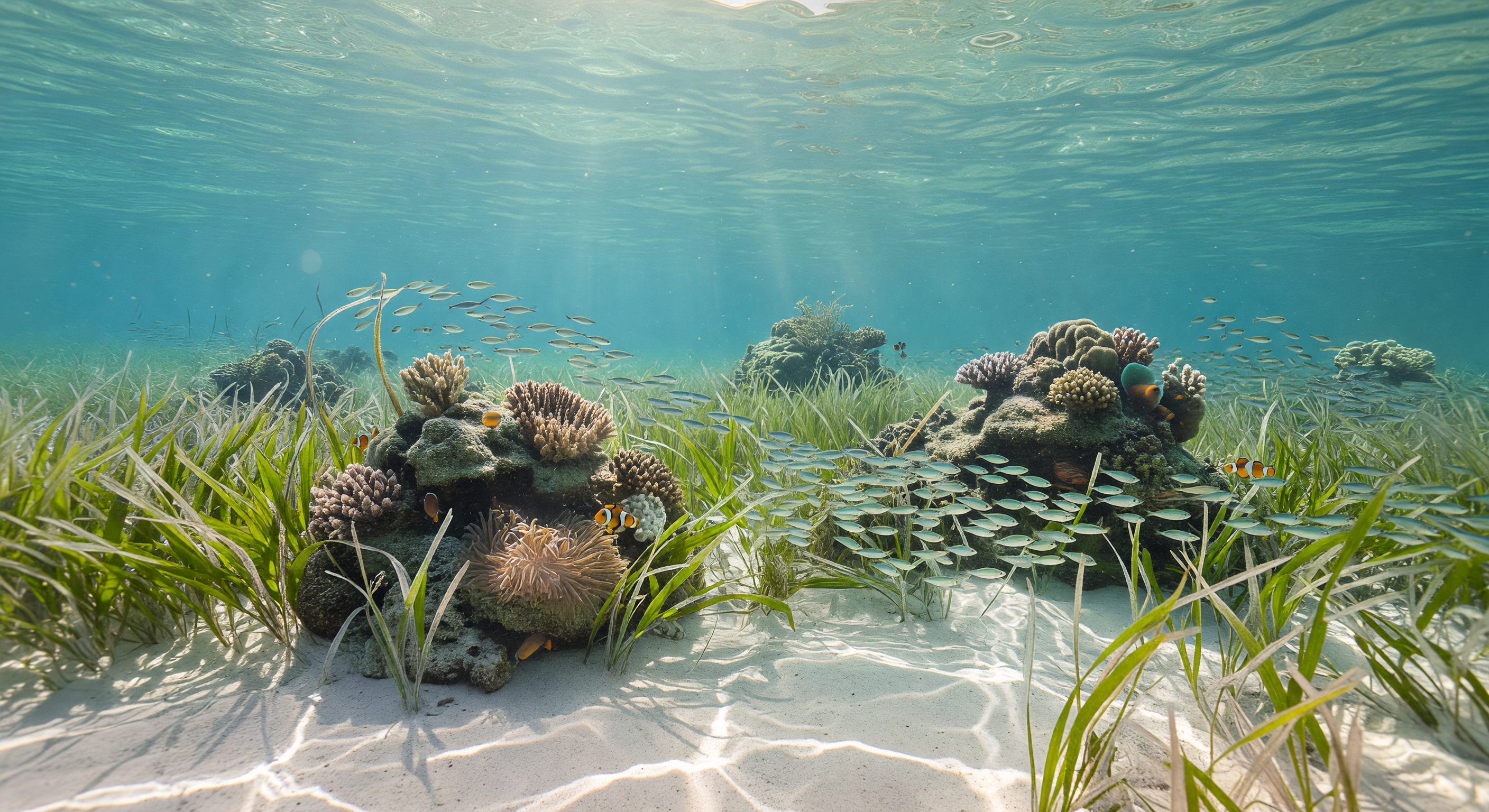
In the shallows of this sunlit lagoon, long blades of turtle grass (*Thalassia testudinum*) sway in a gentle tidal current, their translucent green surfaces catching the full spectrum of tropical light that pours unimpeded from the surface just two to five meters above. At this negligible depth, pressure barely exceeds one atmosphere, and virtually no wavelength of sunlight is lost — warm golds, vivid greens, and piercing blues all reach the sandy substrate simultaneously, generating shifting cautic nets and god rays that sweep continuously across ripple-marked carbonate sand and the rugose limestone flanks of isolated coral heads. Isolated massive corals rise from the meadow floor like self-built citadels of calcium carbonate, their polyp surfaces alive with zooxanthellae-driven photosynthesis, while gorgonian fans stream in the passing water and a sea anemone shelters a pair of clownfish (*Amphiprioninae*) among its nematocyst-armed tentacles. At the meadow's edge, a polarized school of juvenile fish — their silvery scales functioning as adaptive mirrors that confuse visual predators — pivots and flashes as a single liquid entity in the brilliance, while a parrotfish (*Scaridae*) methodically rasps algae and coral tissue with its fused beak-like teeth, excreting the fine white carbonate sand that carpets the lagoon floor beneath them. This mosaic of seagrass, coral, and open sand is one of the most productive and biodiverse ecosystems on Earth, a place where sunlight is so abundant it becomes the very architecture of life, and where the reef exists in full, elaborate expression entirely on its own terms.
Coral reef