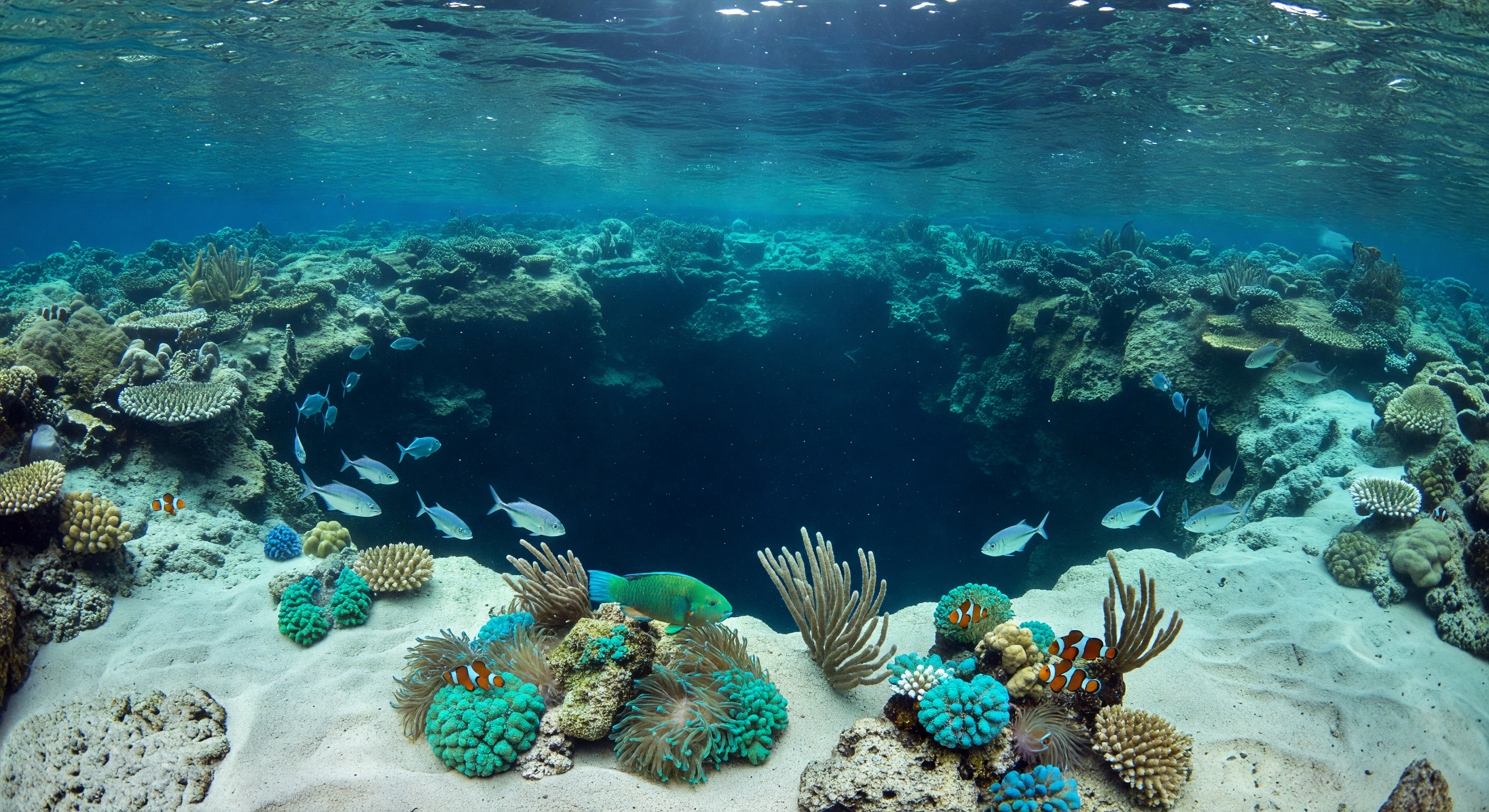
At the lip of a blue hole — a flooded karst sinkhole formed when sea levels were far lower and limestone was dissolved by freshwater — the shallow reef platform abruptly surrenders to an almost perfectly circular vertical shaft, its walls of ancient carbonate pitted and undercut by millennia of chemical weathering. In the foreground, the sunlit rim teems with the compressed energy of a tropical reef: massive coral heads etched with caustic light patterns cast by the rippled surface above, gorgonian sea fans angled into the current to filter passing plankton, a parrotfish methodically excavating limestone with fused beak-like teeth, and anemones sheltering their resident clownfish among waving tentacles — all bathed in water at perhaps 27 °C and barely two atmospheres of pressure. A circling band of horse-eye jacks holds station precisely at the boundary between sunlit clarity and the descending indigo void, exploiting the thermal and current interface where prey concentrate, their silver flanks catching the last of the reef's blue-green light before color bleeds away. Downward, the shaft walls transition from vivid cream carbonate to muted cyan to deep cobalt, the existing ambient light recorded here at its natural limits as photons scatter and absorb across an expanding column of warm tropical ocean. This place exists in complete independence — a self-sustaining carbonate architecture built by colonial polyps over thousands of years, a geological memory of exposed Pleistocene land now drowned and colonized, indifferent to any gaze.
Coral reef