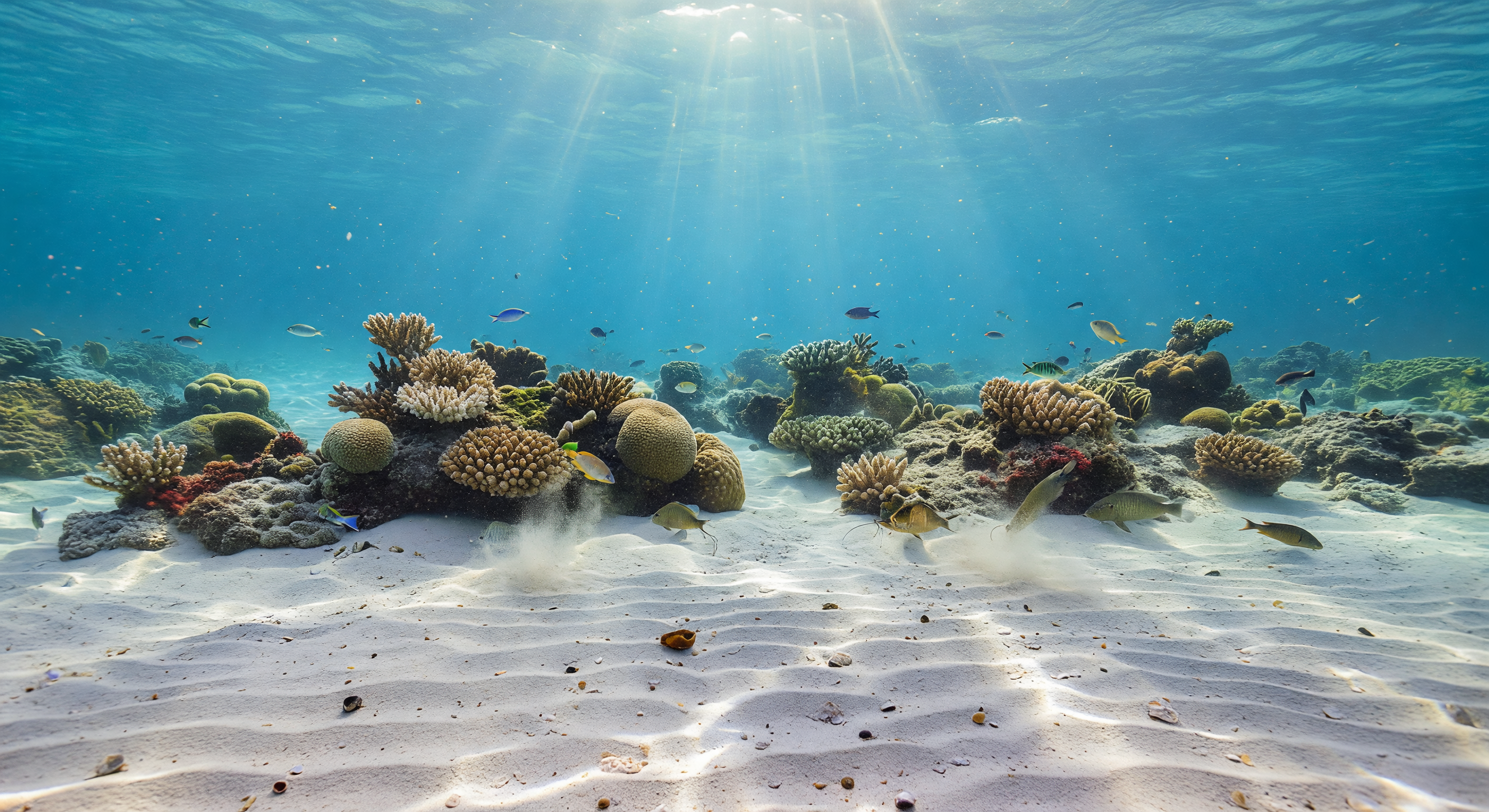
Where the white carbonate sand gives way to scattered coral bommies, tropical sunlight fractures into a shifting lattice of caustics that rolls continuously across ripple crests and hard-coral surfaces, penetrating to perhaps 30 metres in water this clear before the blue finally swallows it. Pressure here hovers between one and a few atmospheres — trivial by oceanic standards — yet the biological intensity is immense: the euphotic zone is operating at full power, with phytoplankton fixing carbon in the upper water column while goatfish work the sand-coral margin below, their chemosensory barbels probing ripple troughs and lifting pale sediment puffs that drift upward through suspended shell fragments and planktonic specks. The reef edge itself is an ecotone, a sharp transition between two productivity regimes — the structured, three-dimensional carbonate architecture of the bommies with their branching Acropora, encrusting coralline algae, and resident anthiids, and the open sandy flat where nutrient cycling depends on bioturbation and the restless redistribution of organics by current and forager alike. Beyond the last coral head the seafloor drops away into open pelagic blue, a reminder that this sunlit, warm, oxygen-rich surface layer — for all its familiarity — rests above an ocean that descends, largely dark and pressurised, for another four kilometres.